EMOM Workout: What EMOM Means, How It Works and 10 Workouts by Level
EMOM stands for every minute on the minute: you start a set of a given exercise at the top of every minute, and whatever is left of that minute is your rest. Do 10 kettlebell swings in 35 seconds and you rest 25 seconds, then go again when the clock hits the next minute. You repeat that for a set number of minutes, usually 8 to 30.

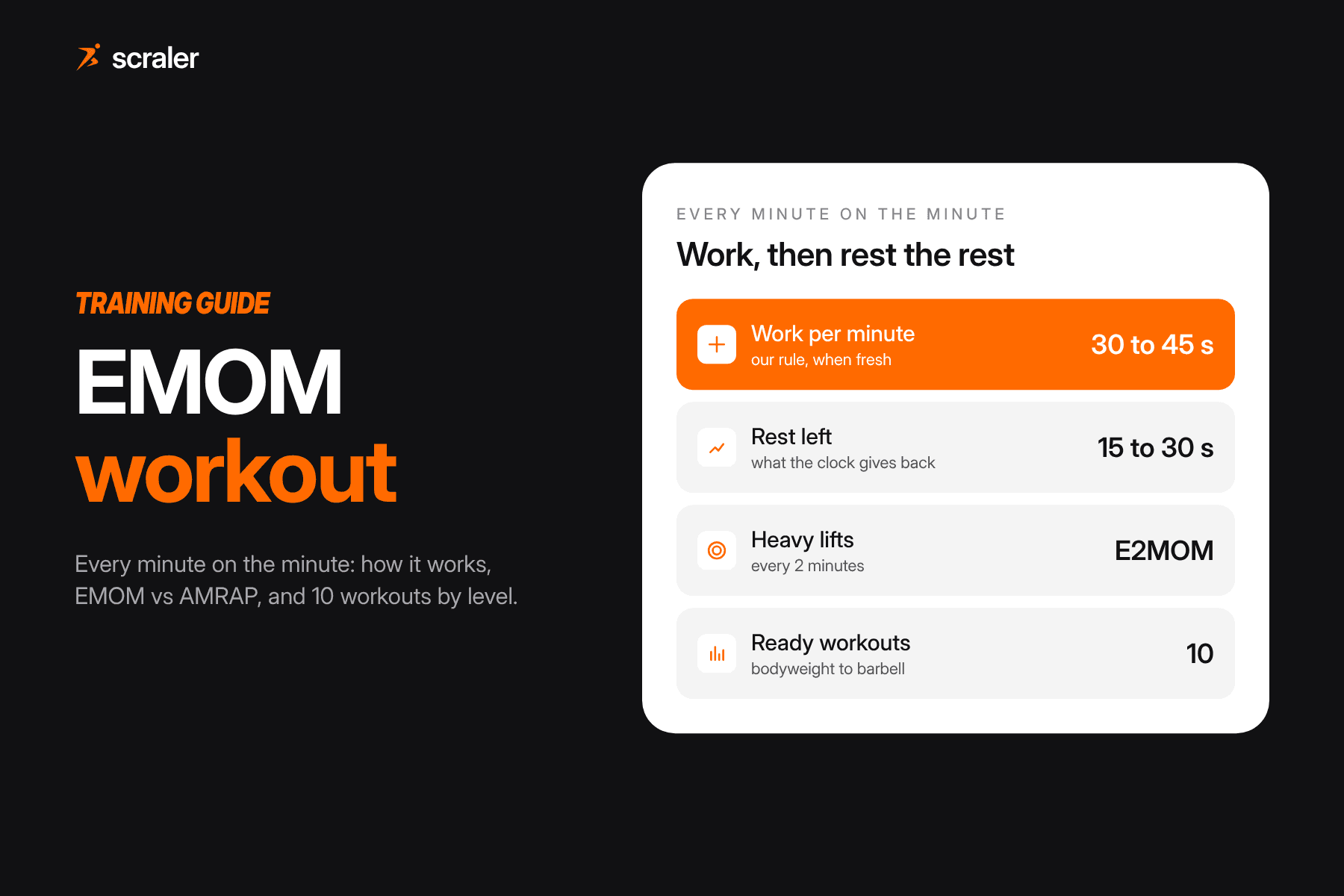
- EMOM = every minute on the minute. The clock sets the pace: work starts each minute, and the faster you finish, the more rest you get.
- An EMOM fixes the time and the reps. An AMRAP fixes only the time and asks for as much work as possible. Tabata is a fixed 20 s on, 10 s off format. In a circuit, rest follows a set rule or the client's choice.
- Our coaching rule: choose reps that take 30 to 45 seconds, so every minute leaves 15 to 30 seconds of rest. If a client cannot finish inside the minute twice in a row, cut the reps.
- For heavy strength work, stretch the interval to every 2 or 3 minutes (E2MOM, E3MOM). Rest research suggests trained lifters gain the most strength with more than 2 minutes between hard sets.
What does EMOM mean?
EMOM is short for every minute on the minute. It is an interval format where a running clock decides when each set starts. At 0:00 the client does the prescribed reps, at 1:00 they start again, at 2:00 again, and so on until the time is up. The rest is not prescribed: it is simply the time left in the minute after the work is done.
That one rule is why EMOMs are popular in CrossFit boxes, group classes and personal training. The session length is fixed, every set starts on a clear signal, and the rest shrinks automatically when the client slows down. A written EMOM looks like "EMOM 12: 8 goblet squats", which means 12 minutes, 8 goblet squats at the start of each one, 96 reps in total.
How does an EMOM workout work? A worked example
Take "EMOM 10: 12 kettlebell swings". The client starts a timer and swings. Here is what the first minutes can look like for a client who slows down as fatigue builds:
- Work starts at
- 0:00
- 12 swings took
- 30 s
- Rest left in the minute
- 30 s
- Work starts at
- 1:00
- 12 swings took
- 32 s
- Rest left in the minute
- 28 s
- Work starts at
- 2:00
- 12 swings took
- 34 s
- Rest left in the minute
- 26 s
- Work starts at
- 5:00
- 12 swings took
- 38 s
- Rest left in the minute
- 22 s
- Work starts at
- 9:00
- 12 swings took
- 42 s
- Rest left in the minute
- 18 s
| Minute | Work starts at | 12 swings took | Rest left in the minute |
|---|---|---|---|
| 1 | 0:00 | 30 s | 30 s |
| 2 | 1:00 | 32 s | 28 s |
| 3 | 2:00 | 34 s | 26 s |
| 6 | 5:00 | 38 s | 22 s |
| 10 | 9:00 | 42 s | 18 s |
The numbers are an illustration, but the pattern is what you see on the gym floor. The work creeps up, the rest drops, and the client is pushed harder in the second half without anyone changing the program. If the swings ever take longer than 60 seconds, the client starts the next minute without rest and the EMOM falls apart. Choosing reps that prevent that is the main skill, covered below.
EMOM vs AMRAP vs Tabata vs circuits: what is the difference?
- What is fixed
- Time and reps per minute
- What the client controls
- How fast they work, so how much rest they get
- Typical use
- Skill practice, strength density, paced conditioning, groups
- What is fixed
- Total time only
- What the client controls
- Pace and rest. The score is rounds or reps done
- Typical use
- Conditioning tests, finishers, tracking fitness over weeks
- What is fixed
- 20 s work, 10 s rest, 8 rounds (4 minutes)
- What the client controls
- Reps inside each 20 s
- Typical use
- Short, very hard conditioning blocks
- What is fixed
- Stations and a rest rule
- What the client controls
- Usually reps, sometimes timed stations
- Typical use
- Full body sessions, classes, general fitness
- What is fixed
- Sets, reps and rest
- What the client controls
- Load and effort
- Typical use
- Strength and muscle building
| Format | What is fixed | What the client controls | Typical use |
|---|---|---|---|
| EMOM (every minute on the minute) | Time and reps per minute | How fast they work, so how much rest they get | Skill practice, strength density, paced conditioning, groups |
| AMRAP (as many rounds or reps as possible) | Total time only | Pace and rest. The score is rounds or reps done | Conditioning tests, finishers, tracking fitness over weeks |
| Tabata | 20 s work, 10 s rest, 8 rounds (4 minutes) | Reps inside each 20 s | Short, very hard conditioning blocks |
| Circuit | Stations and a rest rule | Usually reps, sometimes timed stations | Full body sessions, classes, general fitness |
| Straight sets | Sets, reps and rest | Load and effort | Strength and muscle building |
EMOM vs AMRAP is the comparison people search most. In an AMRAP, a fitter client simply does more work in the same time, and rest is their own choice. In an EMOM, everyone does the same work and a fitter client earns more rest. That makes EMOMs easier to control and to compare session to session, and AMRAPs better as a fitness test.
Tabata comes from a 1996 study by Tabata and colleagues on a cycle ergometer, where the hard-interval group did 7 to 8 bouts of 20 seconds at about 170% of VO2max with 10 seconds of rest. Most "Tabata" classes keep the 20:10 timing but not that intensity. A circuit is a sequence of stations done back to back. An EMOM can be a circuit, if each minute is a different station, but the clock replaces a fixed rest. Our full body circuit workout guide covers the circuit format in depth.
What are the main EMOM variations?
- Single exercise EMOM. One movement every minute, such as "EMOM 10: 10 kettlebell swings". Best for practising a skill or hammering one pattern.
- Alternating EMOM. Odd minutes one exercise, even minutes another: "EMOM 16, odd: 10 goblet squats, even: 8 push-ups". Each muscle group gets close to two minutes between efforts.
- Rotating (multi-station) EMOM. Three to five stations in a loop, one per minute. A 20 minute EMOM with 4 stations is 5 rounds of each. This is the format most group classes use.
- E2MOM, E3MOM. Every 2 or 3 minutes on the minute. Used for heavy lifts, where a hard set needs more recovery than a 60 second window allows.
- Ladder EMOM. The reps change each minute, usually up by one: 1 burpee in minute 1, 2 in minute 2, and so on until the client cannot finish inside the minute. The score is the last minute completed.
- Strength EMOM. Low reps of a big lift at a moderate load, such as 2 deadlifts every minute for 10 minutes. It packs a lot of quality reps into a short block, which is why it is often called density training.
How do you choose reps for an EMOM?
The rule we use with clients is our own coaching practice, not a study protocol: pick a rep count the client can finish in 30 to 45 seconds when fresh, so every minute leaves 15 to 30 seconds of rest. Less than 15 seconds and the client is soon starting the next minute out of breath with poor form. More than 30 seconds and the EMOM turns into easy straight sets.
- 1.Time one round. Have the client do the reps once at the intended pace. 30 to 45 seconds is the sweet spot for a 10 to 20 minute EMOM.
- 2.Check rounds 3 and 4. If they are already past 45 seconds, drop the reps by 2 or 3 now rather than at minute 9.
- 3.Use the two-miss rule. If a client fails to finish inside the minute twice in a row, cut the reps for the rest of the block. One miss can be a slow transition.
- 4.Shorter EMOMs can run tighter. An EMOM of 10 minutes or less can run at the bottom of the range, about 15 seconds of rest. For 20 to 30 minutes, aim for 25 to 30 seconds.
- 5.Progress one variable at a time. Next week add a rep, a little load or 2 more minutes, not all three.
Can an EMOM build strength?
Yes, if the load is right and the interval is long enough. Strength depends on lifting heavy enough loads, and heavy sets need recovery. A 2018 systematic review by Grgic and colleagues (23 studies, 491 participants) found strength gains were still substantial with rests under 60 seconds, but resistance-trained people appeared to need more than 2 minutes between sets for the largest gains. For untrained people, 60 to 120 seconds seemed sufficient. The authors note much of this is inferred from short-term studies.
A 2016 trial by Schoenfeld and colleagues in trained men points the same way: 3 minute rests gave greater strength gains and more thigh muscle growth than 1 minute rests over 8 weeks, while the difference in arm growth was smaller and not significant. In practice that gives two options for strength EMOMs: keep the reps very low (1 to 3) at a moderate load so most of the minute is rest, or switch to an E2MOM or E3MOM for heavier sets.
10 EMOM workouts by goal and level
These ten EMOMs were written by Scraler for this article. They are coaching examples, not study protocols. Reps are a starting point: time the first round and adjust with the rule above. Warm up for 5 to 10 minutes first.
1. Beginner bodyweight EMOM (12 minutes)
- Odd minutes: 8 bodyweight squats to a box or bench
- Even minutes: 6 incline push-ups on a bench or wall
- Why it works for beginners: two simple patterns, plenty of rest, and a clear finish line. These are the emom workouts for beginners we start with.
2. Full body bodyweight EMOM (16 minutes)
- Minute 1: 12 bodyweight squats
- Minute 2: 8 to 10 push-ups (knees or incline to scale)
- Minute 3: 10 reverse lunges (5 per side)
- Minute 4: 30 second plank
- 4 rounds. No equipment, so it works at home or for online clients.
3. Kettlebell swing EMOM (10 minutes)
- Every minute: 12 to 15 two-hand kettlebell swings
- A short finisher. Stop the block if the hinge turns into a squat or the lower back takes over.
4. Kettlebell full body EMOM (20 minutes)
- Minute 1: 8 goblet squats
- Minute 2: 6 single-arm rows per side
- Minute 3: 12 kettlebell swings
- Minute 4: 5 push presses per side
- 5 rounds. Use one bell the client can press 8 times with good form.
5. Upper body pull and push EMOM (16 minutes, intermediate)
- Odd minutes: 4 to 6 pull-ups (band assisted or ring rows to scale)
- Even minutes: 10 to 12 push-ups
6. Deadlift strength EMOM (10 minutes)
- Every minute: 2 deadlifts at a load the client could lift about 6 times
- 20 quality reps in 10 minutes. Every rep is reset on the floor; if bar speed drops clearly, end the block early.
7. Back squat E2MOM (12 minutes)
- Every 2 minutes: 3 back squats at a load with about 3 reps in reserve
- 6 sets. The 2 minute window fits the rest research above better than a 60 second one. See RIR meaning for setting the effort and the one rep max calculator for a starting load.
8. Rower and burpee conditioning EMOM (20 minutes)
- Odd minutes: 12 calories on the rower (10 for smaller or newer clients)
- Even minutes: 8 to 10 burpees
- Track the heart rate zones if the client wears a monitor. Heart rate should come down a little in each rest window.
9. Burpee ladder EMOM (until failure to finish)
- Minute 1: 1 burpee, minute 2: 2 burpees, and so on
- The block ends at the first minute the client cannot finish. Write down the last completed minute and retest in 4 to 6 weeks.
10. Group class EMOM (24 minutes, 4 stations)
- Station 1: 10 dumbbell thrusters
- Station 2: 12 calories bike or 20 jumping jacks
- Station 3: 10 renegade rows (5 per side)
- Station 4: 15 sit-ups
- Each person starts at a different station, so four people share four stations and rotate on the minute: 6 rounds. More formats like this are in group fitness class ideas.
For one-to-one clients, an EMOM block works well as the second half of a session after the main lift. Our personal training session ideas show where it fits next to warm-ups, strength work and finishers.
How do you scale an EMOM for different clients?
The table is our own coaching practice. Change one thing at a time, and start with the reps before touching the exercise.
- Scale down
- Fewer reps, longer interval (E90s or E2MOM), 8 to 12 minutes total
- Scale up
- Add 1 rep per exercise per week
- Scale down
- Cut reps by 2 or 3, or swap to an easier variation
- Scale up
- n/a
- Scale down
- n/a
- Scale up
- Add reps, load, or a harder variation
- Scale down
- Fewer reps per minute (1 to 2)
- Scale up
- Move to E2MOM and add load, not reps
- Scale down
- Same time cap, each person has their own reps or load
- Scale up
- Advanced people add reps, not minutes
- Scale down
- Halve the minutes, keep the reps
- Scale up
- n/a
| Situation | Scale down | Scale up |
|---|---|---|
| New client | Fewer reps, longer interval (E90s or E2MOM), 8 to 12 minutes total | Add 1 rep per exercise per week |
| Cannot finish inside the minute | Cut reps by 2 or 3, or swap to an easier variation | n/a |
| Finishes in under 30 s | n/a | Add reps, load, or a harder variation |
| Heavy strength lift | Fewer reps per minute (1 to 2) | Move to E2MOM and add load, not reps |
| Mixed group | Same time cap, each person has their own reps or load | Advanced people add reps, not minutes |
| Deload or busy week | Halve the minutes, keep the reps | n/a |
Is an EMOM workout safe?
An EMOM is as safe as the exercises and loads in it. The risk is the clock: it rewards speed, and speed under fatigue is where technique breaks. These rules are our own coaching practice:
- Screen first. New clients should complete a health questionnaire such as our PAR-Q form template before high-intensity work.
- Keep complex lifts low rep. Snatches, cleans, heavy squats and deadlifts: 1 to 3 reps a minute, and stop the block when bar speed or position clearly drops.
- Do not put a heavy lift after a hard conditioning minute in an alternating EMOM. Pair a lift with a low-skill movement instead.
- Form beats the clock. A missed minute is fine. A rushed rep with a rounded back is not.
- Cap the length. Most clients need nothing longer than 20 to 30 minutes of EMOM work in a session.
How do you program an EMOM in Scraler?
Scraler has no dedicated EMOM clock, so we will not pretend it does. What the workout builder does have: you can group exercises into a circuit block and set the number of rounds (up to 20), give each exercise reps or a duration per round and a rest value, and add a note to an exercise. For "EMOM 16, odd: 10 goblet squats, even: 8 push-ups", build a two-exercise circuit with 8 rounds and write "start each exercise at the top of the minute" in the note.
In the client app the block shows as one group, the client logs each round, and a rest timer starts when they complete a set that has a rest value. Clients run the minute clock on their own timer or the gym clock. You then see what was logged in their profile.
Group exercises into rounds, set reps, time and rest per exercise, and send the workout straight to every client's app.
See workout planningFrequently asked questions
- What does EMOM stand for?
- EMOM stands for every minute on the minute. You start a set at the top of each minute and rest for whatever time is left in that minute, then repeat for a set number of minutes.
- What is the difference between EMOM and AMRAP?
- An EMOM fixes both the time and the reps per minute, so a fitter person earns more rest. An AMRAP (as many rounds or reps as possible) fixes only the total time, and the score is how much work you get done.
- How long should an EMOM workout be?
- Most EMOMs last 8 to 30 minutes. 10 minutes suits a single exercise finisher or a strength block; 16 to 24 minutes suits alternating or multi-station EMOMs. Beginners do well with 8 to 12 minutes.
- How many reps should I do in an EMOM?
- Our coaching rule is reps that take 30 to 45 seconds when fresh, so you rest 15 to 30 seconds each minute. If you fail to finish inside the minute twice in a row, drop 2 or 3 reps.
- What is an E2MOM?
- E2MOM means every 2 minutes on the minute: you start a set every two minutes instead of every minute. It is used for heavy lifts, because hard strength sets need more recovery than a 60 second window gives.
- Are EMOM workouts good for beginners?
- Yes, with simple movements, low reps and short blocks. An alternating 12 minute EMOM of box squats and incline push-ups gives a beginner structure and plenty of rest.
- Is EMOM the same as Tabata?
- No. Tabata is fixed at 20 seconds of work and 10 seconds of rest for 8 rounds. In an EMOM the work is a rep count and the rest is whatever is left of the minute, so it changes as you tire.
- Can EMOM workouts build muscle and strength?
- They can, as long as the load is heavy enough and the interval allows recovery. Rest research suggests trained lifters gain the most strength with more than 2 minutes between hard sets, so use E2MOM or very low reps for heavy lifts.