Full Body Circuit Workout: 3 Ready Circuits for Your Clients (Plus a 30 Minute Version)
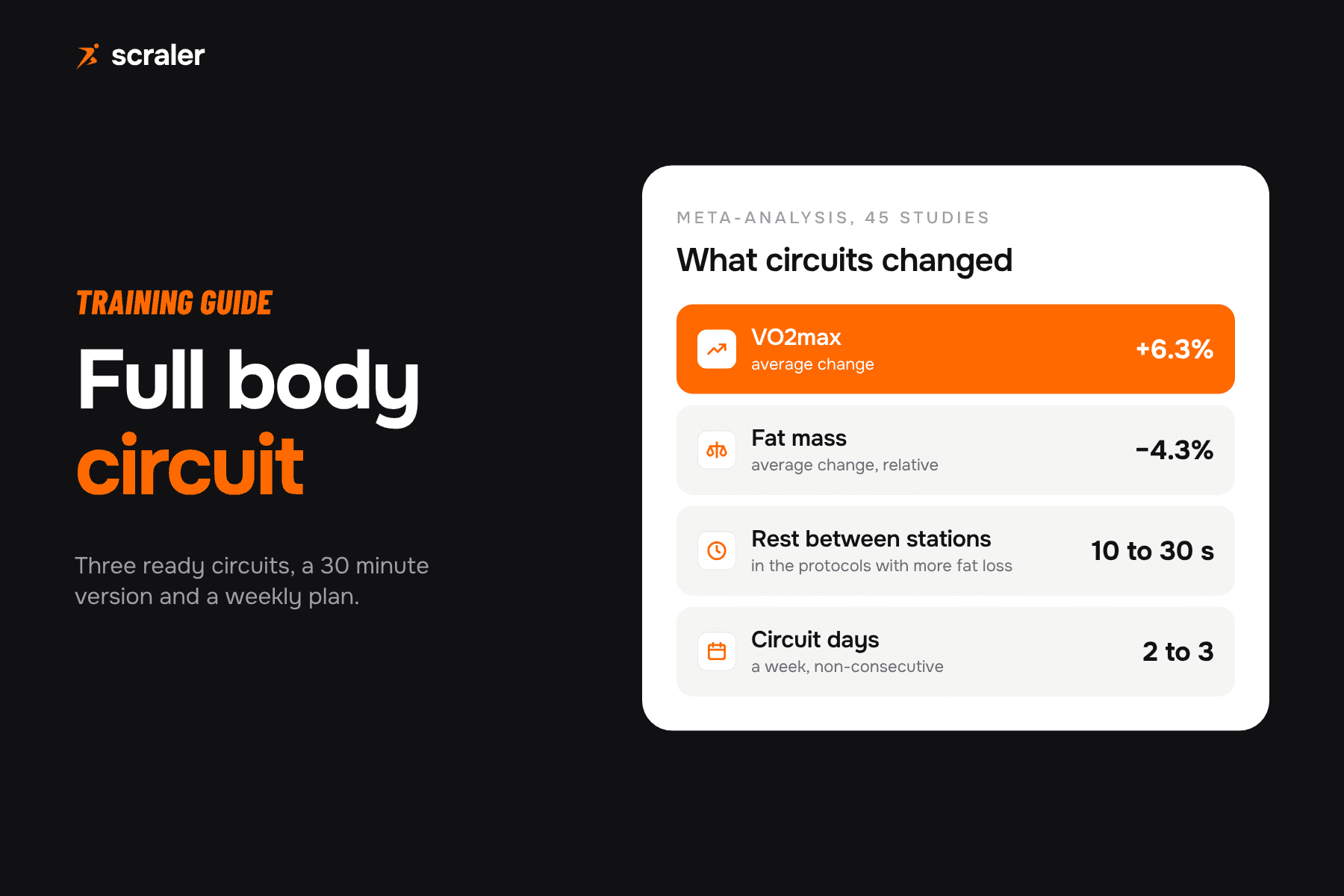
A full body circuit workout is a set of 5 to 8 exercises covering the legs, push, pull and core, done back to back with little rest, then repeated for 2 to 4 rounds. A 2021 meta-analysis of 45 studies found circuit resistance training improved strength, VO2max (by 6.3%) and fat mass.

- A circuit moves the client from station to station with 10 to 30 seconds of rest, so one session trains strength and raises the heart rate.
- Research supports it: gains in strength and VO2max, and a modest 4.3% drop in fat mass in a 45-study meta-analysis. It is not a fat loss shortcut.
- Use the three ready circuits below (bodyweight, dumbbell, gym equipment) and the 30 minute version, then scale stations, work:rest and rounds per client.
- Program 2 to 3 circuit days a week on non-consecutive days. That covers the WHO and ACSM minimum of 2 strength days for all major muscles.
What is a full body circuit workout?
Circuit training is a session structure, not a type of exercise. You line up several exercises, called stations, and the client does one set of each in a row with little or no rest. One pass through every station is a round. After a longer rest between rounds, they go again.
A full body circuit covers every major movement in each round: a squat or lunge, a hinge, a push, a pull and a core or carry exercise. That is the difference from a body part circuit, which repeats one area. It also differs from a straight-set session, where the client finishes all sets of one lift before moving on.
- All sets of one exercise, then the next
- 1 to 3 minutes rest between sets
- Best for heavy strength work
- Longer session for the same exercise count
- One set of each exercise, then repeat the round
- 10 to 30 seconds between stations
- Moderate loads, heart rate stays up
- More work in less time
Coaches use two formats. Rep-based circuits set a rep target per station (for example 10 goblet squats). Timed circuits set a work:rest ratio (for example 40 seconds on, 20 seconds off). Timed circuits suit groups, because everyone moves at the same moment. Rep-based circuits suit weights, because you can prescribe a load against a rep target. If you want a new set to start on every minute, see our EMOM workout guide.
Does circuit training work? What the evidence says
Yes, for strength and fitness at the same time, with smaller effects on body fat than people expect. The largest review is a 2021 meta-analysis of 45 studies, with 897 people in circuit groups and 474 in control groups.
- Strength: circuit training improved the strength of both the upper and lower limbs. The size of the gain depended on the number of sessions, the weekly frequency and the client's training status.
- Aerobic fitness: VO2max rose 6.3% on average. An earlier 2017 meta-analysis found the same direction: VO2max (measured in 118 adults) and bench press 1RM (237 adults) both rose, and both differed from control groups, regardless of the protocol used.
- Body fat: fat mass fell 4.3%. Protocols with low (under 60% 1RM) or moderate (60 to 80% 1RM) loads and 10 to 30 seconds of rest between exercises produced the larger changes.
- Cardiometabolic health: a 2022 network meta-analysis of 81 randomized trials (4,331 adults with overweight or obesity) ranked combined aerobic plus resistance training first and hybrid-type training second of five exercise types. The single-mode options (endurance, interval and resistance training alone) ranked lower.
Circuits are not the best tool for maximal strength. The 2026 ACSM position stand found strength improved most with heavier loads (80% 1RM or more) for 2 to 3 sets, at least 2 sessions a week. Short rest makes those loads hard to use. For a client chasing a heavier squat, keep the main lift as straight sets and put the circuit after it. The same position stand found that set structure and equipment type did not consistently change outcomes, which is good news for circuits done with bodyweight or dumbbells.
Circuit 1: bodyweight full body circuit workout
No equipment, so it works at home, in a park or as a travel session. Format: 40 seconds work, 20 seconds rest to switch stations, 3 rounds, 2 minutes rest between rounds. About 22 minutes after the warm-up.
- Exercise
- Bodyweight squat
- Work:rest
- 40 s : 20 s
- Easier
- Squat to a chair
- Harder
- Jump squat
- Exercise
- Push-up
- Work:rest
- 40 s : 20 s
- Easier
- Hands on a bench or wall
- Harder
- Feet elevated
- Exercise
- Reverse lunge, alternating
- Work:rest
- 40 s : 20 s
- Easier
- Hold a wall for balance
- Harder
- Add a knee drive
- Exercise
- Glute bridge
- Work:rest
- 40 s : 20 s
- Easier
- Both legs, pause at the top
- Harder
- Single leg
- Exercise
- Plank shoulder tap
- Work:rest
- 40 s : 20 s
- Easier
- Plank on the knees
- Harder
- Feet together, slow taps
- Exercise
- Mountain climber
- Work:rest
- 40 s : 20 s
- Easier
- Step the feet in, hands on a bench
- Harder
- Faster pace
There is no pulling exercise without equipment. If the client has a sturdy table or a suspension trainer, swap station 5 for an inverted row every other session so the back gets work too.
Circuit 2: full body dumbbell circuit workout
The best option for most home and small-studio clients: one or two pairs of dumbbells cover every pattern. Format: reps per station, 15 to 30 seconds to move between stations, 3 to 4 rounds, 90 seconds rest between rounds. Pick a load the client could lift 2 to 3 more reps with at the end of the set. About 25 to 35 minutes.
- Exercise
- Goblet squat
- Reps
- 10 to 12
- Rest after
- 15 to 30 s
- Pattern
- Squat
- Exercise
- Dumbbell floor press or bench press
- Reps
- 10 to 12
- Rest after
- 15 to 30 s
- Pattern
- Push
- Exercise
- Dumbbell Romanian deadlift
- Reps
- 10 to 12
- Rest after
- 15 to 30 s
- Pattern
- Hinge
- Exercise
- One-arm dumbbell row
- Reps
- 10 each side
- Rest after
- 15 to 30 s
- Pattern
- Pull
- Exercise
- Dumbbell reverse lunge
- Reps
- 8 each side
- Rest after
- 15 to 30 s
- Pattern
- Single leg
- Exercise
- Seated or standing dumbbell overhead press
- Reps
- 8 to 10
- Rest after
- 15 to 30 s
- Pattern
- Push (vertical)
- Exercise
- Farmer carry
- Reps
- 30 to 40 m or 40 s
- Rest after
- 90 s (end of round)
- Pattern
- Carry and core
Order matters. Lower body and upper body alternate, so one area rests while the other works. Put the two most technical lifts (squat and hinge) early in the round, when the client is fresh.
Circuit 3: full body circuit workout with gym equipment
Machines and cables are easy to load, easy to learn and safe to push near the end of a round. That makes this the best circuit for beginners in a gym and for heavier, deconditioned clients. Format: reps per station, 20 to 30 seconds to walk to the next station, 3 rounds, 2 minutes rest between rounds. About 25 to 30 minutes.
- Exercise
- Leg press
- Reps or time
- 12
- Rest after
- 20 to 30 s
- Exercise
- Chest press machine
- Reps or time
- 12
- Rest after
- 20 to 30 s
- Exercise
- Kettlebell swing
- Reps or time
- 15
- Rest after
- 20 to 30 s
- Exercise
- Lat pulldown
- Reps or time
- 12
- Rest after
- 20 to 30 s
- Exercise
- Cable or machine seated row
- Reps or time
- 12
- Rest after
- 20 to 30 s
- Exercise
- Rowing machine or bike
- Reps or time
- 45 s, hard but steady
- Rest after
- 2 min (end of round)
| Station | Exercise | Reps or time | Rest after |
|---|---|---|---|
| 1 | Leg press | 12 | 20 to 30 s |
| 2 | Chest press machine | 12 | 20 to 30 s |
| 3 | Kettlebell swing | 15 | 20 to 30 s |
| 4 | Lat pulldown | 12 | 20 to 30 s |
| 5 | Cable or machine seated row | 12 | 20 to 30 s |
| 6 | Rowing machine or bike | 45 s, hard but steady | 2 min (end of round) |
In a busy gym, set the circuit up around one cable station and a free corner, or run it at quiet hours. If a machine is taken, have a written swap ready: goblet squat for the leg press, push-up for the chest press, dumbbell row for the seated row.
What does a 30 minute full body circuit workout look like?
This is the version we would hand a busy client who only has half an hour. It uses the dumbbell stations above in a timed format, so the session ends on time no matter how fast the client moves.
- 1Warm-up: 5 minutes
2 minutes easy cardio, then one light round of the circuit at half pace.
- 2Round 1: 6 minutes
Six stations at 45 seconds work, 15 seconds to switch: goblet squat, floor press, Romanian deadlift, row, reverse lunge, overhead press.
- 3Rest: 90 seconds
Water, adjust loads.
- 4Round 2: 6 minutes
Same stations. Aim to match round 1 reps.
- 5Rest: 90 seconds
Note reps for each station.
- 6Round 3: 6 minutes
Same stations. Keep form, drop the load if reps fall more than 2 below round 1.
- 7Cool-down: 4 minutes
Easy walk, then stretch hips, chest and upper back.
Total: 5 + 18 + 3 + 4 = 30 minutes. To make the full body circuit workout harder within the same 30 minutes, switch the stations to 50 seconds work and 10 seconds to switch. Each round still takes 6 minutes, so the total stays at 30.
How do you scale a circuit for beginners and advanced clients?
Change one variable at a time: stations, work:rest, rounds, load or exercise difficulty. The table is our coaching starting point, not a study protocol.
- Beginner
- 5 to 6
- Intermediate
- 6 to 7
- Advanced
- 7 to 8
- Beginner
- 30 s : 30 s
- Intermediate
- 40 s : 20 s
- Advanced
- 45 s : 15 s or 50 s : 10 s
- Beginner
- 2
- Intermediate
- 3
- Advanced
- 3 to 4
- Beginner
- 2 to 3 min
- Intermediate
- 90 s to 2 min
- Advanced
- 60 to 90 s
- Beginner
- Light, 3 to 4 reps left in reserve
- Intermediate
- 2 to 3 reps in reserve
- Advanced
- 1 to 2 reps in reserve on the main stations
- Beginner
- Machines, supported and bilateral moves
- Intermediate
- Dumbbells, single leg moves
- Advanced
- Heavier dumbbells, jumps, complex moves
| Variable | Beginner | Intermediate | Advanced |
|---|---|---|---|
| Stations per round | 5 to 6 | 6 to 7 | 7 to 8 |
| Timed work:rest | 30 s : 30 s | 40 s : 20 s | 45 s : 15 s or 50 s : 10 s |
| Rounds | 2 | 3 | 3 to 4 |
| Rest between rounds | 2 to 3 min | 90 s to 2 min | 60 to 90 s |
| Load (rep-based) | Light, 3 to 4 reps left in reserve | 2 to 3 reps in reserve | 1 to 2 reps in reserve on the main stations |
| Exercise choice | Machines, supported and bilateral moves | Dumbbells, single leg moves | Heavier dumbbells, jumps, complex moves |
Progress a circuit the same way you progress any program. Our progressive overload guide covers the levers. For circuits the easiest order is: add reps inside the time window, then add load, then add a round, then shorten the rest. Check intensity with a rating of effort or a heart rate monitor; the heart rate zone calculator gives each client their own zones.
How do you program a full body workout circuit routine in a week?
Start from the minimums. The WHO guidelines ask adults for 150 to 300 minutes of moderate aerobic activity a week plus muscle-strengthening work for all major muscle groups on at least 2 days. The ACSM position stand gives the same 2 day minimum for resistance training. Two or three full body circuits on non-consecutive days meet the strength part, and the circuit minutes count toward the aerobic part when the heart rate stays up.
- Week structure
- Two gym or bodyweight circuits, plus 2 to 3 walks
- Why
- Meets the 2 day strength minimum and builds the habit
- Week structure
- Bodyweight, dumbbell and gym circuit on alternating days
- Why
- Variety with every pattern trained three times
- Week structure
- Straight-set strength work first, then a short circuit as a finisher
- Why
- Keeps heavy loads where they matter most
- Week structure
- The 30 minute version, same stations, logged reps
- Why
- Fits a lunch break and still progresses
| Client | Week structure | Why |
|---|---|---|
| Beginner, 2 days | Two gym or bodyweight circuits, plus 2 to 3 walks | Meets the 2 day strength minimum and builds the habit |
| General fitness, 3 days | Bodyweight, dumbbell and gym circuit on alternating days | Variety with every pattern trained three times |
| Strength goal, 3 to 4 days | Straight-set strength work first, then a short circuit as a finisher | Keeps heavy loads where they matter most |
| Busy client, 2 to 3 days | The 30 minute version, same stations, logged reps | Fits a lunch break and still progresses |
Use the FITT principle to adjust the week: frequency (circuit days), intensity (load and rest), time (rounds) and type (bodyweight, dumbbell, gym). If a client also does split training, see workout splits for where a full body circuit fits next to upper/lower or push/pull/legs days. For the full block around it, start from the workout plan template.
Clients often ask how many calories a circuit burns. It depends on body weight, intensity and rest, so estimate it per client with the calories burned calculator instead of quoting a single number.
Can you give clients a full body circuit workout PDF?
You can, but a PDF cannot time the stations, record reps or tell you the client skipped round three. A PDF also goes stale the week you progress the plan. The tables above copy straight into a document if you need one, but for clients you coach week to week, a circuit in their app works better.
In Scraler's workout builder you group exercises into a circuit, set the number of rounds and the rest, and use reps or time per exercise. Supersets, giant sets and circuits display as one group in the client app, so the client sees how to run the combination. Clients log each round as they go, and you see completed versus missed workouts and volume per session in their profile.
Build a circuit once with rounds, rest and timed stations, save it as a template and assign it to any client. They log every round; you see what got done.
See workout planningFrequently asked questions
- What is a full body circuit workout?
- It is 5 to 8 exercises covering the legs, push, pull and core, done one after another with 10 to 30 seconds of rest, then repeated for 2 to 4 rounds. It trains strength and raises the heart rate in the same session.
- Is circuit training good for fat loss?
- It helps, but modestly. A 2021 meta-analysis of 45 studies found fat mass fell 4.3% on average, a relative change. Diet drives most fat loss, so pair circuits with a nutrition plan when fat loss is the goal.
- How long should a full body circuit workout be?
- Most circuits take 20 to 35 minutes after a warm-up. A 30 minute version fits in 5 minutes of warm-up, three 6 minute rounds with 90 seconds rest between them and a 4 minute cool-down.
- What is a good full body dumbbell circuit workout?
- Goblet squat, dumbbell floor press, Romanian deadlift, one-arm row, reverse lunge, overhead press and a farmer carry. Do 8 to 12 reps each, 15 to 30 seconds between stations, 3 to 4 rounds with 90 seconds rest.
- Can you build muscle with circuit weight training?
- Yes. Meta-analyses show strength gains in the upper and lower body from circuit resistance training. For maximal strength, heavier loads with longer rest work better, so many coaches put a straight-set lift before the circuit.
- How many times a week should a client do a full body circuit?
- Two to three times a week on non-consecutive days. That meets the WHO and ACSM minimum of muscle-strengthening work for all major muscle groups on at least 2 days a week.
- What work to rest ratio should a circuit use?
- Beginners do well on 30 seconds on, 30 seconds off. Most clients use 40:20, and advanced clients 45:15 or 50:10. Shorten the rest only after reps and form hold up across every round.
- Is there a full body circuit workout PDF?
- The tables in this guide copy into a PDF. For coached clients, an app works better: it times the stations, records reps per round and updates when you progress the plan.
Keep reading