Progressive Overload: How to Apply It to Every Client (With Examples)
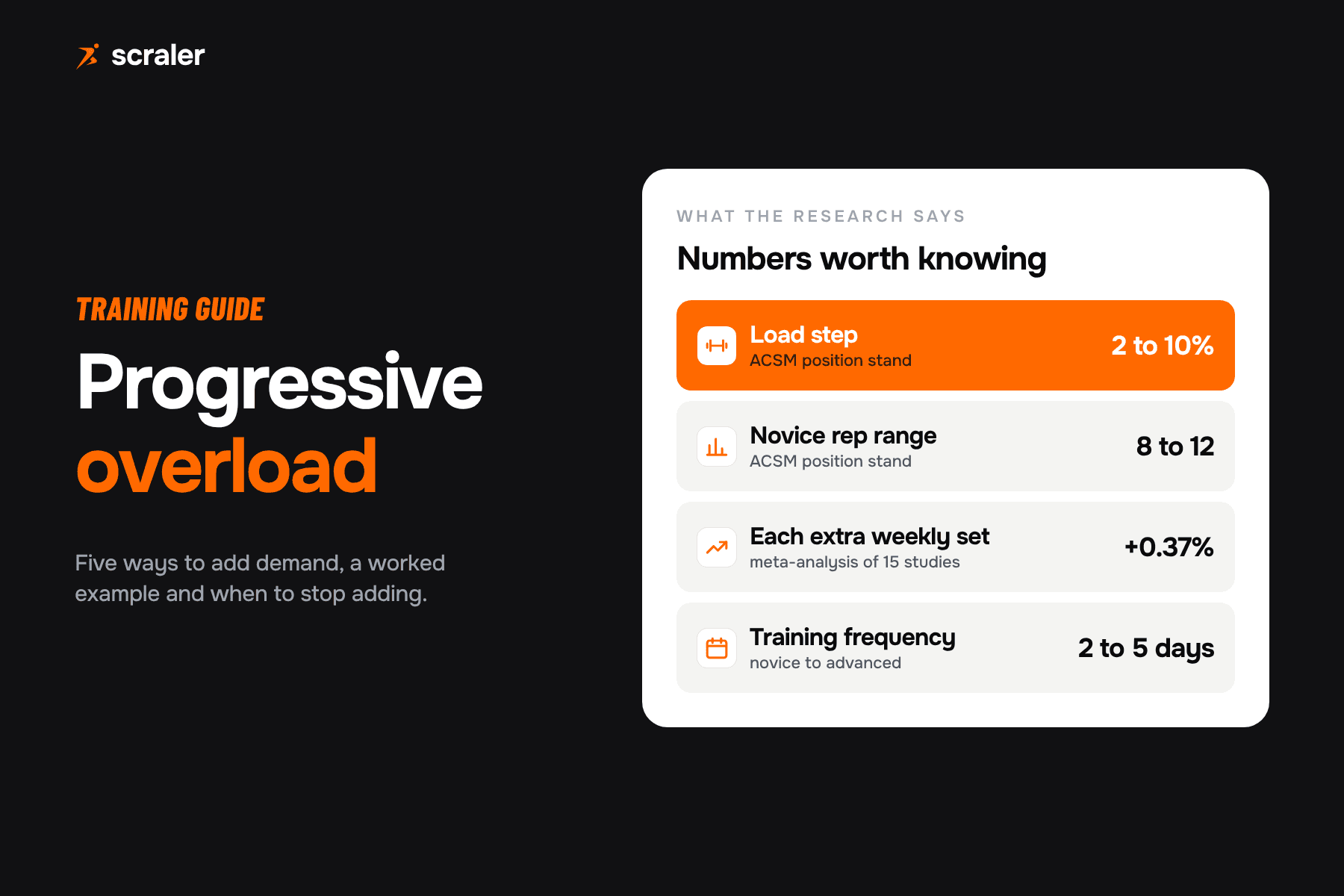
Progressive overload means gradually increasing the demand on the body so it keeps adapting. In practice you add load, reps, sets, training density or technique demand, one at a time. The ACSM position stand recommends raising the load 2 to 10% once a client can do one to two reps over the target.

- Progressive overload has five levers: load, reps, sets, density and technique. Pull one at a time so you know what worked.
- The ACSM says to raise load 2 to 10% when a client can do one to two reps over the target. Novices use 8 to 12RM loads and train 2 to 3 days a week.
- Adding reps looks about as effective as adding load. In one trial of 43 trained lifters over 8 weeks, growth modestly favored reps and strength slightly favored load, with differences of questionable practical significance.
- Sets matter too: in a 15-study meta-analysis, each extra weekly set went with about 0.37% more muscle gain. That has limits, so stop adding when reps drop or recovery slips.
What is progressive overload?
Progressive overload is the gradual increase of the demand a training program puts on the body. A 2022 trial describes it as a principle of program design that "typically relies on increasing load to increase neuromuscular demand to facilitate further adaptations". The ACSM position stand says the same thing from the other side: to stimulate further adaptation, "progressive resistance training (RT) protocols are necessary".
In simple terms, you ask a little more of the client than last time, but not so much that recovery fails. A client who repeats the same workout at the same weight forever gets the same result forever. Progressive overload is the principle that keeps results coming. If you want to see where it sits among the other principles of training, such as specificity and reversibility, read our personal exercise programme guide.
What are the five ways to apply progressive overload?
Load is the lever people think of first, but it is only one. The five below cover almost every progression a coach writes.
- What you change
- Weight on the bar
- Example
- 135 lb becomes 140 lb on the barbell row
- Where the guidance comes from
- ACSM: 2 to 10% once the client is 1 to 2 reps over the target
- What you change
- Reps at the same weight
- Example
- 8 reps becomes 9 reps at 135 lb
- Where the guidance comes from
- A 2022 randomized trial of 43 lifters
- What you change
- Hard sets per muscle per week
- Example
- Add one set to the main lift
- Where the guidance comes from
- A 2017 meta-analysis of 15 studies
- What you change
- Same work in less time
- Example
- 3 x 10 with 90 seconds of rest, not 2 minutes
- Where the guidance comes from
- Coaching practice, no study cited
- What you change
- Range, tempo and control
- Example
- Full depth, or a 3 second lowering, at the same load
- Where the guidance comes from
- Coaching practice, no study cited
| Lever | What you change | Example | Where the guidance comes from |
|---|---|---|---|
| Load | Weight on the bar | 135 lb becomes 140 lb on the barbell row | ACSM: 2 to 10% once the client is 1 to 2 reps over the target |
| Reps | Reps at the same weight | 8 reps becomes 9 reps at 135 lb | A 2022 randomized trial of 43 lifters |
| Sets | Hard sets per muscle per week | Add one set to the main lift | A 2017 meta-analysis of 15 studies |
| Density | Same work in less time | 3 x 10 with 90 seconds of rest, not 2 minutes | Coaching practice, no study cited |
| Technique | Range, tempo and control | Full depth, or a 3 second lowering, at the same load | Coaching practice, no study cited |
The ACSM also lists training frequency as a progression variable: 2 to 3 days a week for novices, 3 to 4 for intermediate lifters and 4 to 5 for advanced lifters. We treat that as a sixth lever, used when a client has more days to give, not as a default.
Should you add load or add reps?
Either one works. In the 2022 trial, 43 resistance-trained adults trained four lower body exercises twice a week for 8 weeks. One group kept the rep range and added load. The other kept the load and added reps. Rectus femoris growth modestly favored adding reps, by 2.8 mm. Smith machine squat strength slightly favored adding load, by 2.0 kg. Nothing else differed meaningfully: other muscle sizes were within 1 mm, endurance within 1% and jump height within 0.1 cm.
The authors call the differences of questionable practical significance, and the confidence intervals include zero, so read this as "both are viable" rather than "reps win". A 2021 review makes a similar point: muscular adaptations can be obtained, and in some cases optimized, across a wide spectrum of loading zones. That frees you to use a rep range and progress inside it, which is exactly what double progression does.
How does double progression work?
Double progression uses two levers in order. Pick a rep range, such as 8 to 12. Stay at one load until every set reaches the top of the range. Then raise the load by the smallest step and start the range again from the bottom. Reps go up first, then load.
- Load
- 135 lb
- Reps per set (3 sets)
- 8, 8, 8
- What you do next
- Keep the load, add reps
- Load
- 135 lb
- Reps per set (3 sets)
- 10, 9, 9
- What you do next
- Keep the load, add reps
- Load
- 135 lb
- Reps per set (3 sets)
- 12, 12, 12
- What you do next
- Top of the range on every set: raise the load
- Load
- 140 lb
- Reps per set (3 sets)
- 8, 8, 8
- What you do next
- A 3.7% step, within the ACSM 2 to 10%. Reps reset
- Load
- 140 lb
- Reps per set (3 sets)
- 10, 10, 9
- What you do next
- Keep the load, add reps
- Load
- 140 lb
- Reps per set (3 sets)
- 12, 12, 12
- What you do next
- Raise the load again next week
| Week | Load | Reps per set (3 sets) | What you do next |
|---|---|---|---|
| 1 | 135 lb | 8, 8, 8 | Keep the load, add reps |
| 2 | 135 lb | 10, 9, 9 | Keep the load, add reps |
| 3 | 135 lb | 12, 12, 12 | Top of the range on every set: raise the load |
| 4 | 140 lb | 8, 8, 8 | A 3.7% step, within the ACSM 2 to 10%. Reps reset |
| 5 | 140 lb | 10, 10, 9 | Keep the load, add reps |
| 6 | 140 lb | 12, 12, 12 | Raise the load again next week |
All numbers are our own example. Our workout log template has a lift tracker that suggests the next load once reps reach the top of the range, and the plate loading calculator helps when the smallest step you own is 2.5 lb per side. For the full plan around it, see the workout plan template.
How do you apply progressive overload to different clients?
The ACSM splits lifters by experience. Novices are untrained people with no resistance training experience, or who have not trained for several years. Intermediate lifters have about six months of consistent training, and advanced lifters have years. Its rep and frequency guidance follows those groups, and the last column is our own coaching guidance. For how to change the rep range by phase, see periodization, and for spreading the weekly days across muscles, workout splits.
- ACSM loads and days
- 8 to 12RM, 2 to 3 days a week
- How we progress them
- Double progression on every lift. Load goes up often at first, sometimes within a few weeks
- ACSM loads and days
- 1 to 12RM in a periodized fashion, 3 to 4 days
- How we progress them
- Change the rep range by phase, then use double progression inside each phase
- ACSM loads and days
- 1 to 12RM periodized, eventually emphasizing 1 to 6RM for strength, 4 to 5 days
- How we progress them
- Smaller load steps, slower progress, and more use of sets, density and technique
- ACSM loads and days
- Counted as a novice: 8 to 12RM, 2 to 3 days
- How we progress them
- Start below the old numbers and rebuild, then progress as normal
| Client | ACSM loads and days | How we progress them |
|---|---|---|
| Novice | 8 to 12RM, 2 to 3 days a week | Double progression on every lift. Load goes up often at first, sometimes within a few weeks |
| Intermediate | 1 to 12RM in a periodized fashion, 3 to 4 days | Change the rep range by phase, then use double progression inside each phase |
| Advanced | 1 to 12RM periodized, eventually emphasizing 1 to 6RM for strength, 4 to 5 days | Smaller load steps, slower progress, and more use of sets, density and technique |
| Back after several years off | Counted as a novice: 8 to 12RM, 2 to 3 days | Start below the old numbers and rebuild, then progress as normal |
Screen new clients before you progress anything. The free PAR-Q template covers the readiness check, and the fitness assessment form gives you baseline numbers to progress from. If you work by RPE, the RPE calculator converts a rating into reps in reserve, and the one rep max calculator estimates a starting load.
When should you stop adding?
Overload is not a weekly obligation. Adding more demand only works while the client can recover from it. A 2017 meta-analysis of 34 treatment groups found a graded dose-response: each additional weekly set went with about 0.37% more muscle gain. But the comparison of under 5, 5 to 9 and 10 or more sets per muscle showed only a trend (P = 0.074), and nothing in the data says more is better without limit. These are the signs we use to hold or back off:
- Reps fall at the same load for two sessions in a row.
- Effort creeps up. Sets planned at RPE 8 keep landing at RPE 9 or 10.
- Joints complain. Aches that do not settle between sessions.
- Recovery slips. Sleep, energy or mood drop on the weekly check-in.
- Form breaks down before the reps are done.
- The load has not moved in three or four sessions. Check sleep, weekly volume and the RPE column before you add anything.
What are the common progressive overload mistakes?
- Changing everything at once. New load, new sets and new tempo in one week hides what worked.
- Fixed reps with no range. A plan that says 3 x 10 gives the client no room to progress inside the week. Write 8 to 12 instead.
- Steps that are too big. A jump past 10% usually breaks the rep range. Use the smallest plate, or add a rep.
- Progressing every lift every week. Rotate which lift gets the push, and let the others hold.
- No log. If the last session is not written down, you are progressing from memory.
All five are our coaching observations, not study results. They share one fix: write the rep range, the next step and the stop rule into the plan before the first session, so the decision is made when you are calm and not mid-set.
How do you track progressive overload in Scraler?
Progression is only as good as the log behind it. In Scraler, clients see the plan in their app with exercises, sets, reps and rest timers, and they log their progress as they finish each workout. In the client profile, the Training Progress view shows adherence, completed versus missed workouts and volume per session, and the 1RM Data view shows each exercise's best lift with a history chart.
When you prescribe by percentage, weights scale automatically with each client's 1RM: set 80% for a client with a 100 kg bench 1RM and they see 80 kg. Update the 1RM and the loads follow.
Build the plan once, let clients log every set in the app, and read the 1RM history and volume per session before you change the next block.
See workout planningIf you are comparing tools, what to look for in workout builder software lists the features that matter for progression: a video exercise library, templates, RPE and % 1RM prescriptions and client logging.
Frequently asked questions
- What is progressive overload in simple terms?
- Progressive overload means asking the body for slightly more over time, by adding weight, reps, sets, density or technique demand, so it keeps adapting. Repeating the same workout at the same weight stops producing change.
- Can you do progressive overload without adding weight?
- Yes. In a 2022 trial of 43 trained lifters over 8 weeks, adding reps at a constant load produced similar results to adding load, with only small differences in muscle growth and strength. Sets, rest time and technique are other levers.
- How much should you increase the weight?
- The ACSM position stand recommends a 2 to 10% increase when the client can do one to two reps over the target at the current load. Round to the smallest plate step you have, and if a step is too big, add reps first.
- How often should a client progress?
- There is no fixed schedule. A common approach is double progression: raise the load when every set reaches the top of the rep range. New clients may get there within a few weeks, and advanced clients take much longer.
- What is double progression?
- Double progression is a rule that uses two levers in order. Work in a rep range such as 8 to 12 at one load until every set reaches 12, then raise the load by the smallest step and start again at 8 reps.
- Does progressive overload work for beginners and advanced clients?
- Yes, but the pace differs. The ACSM recommends progressive protocols at every level and sets different loads and frequencies for novice, intermediate and advanced lifters. Expect fast early progress and slower progress with experience.