Personal Exercise Programme (PEP): How to Plan One, With a Worked Example
A Personal Exercise Programme (PEP) is a plan you design, run and evaluate to improve one part of your fitness for a chosen sport, usually over six to eight weeks. It starts with a PAR-Q and fitness tests, sets a SMART goal, applies training principles like FITT and progressive overload, then compares results before and after.

- In Edexcel GCSE PE, the PEP is Component 4: 10% of the qualification, marked out of 20, covering a six to eight week block.
- You are graded on your analysis and evaluation, not on whether you actually improve or on how well you did the sessions.
- A written PEP has a 1,500 word limit. PAR-Q answers, graphs, charts and training logs do not count towards it.
- The same PAR-Q, baseline test, SMART goal, FITT and retest structure works for an adult planning their own programme, minus the coursework rules.
What is a Personal Exercise Programme (PEP)?
A Personal Exercise Programme is a structured training plan built around one goal: improving a specific component of fitness for a specific sport, over a set number of weeks. It is more than a list of sessions: it starts from a health screen and baseline data, applies training principles on purpose, and ends by comparing your results with where you started.
Most people writing one are GCSE PE students completing coursework, so this guide covers that first: what your exam board actually asks for, how it is marked, and a worked example you can adapt. The rest works just as well for an adult or a coach, minus the word count and moderator.
How much is the PEP worth in GCSE PE?
On the Pearson Edexcel GCSE (9 to 1) Physical Education specification (1PE0), as updated for first assessment in 2023, the PEP is Component 4. It sits alongside Component 3: Practical Performance as one of the two non-exam assessment (NEA) components, which means it is marked by your school and then checked by Pearson through external moderation, rather than sat as a written exam.
The specification content overview for Component 4 covers three things: aim and planning analysis, carrying out and monitoring the PEP, and evaluation of the PEP. Importantly, Edexcel is explicit that you are only assessed on your written or verbal analysis and evaluation, not on whether your fitness actually improved or on how diligently you carried out the sessions.
If you are injured during the weeks you would be doing your PEP, you can base it on your rehabilitation instead.
You submit it one of two ways: as written or word processed text with a maximum of 1,500 words (your PAR-Q, graphs, charts, tables, diagrams and training record forms sit outside that count, typically as an appendix), or as a video presentation of up to 15 minutes with no prompting from a teacher during recording. Our workout log template works as a training record.
Whichever format, Pearson's PEP marking grid uses five strands (initial data, planning and target setting, post-PEP data, evaluation of the training and your recommendations, and coherence of the write-up), each scored out of 20, then totalled, divided by five and rounded to give your mark out of 20.
What are the steps for planning a PEP?
Whatever wording your teacher uses, a PEP follows the same sequence.
- 1.Screen yourself with a PAR-Q before you plan anything, to rule out a reason you should not be training hard.
- 2.Run baseline fitness tests relevant to your sport, so you have a real number to improve on.
- 3.Set one SMART target tied to a specific component of fitness, not a vague "get fitter".
- 4.Choose your principles of training (specificity, progressive overload, FITT and the rest) and decide how each one applies to your plan.
- 5.Pick a training method or combination that actually trains the component of fitness you chose.
- 6.Build the week by week programme for six to eight weeks, with planned progression, not the same session repeated.
- 7.Carry out and monitor the sessions, adapting the plan if something is not working.
- 8.Retest and evaluate, comparing your post-PEP data to your baseline and explaining what the numbers mean.
Step 1: PAR-Q screening
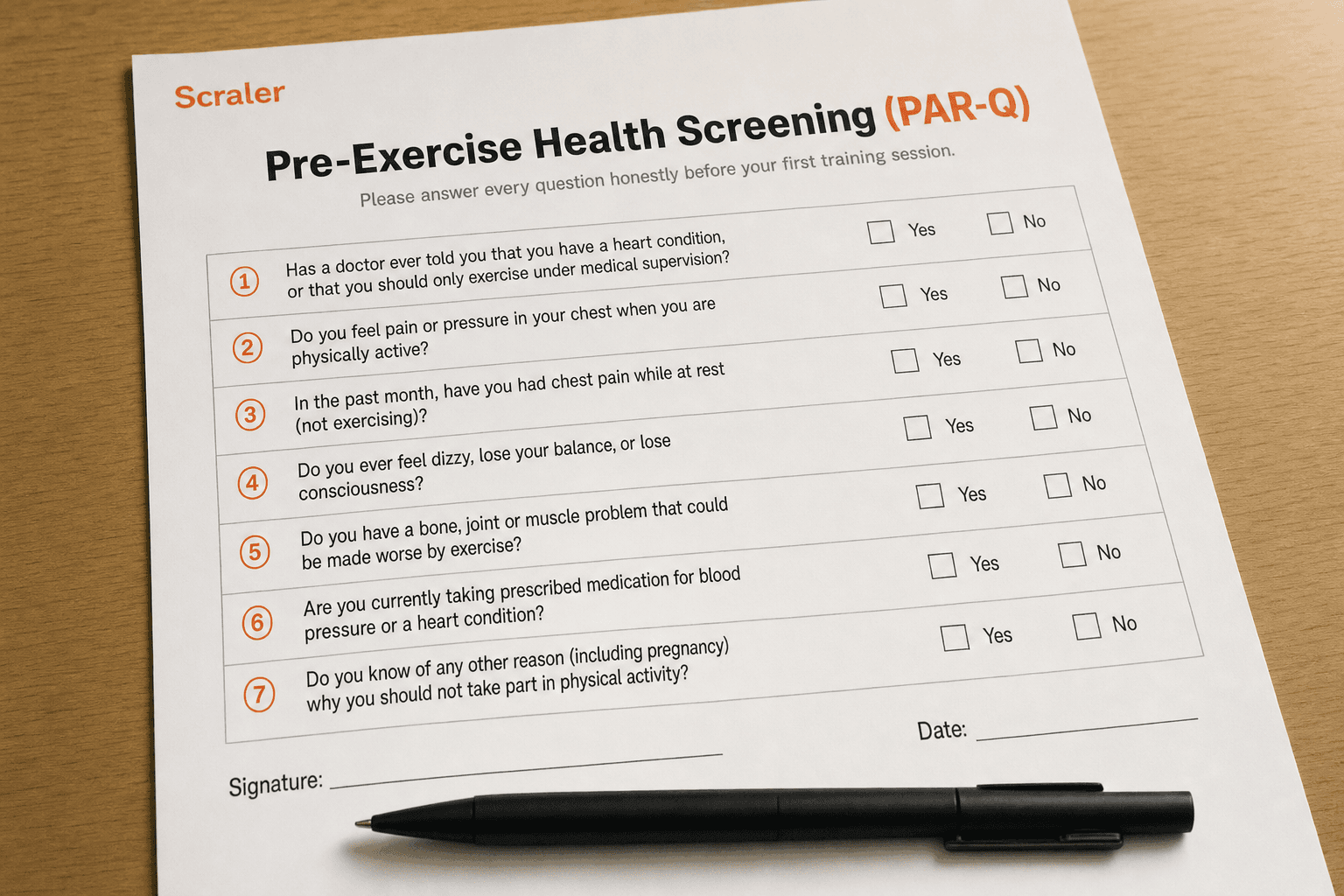
A PAR-Q (Physical Activity Readiness Questionnaire) is a short set of health screening questions, covering things like heart conditions, chest pain, dizziness and joint problems, that flags whether you should check with a doctor before training hard. Edexcel lists your PAR-Q responses among the things your planning should take into account, and its PEP checklist calls including a completed PAR-Q good practice (it does not count towards the word count).
For what each question actually screens for, see What is a PAR-Q?, and for a ready-to-use form, see the PAR-Q form template.
Step 2: fitness tests to set your baseline
You cannot show improvement without a number to improve from. Pick a fitness test that matches the component of fitness your SMART target is aimed at, and run it under the same conditions you will use for the retest at the end. Edexcel also expects some performance data from your sport itself, such as passes completed or sprint splits in a match, so you can link fitness to performance.
- Cardiovascular fitness (aerobic endurance): the Cooper 12 minute run is one of the tests named on the GCSE specification, alongside the Cooper 12 minute swim and the Harvard Step Test. Use the Cooper test calculator to convert your distance into an estimated VO2 max, or the VO2 max calculator if you want to compare it against another method.
- Flexibility: the sit and reach test. The sit and reach test calculator scores your result against age and sex norms.
- Strength: a grip dynamometer is the test named on the GCSE specification. Adults tracking strength more broadly often use a one rep max instead. See the one rep max calculator.
- Muscular endurance, speed and power: one minute sit up or press up tests, a 30 metre sprint and a vertical jump test cover these on the GCSE fitness test list. Record the raw result each time, since these do not have a dedicated calculator on this site.
Step 3: setting a SMART target
A SMART target is Specific, Measurable, Achievable, Relevant and Time bound. "Get fitter" fails on every count. "Increase my Cooper 12 minute run distance from 2,000 m to at least 2,150 m within six weeks, retested under the same conditions" passes all five: it names the exact test, the exact numbers, ties the improvement to a training block you can actually complete, connects to a footballer's real need for cardiovascular endurance, and has a fixed deadline.
Step 4: applying the principles of training
The Edexcel specification lists these principles of training: individual needs, specificity, progressive overload, FITT, overtraining, reversibility and thresholds of training (training zones worked out from your maximum heart rate), as set out in Pearson's Topic Guide 3: Physical Training. Pearson's PEP checklist says you only need to analyse the ones relevant to your plan, not every one.
- Individual needs: the plan should suit your sport, current fitness and the component you are targeting, not a generic programme.
- Specificity: training should resemble the demands of your sport. A footballer improving cardiovascular endurance benefits more from interval running that mimics match surges than from steady swimming.
- Progressive overload: gradually increasing frequency, intensity, time or type (see FITT below) so your body keeps adapting instead of plateauing.
- FITT: Frequency (how often), Intensity (how hard), Time (how long) and Type (which method). Change one or more of these each week to apply progressive overload.
- Overtraining: training too hard or too often without recovery, which reduces performance instead of improving it. Your plan should build in rest.
- Reversibility: fitness gains are lost if training stops or drops off sharply, which is why a plan tapers rather than stopping outright before a retest.
You may hear tedium (boredom from repetitive training) called a principle too. It is not on the Edexcel list, so do not present it as one in your write-up.
Edexcel asks you to calculate an aerobic training zone (60 to 80% of max heart rate) and an anaerobic zone (80 to 90%). The specification calls this the Karvonen formula, but its topic guide uses a simplified version: work out max heart rate as 220 minus your age, then multiply it by each percentage.
For a 16 year old, that gives a max heart rate of 204 bpm, an aerobic zone of 122 to 163 bpm and an anaerobic zone of 163 to 184 bpm. Use that simplified version for your coursework. Outside coursework, the heart rate zone calculator offers the full Karvonen method, which adds in your resting heart rate, and the max heart rate calculator explains why it defaults to the Tanaka formula (208 minus 0.7 times age) rather than 220 minus age.
They give different numbers from the Edexcel method (Tanaka puts a 16 year old at about 197 bpm, not 204), so do not mix them into your write-up.
Step 5: choosing a method of training
Pick a method that trains your target component and suits your sport and equipment.
- Continuous training: steady effort at a constant intensity, for an aerobic base.
- Fartlek: continuous running with changes of pace or terrain, for stop and start sports.
- Interval training: hard work periods with recovery between them, for cardiovascular endurance and speed.
- Circuit training: a set of stations targeting different muscle groups or fitness components in sequence.
- Plyometrics: explosive jumping or bounding movements for power.
- Weight or resistance training: for strength and muscular endurance.
A worked example: a footballer improving cardiovascular endurance
Ellie, 16, plays as a winger and wants to last the full match without her performance dropping in the last 15 minutes. Her PAR-Q raises no concerns. Her baseline Cooper 12 minute run is 2,000 m, and her resting heart rate is 68 bpm. Her SMART target: reach at least 2,150 m on the same test after six weeks.
Using the simplified Edexcel formula for a 16 year old, her aerobic zone is 122 to 163 bpm and her anaerobic zone is 163 to 184 bpm.
- Session focus
- Continuous, baseline volume
- Session detail
- Two 20 min steady runs
- Target zone
- 60 to 70% (122 to 143 bpm)
- Session focus
- Continuous, longer
- Session detail
- Two 25 min runs with short Fartlek surges
- Target zone
- 65 to 75% (133 to 153 bpm)
- Session focus
- Interval introduced
- Session detail
- 5 x 3 min hard, 2 min easy, plus one 25 min steady run
- Target zone
- Hard reps 80 to 85% (163 to 173 bpm)
- Session focus
- Interval, more reps
- Session detail
- 6 x 3 min hard, 90 sec easy, plus one 25 min steady run
- Target zone
- Hard reps 80 to 85% (163 to 173 bpm)
- Session focus
- Interval, higher intensity
- Session detail
- 7 x 3 min hard, 90 sec easy, plus one 30 min steady run
- Target zone
- Hard reps 85 to 90% (173 to 184 bpm)
- Session focus
- Taper and retest
- Session detail
- One light 20 min run, then repeat the Cooper 12 minute run
- Target zone
- 60 to 70% before the retest
| Week | Session focus | Session detail | Target zone |
|---|---|---|---|
| 1 | Continuous, baseline volume | Two 20 min steady runs | 60 to 70% (122 to 143 bpm) |
| 2 | Continuous, longer | Two 25 min runs with short Fartlek surges | 65 to 75% (133 to 153 bpm) |
| 3 | Interval introduced | 5 x 3 min hard, 2 min easy, plus one 25 min steady run | Hard reps 80 to 85% (163 to 173 bpm) |
| 4 | Interval, more reps | 6 x 3 min hard, 90 sec easy, plus one 25 min steady run | Hard reps 80 to 85% (163 to 173 bpm) |
| 5 | Interval, higher intensity | 7 x 3 min hard, 90 sec easy, plus one 30 min steady run | Hard reps 85 to 90% (173 to 184 bpm) |
| 6 | Taper and retest | One light 20 min run, then repeat the Cooper 12 minute run | 60 to 70% before the retest |
Notice how each principle shows up in the numbers. Progressive overload runs through the whole plan: run duration rises from week 1 to week 2, intensity jumps when intervals start in week 3, the number of hard reps goes up every week from week 3 to week 5, recovery between reps shortens in week 4, and intensity rises again in week 5.
Specificity shows up once interval training starts, since repeated hard efforts followed by short recoveries match the demands of a game far more closely than steady running. Reversibility is respected by tapering in week 6 rather than stopping training in the run up to the retest, and the plan guards against overtraining by keeping to one hard interval session a week, with a steady run as the second session.
How do you monitor and evaluate a PEP?
Monitoring means recording every session (what you did, how it felt, any adjustment) so you have evidence to refer back to. Pearson requires a training record (or equivalent evidence) for every session. If week 4 feels too easy, that is a monitoring note that justifies increasing intensity in week 5.
Evaluation covers two of the five marking strands: comparing your pre and post-PEP data, and judging how well your methods, targets and principles worked. Edexcel wants three things: an analysis of the data you collected initially, during and after the PEP; a judgement on how effective the programme actually was; and specific recommendations for what you would change next time.
"My fitness improved" is not an evaluation. "My Cooper test distance rose from 2,000 m to 2,180 m, a 9% improvement that beat my SMART target. I link most of it to the interval sessions in weeks 3 to 5, because my training logs show my heart rate recovering faster between reps by week 5.
Next time I would add a mid-PEP test in week 3 to reset my intensities" is closer to what earns marks.
What are the most common PEP mistakes?
- No real baseline. Guessing your starting fitness instead of testing it makes the comparison meaningless.
- A vague or unmeasurable goal. "Get fitter for football" cannot be marked against, since there is nothing to check it against.
- The same session every week. Without progressive overload, a plan just repeats week 1 for six weeks and shows no reason to expect improvement.
- Describing instead of evaluating. Explaining what a training method is scores far fewer marks than explaining whether it worked and why.
- Ignoring the PAR-Q. Edexcel lists your PAR-Q responses as something your planning should consider, so refer to them rather than filling the form in and filing it away.
- Going over the word count. Pearson's guidance is direct: if you go over 1,500 words, it is likely you will not meet the requirement for a concise, coherently structured PEP, which is what the fifth marking strand assesses.
Can adults use the same PEP structure?
Yes. A PAR-Q flags health risks before you train hard, a baseline test gives you a real number instead of a feeling, a SMART goal keeps you honest, and FITT and progressive overload apply to any programme, six weeks or six months. For longer plans, periodization explains how to organise the blocks. Drop the word count and marking strands and keep everything else.
Coaches use the same structure for client programmes. In Scraler you can build a programme like this once through workout planning and assign it to a client with the sessions, intensities and a check-in attached, instead of rebuilding it in a spreadsheet for every client. On paper, our workout plan template uses the same columns.
Plan the sessions, set the progression and schedule the retest on the client's calendar, then let clients log each session in the app. Free for 14 days.
See workout planningFrequently asked questions
- How many words should a written PEP be?
- Edexcel's limit for Component 4 is 1,500 words for the written version. PAR-Q answers, graphs, charts, tables, diagrams and training record forms do not count towards that total, so keep them separate and spend the word count on your analysis and evaluation.
- What percentage of my GCSE PE grade is the PEP worth?
- On the Edexcel specification it is Component 4, worth 10% of the full GCSE and marked out of 20. If you sit a different exam board, check that board's own specification, since the weighting is not guaranteed to match.
- Do I lose marks if my fitness does not actually improve?
- No. Edexcel states you are assessed only on your analysis and evaluation of the PEP, not on whether an improvement occurred or on how well you carried out the actual sessions.
- How long does a PEP need to run for?
- Edexcel says the PEP covers a six to eight week period. Check with your teacher which length your school uses.
- Can my PEP be based on a different sport to my Component 3 activities?
- Yes. You can base it on one of the three activities you are performing for Component 3: Practical Performance, or choose a different activity from the same approved activity list.
- Is a PEP the same as a training diary?
- No. A training diary just logs what you did each session. A PEP plans the programme against a justified goal, applies training principles on purpose, and then analyses and evaluates the results against your baseline data.