Personal trainer income calculator
Enter what you charge, how many sessions you deliver and what the gym takes, and this works out what actually reaches you each month. Add as many income streams as you actually run, one to one, group, a monthly online fee and anything you bill by hand, and it adds them up. The three delivery models have very different ceilings for the same hours worked.

£39 an hour once the venue and your costs come out, across 20 delivered hours a week and 20 paying clients.
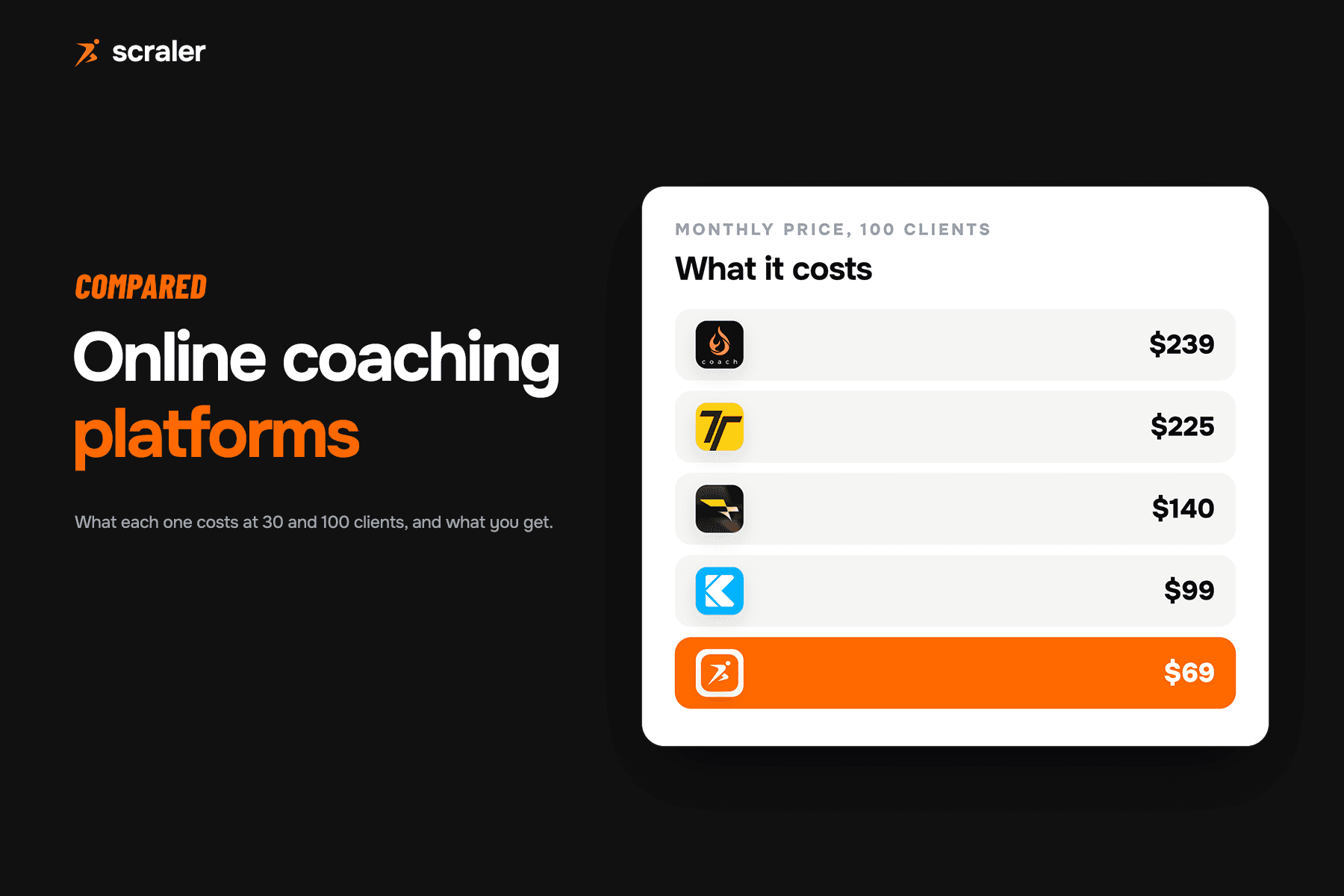
Working the other way round? The session rate calculator starts from the take-home you want and tells you what to charge. If a platform fee is one of your monthly costs, the coaching software cost calculator prices eleven platforms at your roster size.
The sticker price is not your wage
A session priced at 45 is rarely 45 in your pocket. Two deductions sit between the two, and only one of them is obvious.
- The venue. Either a flat rent, or a percentage of every session. A 40 percent split on a 3,450 month is 1,380 gone before anything else.
- Fixed costs. Insurance, certification renewals, software, travel. Small individually, and they come out of the same money.
On 20 sessions a week at 45, 46 weeks a year, with 400 rent and 60 of other costs, the gross is 3,450 a month and the take-home is 2,990. That is 39 an hour against a 45 sticker price, before a penny of tax.
The calculator shows both numbers at once, because the gap between them is the thing worth acting on.
Weeks worked is the input people leave out
Annualising a good week is the most common way trainers overestimate their income. Nobody works 52 weeks. Holiday, illness, Christmas and the quiet fortnight in August all come out of your own pocket when you are self-employed.
Moving from 52 weeks to 46 is a 12 percent cut to annual revenue and it changes nothing about your week. The slider defaults to 46 for that reason, and it is worth being honest with it rather than optimistic.
Online coaching is the exception: a monthly retainer bills twelve times a year whether you take a week off or not, which is why the weeks slider disappears in that mode.
One to one, online and group have different ceilings
The same hours produce very different numbers depending on how you deliver them.
One to one
Capacity is hard-capped by hours. Twenty sessions is twenty hours, and the only lever is price. Reliable, and the model with the lowest ceiling of the three.
Group
One slot, several payers. Twelve a head with eight in the room is 96 for the hour against 45 for a one to one, and 14 slots a week reaches 112 paying clients. The constraint moves from your diary to the room and to filling it.
Online
Billed per client per month, so revenue decouples from the clock entirely. Thirty clients at 120 is 3,600 a month with no session hours at all. The work moves to programme writing and check-ins, which is why platform time matters more here than room hire.
Most trainers who raise their income meaningfully do it by changing model, not by raising their one to one rate.
What this does not tell you
There are no default salary figures in this tool, on purpose. Published averages swing enormously by country, by employment status and by survey, and anchoring your pricing to someone else is how trainers end up underpricing.
For reference rather than for planning: the US Bureau of Labor Statistics put the median annual wage for fitness trainers and instructors at $47,160 in May 2025, or $22.67 an hour. That figure includes employed gym staff on a wage, so it is a poor comparison for a self-employed trainer setting rates, and a good reminder of what the employed alternative pays.
The number here is also before tax. What you owe depends on your country, your structure and your allowable expenses, and this tool deliberately does not guess at any of them.
Frequently asked questions
- Does this account for tax?
- No. It stops at take-home before tax, because self-employment tax, national insurance and allowable expenses differ by country and by how you are set up. Treat the figure as pre-tax income and apply your own rates to it.
- Why does the weeks slider disappear for online coaching?
- Online is modelled as a monthly retainer per client, so it bills twelve times a year regardless of the weeks you work. Session-based delivery stops earning when you stop, which is exactly the difference the two modes are meant to show.
- Is rent or a percentage split better?
- Rent is better once you are busy, because the cost stops growing while your revenue does not. A split is better when you are quiet or starting out, since you pay nothing on a week with no clients. The crossover is where the split equals the rent, which you can find by switching between the two options at your real volume.
- What counts as other monthly costs?
- Anything fixed that keeps you trading: insurance, certification renewals, coaching software, music licensing, travel between clients, a phone plan. Equipment you buy once belongs in your accounts rather than here.
- Why is my effective hourly rate so much lower than my session price?
- Because the venue cut and your fixed costs come out of every hour you deliver, not out of a separate pot. The gap widens as your session count falls, since fixed costs spread across fewer hours.
- Does this include unpaid time?
- No, and that is the figure most likely to flatter you. Programme writing, check-in messages, admin, travel and no-shows all consume hours that no client pays for. If you want a truer hourly figure, add those hours to your own estimate after reading the result.
Sources
- US Bureau of Labor Statistics: Fitness Trainers and InstructorsMedian annual wage $47,160, or $22.67 an hour, May 2025. Includes employed staff, not only self-employed trainers.

Calories, macros, workouts and check-ins tracked per client, so the number you just calculated becomes a plan you can run. Free to try, no card needed.
Start free trial