Daily Undulating Periodization (DUP) vs Linear and Block: Examples for Coaches
Daily undulating periodization (DUP) changes the rep range and load from session to session, such as a heavy, a moderate and a light day in one week, instead of every few weeks. Linear periodization shifts gradually and block periodization stacks focused phases. In a 2022 meta-analysis, undulating programs favored strength gains in trained lifters (a borderline result), while muscle growth looked similar across models.

- DUP varies reps and load every session. Linear periodization changes them every few weeks. Block periodization stacks focused phases of several weeks each.
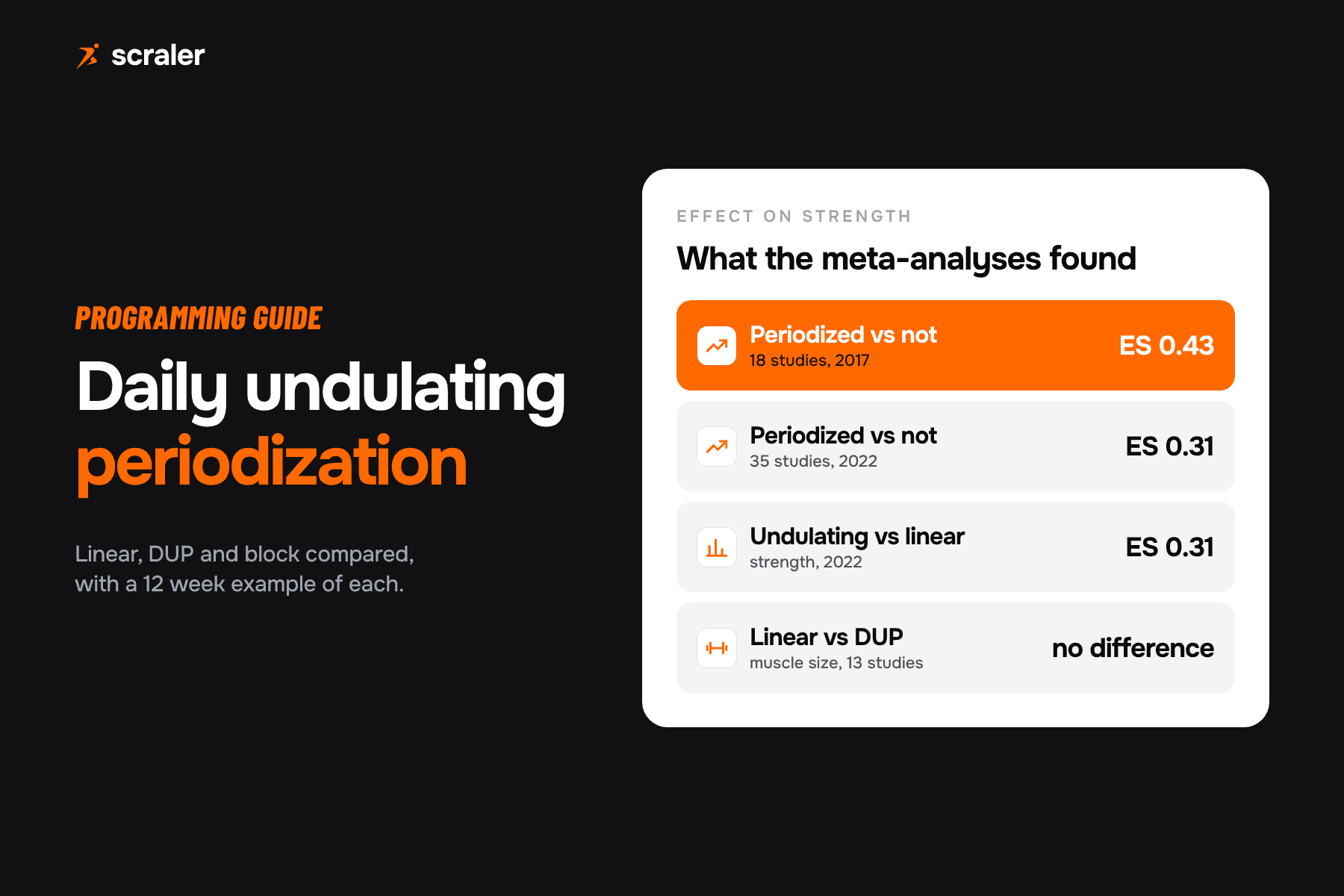
- Periodized plans beat non-periodized ones for maximal strength: an effect size of 0.43 across 18 studies and 0.31 across 35 studies. Muscle size did not differ.
- Undulating beat linear for strength in trained lifters (effect size 0.61, interval from 0.00 to 1.22) but not in untrained ones (0.06). For muscle size, linear and DUP look the same.
- For new clients, pick the simplest plan they will follow. For trained clients on three days a week, DUP is a sound default. For a competition date, build blocks.
Periodization is one of those words that sounds more complicated than the plan it describes. This guide explains the three common models in plain language, shows what each looks like over 12 weeks, and tells you what the meta-analyses actually found. Where a number is our own worked example, it says so.
What is daily undulating periodization (DUP)?
Daily undulating periodization varies the training stimulus every session. A week holds a heavy day of low reps, a moderate day and a light day of higher reps, and the pattern repeats while the loads slowly climb. "Undulating" means intensity moves up and down within the week instead of rising in one direction over months.
- Focus
- Heavy, strength
- Squat sets x reps
- 4 x 4
- Effort
- RPE 8
- Focus
- Moderate, size
- Squat sets x reps
- 3 x 8
- Effort
- RPE 8
- Focus
- Light, volume and technique
- Squat sets x reps
- 3 x 12
- Effort
- RPE 7
| Day | Focus | Squat sets x reps | Effort |
|---|---|---|---|
| Monday | Heavy, strength | 4 x 4 | RPE 8 |
| Wednesday | Moderate, size | 3 x 8 | RPE 8 |
| Friday | Light, volume and technique | 3 x 12 | RPE 7 |
Run the other lifts on the same pattern, or rotate which lift is heavy so one session does not carry every heavy set. That layout is ours. The research design is simpler. In Rhea and colleagues' 2002 study, 20 men trained the bench press and leg press for 3 sets, 3 days a week, for 12 weeks. The DUP group trained at 8RM on Monday, 6RM on Wednesday and 4RM on Friday. The linear group did 8RM, then 6RM, then 4RM in four week blocks. The DUP group gained more strength.
One small study does not settle it. A 9 week study of 28 recreationally trained adults, Buford et al. in 2007, compared linear, daily undulating and weekly undulating programs and found no differences in strength, body fat or circumference. The authors concluded that no separation between models shows up in early-phase training. The pooled evidence below is a better guide.
What is periodization?
Periodization is a plan for changing training over time. A 2017 meta-analysis defines it as "a logical method of organizing training into sequential phases and cyclical time periods in order to increase the potential for achieving specific performance goals while minimizing the potential for overtraining." In plain words: you decide in advance how volume, load and effort will change, instead of repeating the same workout.
Coaches use three time frames. In sports periodization, the macrocycle is the whole plan, often a season or a year, working back from the main competition. Each macrocycle splits into mesocycles and microcycles.
- Typical length
- A season or a year
- Example
- Twelve months leading to a competition
- Typical length
- Several weeks
- Example
- A 4 week block with one focus
- Typical length
- One week
- Example
- Heavy, moderate and light days
| Term | Typical length | Example |
|---|---|---|
| Macrocycle | A season or a year | Twelve months leading to a competition |
| Mesocycle | Several weeks | A 4 week block with one focus |
| Microcycle | One week | Heavy, moderate and light days |
Does periodization work?
For maximal strength, yes, modestly. The 2017 meta-analysis pooled 81 effects from 18 studies and found periodized training beat non-periodized training for 1RM strength, with an effect size of 0.43 (95% interval 0.27 to 0.58). Undulating programs were the more favorable models, gains were larger in untrained participants, and higher training frequency went with bigger gains.
A 2022 meta-analysis of 35 studies held volume equal across groups and found the same story with smaller numbers. Periodized beat non-periodized for 1RM (0.31), but not for muscle size (0.13, interval from -0.10 to 0.36). Undulating beat linear for 1RM (0.31). The split by training status matters: 0.61 in trained participants (interval 0.00 to 1.22, P = 0.05) and 0.06 in untrained ones. For muscle size, linear and undulating did not differ (0.05).
A separate meta-analysis of 13 studies looked only at muscle growth and found linear and daily undulating periodization likely similar (-0.02, interval -0.25 to 0.21). The 2022 authors propose that the effect of periodization on maximal strength may instead relate to the neurophysiological adaptations that come with resistance training.
What are linear and block periodization?
Linear periodization moves in one direction. Early weeks use lighter loads and more reps. Later weeks use heavier loads and fewer reps, and the change happens in steps of several weeks. It is the model most clients have already met, and within each step it relies on progressive overload. The ACSM position stand recommends periodization in general for experienced lifters, not linear specifically: a wide loading range of 1 to 12RM in a periodized fashion, with eventual emphasis on heavy loading of 1 to 6RM.
Block periodization stacks short, focused phases. A common order is accumulation (higher volume), then intensification (heavier, lower volume), then realization (peaking for a test or competition). It comes from sport coaching. The best pooled evidence we found is in endurance training: a 2019 meta-analysis reported small advantages for block over traditional organization in trained endurance athletes, 0.40 for VO2max and 0.28 for maximal power output. We did not find a meta-analysis for lifting, so we do not quote one.
What does a 12 week example of each model look like?
- Weeks 1 to 4
- 3 x 10 to 12, RPE 7
- Weeks 5 to 8
- 4 x 6 to 8, RPE 8
- Weeks 9 to 12
- 5 x 3 to 5, RPE 8 to 9, test in week 12
- Weeks 1 to 4
- Mon 4 x 4, Wed 3 x 8, Fri 3 x 12
- Weeks 5 to 8
- Same days, add 2 to 5% to each load
- Weeks 9 to 12
- Same days, add 2 to 5% again, test in week 12
- Weeks 1 to 4
- Accumulation: 4 x 8 to 12, RPE 7 to 8
- Weeks 5 to 8
- Intensification: 4 x 4 to 6, RPE 8
- Weeks 9 to 12
- Realization: 3 x 1 to 3, RPE 8 to 9, test in week 12
| Model | Weeks 1 to 4 | Weeks 5 to 8 | Weeks 9 to 12 |
|---|---|---|---|
| Linear | 3 x 10 to 12, RPE 7 | 4 x 6 to 8, RPE 8 | 5 x 3 to 5, RPE 8 to 9, test in week 12 |
| Daily undulating | Mon 4 x 4, Wed 3 x 8, Fri 3 x 12 | Same days, add 2 to 5% to each load | Same days, add 2 to 5% again, test in week 12 |
| Block | Accumulation: 4 x 8 to 12, RPE 7 to 8 | Intensification: 4 x 4 to 6, RPE 8 | Realization: 3 x 1 to 3, RPE 8 to 9, test in week 12 |
All three are worked examples for one main lift. A real plan covers several lifts and a deload somewhere in the 12 weeks. Use the one rep max calculator to set the test loads, the RPE calculator to translate effort into reps in reserve, and the workout plan template to lay the weeks out on a sheet.
Which periodization model fits which client?
Start from the client, not the model. The table is our coaching guidance, built on the results above.
- Start with
- The simplest plan they will follow
- Why
- Periodizing helped untrained people most, but linear and undulating did not differ in them (0.06), so the simplest model wins
- Start with
- Daily undulating
- Why
- Undulating beat linear for strength in trained lifters, and the weekly pattern keeps sessions varied
- Start with
- Alternate a heavy and a moderate day
- Why
- A trimmed DUP. Our suggestion, no study behind it
- Start with
- Block, working back from the date
- Why
- Built for peaking. The pooled evidence is in endurance sport
- Start with
- Any model, and count weekly sets
- Why
- Muscle growth did not differ between models with volume matched
| Client | Start with | Why |
|---|---|---|
| New to lifting | The simplest plan they will follow | Periodizing helped untrained people most, but linear and undulating did not differ in them (0.06), so the simplest model wins |
| Trained, 3 sessions a week | Daily undulating | Undulating beat linear for strength in trained lifters, and the weekly pattern keeps sessions varied |
| Trained, only 2 sessions | Alternate a heavy and a moderate day | A trimmed DUP. Our suggestion, no study behind it |
| Peaking for a meet or test | Block, working back from the date | Built for peaking. The pooled evidence is in endurance sport |
| Goal is muscle size | Any model, and count weekly sets | Muscle growth did not differ between models with volume matched |
Frequency also limits your choices. The ACSM suggests 2 to 3 days a week for novices, 3 to 4 for intermediate and 4 to 5 for advanced lifters, and the DUP study above used three. If you want to see how workout splits fit around these models, our workout log template shows the session record that tells you whether a block is working. For beginners, run a PAR-Q first: the free PAR-Q template covers screening before programming.
How do you build a periodized plan in Scraler?
The Scraler training plan builder gives you two layouts. The Calendar layout is a Monday to Sunday grid with one row per week, so a linear or block plan is a matter of placing workouts week by week, and you can copy a week and paste it. The Fixed layout is a rotation of named days with no dates, which suits DUP: name the days Heavy, Moderate and Light, and when the client finishes the last outstanding day, that round closes and a new one opens automatically. Each closed round lands in plan history with its start and end dates.
Each set can carry Reps, % 1RM, KG, RPE and Rest. If you set 80% for a client whose bench 1RM is 100 kg, they see 80 kg. You can also describe a program in your own words and let the AI draft it. The draft opens in the builder, unsaved and fully editable. Plus includes 5 AI generations a month and Premium is unlimited.
Lay out a linear, block or DUP plan in the Scraler training plan builder, copy weeks, prescribe by % 1RM or RPE and assign it to the client app.
See workout planningPicking a tool first? What to look for in workout builder software lists the features worth checking, and AI for personal trainers covers what to review in a generated plan. The personal exercise programme guide puts periodization next to the other principles of training.
Frequently asked questions
- What is daily undulating periodization?
- Daily undulating periodization (DUP) changes the reps and load every session within a week, for example a heavy day, a moderate day and a light day, instead of changing them every few weeks. The pattern repeats while loads rise slowly.
- Is daily undulating periodization better than linear?
- For strength, slightly, and mainly in trained lifters: a 2022 meta-analysis found an effect size of 0.31 overall and 0.61 in trained participants, with an interval that starts at 0.00. For muscle size, two meta-analyses found no difference.
- What is a macrocycle?
- A macrocycle is the whole training plan, usually a season or a year, built around a main goal such as a competition. It is divided into mesocycles of several weeks and microcycles of about a week.
- Do beginners need periodization?
- Some, but the model matters little. In a 2017 meta-analysis the benefit of periodized over non-periodized training was larger in untrained participants, but a 2022 meta-analysis found linear and undulating plans did not differ in them (effect size 0.06). The ACSM recommends 8 to 12RM loads for novices. Keep the plan simple and add load steadily.
- How many days a week do you need for DUP?
- Three is the classic setup, and it is what the 2002 study used: heavy on Monday, moderate on Wednesday, light on Friday. With two days, alternate a heavy and a moderate session. That version is our suggestion, not a tested protocol.
- What is block periodization?
- Block periodization stacks focused phases of a few weeks: accumulation of volume, then intensification, then realization or peaking. It comes from sport coaching, and the best pooled evidence we found is in endurance training.