Deload Week: When and How to Program One for Clients
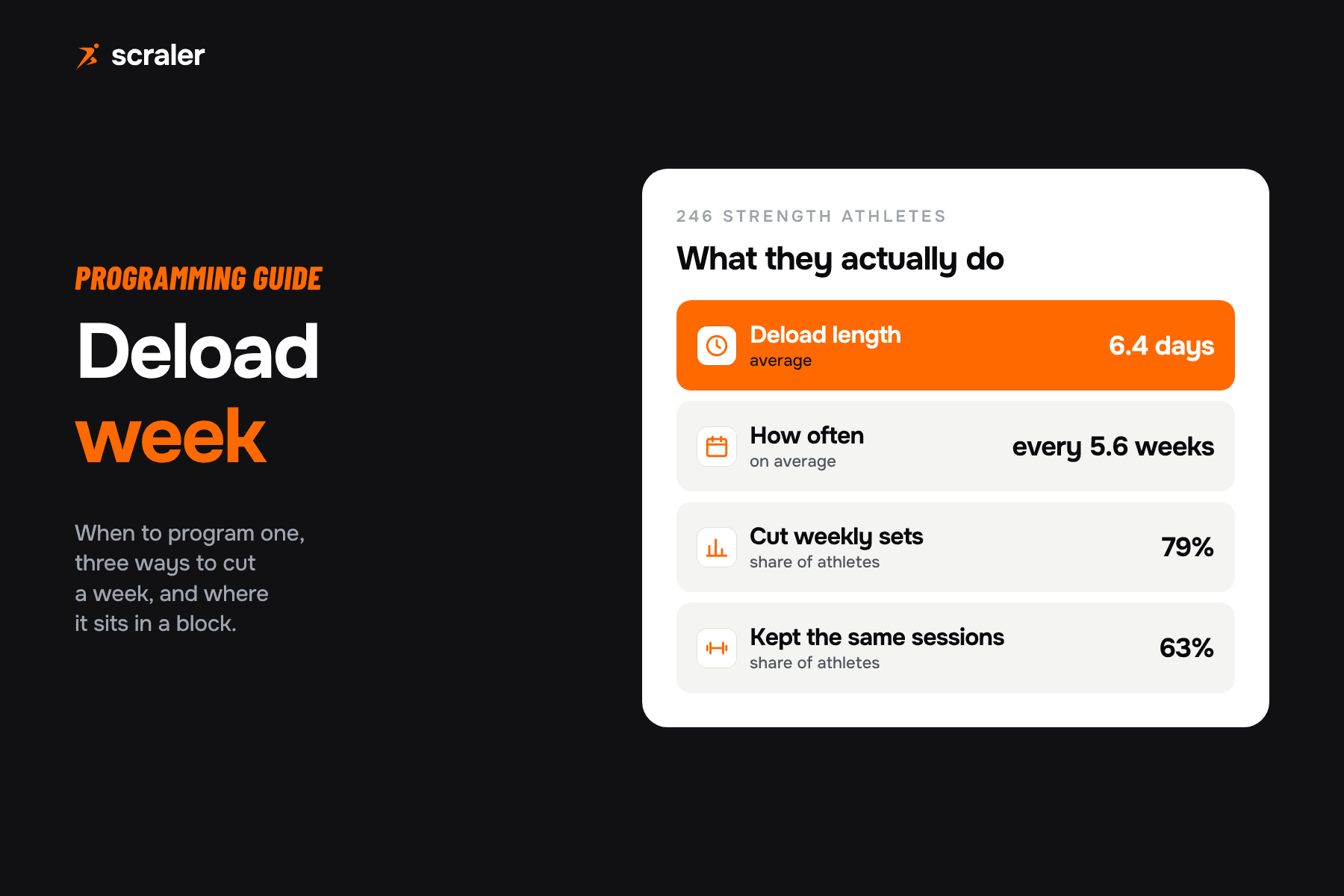
A deload week is a planned period of reduced training stress, usually about a week, built into a program to clear fatigue before the next block. Most lifters cut sets and effort and keep the same exercises. In a 2024 survey of 246 strength athletes, deloads averaged 6.4 days and came around every 5.6 weeks.

- The 2023 expert consensus defines a deload as a period of reduced training stress that mitigates physical and psychological fatigue and promotes recovery. It is a lighter week, not a week off.
- In a survey of 246 competitive strength athletes, every one deloaded. The average was 6.4 days every 5.6 weeks. 79% cut weekly sets, 84% lowered the load on main lifts and 63% kept the same number of sessions.
- Cut one lever at a time: volume, intensity or frequency. Volume is the default, and the exercises stay the same.
- Deloading is under-researched. In the one randomized trial we found, a full week off did not change lower body muscle growth but gave smaller strength gains, so schedule deloads deliberately and let the check-in data decide.
Coaches argue about deloads more than they test them. This guide sticks to what the published studies say, adds worked examples you can copy into a client program, and marks which parts are our own coaching practice rather than research.
What is a deload week?
A deload week is a short, planned stretch of easier training between harder ones. A panel of expert strength and physique coaches reached consensus on a definition in 2023: "a period of reduced training stress designed to mitigate physiological and psychological fatigue, promote recovery, and enhance preparedness for subsequent training."
That is why a deload is not a week off. The client still trains, with the same exercises and a smaller dose. In the panel's final round, agreement was 100% that a deload could use familiar exercises and could keep the multi-joint lifts. Nothing in the definition says seven days either. It is a job description: bring fatigue down so the next block starts fresh.
A deload is also not quite a taper. A taper cuts volume while keeping the bar heavy, ahead of a competition or test day. A deload resets a training block. The panel was split on whether the two are the same thing: 55% agreed deloading is a form of tapering. For a client, the practical difference is the goal. A taper peaks for a date, a deload prepares for more training.
How often should you deload?
There is no single answer, and the numbers show it. In a survey of 246 competitive strength and physique athletes, every athlete used deloads, on average every 5.6 weeks (spread of 2.3 weeks either way) and for 6.4 days (spread of 1.7). The consensus paper describes regular, pre-planned deloading every 4 to 8 weeks as a precaution.
- What it reports
- Average gap between deloads
- Number
- 5.6 weeks, plus or minus 2.3
- What it reports
- Average deload length
- Number
- 6.4 days, plus or minus 1.7
- What it reports
- Regular pre-planned deloading
- Number
- Every 4 to 8 weeks
- What it reports
- Four hard weeks, then one deload
- Number
- Every 5th week (a worked example)
| Source | What it reports | Number |
|---|---|---|
| Survey of 246 athletes (2024) | Average gap between deloads | 5.6 weeks, plus or minus 2.3 |
| Survey of 246 athletes (2024) | Average deload length | 6.4 days, plus or minus 1.7 |
| Consensus paper discussion (2023) | Regular pre-planned deloading | Every 4 to 8 weeks |
| Our default for client blocks | Four hard weeks, then one deload | Every 5th week (a worked example) |
On planned versus reactive, the survey split three ways. 47.2% planned their deloads in advance, 39.4% used both planned and reactive deloads, and 13.4% only deloaded when something told them to. The reasons they gave: the programme said so (65.4%), they felt beaten up with soreness or joint aches (62.6%), and performance stalled or dropped (54.1%). The expert panel agreed all three approaches were fine: pre-planned, autoregulated, or both.
What are the signs a client needs a deload?
Survey athletes pointed to two triggers: feeling beaten up and stalled or falling performance. The expert panel added a third that reached 100% agreement in the final round: a deload could be used when someone feels physically and mentally fatigued, whichever week of the block it is. Here is the checklist we use. It is our own, not a validated test.
- The main lift gets worse. Two or more sessions in a row where the same load moves slower or for fewer reps.
- Effort creeps up. Sets planned at RPE 8 keep landing at RPE 9 or 10. The RPE calculator turns a rating into reps in reserve.
- Recovery scores slide. Sleep, energy or mood fall on the weekly check-in for two weeks in a row.
- Soreness or joint aches do not settle between sessions.
- Motivation drops and sessions get skipped, a sign of the psychological fatigue the panel says a deload can address.
What are the three ways to deload?
A deload cuts volume, intensity or frequency. In the panel's final round, 100% agreed a deload could be a reduction in each of the three, and 100% agreed it could mean stopping sets further from failure. In the survey, the choices were uneven. Weekly sets went down for 78.9% of athletes, and reps per set went down for 52.8%. The load on main lifts dropped for 83.7%, and 84.9% lowered the effort. Sessions stayed the same for 63.0% and went down for 32.9%.
- What you change
- Fewer sets, reps or exercises
- Worked example (base: 4 x 6 at 100 kg, RPE 8, 3 sessions)
- 2 x 6 at 100 kg, RPE 7
- Pick it when
- Default. Keeps the movement and the load familiar.
- What you change
- Lighter load, stop further from failure
- Worked example (base: 4 x 6 at 100 kg, RPE 8, 3 sessions)
- 4 x 6 at 90 kg, RPE 6
- Pick it when
- Joints are sore or technique is slipping.
- What you change
- Drop a session
- Worked example (base: 4 x 6 at 100 kg, RPE 8, 3 sessions)
- 2 sessions, same sets per session
- Pick it when
- Life is the problem: travel, exams, a new baby.
| Lever | What you change | Worked example (base: 4 x 6 at 100 kg, RPE 8, 3 sessions) | Pick it when |
|---|---|---|---|
| Volume | Fewer sets, reps or exercises | 2 x 6 at 100 kg, RPE 7 | Default. Keeps the movement and the load familiar. |
| Intensity | Lighter load, stop further from failure | 4 x 6 at 90 kg, RPE 6 | Joints are sore or technique is slipping. |
| Frequency | Drop a session | 2 sessions, same sets per session | Life is the problem: travel, exams, a new baby. |
The "pick it when" column is our rule of thumb. The survey says most athletes use volume and load together and leave frequency alone, so start there. Our default is to keep the exercises: 100% of the panel agreed a deload could use familiar exercises (90.5% also accepted new ones), and 70.3% of surveyed athletes kept the number of multi-joint exercises unchanged. In our experience a new movement brings soreness you were trying to avoid.
How do you program a deload week into a block?
Put it at the end of the block and restart afterwards. In the panel's final round, 95.2% agreed a deload could sit in the last week of a mesocycle and 100% agreed it could sit between mesocycles. After the deload, 67.9% of surveyed athletes started a new training block. Here is a five week example with the volume building for four weeks and then halving. For how blocks like this fit into a longer plan, see our guide to periodization.
- Hard sets per muscle
- 10
- Target RPE
- 7
- Note
- Start below the limit
- Hard sets per muscle
- 12
- Target RPE
- 8
- Note
- Add sets
- Hard sets per muscle
- 14
- Target RPE
- 8
- Note
- Add sets
- Hard sets per muscle
- 16
- Target RPE
- 9
- Note
- Hardest week of the block
- Hard sets per muscle
- 8
- Target RPE
- 6
- Note
- Half the sets of week 4, about three reps further from failure
| Week | Hard sets per muscle | Target RPE | Note |
|---|---|---|---|
| 1 | 10 | 7 | Start below the limit |
| 2 | 12 | 8 | Add sets |
| 3 | 14 | 8 | Add sets |
| 4 | 16 | 9 | Hardest week of the block |
| 5 (deload) | 8 | 6 | Half the sets of week 4, about three reps further from failure |
RPE 9 leaves one rep in reserve and RPE 6 leaves four, which is where the "three reps further from failure" comes from. The workout plan template has an eight week progression tab if you want to see the build and the drop on a sheet, and the workout log template records the RPE you need to judge the week.
How do you know the deload worked? Surveyed athletes judged it a success when fatigue dissipated (87.8%), motivation rose (69.5%) and performance improved (67.5%). Those are the three things to look for in the first session back. If a client still feels flat, the deload may have been too short: 32.5% of athletes named that as a reason a deload failed.
Do clients actually need a deload week?
Less certainly than gym lore suggests. The 2023 consensus paper calls deloading "a ubiquitous yet under-researched strategy". In the survey, 65.0% of athletes said they thought they could progress without deloads, and they deloaded anyway, mostly to decrease fatigue (92.3%).
The one randomized trial we found tested it directly. Thirty-nine resistance-trained adults did a 9 week high-volume program. One group stopped training for a week at the midpoint, the other trained straight through. Lower body muscle size, local endurance and power did not differ. The continuous group gained more strength and scored slightly better on a readiness to train questionnaire. Two limits: the break was a full week off rather than a lighter week, and it is one small trial.
Our reading for coaches: do not deload by reflex. A planned deload costs little, and for a client with a hard job or a long block it is a sensible precaution. But a client who is recovering and progressing does not need one on a calendar date. Plan the slot, then let the check-in and the log decide whether to use it. For how load and reps should climb inside the block, read progressive overload.
How do you build a deload into a client program in Scraler?
In the Scraler workout builder you lay a plan out on a calendar with one row per week and drag workouts onto the days. You can copy an entire week and paste it, so the deload is quick: build week 4, copy it to week 5, then cut the sets and lower the RPE targets. Every set carries Reps, % 1RM, KG, RPE and Rest, so the effort target travels with the plan. Save the finished block as a template and reuse it for the next client.
Lay out the block week by week, copy a week for the deload and assign it. Clients log every set and RPE in the app, so you see the numbers before you decide.
See workout planningIf you are still choosing a builder, what to look for in workout builder software covers the features that matter, and the personal exercise programme guide explains how principles like progressive overload and reversibility fit together in a plan.
Frequently asked questions
- What is a deload week?
- A deload week is a planned period of reduced training stress, usually about a week, that lets fatigue fall before the next block. The client keeps training with the same exercises but does fewer sets, lighter loads or stops further from failure.
- How long should a deload week last?
- In a survey of 246 strength athletes the average deload lasted 6.4 days, with a spread of 1.7 days. One week is the usual default. 32.5% of athletes said a deload that was too short was a reason it failed.
- How often should you deload?
- The survey average was every 5.6 weeks, with a spread of 2.3 weeks. The consensus paper describes regular pre-planned deloading every 4 to 8 weeks. Four hard weeks and one deload is a common starting point.
- Will a client lose muscle during a deload week?
- In the one randomized trial we found, a full week of no training in the middle of nine weeks did not change lower body muscle size compared with training straight through. A lighter deload, where the client still trains, is a smaller break than that.
- What should a client do on a deload week?
- Keep the sessions and the exercises, cut the sets or the effort, and stop each set with more reps in reserve. Sleep, eating and daily steps stay as normal. Keep logging so you can compare the first session back with the last hard one.
- Is a deload the same as a taper?
- Not quite. A taper cuts volume while keeping the bar heavy, to peak for a date. A deload lowers training stress to reset a block. Expert coaches were split on it: 55% agreed deloading is a form of tapering.