Workout Split Guide: 3, 4 and 5 Day Splits With Free Templates
A workout split is how you divide training across the week, such as full body three days, upper and lower four days, or push, pull and legs five days. When weekly sets are equal, research finds frequency per muscle matters little, so the best split is the one a client attends. Free 3, 4 and 5 day templates are below.

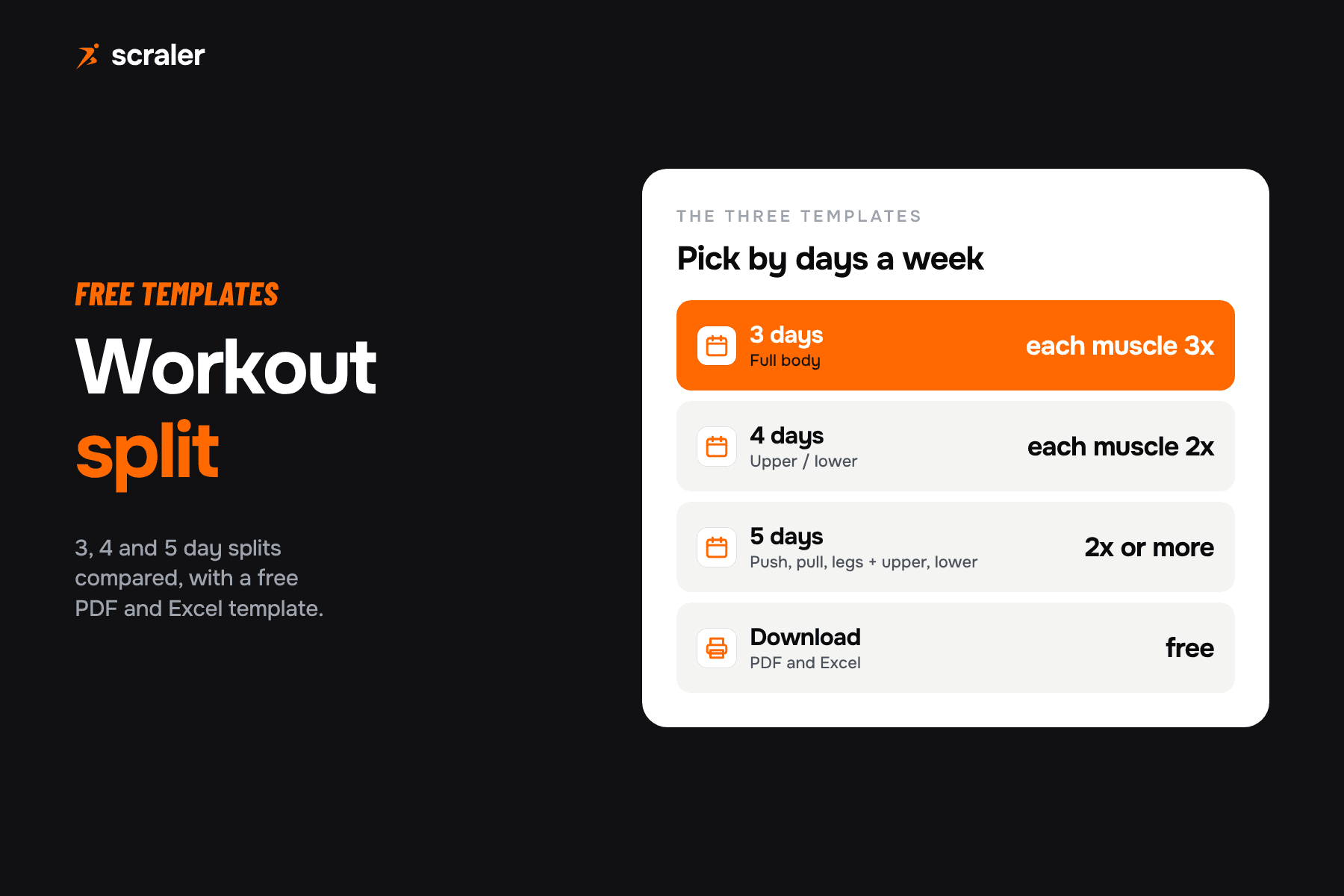
- The main splits are full body (3 days, each muscle 3x a week), upper / lower (4 days, 2x), push / pull / legs plus upper and lower (5 days, 2x or more) and the bro split (5 days, 1x).
- A 2016 meta-analysis found training a muscle twice a week beat once a week for growth when volume was matched. A 2019 meta-analysis of 25 studies found no significant difference once volume was equal.
- For strength, effect sizes rose with frequency (0.74 at 1x to 1.08 at 4x or more), but not when volume was equated. Extra sessions are mainly a way to fit more volume.
- The ACSM suggests 2 to 3 days a week for novices, 3 to 4 for intermediate and 4 to 5 for advanced lifters.
- Our free PDF and Excel pack has a 3, 4 and 5 day plan with live weekly set counts per muscle.
What is a workout split?
A workout split, or split routine, is the way you spread muscle groups and movements across the training days of a week. A full body split trains everything every session. An upper / lower split alternates halves of the body. A push / pull / legs split groups muscles by what they do. A bro split gives each muscle its own day. The split decides two things that matter for a client: how many days they train and how often each muscle gets trained.
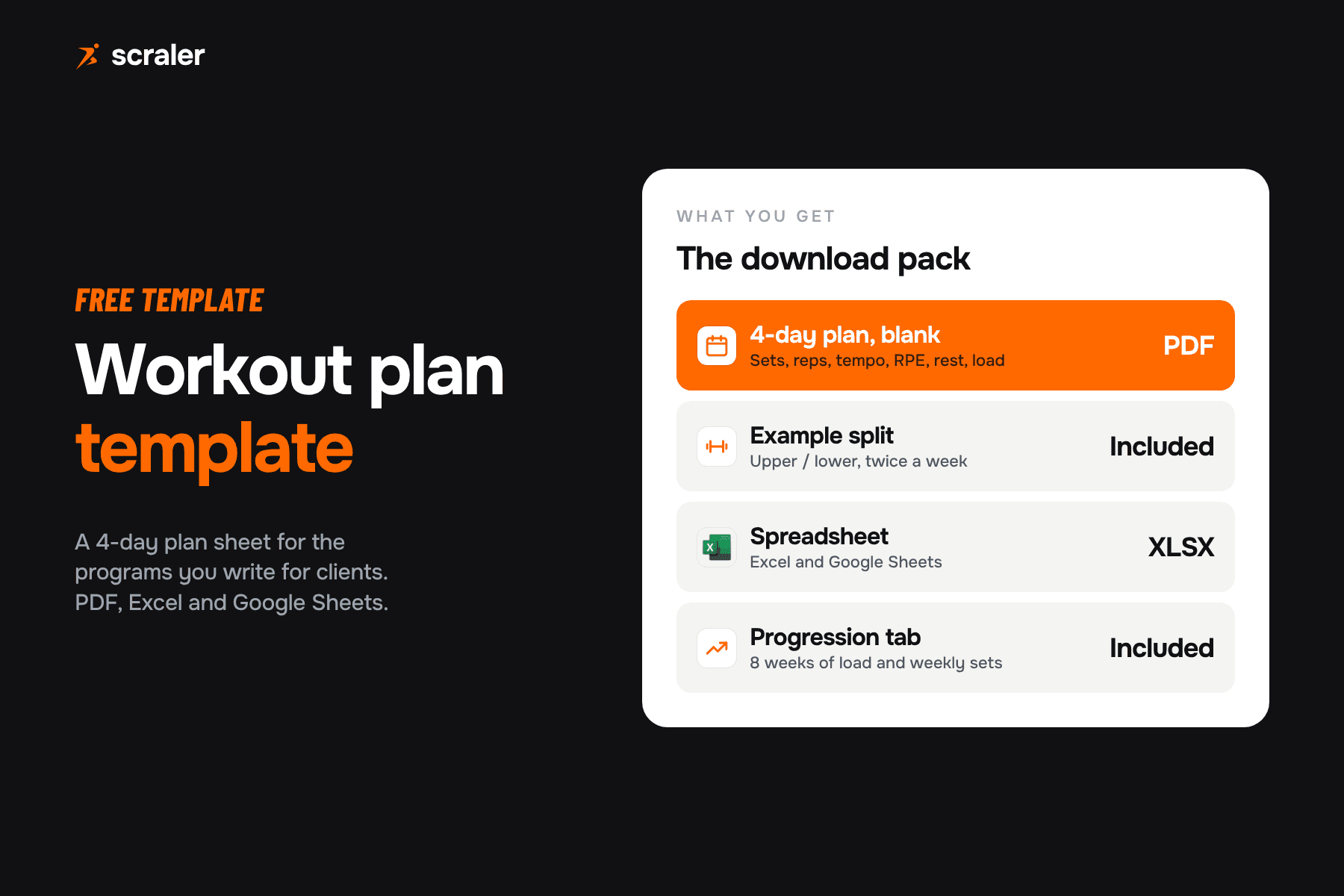
A 4 page A4 PDF with a week view, a weekly sets table and a plan page for each split. The XLSX has the same plans as tabs, plus a Compare tab that counts hard sets and sessions per muscle for you. Works in Excel and Google Sheets.
Which workout split is best?
The honest answer from the research is that the split matters less than the volume and the attendance. A 2016 meta-analysis of ten studies found higher frequency was linked to a larger effect on muscle growth than lower frequency, 0.49 against 0.30. With volume matched, training a muscle twice a week beat once a week. The data covered one to three days per muscle, and whether three beats two was left open.
A 2019 follow-up with 25 studies found no significant difference between higher and lower frequency on a volume-equated basis. Its conclusion for coaches: for a given training volume, a client can choose the weekly frequency per muscle based on personal preference. The same holds for strength. A 2018 meta-analysis of 22 studies found effect sizes of 0.74, 0.82, 0.93 and 1.08 for training 1, 2, 3 and 4 or more times a week, but the volume-equated subgroup showed no significant effect. More sessions seem to have helped mainly because they carried more volume.
Studies that compare actual splits are small. In a 2015 trial of 20 well-trained men, a bro-style split (each muscle once a week) gave less forearm flexor growth than a total body routine three days a week, with no difference in strength. In a 2019 trial of 36 trained men, a split with each muscle twice a week and a total body routine three times a week produced similar results over 10 weeks, with effect sizes favoring the split for every hypertrophy measure. Small samples, short trials, young men: read these as hints.
What is a 3 day workout split?
The classic 3 day split is full body: three sessions a week, such as Monday, Wednesday and Friday, each working every major muscle. Each muscle is trained three times. In our template, day A pairs a back squat, bench press and barbell row with a Romanian deadlift, a lateral raise, a curl and a calf raise. Day B and day C swap in different variations so the client is not doing the same session three times.
- Suits: new lifters, busy clients and anyone who can only guarantee three sessions. The ACSM suggests 2 to 3 days for novices.
- Strength: each movement pattern is practiced three times a week, which helps skill.
- Watch out for: long sessions. Keep to six or seven exercises and rotate variations, or day three becomes the day everyone skips.
- In our template: 54 hard sets a week, about 18 a session, with 7 to 9 sets for each main muscle.
What is a 4 day workout split?
The standard 4 day split is upper / lower: two upper days and two lower days, for example Monday, Tuesday, Thursday and Friday. Each muscle is trained twice, which lines up with the 2016 evidence, and each session stays at a manageable length. It is the split we default to for most clients.
- Suits: most clients with four sessions to give, and intermediate lifters (the ACSM suggests 3 to 4 days).
- Strength and size: every main muscle gets two quality sessions, and the plan has more weekly sets in total than the 3 day plan (67 vs 54).
- Watch out for: two hard days in a row. Keep a rest day between the two upper days.
- In our template: 67 hard sets a week, about 17 a session. The exercises match our 4-day workout plan template, which adds tempo, rest, a progression tab and a weekly sets tab.
What is a 5 day workout split?
There are two common 5 day splits, and they behave differently. The first is push, pull, legs, upper, lower: three focused days, then an upper and a lower day, so most muscles are trained twice. The second is the bro split: chest, back, shoulders, legs and arms on separate days, so each muscle is trained once. Both use five sessions. Only one fits the twice-a-week evidence.
- Suits: experienced lifters who recover well from five sessions. The ACSM suggests 4 to 5 days for advanced lifters.
- Push / pull / legs: a 3 day version trains each muscle once. Run it twice (6 days) and each muscle gets two sessions, with twice the time commitment.
- Bro split: one muscle a day allows a lot of sets for that muscle in one go. The 2015 trial above is the cautionary data point on once-a-week frequency.
- In our template: 82 hard sets a week, about 16 a session, with most main muscles trained twice and shoulders three times.
- Days
- 3
- Sessions per muscle
- 3x
- Sets per session, our templates
- About 18
- Suits
- New lifters, busy clients
- Watch out for
- Long sessions
- Days
- 4
- Sessions per muscle
- 2x
- Sets per session, our templates
- About 17
- Suits
- Most clients
- Watch out for
- Two hard days back to back
- Days
- 5
- Sessions per muscle
- 2x, shoulders 3x
- Sets per session, our templates
- About 16
- Suits
- Experienced lifters
- Watch out for
- Recovery, five days to protect
- Days
- 5
- Sessions per muscle
- 1x
- Sets per session, our templates
- Varies
- Suits
- Bodybuilding style
- Watch out for
- Once a week per muscle
- Days
- 6
- Sessions per muscle
- 2x
- Sets per session, our templates
- Varies
- Suits
- Advanced, high volume
- Watch out for
- Time and recovery
How do you choose a workout split for a client?
- 1.Count the days they will really attend. Use the days they have kept for the last month, not the days they hope for. Screen new clients before you write anything.
- 2.Match experience. Novices do well on 2 to 3 days, intermediate lifters on 3 to 4, advanced on 4 to 5, per the ACSM.
- 3.Aim for two hits per muscle when the days allow. With three days, run full body. With four or more, split.
- 4.Count weekly sets per muscle. The bands in the 2017 volume meta-analysis (under 5, 5 to 9, 10 or more) are a reference point, and the template counts them for you.
- 5.Run it for 4 to 8 weeks, then review the log and the check-in. Change one thing at a time, and add load with progressive overload. For phases across several months, see periodization, and for a lighter week between blocks, deload week. The workout log template shows what to record.
What is in the free workout split templates?
The PDF opens with a week view of all three splits and a table of hard sets and sessions per muscle, then has one plan page per split with sets, reps, target RPE and blank load and done columns. The XLSX has four tabs: Compare splits, 3 day full body, 4 day upper lower and 5 day PPL + UL. Every exercise has a muscle tag from a dropdown, and the Compare tab counts hard sets and sessions per muscle from whatever you type, so editing a plan updates the comparison.
Open the XLSX in Excel, or upload it to Google Drive and open it with Sheets. The plans are examples, so overwrite any exercise, set count or weekday. Use the RPE calculator to set effort targets and the one rep max calculator for starting loads.
How do you build a workout split in Scraler?
The Scraler workout builder has two layouts. The Calendar layout is a Monday to Sunday grid with one row per week: drag workouts onto days, copy a week and paste it to repeat the structure. The Fixed layout is a rotation of named days with no dates, which suits push, pull, legs: name the days, and when the client finishes the last outstanding day, that round closes and a new one opens. Either way, save the plan as a template and assign it to the next client in a few clicks.
Create the plan once, save it as a template and assign it to the client app, where they log every set. Edit exercises, sets, reps, rest and RPE any time.
See workout planningComparing tools first? What to look for in workout builder software lists the features that matter, and the workout plan template is the longer single-split version of the 4 day plan.
Frequently asked questions
- What is the best workout split for beginners?
- A 3 day full body split. The ACSM suggests 2 to 3 days a week for novices, and each muscle gets three sessions, which gives plenty of practice with the main movement patterns. Keep each session to six or seven exercises.
- Is a 4 day split better than a 3 day split?
- It trains each muscle twice, which a 2016 meta-analysis linked to better growth than once a week, and it spreads volume over shorter sessions. When volume is equal, a 2019 meta-analysis found no significant difference, so the better split is the one the client attends.
- Is the bro split bad?
- It is not bad, but it trains each muscle once a week. A 2015 trial of well-trained men found less growth in one muscle than a total body routine, and a 2016 meta-analysis favored twice a week over once. It can work if the weekly volume is high enough.
- How many days a week should you work out?
- The ACSM position stand suggests 2 to 3 days for novices, 3 to 4 for intermediate and 4 to 5 for advanced lifters. Pick the number the client will keep every week.
- Is push pull legs better than upper lower?
- The studies we found did not compare them directly. The difference is frequency and session length. A 3 day push, pull, legs plan trains each muscle once, a 6 day version twice, and 4 day upper / lower twice with fewer sessions.
- Can I download the workout split templates for free?
- Yes. The PDF and the XLSX on this page are free to download, copy and adapt. The XLSX opens in Excel and Google Sheets and counts weekly sets and sessions per muscle for you.