Client Check-In Form Template + 25 Questions for Online Coaches
A check in form is the short questionnaire a coaching client completes at the end of each week. It covers weight, training, nutrition, sleep, stress and mood, so you can adjust the plan with facts. This guide gives you a free client check-in form template as a PDF and 25 questions to choose from.

- A weekly check-in form has five parts: the numbers, a 1 to 5 rating of the week, training, mindset and feedback for the coach.
- Use 8 to 12 questions a week. Keep the numbers and ratings identical every week so trends show up, and rotate the open questions.
- The form is only useful if you reply. Review a batch of check-ins at a set time, change one thing, and tell the client what changes.
- Scraler check-ups can send the same template on a recurring schedule and collect photos, so you stop chasing answers in chat.
Most online coaching goes wrong quietly. A client stops logging meals, sleeps badly for two weeks, gets a sore shoulder, and you find out in week six. A check-in is how you find out in week one. It is a fixed set of questions on a fixed day, so the answers can be compared.
This guide covers what a good check-in form includes, 25 questions you can pick from, and how to review the answers quickly. The PDF below is free to print, copy and adapt. If you are still collecting the first set of information from a new client, start with the client intake form template and use the check-in once training is under way.
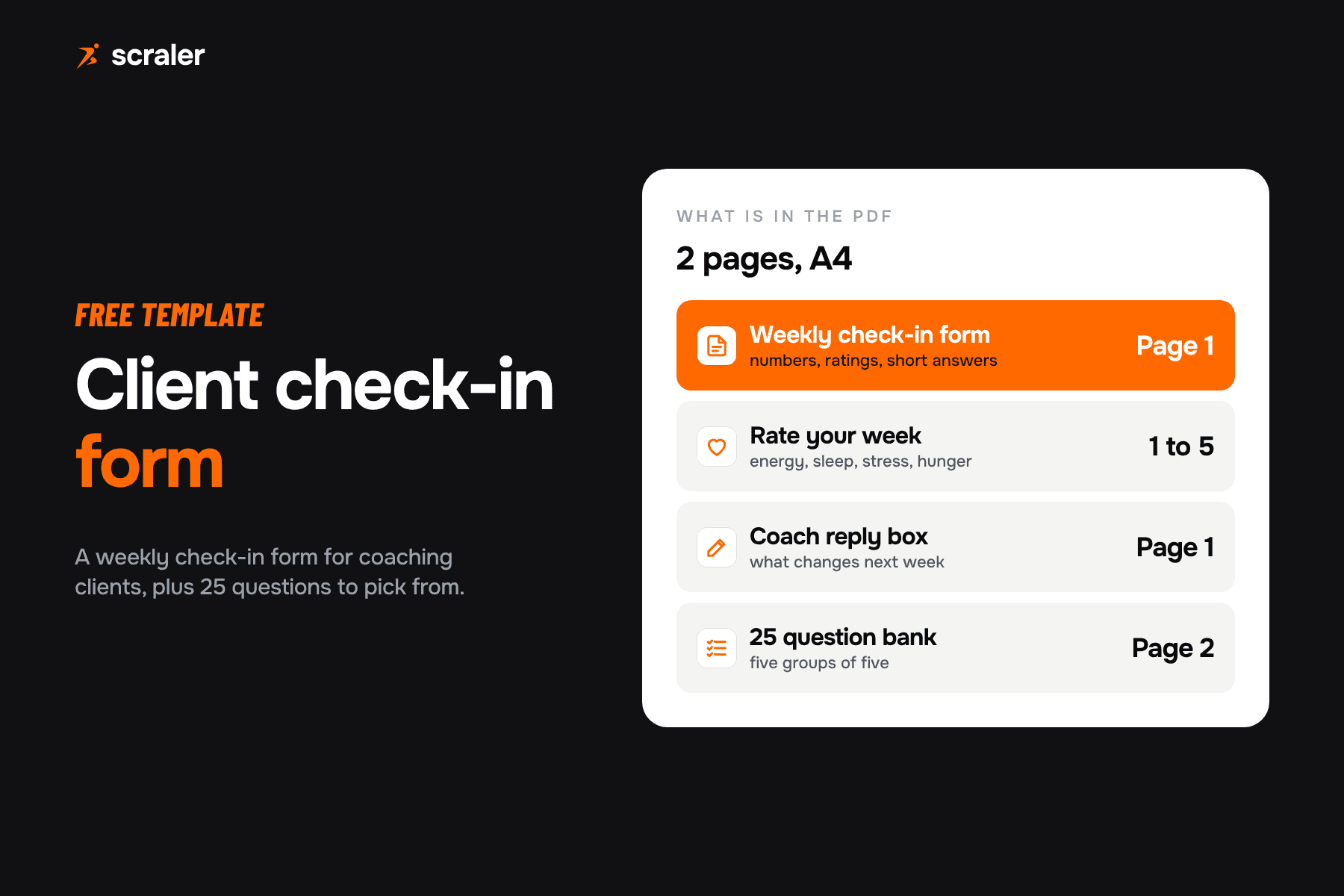
Two A4 pages. Page one is the weekly check-in form with numbers, 1 to 5 ratings, short answers and a coach reply box. Page two is the 25 question bank. Free to copy and adapt.
What is a client check-in form?
A client check-in form is a recurring questionnaire that a coaching client fills in and sends to their coach, usually once a week. It records how the week went in a consistent format: body measurements, how many workouts were done, how the client slept and felt, what got in the way, and what they need from you. The answers tell you what to change in the client’s workout plan next week.
It is different from an intake form. The intake form is filled in once, before the first session, and covers goals, health history and consent. The check-in repeats. Its job is to show change over time and give you a reason to adjust the program or the nutrition targets. It also differs from a fitness assessment form, which records baseline tests you repeat every few weeks.
- Filled in once
- Goals, history, injuries, consent
- Helps you design the first plan
- Stored on the client file
- Filled in every week or two
- Numbers, ratings, wins and obstacles
- Helps you adjust the plan
- Compared week against week
What should a client check-in form template include?
Five sections cover almost everything a coach needs. Our template has 21 fields across them.
- 1.The numbers. Body weight, an optional waist measurement, average daily steps, workouts completed against planned, days the client followed the plan, and average hours of sleep. These are the facts. Ask for the same ones every week. For the days-on-plan number, a daily habit tracker gives the client something to count from.
- 2.Rate your week. Energy, sleep quality, stress, hunger, motivation and soreness, each from 1 to 5. A fixed scale is quick to answer and easy to chart. Say what 1 and 5 mean, and flip the wording where needed (5 = very stressed).
- 3.Training. Any pain and where, which session felt best, and where the client fell short of the plan and why. This is where an injury or a bad schedule shows up first.
- 4.Mindset and week ahead. Biggest win, biggest obstacle, and anything coming up next week that affects training or food, such as travel, events or shift changes.
- 5.Feedback for the coach. Did the plan feel too easy, about right or too hard, were progress photos sent, and one question for you.
Add a box at the bottom for your reply. Writing "what changes next week" into the form itself closes the loop. The client sees that the answers led to something, and that is what keeps them filling it in.
What are good weekly check-in questions for coaching clients?
The 25 questions below are the question bank on page two of the PDF, grouped in five sets of five. You do not ask all of them every week. Pick the ones that match what you coach, and rotate the open questions so they do not go stale.
Training
- 1.How many of your planned workouts did you complete?
- 2.Which session or lift felt best this week?
- 3.Did you hit the planned weights and reps? Where not?
- 4.Any pain or discomfort, and where (0 to 10)?
- 5.How hard did the week feel overall (1 to 5)?
Nutrition
- 1.What was your average body weight this week?
- 2.On how many days did you follow your plan (0 to 7)?
- 3.How hungry were you on average (1 to 5)?
- 4.On how many days did you hit your protein target?
- 5.What got in the way of eating to plan?
Recovery
- 1.How many hours did you sleep on average?
- 2.How was your sleep quality (1 to 5)?
- 3.How were your energy levels (1 to 5)?
- 4.How stressed did you feel (1 to 5)?
- 5.How sore or fatigued were you (1 to 5)?
Mindset
- 1.How motivated did you feel (1 to 5)?
- 2.What was your biggest win this week?
- 3.What was your biggest obstacle?
- 4.How confident are you about next week (1 to 5)?
- 5.Which one habit do you want to improve?
Feedback
- 1.Did the plan feel too easy, about right or too hard?
- 2.Is there anything you want changed in the program?
- 3.Do you have a question for me?
- 4.Is anything coming up next week that affects the plan?
- 5.How supported do you feel in your coaching (1 to 5)?
For the training effort question, clients who do not know what a hard set feels like can use a simple scale. Our RPE calculator explains how effort maps to reps in reserve.
How long should a check-in form be?
Short enough that the client finishes it on a Sunday evening without resenting it. A workable range is 8 to 12 questions. That is a rule of thumb from coaching practice, not survey data, so test it with your own clients. If completion drops, cut questions before you cut the frequency.
- Use it for
- Trends you can chart
- Example
- Average body weight, hours of sleep, steps
- Use it for
- Fast, comparable feelings
- Example
- Energy, stress, hunger, motivation
- Use it for
- Flags that need a follow-up
- Example
- Any pain this week?
- Use it for
- Context behind the numbers
- Example
- What was your biggest obstacle?
- Use it for
- Visible change over weeks
- Example
- Front, side and back, same light and pose
| Question type | Use it for | Example |
|---|---|---|
| Number | Trends you can chart | Average body weight, hours of sleep, steps |
| 1 to 5 rating | Fast, comparable feelings | Energy, stress, hunger, motivation |
| Yes or no | Flags that need a follow-up | Any pain this week? |
| Short answer | Context behind the numbers | What was your biggest obstacle? |
| Photo | Visible change over weeks | Front, side and back, same light and pose |
Keep the numbers and ratings the same every week and change only the open questions. A client who answers "stress: 4" four weeks in a row tells you something. A client who gets a new set of questions each week tells you nothing you can compare.
How do you review check-ins without losing hours?
The review is the real work, and it is where most coaches fall behind. A simple routine keeps it short:
- 1.Review in one batch. Pick a fixed time, for example Monday morning, and go through every check-in in one sitting. It is quicker than answering as they arrive.
- 2.Read the flags first. Pain, very low sleep, high stress and a missed week come first. For sleep, the US NHLBI recommends that adults sleep between 7 and 9 hours a night, and says adults who sleep under 7 hours may have more health issues. A client averaging 5 hours is worth a conversation, not just a tweak to the program. Check-ins are coaching information, not medical advice. If a client reports severe or worsening pain, refer them to a healthcare professional.
- 3.Look at trends, not single days. Body weight moves around from day to day, so compare weekly averages across three or four weeks, not one weigh-in against the last.
- 4.Change one thing. If the numbers are stalled, adjust one variable, such as calories, steps or a training block, so you know what caused the result. Use the TDEE calculator to re-check targets.
- 5.Reply in writing. A two line answer with what changes next week is worth more than a long essay. Name the win first.
How often should clients check in?
Weekly is the usual choice for coaching clients who are changing their body or their training, because a week is long enough to see a pattern and short enough to fix a problem. Some coaches use a lighter schedule:
- Weekly: the full form. Best for new clients and anyone in a fat loss or competition phase.
- Every two weeks: the same form for clients who are stable, self-directed or on a lower price package.
- Monthly: measurements (the body measurement chart shows how to take them) and progress photos, plus a longer review of goals. This pairs well with a weekly short form for the numbers only.
Match the frequency to the package. A premium client with weekly coaching gets a weekly reply. A lower tier client can check in every two weeks. Say so in the package description, so the expectation is clear before they pay.
Can you automate client check-ins?
Yes, and it is the best reason to move off a PDF. A printed or emailed form works for a handful of clients. At 20 or more, the work is not the form, it is sending it, reminding people, collecting the photos and keeping each answer next to the previous week.
In Scraler, a check-up is a reusable template you build once with weight, measurements, progress photos, rating scales and open questions. You send it on a schedule (daily, weekly, every two weeks, monthly or a custom interval), the client gets a push notification and in-app reminder, and the answers land in one review screen. You can leave notes, approve the check-in or ask for a revision, and compare progress photos side by side over time.
Build the weekly form once in Scraler, send it on a schedule, and review every answer, photo and measurement in one place.
See client check-upsIf you are setting up the rest of an online coaching business around the check-in, read how to become an online personal trainer for the wider picture of packages, tools and clients.
Frequently asked questions
- What is a check-in form for coaching?
- It is a recurring questionnaire a client sends their coach, usually weekly. It covers numbers such as weight and workouts completed, ratings of energy, sleep and stress, and short answers about wins and obstacles, so the coach can adjust the plan.
- What should I ask in a weekly check-in?
- Ask for the same few numbers every week (weight, workouts done, days on plan, hours of sleep), a 1 to 5 rating of energy, stress, hunger and motivation, any pain, the biggest win and obstacle, and one question for the coach. The free template has 21 fields and a 25 question bank to choose from.
- How many questions should a check-in have?
- A workable range is 8 to 12 questions. That is a rule of thumb rather than research, so watch how many clients finish it. If completion drops, shorten the form before you reduce how often you ask.
- How often should a client check in?
- Weekly for most coaching clients, because a week shows a pattern while there is still time to fix it. Stable or lower tier clients can check in every two weeks, and progress photos and measurements are often monthly.
- What is the difference between an intake form and a check-in form?
- The intake form is completed once before training starts and covers goals, health history and consent. The check-in form repeats every week or two and tracks how the client is progressing against the plan.
- Can I use this check-in form for free?
- Yes. The PDF is free to print, copy and adapt for your own clients. If you want to send it digitally on a schedule, you can rebuild the same questions as a template in a coaching platform such as Scraler.