Client Intake Form Template for Personal Trainers (Free PDF)
A client intake form is the questionnaire a new client completes before the first session. It collects contact details, goals, health and injury history, training background, lifestyle, nutrition and consent. Use it with a separate PAR-Q. Our free client intake form template is a 3 page PDF that covers all eight sections, ready to print or copy.

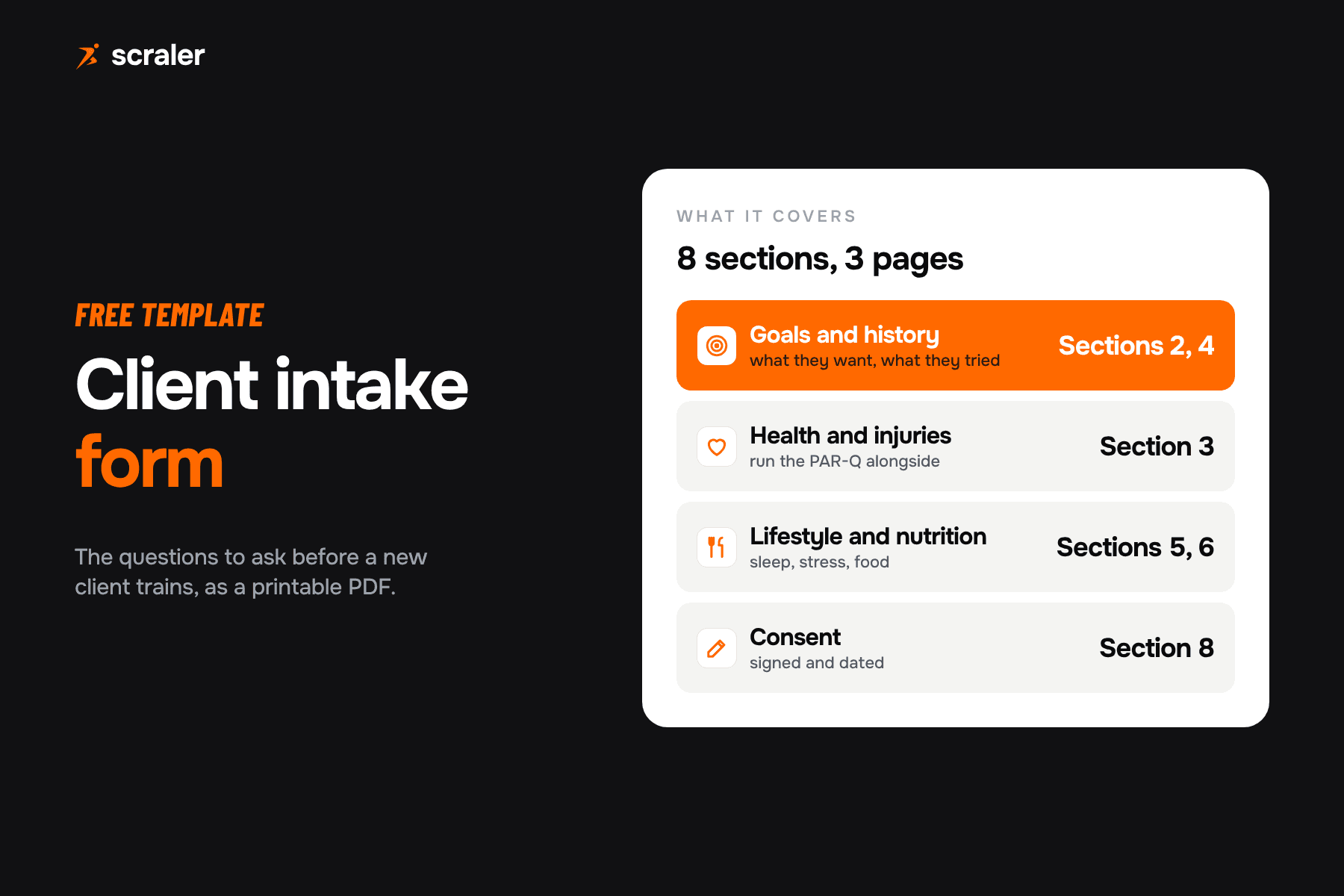
- A good client intake form has eight parts: about you, goals, health and injuries, training history, lifestyle, nutrition, logistics and consent.
- It is not a PAR-Q. Keep the health screening as its own signed form and link the two on the client file.
- Health answers are sensitive personal data. Say why you collect them, get explicit consent and store them safely.
- Send the form when the client pays, not in the first session, so you arrive with a plan instead of a clipboard.
A new client tells you a lot in the first ten minutes, but not everything that matters. The bad knee comes up in week three. The night shifts come up when they miss sessions. An intake form moves those conversations to before you meet, so the first session starts with a plan. This page gives you the form, explains each section and shows what to do with the answers.
What is a client intake form?
A client intake form is the standard set of questions every new client answers before training starts. It is the trainer’s version of a doctor’s new patient form. It gives you the facts you need to write a safe programme, set a realistic goal and decide how you will work together. Two forms follow it: a fitness assessment form for baseline tests and a weekly client check-in form.
It does three jobs. It saves time, because you stop asking the same ten questions in every first call. It protects the client, because an injury or condition you did not know about cannot be trained around. And it protects you, because a signed and dated record shows what you were told and when.
Three pages, A4, eight sections, with space to write. Print it, or use it as the question list for your own digital form. Free to copy and adapt.
What should a client intake form template include?
Keep every section tied to a decision you will make. If you will not use the answer, drop the question. A long form gets half finished. These are the eight sections in the template and what each one is for.
- What to ask
- Name, phone, email, emergency contact, occupation
- What you do with it
- Reach the client and someone to call in an emergency
- What to ask
- Main goal, what success looks like in 12 weeks, what got in the way before
- What you do with it
- Write a goal you can measure and spot the real obstacle
- What to ask
- Past and current injuries, surgery, conditions, medication, allergies
- What you do with it
- Choose exercises, flag when to refer to a doctor or physio
- What to ask
- Current routine, experience, what they liked, kit, where they train
- What you do with it
- Set the starting level and the programme format
- What to ask
- Sleep, stress, work pattern, time sitting, activity
- What you do with it
- Set realistic session counts and recovery
- What to ask
- Allergies, meals a day, foods they avoid, whether they want food coaching
- What you do with it
- Decide how much nutrition to include in the package
- What to ask
- Days and times, best way to reach them, check-in time
- What you do with it
- Book sessions and set response expectations
- What to ask
- Signature, date, permission to store health data
- What you do with it
- A record that the client agreed, and a basis to keep the data
| Section | What to ask | What you do with it |
|---|---|---|
| About you | Name, phone, email, emergency contact, occupation | Reach the client and someone to call in an emergency |
| Goals | Main goal, what success looks like in 12 weeks, what got in the way before | Write a goal you can measure and spot the real obstacle |
| Health and injuries | Past and current injuries, surgery, conditions, medication, allergies | Choose exercises, flag when to refer to a doctor or physio |
| Training history | Current routine, experience, what they liked, kit, where they train | Set the starting level and the programme format |
| Lifestyle | Sleep, stress, work pattern, time sitting, activity | Set realistic session counts and recovery |
| Nutrition | Allergies, meals a day, foods they avoid, whether they want food coaching | Decide how much nutrition to include in the package |
| Logistics | Days and times, best way to reach them, check-in time | Book sessions and set response expectations |
| Consent | Signature, date, permission to store health data | A record that the client agreed, and a basis to keep the data |
Two optional additions are worth considering. Add a photo upload for posture or progress pictures if your coaching uses them, and say why you want them. Add a body measurements block only if you will track them. If your clients want food guidance, the answers feed straight into a macro calculator or TDEE calculator conversation.
What is the difference between an intake form and a PAR-Q?
The intake form is broad. It covers goals, lifestyle and logistics, and it includes an open health section. The PAR-Q is narrow. It is a short, standard screening questionnaire that checks for the red flags where a client should see a doctor before exercising. Many trainers use both, as two separate documents.
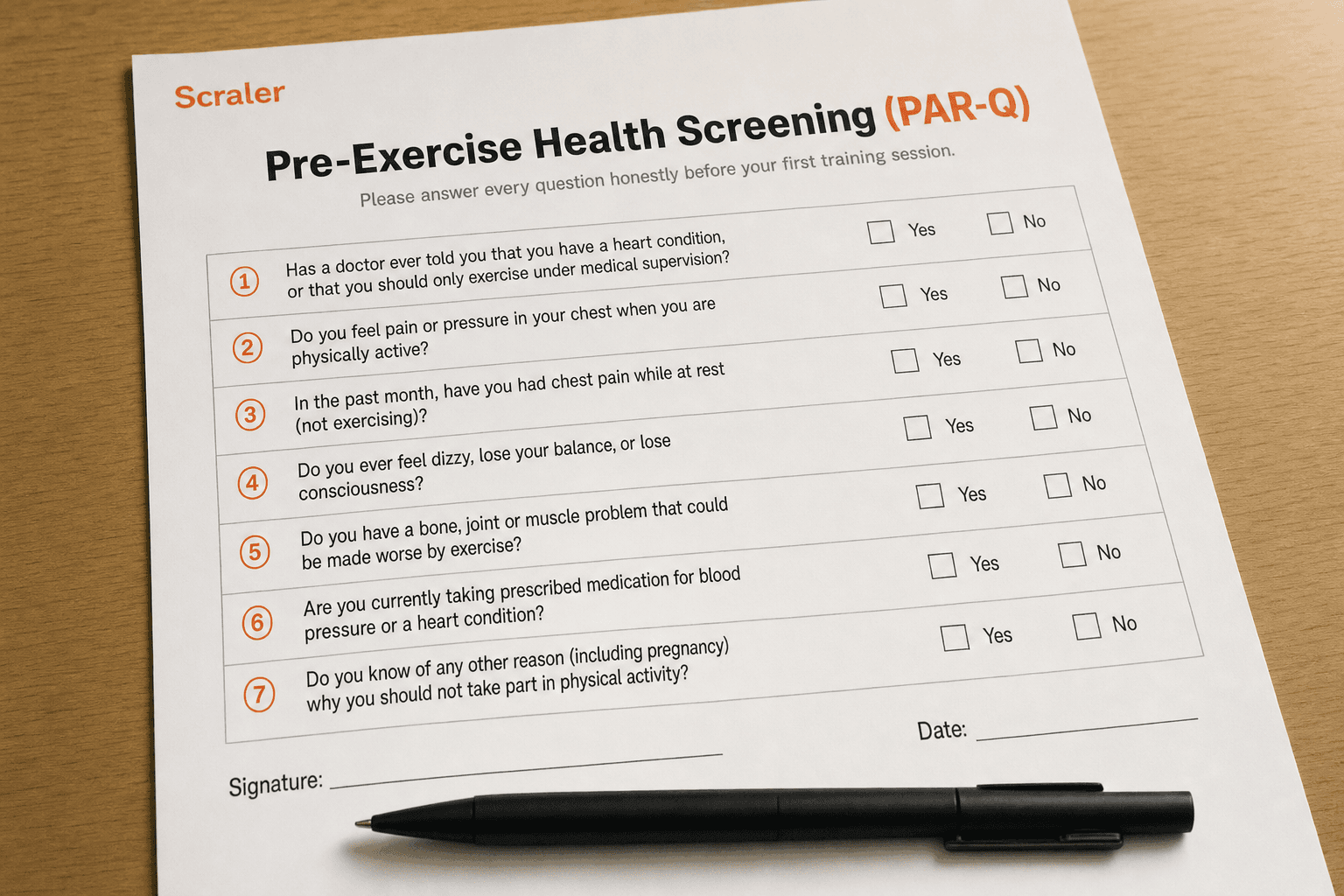
We do not reproduce PAR-Q questions here. The official PAR-Q+ is published at eparmedx.com and is copyrighted by the PAR-Q+ Collaboration, so we do not reprint it. Our own plain-language version, with a printable PDF, is in the free PAR-Q form template. If you want the background first, read what is a PAR-Q, and to choose between the two versions see PAR-Q vs PAR-Q+.
How do you use a client intake form once it is filled in?
Read it before the first session, not during it. Block ten minutes and work through it with a pen:
- 1.Check the health section first. Anything that touches the heart, blood pressure, pregnancy, recent surgery or a new injury goes through the PAR-Q result and, where needed, the client’s doctor before you load them.
- 2.Circle the contradictions. A client who wants to lose fat in 12 weeks, trains five days and sleeps five hours a night has told you where the problem is.
- 3.Turn the goal into a measurable target. Not “get fitter”, but a number and a date you can check at the first review.
- 4.Match the programme to the real week. If they can train three days, write three days. The best programme is the one that survives their schedule.
- 5.Note what to ask in the first session. Mark two or three answers you want to hear in the client’s own words.
Then write their first program with our workout plan template, and use the form again later. Put the goal and the obstacle answers in front of you at the 4 week and 12 week reviews. Clients forget what they wrote on day one, and showing them is a good way to point out progress. For a full write-up of the programme itself see how to write a personal exercise programme.
How do you handle consent and health data on an intake form?
Treat every health answer as sensitive. The UK Information Commissioner’s Office lists data concerning health as special category data. Under UK GDPR you need a lawful basis for it plus a separate condition for processing, and you should identify and document that condition before you start. Similar rules apply in the EU, and other countries have their own.
- Say why you collect it. One sentence on the form: you use these answers to plan and deliver training.
- Get a clear yes. A signature and a date, or a recorded tick in a digital form. The template has a consent paragraph you can adapt.
- Collect only what you use. Do not ask for a diagnosis history you will never act on.
- Store it safely. A locked cabinet for paper, or an access-controlled client system. Not a shared inbox or a photo of the form on your phone.
- Know how to delete. Clients can ask to see, correct or delete their data. Decide how you will handle that and for how long you keep records.
Should a client intake form be on paper or digital?
Paper works for a handful of clients. Digital works better as soon as you have more than you can file by hand. The deciding factors are completion, searchability and security.
- Filled in at the gym, often rushed
- Handwriting you cannot read
- Lives in a folder at one location
- Security depends on a locked drawer
- Completed at home before session one
- Typed answers you can search
- Stored on the client profile
- Consent and time stamp recorded
In Scraler you build the form once in your client onboarding. Question types include short and long text, number, yes or no, single and multiple choice, date and photo upload. Every new client gets it automatically, and the answers land on their profile next to their programme and check-ins. The PDF above doubles as your question list when you set it up.
Build the form once and send it to every new client. Answers are saved on the client profile, next to their programme and check-ins.
See client check-ins and formsWhat is the best order to onboard a new personal training client?
There is no single correct order, but this one works for most trainers. Collect payment first so the client is committed, then the intake form, then the health screening, then a short consultation where you go through the answers, then the first programme.
- 1Payment
The client picks a package and pays, so the start date is real.
- 2Intake form
Sent automatically on payment. Ask them to finish it within two days.
- 3PAR-Q
A separate signed health screen. Any yes answer is handled before training.
- 4Consultation
A short call to go through the answers and agree the plan.
- 5First programme
Workouts and, if included, a meal plan, ready before session one.
Some trainers prefer a free consultation before payment. That is fine. Keep the intake form after the consultation, so the client has already said yes and you are not collecting health data from people who never become clients. For the wider system around this, see our guide to a personal trainer CRM, and if you sell hybrid memberships, the hybrid personal training contract covers the data and consent clause in a signed agreement.
What mistakes make a client intake form fail?
- Too long. Past about three pages people stop writing real answers. Cut anything you will not act on.
- Asking in the first session. The client fills it in while you wait, and you read it afterwards, if at all.
- Mixing it with the PAR-Q. Screening answers get buried in the longer form.
- No follow up on answers. If a client mentions pain and you never respond, the form becomes a liability, not a protection.
- Never updating it. Injuries, pregnancy, medication and goals change. Ask the client to update the health section at least once a year and after any change.
Frequently asked questions
- What should a client intake form for a personal trainer include?
- Contact details and an emergency contact, goals, health and injury history, training background, lifestyle, nutrition, scheduling preferences and a consent signature. Keep a separate PAR-Q for the health screening.
- Is a client intake form the same as a PAR-Q?
- No. The intake form is a broad questionnaire about the client and their goals. The PAR-Q is a short, standard pre-exercise health screen with its own signature. Many trainers use both.
- Is the client intake form template free?
- Yes. Download the PDF, print it or copy the questions into your own digital form. No email address is needed and you can adapt the wording to your business.
- Do clients have to sign an intake form?
- It is good practice. A signature and date show the client agreed to your storing their information and that the answers were accurate when given. Rules differ by country, so check with a local professional or your insurer.
- How often should a client update their intake form?
- Ask for a refresh of the health section at least once a year, and straight away after an injury, surgery, pregnancy, new diagnosis or change in medication. Review goals at each programme review.
- Can I send a client intake form digitally?
- Yes, and it usually gets completed faster. Use a system that stores answers securely, records consent and lets you search them. In Scraler you build the form once in client onboarding and it goes to every new client.