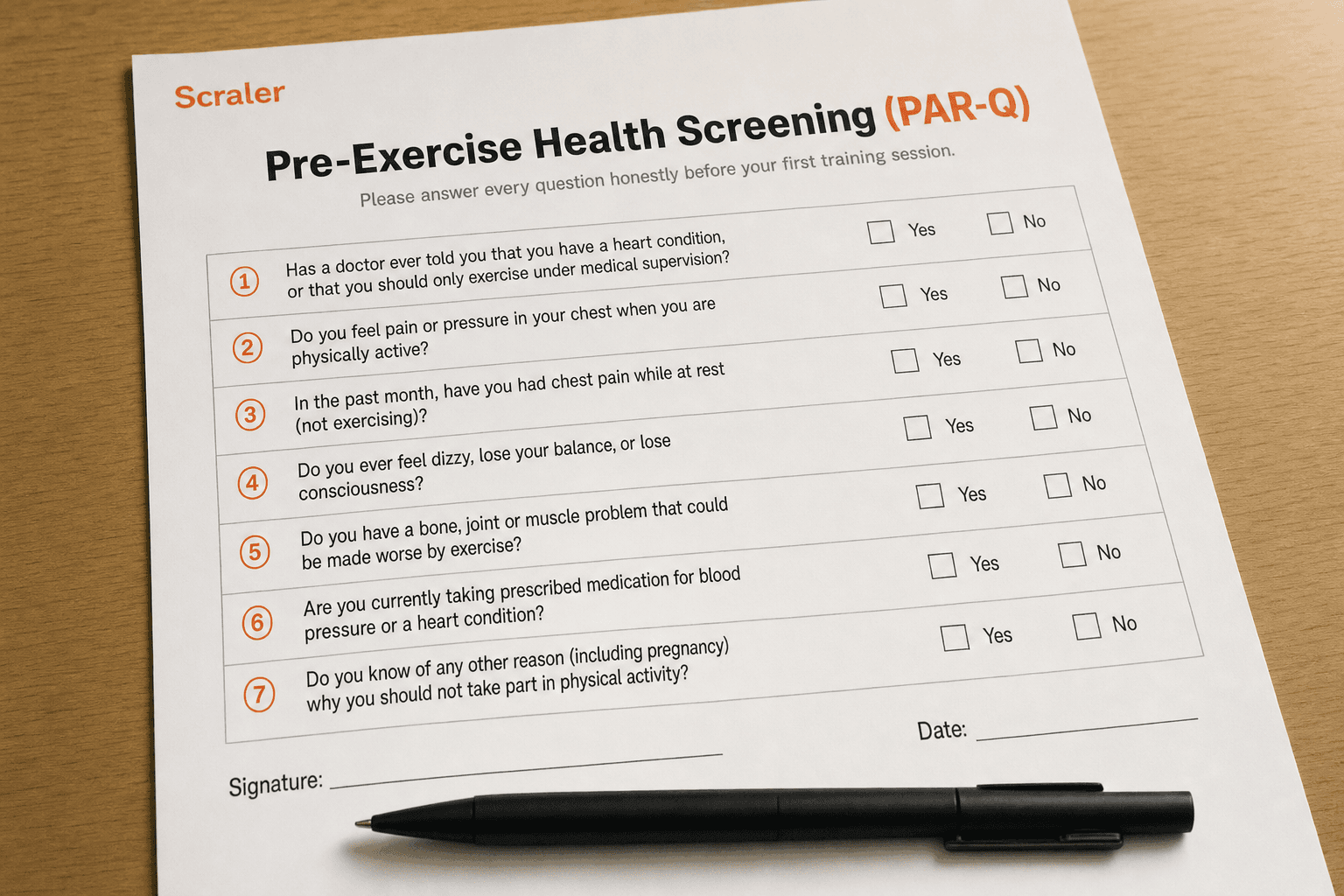
PAR-Q vs PAR-Q+: What Changed and Which Should You Use?
Two names, one job. The original PAR-Q is the seven-question screen the fitness industry ran on for decades; the PAR-Q+ is its 2011 replacement, built to stop sending quite so many healthy people to the doctor. Here is what actually changed, and what a working trainer should use.

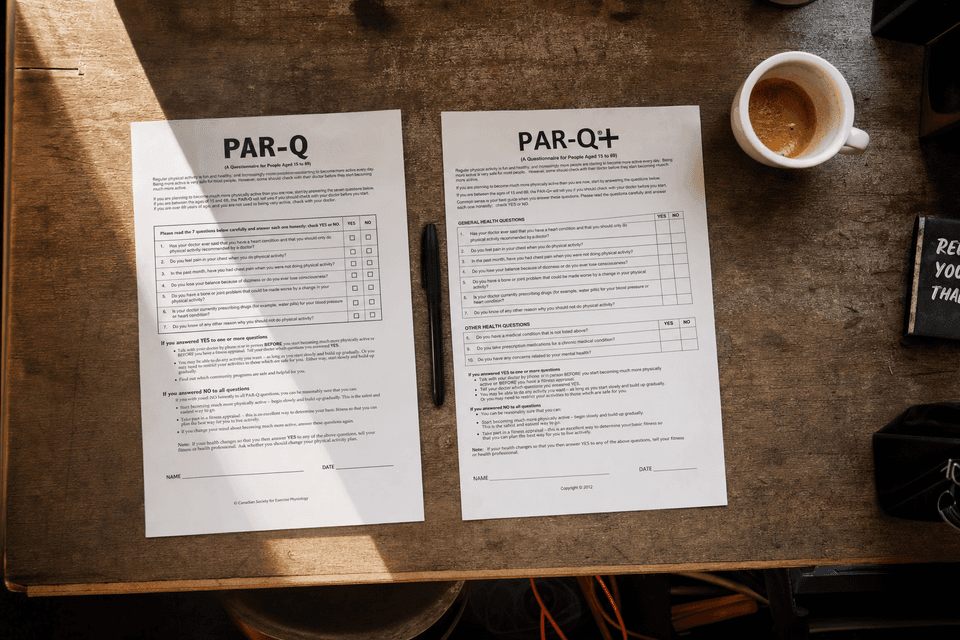
The original PAR-Q
Developed in 1970s Canada and standardised over the decades that followed, the classic PAR-Q is seven yes/no questions covering heart conditions, chest pain, dizziness, joint problems, medication and a catch-all (explained one by one here). Its genius is its bluntness: any yes → see a doctor first. Its flaw is the same bluntness: it was designed to be maximally cautious, so it refers a lot of people to the GP who never needed to go.
What the PAR-Q+ changed
The PAR-Q+ (2011, maintained by the PAR-Q+ Collaboration) keeps a similar set of seven general questions but adds follow-up pages: answer yes to a general question and instead of being sent straight to a doctor, you answer more specific questions about your condition. A well-managed, stable condition often clears the client to start becoming active anyway. Fewer false-positive GP referrals, fewer people bouncing off exercise because a form told them to make an appointment they did not need.
- PAR-Q (original)
- 7 questions, one page
- PAR-Q+
- 7 general questions + condition-specific follow-ups
- PAR-Q (original)
- See a doctor before starting
- PAR-Q+
- Answer follow-ups; many stable conditions self-clear
- PAR-Q (original)
- Fast, simple screening
- PAR-Q+
- Clients with known chronic conditions
- PAR-Q (original)
- Retired as an official document
- PAR-Q+
- Current official version (eparmedx.com)
- PAR-Q (original)
- ~2 minutes
- PAR-Q+
- 2 to 10 minutes depending on answers
| PAR-Q (original) | PAR-Q+ | |
|---|---|---|
| Length | 7 questions, one page | 7 general questions + condition-specific follow-ups |
| Any yes means | See a doctor before starting | Answer follow-ups; many stable conditions self-clear |
| Best for | Fast, simple screening | Clients with known chronic conditions |
| Status | Retired as an official document | Current official version (eparmedx.com) |
| Time to complete | ~2 minutes | 2 to 10 minutes depending on answers |
The copyright wrinkle
The official PAR-Q+ document is copyrighted and may only be reproduced unaltered and in full; you can download the canonical PDF free at eparmedx.com, but you cannot legally reword it, rebrand it, or embed a modified version in your own paperwork. That is why virtually every PAR-Q a UK trainer actually uses, including our free template, is a paraphrased form screening the same seven areas under the generic PAR-Q name. The name is the industry’s generic term; only the official document’s exact text is protected.
Which should you use?
- Most trainers, most clients: a clear PAR-Q-style screen of the seven core areas, delivered as part of client onboarding. Two minutes, catches the red flags, satisfies the documented-screening expectation your insurer has. This is what the Scraler onboarding template is.
- Clients with known chronic conditions: point them at the official PAR-Q+ as well: the follow-up logic is genuinely useful there, and linking the canonical document costs you nothing.
- Either way: what protects you is not which version you picked. It is that screening happened, was signed, was acted on, and is stored properly.
Add the Pre-Exercise Health Screening (PAR-Q) template to your Scraler onboarding; every new client is screened before their first session, automatically.
Start freeFrequently asked questions
- Is the original PAR-Q still valid to use?
- The original document was officially retired in favour of the PAR-Q+, but the seven-area screening it defined remains the industry standard, which is why PAR-Q-style forms are what trainers, gyms and insurers work with every day.
- Is the PAR-Q+ free?
- Yes, the official PDF is freely available at eparmedx.com. The licence requires reproducing it unaltered and in full.
- Can I put my logo on the PAR-Q+?
- Not on the official document: modifications are not permitted. Brand your own paraphrased screening form instead; that is standard industry practice.