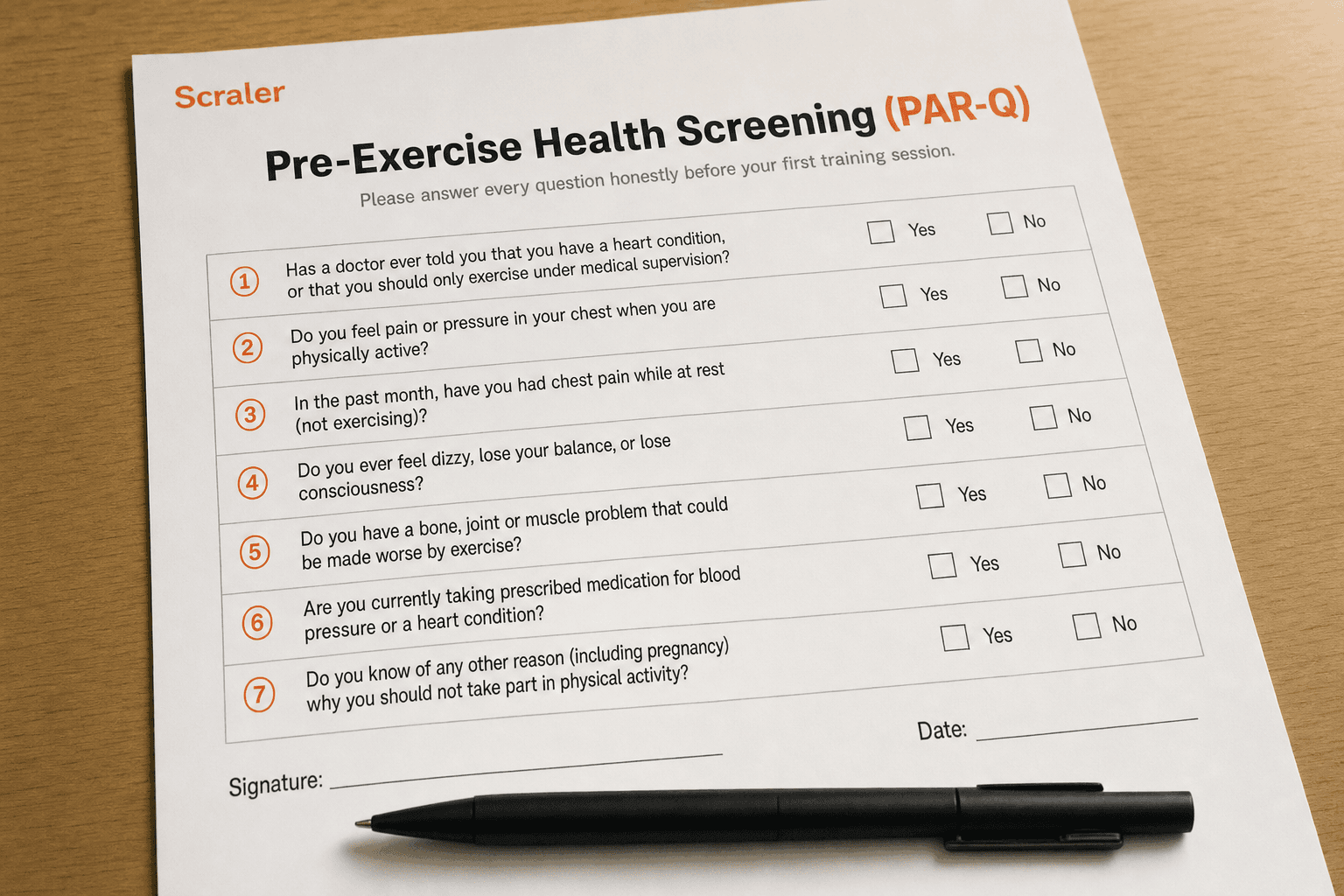
Do Personal Trainers Legally Need a PAR-Q? (UK Guide)
Short answer: no UK law names the PAR-Q, and it does not matter, because your insurance policy, your duty of care and your professional standards all assume documented [pre-exercise screening](/features/checkups) exists for every client. In practice, training a client without one is training uninsured.


The actual legal position
There is no statute that says "personal trainers must administer a PAR-Q". What exists instead is negligence law: as a trainer you owe every client a duty of care, and a court asks whether you acted as a reasonably competent professional would. Screening a new client for health risks before loading them is about as basic as that standard gets; it is taught in every Level 2 gym instructor course precisely because it is the industry’s definition of reasonable care.
So the question is never "was a PAR-Q legally required?" It is "a client got hurt, and you had no record of ever asking about their health: how do you defend that?"
What your insurer actually expects
- Documented screening for every client. UK personal trainer insurance policies are written on the assumption that you assess and screen clients. If a claim lands and there is no completed screening form, the insurer’s first question has no good answer.
- A signature and a date. An unsigned form proves nothing. Signed and dated (on paper or as a recorded digital confirmation), it proves the client told you what they told you, and when.
- Evidence you acted on red flags. The form plus your written "please check with your GP first" message is the paper trail that turns "trainer ignored a heart condition" into "trainer screened, flagged and referred correctly".
Professional bodies point the same direction: CIMSPA-aligned qualifications teach pre-exercise screening as core competency, and REPs guidance has always treated it as standard practice. None of it is optional-extra territory.
How long to keep completed PAR-Qs
- 1Client signs the PAR-Q
Signed, dated, stored securely.
- 2While they train with you
Keep it on file; re-screen yearly.
- 3After they leave
Keep it ~6 more years: the UK claim window.
- 4Then delete it
Retention window over, erase the record.
Six years is the general UK limitation period for contract and negligence claims (personal injury claims are typically three years from the injury, but six covers both, and a claim can surface years after a client leaves). Deleting a former client’s PAR-Q the week they cancel is deleting your own defence.
GDPR: health answers are special-category data
PAR-Q answers are health data, which UK GDPR treats as special category, the most protected class of personal data. For a working trainer that means four concrete things:
- 1.Explicit consent, collected with the answers. A specific line: "I consent to my trainer storing this health information to plan safe training", answered by the client, not buried in your terms. This is why our template ends with a consent question.
- 2.Store it securely, access-controlled. A locked filing cabinet or an encrypted system where only you can see the client’s answers. A shared Google Drive folder or a WhatsApp photo of the form does not qualify.
- 3.Use it only for what you collected it for. Screening and programming, not marketing, not sharing.
- 4.Retention with a reason. "Six years post-relationship for legal claims" is a legitimate, documentable retention policy. "Forever, because I never delete anything" is not.
The 60-second compliance checklist
- Every active client has a completed, signed, dated PAR-Q on file
- Every yes answer has a documented GP recommendation next to it
- Forms are stored securely, and only you can access them
- Explicit health-data consent is recorded with each form
- Former clients’ forms are retained ~6 years, then deleted
- Clients are re-screened annually and after any health change
Scraler collects the PAR-Q during client onboarding, signed digitally, consent recorded, stored on the client profile until you delete it. The checklist above becomes the default.
Start freeFrequently asked questions
- Can I train a client who refuses to complete a PAR-Q?
- You can, but you should not. If they are ever injured, you have no evidence you took reasonable care, and your insurer may take the view that you did not. A client who will not spend two minutes on a health form is telling you something.
- Does an online PAR-Q count for insurance purposes?
- Yes. What matters is that the screening happened, the answers are recorded, and the client’s confirmation is captured with a date. A digital submission with a recorded confirmation does that at least as well as ink.
- Do I need a PAR-Q for online-only coaching clients?
- Yes, arguably more. You cannot see an online client move, spot symptoms, or intervene mid-session, so the written screen is your only pre-exercise safety net.