Fitness Assessment Form for Personal Trainers (Free PDF and Test Battery)
A fitness assessment form records a new client's goals, health history, resting measurements and fitness test results on one document, so you can plan their program and retest later. Below is a free 4-page PDF with a test battery, how to run each test and where to find the norms.

- A fitness assessment form has four jobs: collect history, flag who needs a doctor first, record measurements and tests, and set a retest date.
- Screen before you test. ACSM's screening model looks at current activity, signs or symptoms and known disease, and the intensity the client wants to start at.
- Reference values you can cite: a resting pulse of 60 to 100 bpm for adults (MedlinePlus), 140/90 or higher at a clinic as high blood pressure (NHS), and a waist under half of height (NHS).
- Do not invent push-up or run norms. Use the Cooper, sit-and-reach and VO2 max calculators for age and sex tables, and track each client against their own earlier results.
- Run the tests in a set order, lightest first and the 12 minute run last, and repeat them the same way every time.
A fitness assessment gives you a baseline. Without one, "you have improved" is a feeling. With one, it is a number the client can see. This guide gives you the form, the tests to put on it, the reference values we could source, and the order that keeps the session safe and consistent.
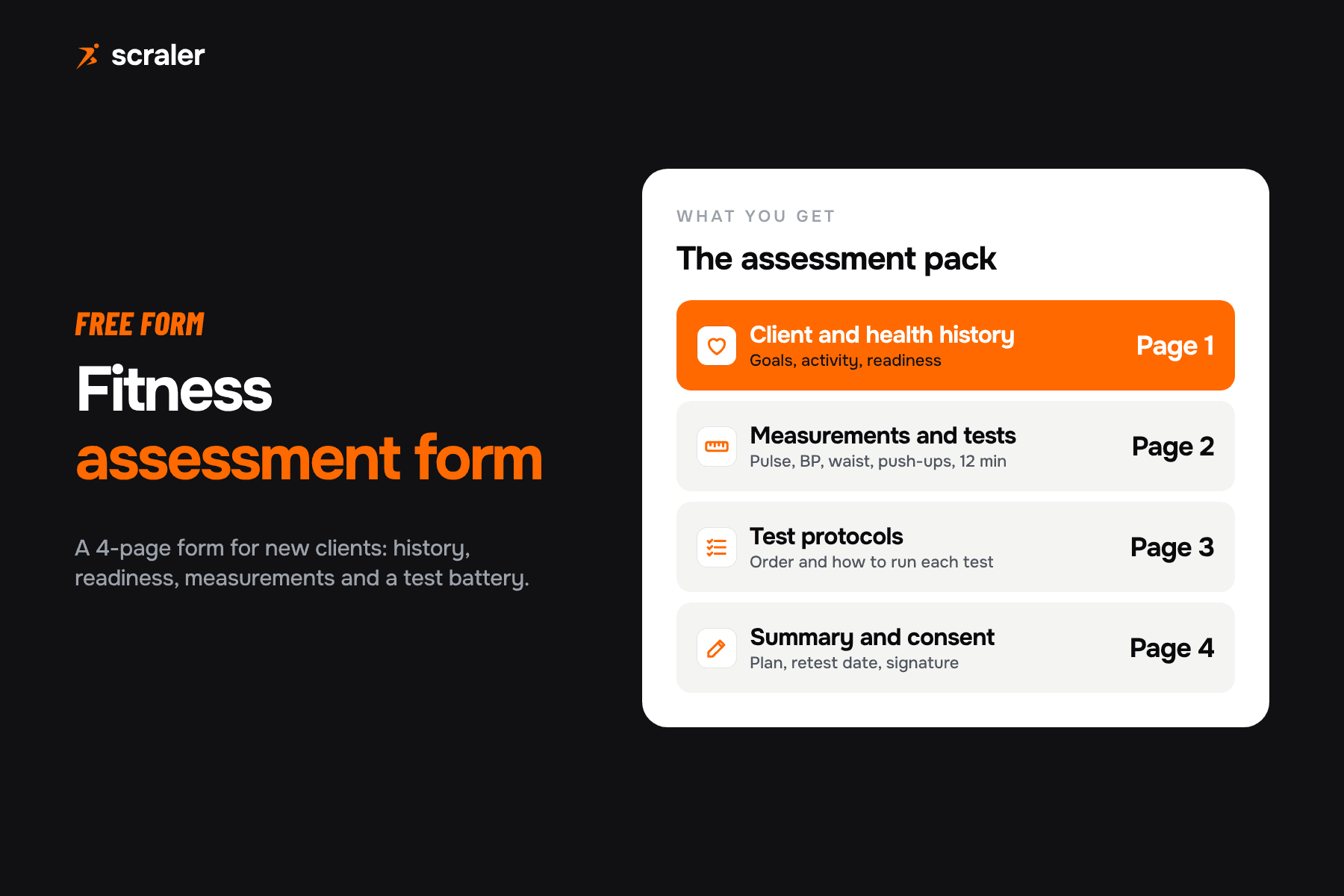
Four A4 pages: client and health history, measurements and tests with a retest column, test protocols, and a summary with consent. Print it or fill it in on a tablet. Pair it with a separate PAR-Q+ screening (see our PAR-Q form template) for anyone who ticks a health box.
What is a fitness assessment form?
It is the document you complete with a new client before training starts. Part of it is a questionnaire the client fills in. Part is a record sheet that you fill in while you measure and test. Together they show where the client starts and what to prioritize.
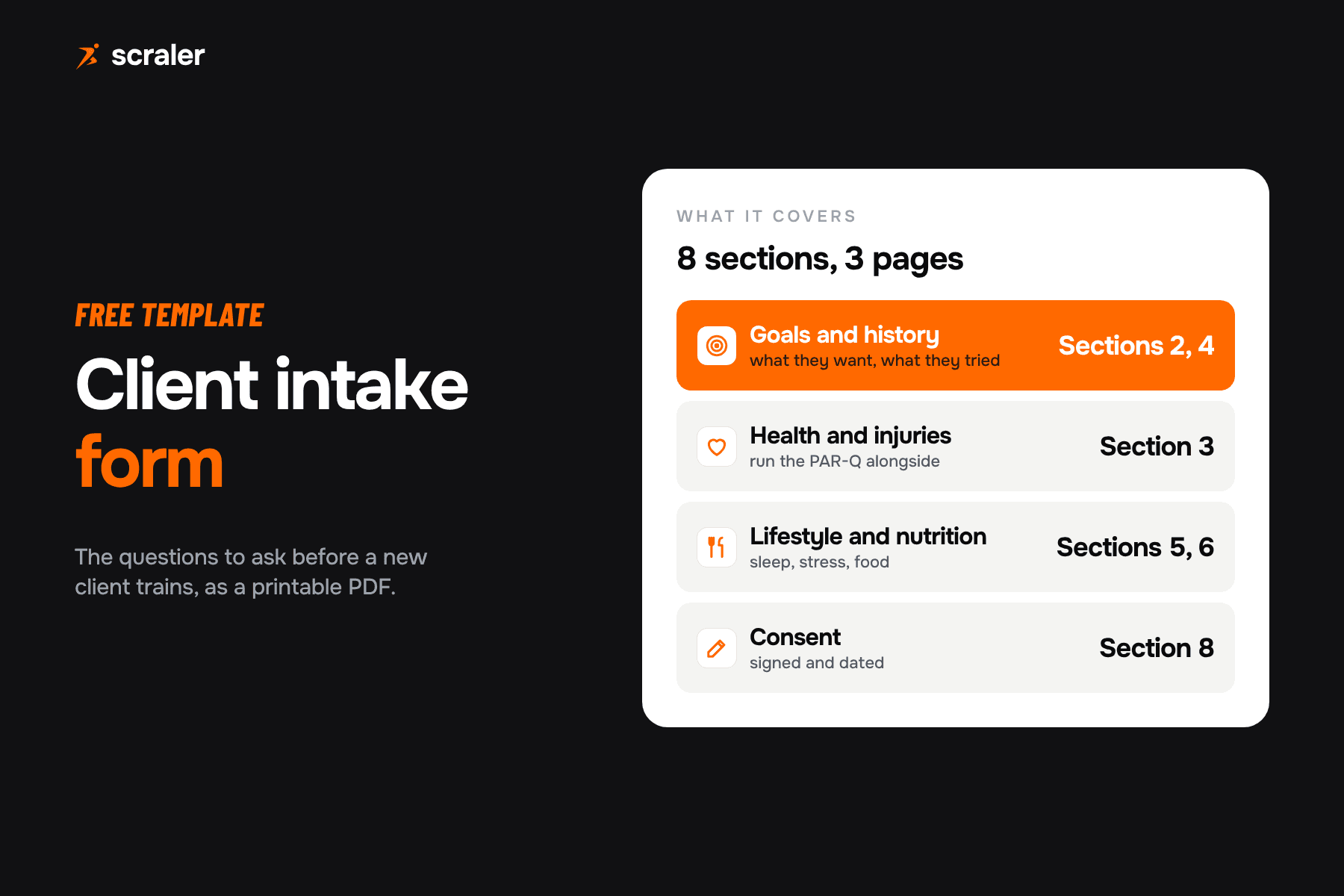
It overlaps with a client intake form, but the focus differs. The intake form is about the person: goals, lifestyle, nutrition, logistics. The assessment form is about the body today: measurements and test results you can repeat. Many coaches send the intake form first and run the assessment in the first session.
What should a fitness assessment form include?
- What it collects
- Name, contact, date, who assessed
- Why it matters
- Every result needs a date and an assessor
- What it collects
- Main goal, what success looks like in 12 weeks
- Why it matters
- Decides which tests matter
- What it collects
- Current activity, training age, sleep, stress
- Why it matters
- Sets the starting intensity
- What it collects
- A tick list of red flags, injuries, medication
- Why it matters
- Decides who sees a doctor before testing
- What it collects
- Resting pulse, blood pressure, height, weight, waist
- Why it matters
- Baseline numbers you can repeat
- What it collects
- Push-ups, sit-and-reach, 12 minute run, plank, squat
- Why it matters
- Strength endurance, flexibility, cardio, movement
- What it collects
- Strengths, priorities, retest date
- Why it matters
- Turns data into a program
- What it collects
- Signature and data permission
- Why it matters
- Your record that the client agreed
| Section | What it collects | Why it matters |
|---|---|---|
| Client details | Name, contact, date, who assessed | Every result needs a date and an assessor |
| Goals | Main goal, what success looks like in 12 weeks | Decides which tests matter |
| Activity history | Current activity, training age, sleep, stress | Sets the starting intensity |
| Health and readiness | A tick list of red flags, injuries, medication | Decides who sees a doctor before testing |
| Measurements | Resting pulse, blood pressure, height, weight, waist | Baseline numbers you can repeat |
| Fitness tests | Push-ups, sit-and-reach, 12 minute run, plank, squat | Strength endurance, flexibility, cardio, movement |
| Summary and plan | Strengths, priorities, retest date | Turns data into a program |
| Consent | Signature and data permission | Your record that the client agreed |
Leave a retest column next to every result. That is the part clients care about: the same test, a few weeks later, with a better number next to it.
What personal training consultation questions should you ask?
The consultation is a conversation, not an interrogation. Use the form to guide it, and ask follow-up questions on anything the client ticks or hesitates on. These are the questions that change what you do next.
- Goals. "What do you want to be different in 12 weeks?" Ask for something they could measure or notice.
- Why now. "What made you decide to start this month?" The answer tells you how motivated they are and what has failed before.
- Training history. "What have you done in the last year, and what stopped?" A pattern of quitting is more useful than a list of exercises.
- Injuries and pain. "Is there anything that hurts, or that you avoid?" Follow up on where, when and what makes it worse.
- Health. "Has a doctor ever advised you to limit exercise?" Anything yes goes to a medical check before testing.
- Time and logistics. "Which days and how long can you really train?" Plan around the real number, not the hopeful one.
- Sleep and stress. "How many hours do you sleep, and how stressful is a normal week?" Both change how hard you can push.
- Support. "Who around you will help or get in the way?" Training dies at home more often than in the gym.
Write the answers down in the client's words. Quotes make a better program summary than your paraphrase, and clients notice when you remember what they said.
Who should you screen before running fitness tests?
Anyone with a symptom or a known condition, before any test that raises their heart rate. ACSM updated its preparticipation screening in 2015 and based it on three factors: the person's current level of physical activity, whether they have signs or symptoms or a known cardiovascular, metabolic or renal disease, and the intensity of exercise they want to start with. The group noted that exercise is safe for most people and that over-referral to doctors can itself become a barrier.
In practice, the form's health section is your first filter. A tick on any item means the client sees a doctor, and you complete the official PAR-Q+ with them, before any fitness testing. The PAR-Q+ and its follow-up tool are published at eparmedx.com. Their text is copyrighted, so we do not copy it into the form. The tick list on our form is our own wording and does not replace the official screening.
Which fitness tests belong in a new client assessment?
A small battery covers the basics: heart rate and blood pressure at rest, a body measure, strength endurance, flexibility and cardio. Keep it short. Five to six tests are enough to set a baseline, and each additional test makes the session longer without changing the program.
- What it measures
- Resting cardiovascular state
- How to record it
- Beats per minute after 10 minutes sitting
- What it measures
- Resting blood pressure
- How to record it
- Two seated readings, in mmHg
- What it measures
- Central fat distribution
- How to record it
- Waist divided by height, both in cm
- What it measures
- Upper body strength endurance
- How to record it
- Full reps until form breaks
- What it measures
- Hamstring flexibility
- How to record it
- Best of 3, in cm
- What it measures
- Aerobic fitness
- How to record it
- Distance covered, in metres
| Test | What it measures | How to record it |
|---|---|---|
| Resting heart rate | Resting cardiovascular state | Beats per minute after 10 minutes sitting |
| Blood pressure | Resting blood pressure | Two seated readings, in mmHg |
| Waist-to-height ratio | Central fat distribution | Waist divided by height, both in cm |
| Push-ups | Upper body strength endurance | Full reps until form breaks |
| Sit-and-reach | Hamstring flexibility | Best of 3, in cm |
| 12 minute run (Cooper) | Aerobic fitness | Distance covered, in metres |
The form also has a plank hold and a bodyweight squat check. They have no published norms here, so use them to compare a client with their own earlier result and to note movement quality.
What are normal fitness assessment results?
It depends on the test, and for several of them there is no single "normal" you can cite honestly. Here is what we could source from pages we read on 7 October 2026.
- Resting pulse. MedlinePlus gives 60 to 100 beats per minute for adults and 40 to 60 for well-trained athletes. Measure after at least 10 minutes of rest, and count for a full minute or for 30 seconds and double it.
- Blood pressure. The NHS says a reading of 140/90 or higher at a healthcare professional, or 135/85 or higher at home, is usually considered high. A coach does not diagnose. Record it and refer if it is high.
- Waist-to-height ratio. The NHS advises keeping your waist size under half your height, which is a ratio below 0.5. Their calculator is for adults with a BMI under 35. Our waist-to-height ratio calculator does the division.
- Push-ups. A 2019 study in JAMA Network Open followed 1,104 male firefighters for 10 years. Those who could do more than 40 push-ups had a much lower rate of cardiovascular events than those who could do fewer than 10. It was a retrospective study of active men, and the authors say larger and more diverse studies are needed. It supports tracking push-ups. It is not a pass mark for your client.
- Sit-and-reach. A meta-analysis of 34 studies found the test is a moderate indicator of hamstring flexibility and a poor one for the lower back. Use it for hamstrings only.
For age and sex tables on the run and the reach, use the calculators rather than a chart pasted from somewhere else: the Cooper test calculator turns a 12 minute distance into a VO2 max estimate and a fitness category, the sit-and-reach test calculator scores the reach, and the VO2 max calculator compares three methods side by side. Cooper described the field test and its link to treadmill measured oxygen intake in JAMA in 1968. If you want a client's body size measure as well, the BMI calculator is there too, but the waist-to-height ratio says more about fat distribution.
In what order should you run the tests?
Lightest first and the hardest last. This is our own running order, not a standard, but it follows one rule: measures that fatigue the client come after the ones that do not. Resting pulse and blood pressure are only valid before any activity.
- 1Screen
History and the health tick list. Stop here if a box is ticked.
- 2Rest
Resting pulse, then blood pressure, after 10 minutes sitting.
- 3Body
Height, weight and waist.
- 4Move
Warm up, then the squat check and sit-and-reach.
- 5Strength
Push-ups and plank.
- 6Cardio
12 minute run or walk, last, because it leaves the most fatigue.
Run each test the same way every time: same time of day, same surface, same instructions, and no coaching mid-test. A result only means something if it is repeatable. Page 3 of the PDF gives a short protocol for each test.
How do you use the results with a client?
- 1.Pick three priorities. Not eight. Choose the three results that matter most for the client's goal and write them in the summary.
- 2.Show the client their numbers. Explain each in one plain sentence. A result is a starting point, not a verdict.
- 3.Set a retest date. We suggest 8 to 12 weeks. That is our suggestion, not a rule. Put the date on the form before the client leaves.
- 4.Retest under the same conditions. Same tests, same order, same time of day. Note anything that differs.
- 5.Build the program from the priorities. The workout plan template gives you a sheet for it.
Between assessments, a weekly check-in keeps the picture current. The client check-in form template covers what to ask, and our body measurement chart shows how to take tape measurements the same way each time.
Build your intake and assessment questions once in Scraler and send them to every new client. Answers, photos and measurements are saved on the client profile, next to their program and check-ins.
See client check-ins and formsFrequently asked questions
- What is a fitness assessment form?
- A document a trainer completes with a new client before training starts. It records goals, activity and health history, resting measurements such as pulse and blood pressure, and the results of a short fitness test battery, with a retest column and a summary.
- What tests should a personal trainer include in a fitness assessment?
- A short set that covers resting heart rate and blood pressure, a body measure such as waist-to-height ratio, strength endurance such as push-ups, flexibility such as sit-and-reach, and cardio such as the 12 minute Cooper run. Add a movement check like a bodyweight squat.
- Do clients need a PAR-Q before a fitness assessment?
- Screen before you test. The official PAR-Q+ is published at eparmedx.com and only the official, unmodified version should be used. Use the health tick list on the form as a first filter, and have anyone who ticks a box see a doctor and complete the official screening before testing.
- What is a normal resting heart rate?
- MedlinePlus gives 60 to 100 beats per minute for adults and 40 to 60 for well-trained athletes. Measure after at least 10 minutes of rest. Anything that worries you or the client is a reason to refer, not to interpret.
- How often should you reassess a client?
- We suggest retesting every 8 to 12 weeks. That is our suggestion, not a standard. Keep the tests, the order and the conditions the same each time, so the change in the number is real.
- Where can I find norms for the Cooper test and sit-and-reach?
- Use the Cooper test calculator, the sit-and-reach test calculator and the VO2 max calculator on Scraler. They show age and sex categories and cite their sources, so you do not need to copy a chart from elsewhere.