Hybrid Personal Training Contract: 7 Clauses In-Person Agreements Miss
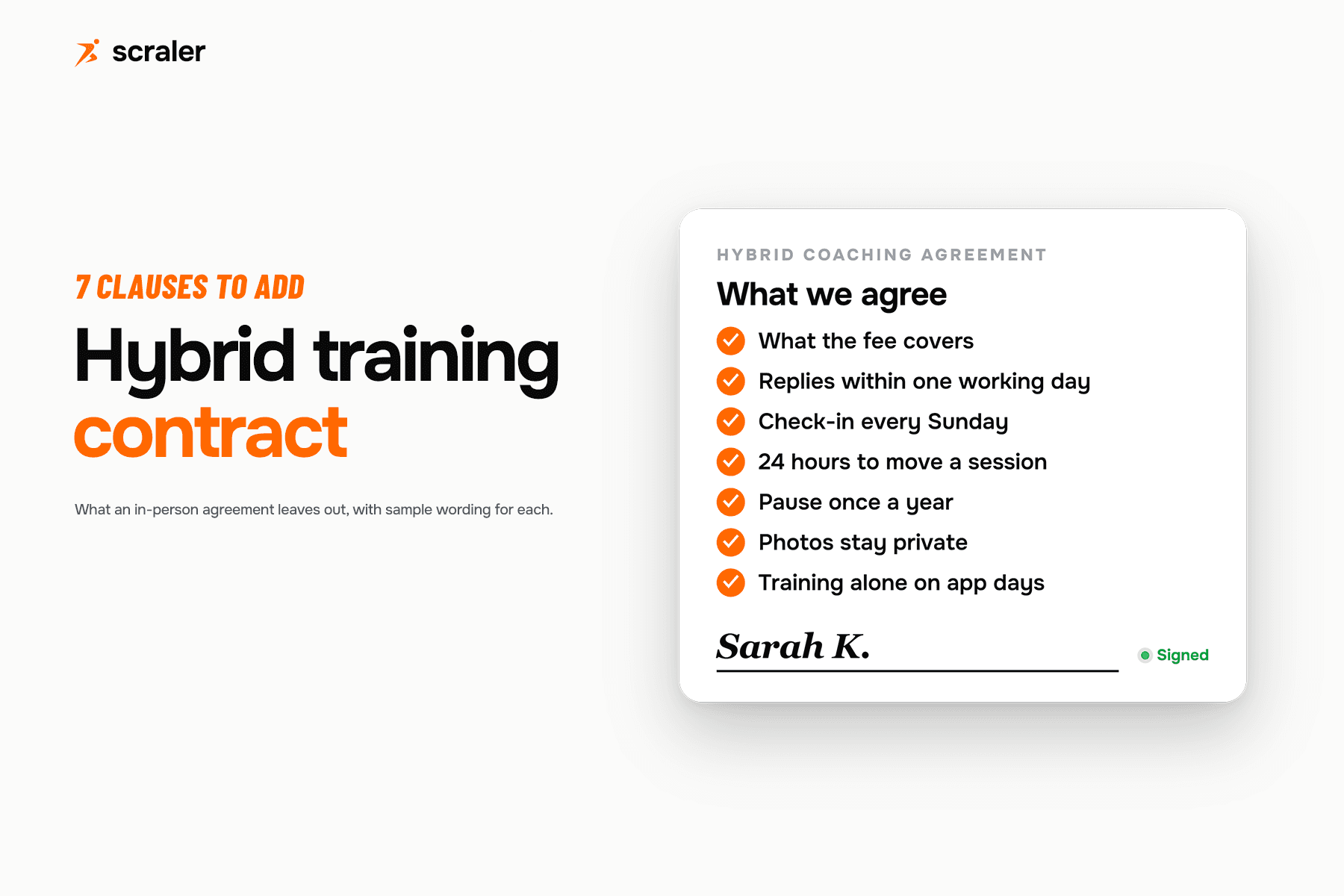
A hybrid personal training contract is a membership agreement that covers both the in-person session and the app coaching. It needs seven clauses an in-person agreement skips: what the monthly fee covers, reply times, check-in duties, cancellations versus app access, pausing and notice, client data and photos, and unsupervised workouts.

- An in-person contract covers the hour in the room. A hybrid contract also has to cover the rest of the week, when the client trains alone with the app.
- The monthly fee should buy coaching, not slots. Write that down and a cancelled session stops being a refund argument.
- Reply times are the clause that protects your evenings. Give a window, a channel and a plain rule for urgent medical issues.
If you sell hybrid personal training, your old session agreement is half a contract. It says what happens in the gym. It says nothing about the app, the messages or the check-ins, which is where disagreements tend to start. Here are the seven clauses to add.
How is a hybrid personal training contract different from an in-person one?
An in-person agreement sells time: a session, at a place, with a cancellation rule. A hybrid agreement sells a service that runs all week, in the gym, in the app and in the chat.
That second half has no natural edges. When do you answer? What does a missed check-in mean? Does a cancelled session change the bill? Leave these open and the client assumes the generous version while you assume the strict one. A short clause for each removes the guessing.
Still working out the package itself? Start with hybrid personal training packages. The contract should describe the package you actually sell. For an in-person agreement with a separate waiver, see our personal training contract template.
Which 7 clauses does a hybrid personal training contract need?
Here is the list at a glance. A personal trainer contract template with these seven plus your normal terms (payment, insurance, health declaration) is a solid base.
- What it says
- Lists the sessions, the programme, the check-ins and the app access in one monthly price.
- Example wording
- “The monthly fee covers two in-person sessions a month, an app programme and a weekly check-in reply.”
- What it says
- Sets a reply window, the channel to use and what counts as urgent.
- Example wording
- “Messages are answered within one working day, Monday to Friday.”
- What it says
- Says what the client sends, by when, and what happens if they skip.
- Example wording
- “Send your check-in by Sunday evening. I reply by Tuesday.”
- What it says
- Sets notice for a session and says app access continues either way.
- Example wording
- “Cancel a session with 24 hours’ notice or it is forfeited. App access is unaffected.”
- What it says
- Covers how to pause, the minimum term and how to leave.
- Example wording
- “Pause once a year for up to four weeks. Cancel with 30 days’ written notice.”
- What it says
- Says what you store, why, who sees it and how it is deleted.
- Example wording
- “Progress photos are private and are never posted without your written permission.”
- What it says
- Puts the client in charge of how they train alone and what they report.
- Example wording
- “Stop and tell me if you feel pain, dizziness or chest tightness.”
| Clause | What it says | Example wording |
|---|---|---|
| 1. What the fee covers | Lists the sessions, the programme, the check-ins and the app access in one monthly price. | “The monthly fee covers two in-person sessions a month, an app programme and a weekly check-in reply.” |
| 2. Response times | Sets a reply window, the channel to use and what counts as urgent. | “Messages are answered within one working day, Monday to Friday.” |
| 3. Check-in duties | Says what the client sends, by when, and what happens if they skip. | “Send your check-in by Sunday evening. I reply by Tuesday.” |
| 4. Cancellations and no-shows | Sets notice for a session and says app access continues either way. | “Cancel a session with 24 hours’ notice or it is forfeited. App access is unaffected.” |
| 5. Pausing, term and notice | Covers how to pause, the minimum term and how to leave. | “Pause once a year for up to four weeks. Cancel with 30 days’ written notice.” |
| 6. Data, privacy and photos | Says what you store, why, who sees it and how it is deleted. | “Progress photos are private and are never posted without your written permission.” |
| 7. Unsupervised workouts | Puts the client in charge of how they train alone and what they report. | “Stop and tell me if you feel pain, dizziness or chest tightness.” |
What should the monthly fee cover?
Name every part of the service in one clause: in-person sessions per month, the app programme and how often you update it, the check-in and reply, and app access. Then say the price is for the whole month of coaching.
The last sentence matters most. When the fee buys coaching rather than slots, a missed session is a scheduling issue, not a refund request. Also say whether unused sessions roll over. Most trainers say no.
What should coach response times say?
Clients check this clause first and trainers forget to write it. Without one, a message at 9pm feels like it deserves an answer by 9:05. Give a window, name one channel and say what you do not answer.
- A window. For example one working day, within set hours. Do not promise same day if you cannot keep it.
- One channel. Replies happen in the app chat. Texts, DMs and email are not monitored for coaching.
- An urgent rule. Anything medical or urgent goes to a doctor or emergency services, not to you.
- Holidays. Say you will post a notice before you are away.
What are the client’s check-in obligations?
In hybrid coaching the client owes something too: the check-in. Your programming depends on it, so say when it is due, what it includes and what happens if it does not arrive.
Keep the consequence practical, not a penalty: the programme stays as it is until you hear back. Add your own side too, which is when you reply.
How should a personal training cancellation policy work for hybrid clients?
Keep the notice period you already use. Twenty four hours is common. What changes is the second half of the sentence: the session is forfeited, but the app, the programme and the check-in carry on. Say that, or the client will ask for a partial refund.
Decide whether a no-show differs from a late cancellation. Many trainers treat them the same. Some allow one reschedule a month for illness. Write that exception in, and no others.
What should you say about pausing, minimum term and notice?
Hybrid clients stop for reasons like travel, a busy month or an injury. A pause rule lets them stop paying without cancelling. Say how long a pause can last, how often, and what happens to billing.
Then set a minimum term and a notice period. Many trainers start with three months and 30 days’ notice. A minimum term keeps the client long enough to see results. Also say that a client can take their programme history with them when they leave. Some countries give consumers a short right to cancel contracts agreed online or at a distance, so ask your lawyer how that fits with your minimum term.
If you are moving existing clients onto a membership, introduce the new terms as part of the offer, not as a surprise. Our guide on how to transition clients to online training covers that conversation step by step.
How do you handle client data and progress photos?
Hybrid coaching collects more than in-person training did: health answers, bodyweight, measurements, photos and chat history, all stored in an app. The contract should say what you keep, why, who can see it and how the client can ask for it to be deleted.
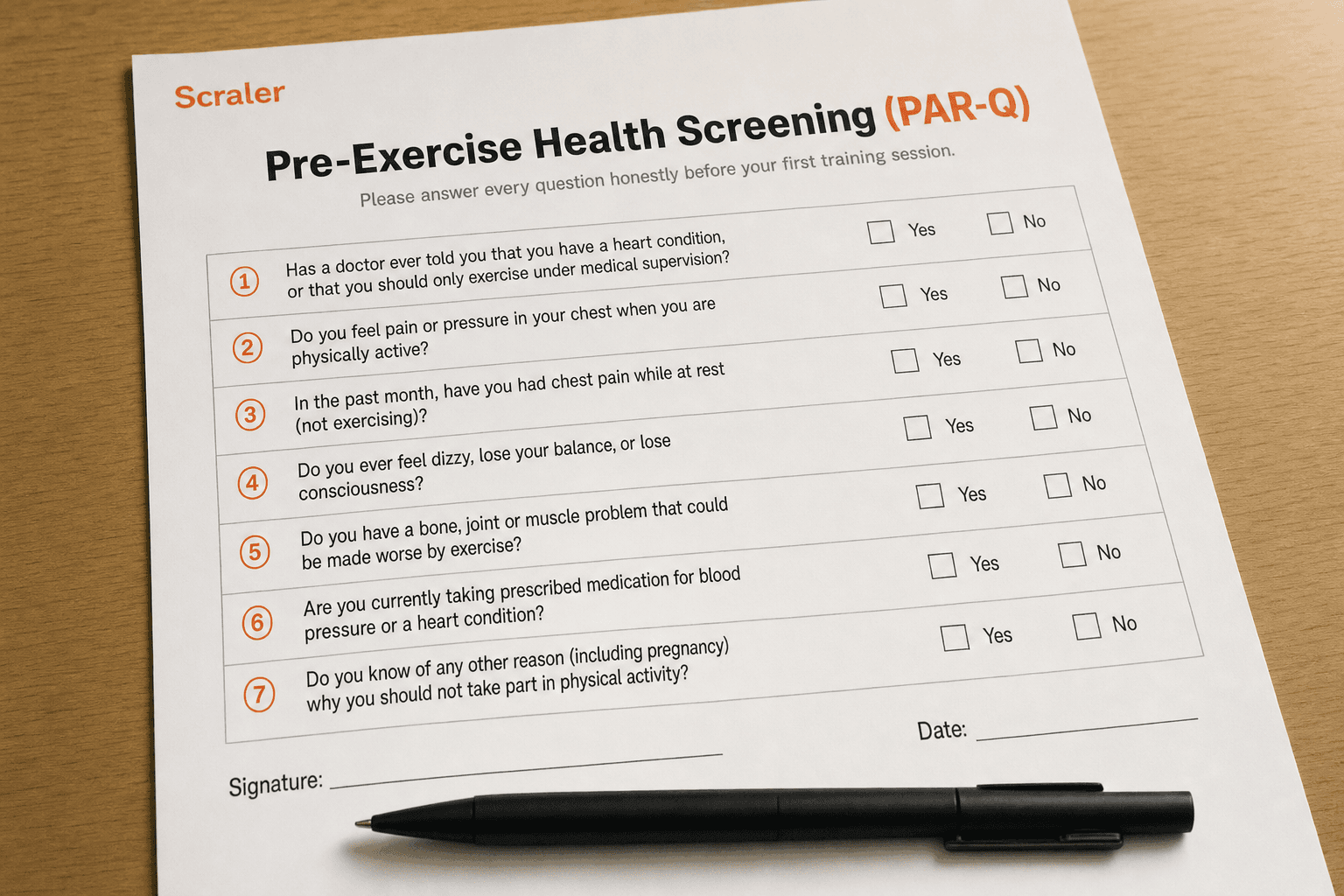
Give progress photos their own sentence: private, used only for coaching, never posted without written permission. Posting a transformation photo is a separate consent. Your health screening belongs next to this clause, so keep your PAR-Q and intake form with the signed agreement.
Health information often has extra protection under data protection law, and the rules vary by country. Ask your lawyer which apply to you. The sample above is plain language, not a compliance statement.
Who is responsible for workouts done without you?
In person, you see the exercise and stop it. In the app, nobody is watching. The contract should say the client trains alone on app days, must tell you about pain or health changes, and should stop if something feels wrong.
This clause does not remove your duty of care, and it should not try to. Your programme still has to suit the client you screened. It only makes the client’s part clear. Ask your insurer whether your cover includes coaching you deliver through an app, and keep that answer on file.
How do you keep the agreement and the client record together?
A signed agreement only helps if you can find it when a client says “you told me you would reply the same day”. Keep it with the client’s health form, your notes and the date you sent each version.
When the terms change, send the new version, note the date and keep the old one. Review the agreement once a year, or when you change your packages.
In Scraler, clients fill in your onboarding forms, such as a PAR-Q, when they sign up. Their answers, progress photos and your private notes sit together on one profile.
See client managementFrequently asked questions
- What is a hybrid personal training contract?
- It is a membership agreement for clients who train both in person and through an app. It covers the sessions, the app programme, check-ins, message replies, cancellations, pausing, client data and training done alone.
- Can I use a personal trainer contract template for hybrid clients?
- Yes, as a base. Most templates cover payment, cancellation and liability for in-person sessions. Add the seven clauses in this post for the app side, then have a local lawyer check the final version.
- What response time should I promise clients?
- Promise only what you can keep. One working day inside set hours, in one channel, is a common starting point. Write down what is urgent and send those clients to a doctor or emergency services, not to you.
- Do I need a minimum term for hybrid coaching?
- It is not required, but many trainers use about three months, long enough for the client to see results. Pair it with a clear notice period and a pause rule.