Habit Tracker Template for Coaching Clients (Free Printable + Digital)
A habit tracker is a grid where you fill one circle a day for each habit. The free printable below tracks up to six habits for 30 days and adds a weekly review. Start with one to three small habits, because forming one can take far longer than a month.

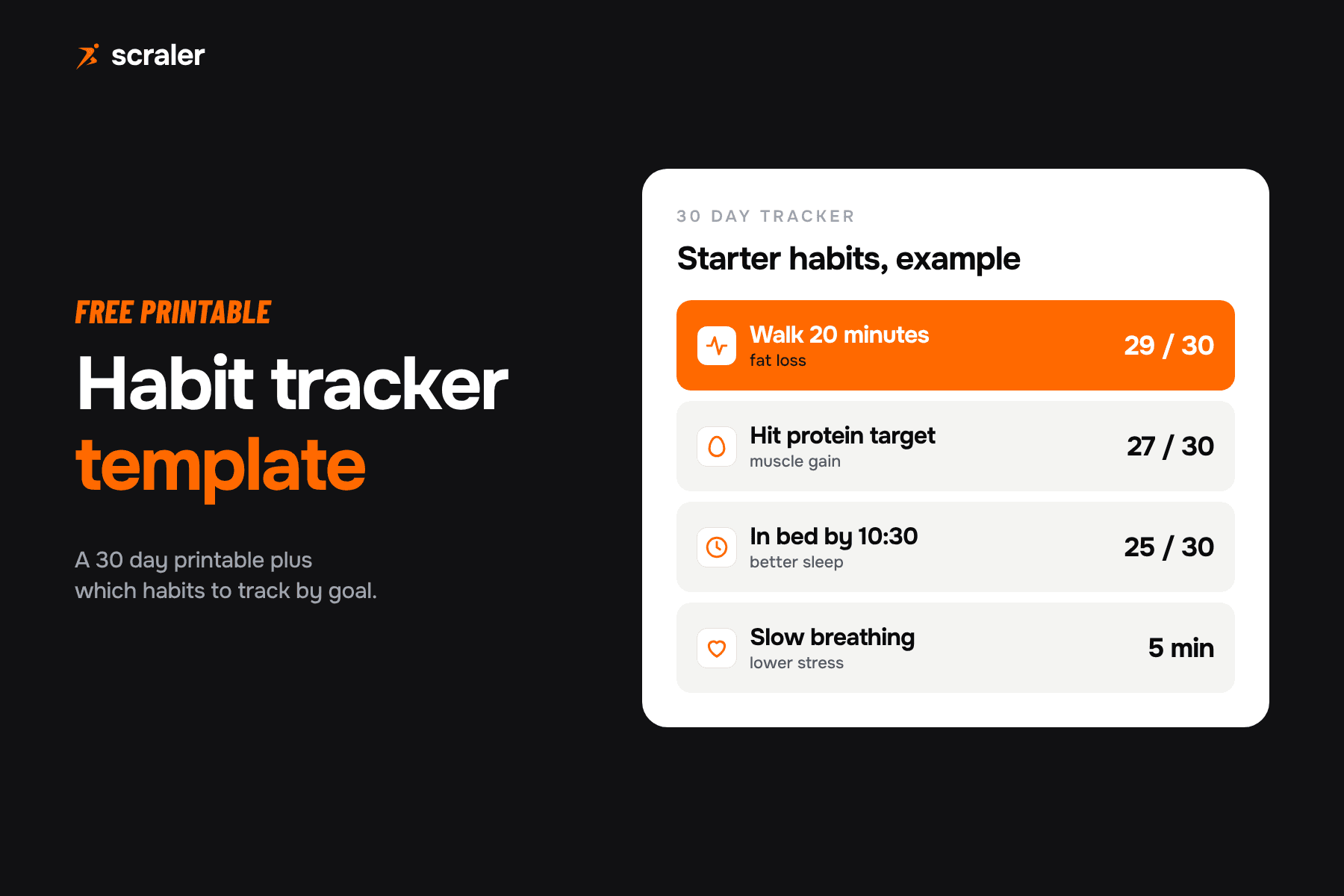
- Download the 2 page PDF: a 30 day grid for up to 6 habits, a weekly review and a goal-by-goal list of 12 starter habits.
- Track 1 to 3 habits at once. Make each one small enough to do on your worst day.
- In a 12 week study, the modelled time to reach a stable habit ranged from 18 to 254 days across the 62 people the model fitted. Missing a single day did not materially affect it.
- Review the grid once a week with your coach: count the circles, name one obstacle, then keep, shrink or swap the habit.
Habits are what clients do between sessions, and sessions are a small part of the week. A tracker makes the invisible part visible: one grid, one glance, and an honest answer to "did I do it?". This guide gives you the template, the habits worth tracking and a simple way to review them with a client.
Two A4 pages. Page 1 is a 30 day grid for up to 6 habits with a streak and completion strip and four weekly review boxes. Page 2 lists 12 starter habits by goal and four rules for making them stick.
What is a habit tracker?
A habit tracker is a simple record of whether you did a behavior on a given day. Each row is a habit, each column a day, and each cell a circle you fill in or leave blank. That is the whole system. Its value is the feedback: the filled circles show consistency, and the gaps show where life got in the way.
Trackers come in three forms. A printable like this one lives on the fridge or in a planner. A habit tracker journal adds a line of writing per day, such as what helped or hurt. A digital tracker lives in an app and sends reminders. They all do the same job, so pick the one the client will actually open.
How do you use a 30 day habit tracker?
- 1Pick 1 to 3 habits
Choose from the goal that matters most. Write them in the left column.
- 2Make each one small
"Walk 20 minutes" beats "get fit". Aim for something you can do on your worst day.
- 3Anchor it
Tie it to an existing routine: after breakfast, after brushing your teeth.
- 4Fill a circle each day
Do it at the same time every day, ideally right after the habit. Do not backfill from memory a week later.
- 5Review once a week
Count the circles, note what got in the way, then keep, shrink or swap.
The printable has a heavier line at the start of each week, so the weekly review is easy to find. It also has an example row with 29 of 30 days filled, so you can see what a good month looks like and that one miss does not ruin it. Delete the example or ignore it.
Which habits should you track for fat loss, muscle, sleep and stress?
Track behaviors the client controls, not outcomes they do not. "Hit your protein target" is a habit. "Lose 1 kg" is a result. The table has three starting points per goal. They are our own coaching suggestions, with the numbers that come from published guidelines sourced below the table.
- Habit 1
- Log everything you eat
- Habit 2
- Hit your protein target
- Habit 3
- Walk 20 minutes after a meal
- Habit 1
- Finish the planned session
- Habit 2
- Protein in your range
- Habit 3
- Sleep 7 hours or more
- Habit 1
- Same bedtime, within 30 minutes
- Habit 2
- Phone out of the bedroom
- Habit 3
- No caffeine after midday
- Habit 1
- 10 minute walk outside
- Habit 2
- 5 minutes of slow breathing
- Habit 3
- Write one thing that went well
| Goal | Habit 1 | Habit 2 | Habit 3 |
|---|---|---|---|
| Fat loss | Log everything you eat | Hit your protein target | Walk 20 minutes after a meal |
| Muscle gain | Finish the planned session | Protein in your range | Sleep 7 hours or more |
| Better sleep | Same bedtime, within 30 minutes | Phone out of the bedroom | No caffeine after midday |
| Lower stress | 10 minute walk outside | 5 minutes of slow breathing | Write one thing that went well |
- Sleep. The NHLBI notes that experts recommend adults sleep between 7 and 9 hours a night and notes that adults who sleep less than 7 hours may have more health issues.
- Strength training. The NHS advises strengthening activities that work all the major muscle groups on at least 2 days a week.
- Protein. The International Society of Sports Nutrition says 1.4 to 2.0 g of protein per kg of body weight a day is enough for most exercising people to build and keep muscle. Work out your own number with the protein calculator. If the habit is logging food, our guide to food logging apps compares the options.
- Movement. The NHS and WHO both give 150 minutes of moderate activity a week as the adult target. A 20 minute walk on most days is a way to approach it.
Hydration is another common pick. If your client wants a number, the water intake calculator gives one, and a "finish your bottle by 3 pm" habit makes it trackable.
How many habits should you track at once?
Start with one to three. This is our coaching rule, not a studied number. The reason is practical: every habit you add competes for the same limited attention, and a client who fails at five habits learns they are bad at habits. A client who succeeds at one learns the opposite.
Add the next habit only when the first runs on autopilot, or after about four weeks, whichever comes later. The printable has room for six rows so you can swap habits across months, but fill at most three at a time.
How long does it take to form a habit?
Longer than a 30 day challenge suggests. In a widely cited 2009 study by Lally and colleagues, 96 volunteers picked one eating, drinking or activity behavior and did it daily in the same context for 12 weeks. For the 62 people whose data fit the model, the time to reach a stable habit ranged from 18 to 254 days. The study also found that missing a single opportunity did not materially affect the process.
Two things follow. First, tell clients that 30 days is a first lap, not a finish line. Second, tell them a missed day is data, not failure. Both make it more likely they restart after a bad week instead of quitting. If you want a time-boxed format with an end date, our fitness challenge ideas include a free 30 day calendar.
What should a client do after a missed day?
Fill the circle with a dashed line, note why in one word, and do the habit the next day. Do not double up and do not skip the review. The printable has a dashed circle style for misses on purpose: a miss that is recorded honestly is more useful than a gap that is hidden, because the pattern behind it is what you change.
The Lally study backs this up. Missing one opportunity to do the behavior did not materially affect how the habit formed, while the people who performed the behavior more consistently fitted the model better. The message for clients is simple: consistency matters, perfection does not. Reframe a streak that breaks as a restart, and make the next day easy to win.
How do you review a habit tracker at the weekly check-in?
Keep it to five minutes and the same four steps every week. Put it near the end of your weekly check-in form, after sleep, stress and training.
- 1.Count. How many circles out of how many possible? Write the number in the week box.
- 2.Find the pattern. Which day or situation caused the misses? Weekends, travel and late meetings are the usual ones.
- 3.Name one obstacle. One, not five. Write it in "what got in the way".
- 4.Decide. Keep the habit, make it easier, or swap it. If it was done 6 or 7 days out of 7 for three weeks, it is ready to be joined by a new one.
For clients who log training too, pair the tracker with a workout log so the habit "finish the planned session" has evidence behind it. Habits and body numbers tell different stories, so log tape measurements monthly on a body measurement chart. For new clients, the habits to start with belong in the first conversation, so add the question to your client intake form.
Printable or digital habit tracker: which is better?
- Free and always on the fridge
- No app or login to forget
- You fill it in at a glance, by hand
- Easy to lose or skip for a week
- You only see it when the client shows you
- Reminders and one-tap logging
- Streaks, personal bests and completion rates
- The coach sees it live, with no photos of paper
- Per-client schedules: daily, weekly or every N days
- Lives next to workouts, food and check-ins
Print it for yourself, or for a client who likes paper. If you coach people, the digital version saves you from asking for a photo of a sheet every week. In Scraler you assign habits from a library of 26 ready-made ones or build your own, schedule each per client, and clients log in a single tap on web or mobile. You see streaks and completion rates in the client profile.
Assign daily habits from a ready-made library, set a schedule per client and track streaks and completion in one place.
See habit coachingThe printable has no medical content and is not medical advice. If a habit causes pain or worries the client, they should speak to a doctor first.
Frequently asked questions
- What is a habit tracker?
- A habit tracker is a grid where each row is a habit and each column a day. You fill a circle when you do the habit. It shows consistency at a glance and shows where the misses cluster.
- How many habits should I track at a time?
- Start with one to three. This is a coaching rule of thumb rather than a studied number, but more habits compete for the same attention. Add another once the first feels automatic.
- How long does it take to build a habit?
- It varies a lot. In a 2009 study where volunteers did one daily behavior for 12 weeks, the modelled time to reach a stable habit ranged from 18 to 254 days. Missing one day did not materially affect the process.
- What habits should I track for weight loss?
- Common starting points are logging your food, hitting a protein target and a short walk after a meal. Pick one to three and make them small. Targets should come from your coach or a calculator, not guesswork.
- Is a habit tracker printable or an app better?
- Use whichever you will open every day. A printable is free and visible. An app adds reminders and lets a coach see the streaks without asking for a photo of the sheet.