The FITT Principle: Definition, FITT-VP and Examples for Every Client
The FITT principle is a framework for writing an exercise prescription: Frequency (how often), Intensity (how hard), Time (how long) and Type (what kind of exercise). The ACSM extends it to FITT-VP by adding Volume and Progression. Set all four for each client, then change one at a time to keep them progressing.

- FITT stands for frequency, intensity, time and type. FITT-VP adds volume (frequency x intensity x time) and progression (how the plan changes over weeks).
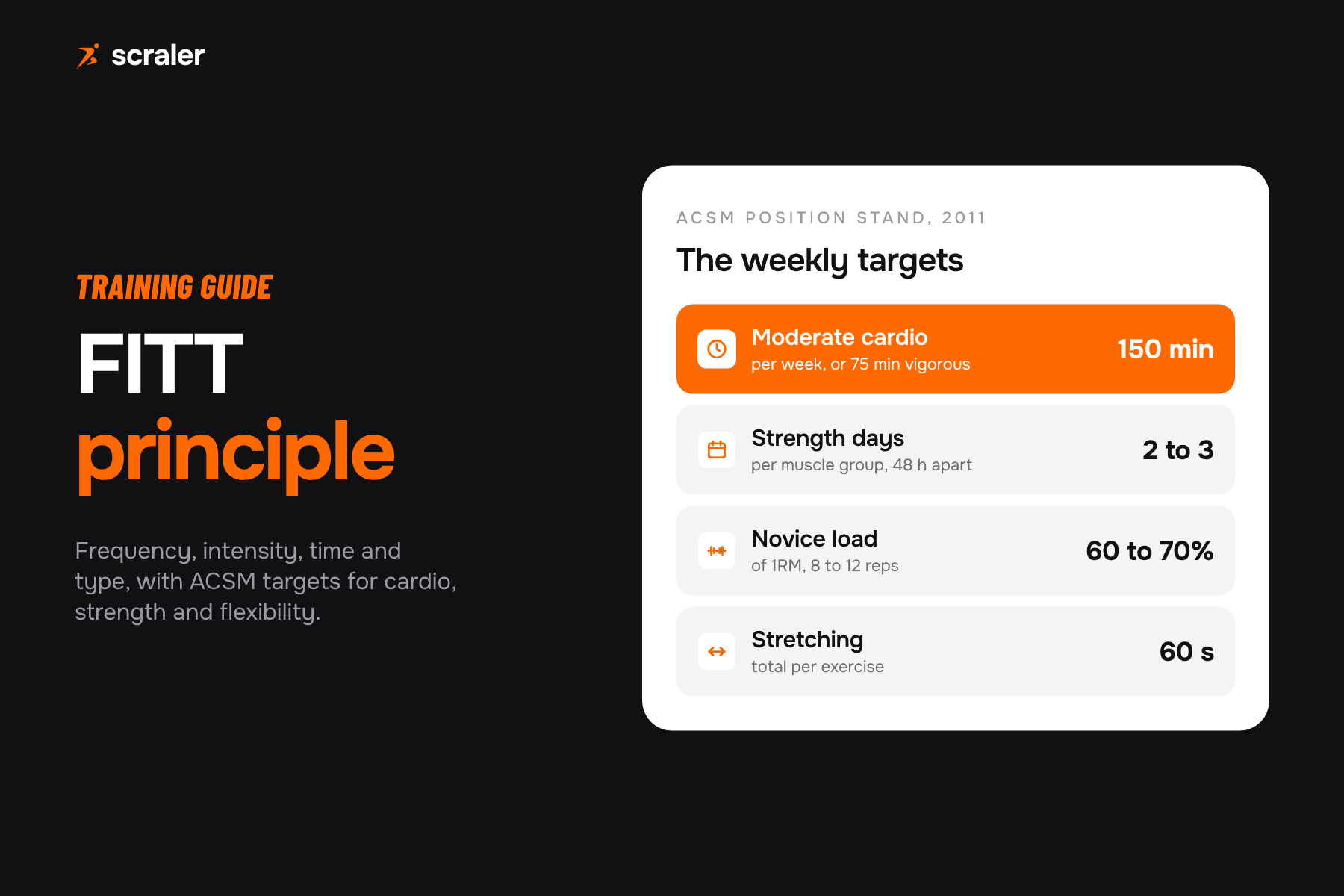
- ACSM cardio targets: at least 150 minutes a week of moderate exercise, or at least 75 minutes of vigorous, for a total of about 500 to 1000 MET-minutes a week.
- ACSM strength targets: each major muscle group 2 to 3 days a week, 2 to 4 sets of 8 to 12 reps at 60 to 70% of 1RM for novice to intermediate lifters.
- ACSM flexibility targets: at least 2 to 3 days a week, hold each stretch 10 to 30 seconds and build to 60 seconds per stretch in total.
- Progress one variable at a time so you can tell what worked. Doing less than the target still has benefits.
What is the FITT principle?
The FITT principle is a checklist of the four variables every exercise prescription needs. If one is missing, the plan is incomplete: "do cardio" names a type but no frequency, intensity or time, so the client cannot tell whether they did it right. Filling in all four turns a vague instruction into a dose you can measure, repeat and change.
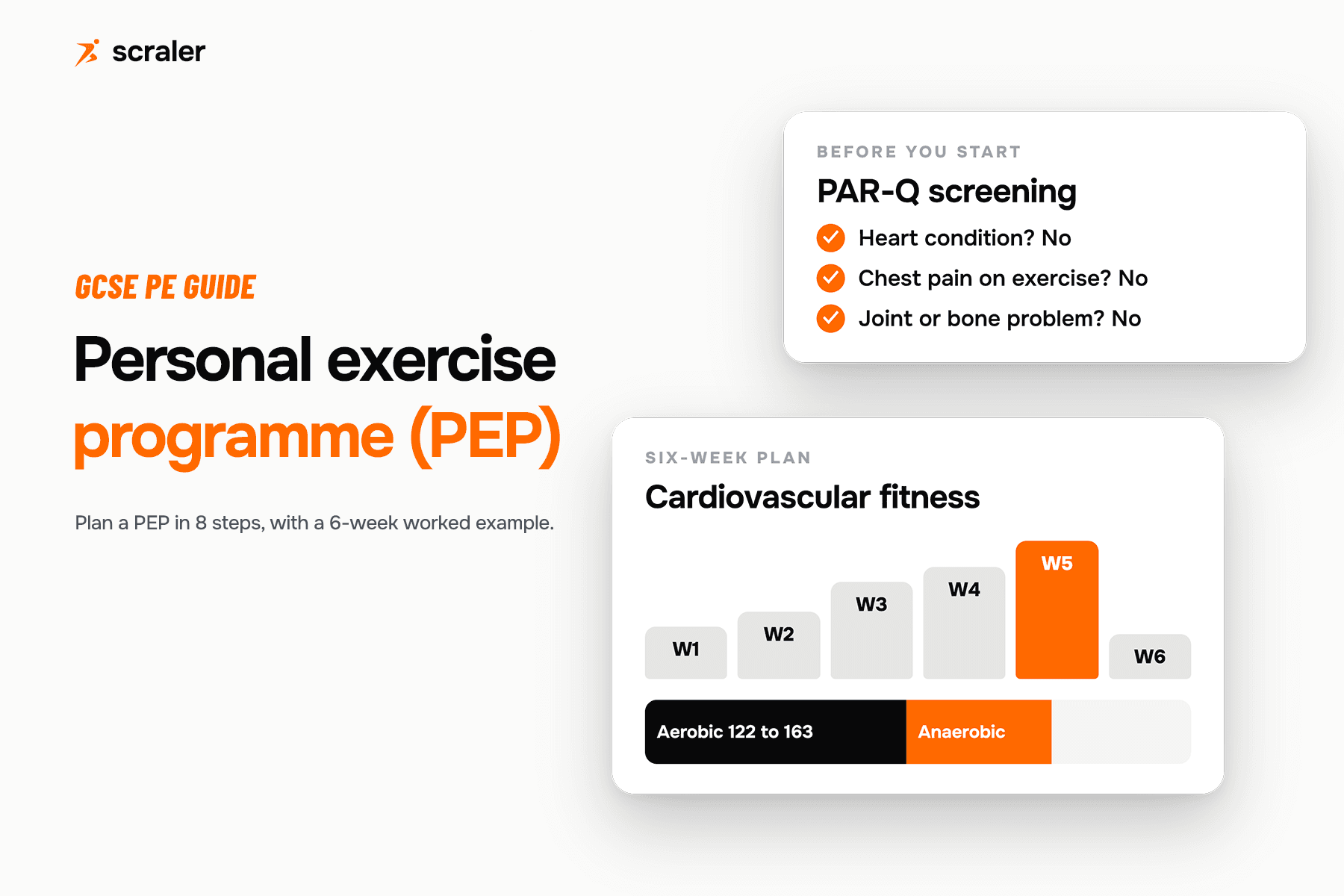
Most of the ACSM figures in this guide come from the 2011 ACSM position stand by Garber and colleagues, which sets out how much and what kind of exercise apparently healthy adults need for cardiorespiratory, resistance, flexibility and neuromotor fitness. Its recommendations are written variable by variable, so they slot straight into FITT. In school PE the same idea sits next to specificity and progressive overload as a principle of training; see our personal exercise programme guide for that side of it.
What does FITT stand for? Each FITT principle and what it represents
- Stands for
- Frequency
- What it represents
- How often the client trains
- How you write it
- Days per week, or sessions per muscle group per week
- Stands for
- Intensity
- What it represents
- How hard each session or set is
- How you write it
- % heart rate reserve, RPE, % of 1RM or reps in reserve
- Stands for
- Time
- What it represents
- How long the exercise lasts
- How you write it
- Minutes per session for cardio, sets and reps for strength, seconds per stretch
- Stands for
- Type
- What it represents
- What kind of exercise it is
- How you write it
- Running, cycling, squats, static stretching, balance work
- Stands for
- Volume (FITT-VP)
- What it represents
- The total dose: frequency x intensity x time
- How you write it
- Minutes or MET-minutes per week, weekly sets or reps per muscle
- Stands for
- Progression (FITT-VP)
- What it represents
- How the dose changes over time
- How you write it
- Which variable goes up, by how much and when
| Letter | Stands for | What it represents | How you write it |
|---|---|---|---|
| F | Frequency | How often the client trains | Days per week, or sessions per muscle group per week |
| I | Intensity | How hard each session or set is | % heart rate reserve, RPE, % of 1RM or reps in reserve |
| T | Time | How long the exercise lasts | Minutes per session for cardio, sets and reps for strength, seconds per stretch |
| T | Type | What kind of exercise it is | Running, cycling, squats, static stretching, balance work |
| V | Volume (FITT-VP) | The total dose: frequency x intensity x time | Minutes or MET-minutes per week, weekly sets or reps per muscle |
| P | Progression (FITT-VP) | How the dose changes over time | Which variable goes up, by how much and when |
The F in the FITT principle stands for frequency: how many times a week the client does that kind of training. It is usually the first number to set because it depends on the client's schedule, not only on physiology. A client who can only train twice a week gets a different plan from one who can train five times, even with the same goal.
What is the FITT-VP principle?
FITT-VP is the version used in ACSM's Guidelines for Exercise Testing and Prescription. It keeps the four FITT variables and adds two. Volume is the product of frequency, intensity and time, so it answers "how much in total". Progression is the plan for changing the dose as the client adapts.
- Frequency
- Intensity
- Time
- Type
- Describes one week of training
- The same four variables
- Volume: the weekly total
- Progression: how the total changes
- Describes a program over many weeks
Volume matters because two very different weeks can add up to the same dose. Three 50 minute sessions and five 30 minute sessions are both 150 minutes. Progression matters because a dose that worked in week 1 stops being a challenge by week 8. That is where FITT meets progressive overload: the overload is applied by raising one FITT variable.
FITT principle example: cardio
The Garber position stand recommends at least 30 minutes of moderate exercise on at least 5 days a week (150 minutes or more), or at least 20 minutes of vigorous exercise on at least 3 days (75 minutes or more), or a mix of both. Together that should reach a total energy expenditure of at least 500 to 1000 MET-minutes a week. The ACSM describes moderate intensity as 40 to 59% of heart rate reserve.
- ACSM figure
- At least 5 days a week moderate, or at least 3 days vigorous
- Worked example: 40 year old, resting heart rate 60
- 5 days a week
- ACSM figure
- Moderate: 40 to 59% of heart rate reserve
- Worked example: 40 year old, resting heart rate 60
- Estimated max 180, reserve 120, so 108 to 131 bpm
- ACSM figure
- At least 30 minutes a day moderate, or 20 minutes vigorous
- Worked example: 40 year old, resting heart rate 60
- 30 minutes per session
- ACSM figure
- Not set as a number in the stand
- Worked example: 40 year old, resting heart rate 60
- Brisk walking, cycling or rowing
- ACSM figure
- At least 500 to 1000 MET-minutes a week
- Worked example: 40 year old, resting heart rate 60
- 150 minutes a week
- ACSM figure
- Gradually progress intensity and volume
- Worked example: 40 year old, resting heart rate 60
- Add 5 minutes per session before raising intensity
| Variable | ACSM figure | Worked example: 40 year old, resting heart rate 60 |
|---|---|---|
| Frequency | At least 5 days a week moderate, or at least 3 days vigorous | 5 days a week |
| Intensity | Moderate: 40 to 59% of heart rate reserve | Estimated max 180, reserve 120, so 108 to 131 bpm |
| Time | At least 30 minutes a day moderate, or 20 minutes vigorous | 30 minutes per session |
| Type | Not set as a number in the stand | Brisk walking, cycling or rowing |
| Volume | At least 500 to 1000 MET-minutes a week | 150 minutes a week |
| Progression | Gradually progress intensity and volume | Add 5 minutes per session before raising intensity |
The heart rate numbers use the Karvonen method: reserve is estimated max minus resting heart rate, and the target is resting heart rate plus the chosen percentage of the reserve. The heart rate zone calculator does that math for any client. The progression row is our own coaching choice, not an ACSM rule.
FITT principle for muscular strength
For resistance training, the 2011 stand says adults should train each major muscle group on 2 to 3 days a week and wait at least 48 hours before training the same group again. Novice to intermediate exercisers work at 60 to 70% of their one rep max (1RM), experienced lifters at 80% or more, and older or sedentary people starting out at 40 to 50%. Most adults do 2 to 4 sets of 8 to 12 reps for strength and power, 10 to 15 reps when middle-aged or older and new to it, and 15 to 20 reps for muscular endurance.
- ACSM figure
- 2 to 3 days a week per muscle group, 48 hours apart
- Worked example: novice, back squat 1RM 80 kg
- Monday and Thursday
- ACSM figure
- 60 to 70% of 1RM for novice to intermediate
- Worked example: novice, back squat 1RM 80 kg
- 48 to 56 kg
- ACSM figure
- 2 to 4 sets of 8 to 12 reps
- Worked example: novice, back squat 1RM 80 kg
- 3 sets of 8 to 12 reps
- ACSM figure
- Exercises for each major muscle group
- Worked example: novice, back squat 1RM 80 kg
- Back squat, plus a push, pull and hinge
- ACSM figure
- Sets x reps x load per week
- Worked example: novice, back squat 1RM 80 kg
- 2 sessions x 3 sets = 6 hard squat sets a week
- ACSM figure
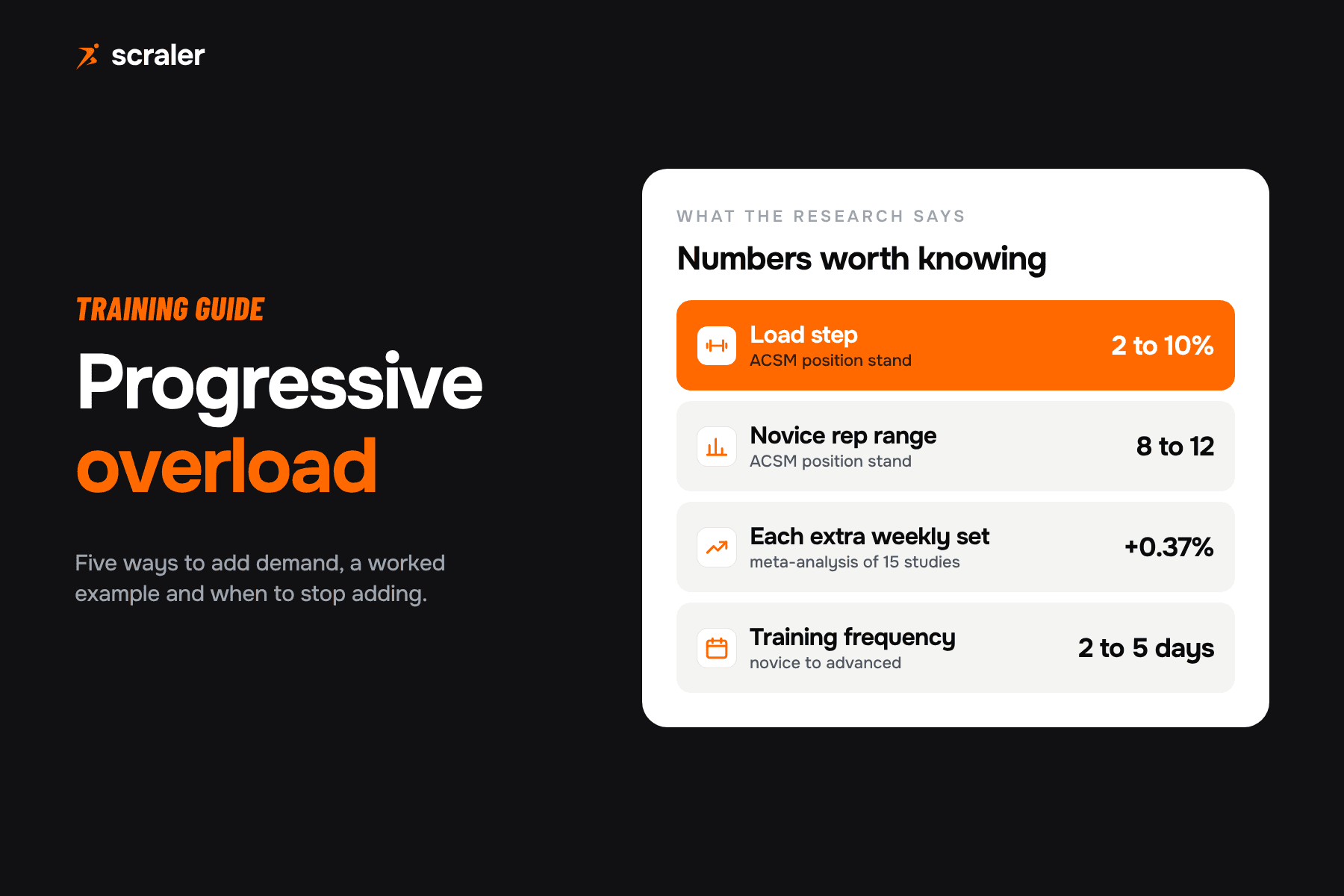
- 2 to 10% more load once the client beats the target by 1 to 2 reps
- Worked example: novice, back squat 1RM 80 kg
- 50 kg becomes 52.5 kg (a 5% step)
| Variable | ACSM figure | Worked example: novice, back squat 1RM 80 kg |
|---|---|---|
| Frequency | 2 to 3 days a week per muscle group, 48 hours apart | Monday and Thursday |
| Intensity | 60 to 70% of 1RM for novice to intermediate | 48 to 56 kg |
| Time | 2 to 4 sets of 8 to 12 reps | 3 sets of 8 to 12 reps |
| Type | Exercises for each major muscle group | Back squat, plus a push, pull and hinge |
| Volume | Sets x reps x load per week | 2 sessions x 3 sets = 6 hard squat sets a week |
| Progression | 2 to 10% more load once the client beats the target by 1 to 2 reps | 50 kg becomes 52.5 kg (a 5% step) |
The progression row comes from the 2009 ACSM progression models stand. ACSM published a new resistance training position stand in 2026 that updates the 2009 one; its headline advice is to train each major muscle group at least twice a week. If you do not have a tested 1RM, the one rep max calculator estimates one from a set of reps, and the RPE calculator converts a rating into reps in reserve if you prefer to set intensity by effort.
FITT principle for flexibility
The 2011 stand recommends flexibility work for each major muscle-tendon group on at least 2 to 3 days a week, with a total of 60 seconds per exercise. Most adults hold a static stretch for 10 to 30 seconds, and older people may benefit from 30 to 60 seconds. Static, dynamic, ballistic and PNF stretching are each effective. For PNF, the client contracts the muscle for 3 to 6 seconds, then takes a 10 to 30 second assisted stretch.
- ACSM figure
- At least 2 to 3 days a week
- Worked example: hamstring stretch
- 3 days a week, after training
- ACSM figure
- Not set as a number in the stand
- Worked example: hamstring stretch
- Stretch to mild tightness, never pain (coaching practice)
- ACSM figure
- 10 to 30 seconds per hold, 30 to 60 for older adults
- Worked example: hamstring stretch
- 20 second hold
- ACSM figure
- Static, dynamic, ballistic or PNF
- Worked example: hamstring stretch
- Static, lying with a strap
- ACSM figure
- 60 seconds in total per exercise
- Worked example: hamstring stretch
- 3 holds of 20 seconds per leg
- ACSM figure
- Not set as a number in the stand
- Worked example: hamstring stretch
- Move to 2 holds of 30 seconds, or add a PNF contraction
| Variable | ACSM figure | Worked example: hamstring stretch |
|---|---|---|
| Frequency | At least 2 to 3 days a week | 3 days a week, after training |
| Intensity | Not set as a number in the stand | Stretch to mild tightness, never pain (coaching practice) |
| Time | 10 to 30 seconds per hold, 30 to 60 for older adults | 20 second hold |
| Type | Static, dynamic, ballistic or PNF | Static, lying with a strap |
| Volume | 60 seconds in total per exercise | 3 holds of 20 seconds per leg |
| Progression | Not set as a number in the stand | Move to 2 holds of 30 seconds, or add a PNF contraction |
To see whether flexibility is improving, retest on the same day of the week under the same warm-up. The sit and reach test calculator compares a client's score with norms for their age and sex.
Does FITT apply to balance and other exercises?
Yes. The 2011 stand also covers neuromotor exercise, such as balance, agility and coordination work, and recommends it on 2 to 3 days a week. Summaries of its tables give about 20 to 30 minutes a day as the time. It is especially useful for older clients, and it fits into a warm-up or a circuit without a separate session.
How do you use the FITT principle to progress a client?
The position stand notes that gradually progressing intensity and volume may reduce the risks of exercise, and that people who cannot reach the targets still benefit from doing less. Both points shape how we use FITT with clients:
- 1Screen first
Run a PAR-Q and a baseline test before you set any numbers.
- 2Set all four variables
Frequency from the client's schedule, then type, time and intensity.
- 3Change one variable at a time
Usually time or reps first, then frequency, then intensity.
- 4Check the response
Read the log and the weekly check-in before the next change.
- 5Plan the bigger picture
Group the weekly changes into blocks with lighter weeks in between.
The step order is our coaching practice. Raising one variable at a time tells you which change worked and which one caused a problem. When you string several FITT changes into phases, that is periodization, and a planned lighter week is a deload week. For screening, use the free PAR-Q template.
How do you write FITT into a client program in Scraler?
In the Scraler training plan builder you place workouts on a weekly calendar, which sets frequency, and pick exercises from a library with videos and instructions, which sets type. Sets, reps and rest set time, and you can prescribe intensity as a percentage of 1RM or by RPE. When you prescribe by percentage, the weights scale with each client's 1RM. Copy a week and adjust it to write the progression.
Clients log each workout in their app, and the Training Progress view in the client profile shows completed and missed workouts and volume per session. Pair that with a weekly check-in on sleep and energy before you change the next variable.
Set frequency on the calendar, type from the exercise library, sets and reps for time, and % 1RM or RPE for intensity. Then copy the week and progress it.
See workout planningFrequently asked questions
- What is the FITT principle definition?
- The FITT principle is a framework for prescribing exercise by four variables: frequency (how often), intensity (how hard), time (how long) and type (what kind). Setting all four makes the dose measurable, and changing one at a time drives progress.
- What does the FITT principle stand for?
- FITT stands for Frequency, Intensity, Time and Type. The ACSM version, FITT-VP, adds Volume, the total weekly dose, and Progression, how that dose changes over time.
- What does the F in the FITT principle stand for?
- The F stands for frequency: how many times a week a client does a type of training. For example, the ACSM recommends training each major muscle group 2 to 3 days a week.
- What is the FITT-VP principle?
- FITT-VP is the ACSM extension of FITT. It keeps frequency, intensity, time and type and adds volume (frequency x intensity x time) and progression (the planned increase in dose). It describes a program over weeks, not just one week.
- Can you give a FITT principle example?
- For cardio: 5 days a week (frequency), 40 to 59% of heart rate reserve (intensity), 30 minutes (time), brisk walking (type). That is 150 minutes a week, the ACSM minimum for moderate exercise.
- How does the FITT principle apply to muscular strength?
- Train each major muscle group 2 to 3 days a week, at least 48 hours apart, at 60 to 70% of 1RM for novice to intermediate lifters, for 2 to 4 sets of 8 to 12 reps, using exercises for every major muscle group.
- How does the FITT principle apply to flexibility?
- Stretch each major muscle-tendon group at least 2 to 3 days a week. Hold static stretches for 10 to 30 seconds (30 to 60 for older adults) and repeat to reach 60 seconds per stretch in total.
- Is the FITT principle the same as progressive overload?
- No, but they work together. FITT describes the dose. Progressive overload is the principle of raising that dose over time, which you do by increasing one FITT variable, such as time, frequency or intensity.