Synergist Muscle: Agonist, Antagonist and Stabilizer Muscles Explained
A synergist muscle is a muscle that assists the prime mover (the agonist) in producing a movement. In a biceps curl, the biceps brachii is the agonist, the brachialis and brachioradialis are synergists, the triceps is the antagonist that does the opposite action, and stabilizers such as the rotator cuff hold the shoulder still so the elbow can work.

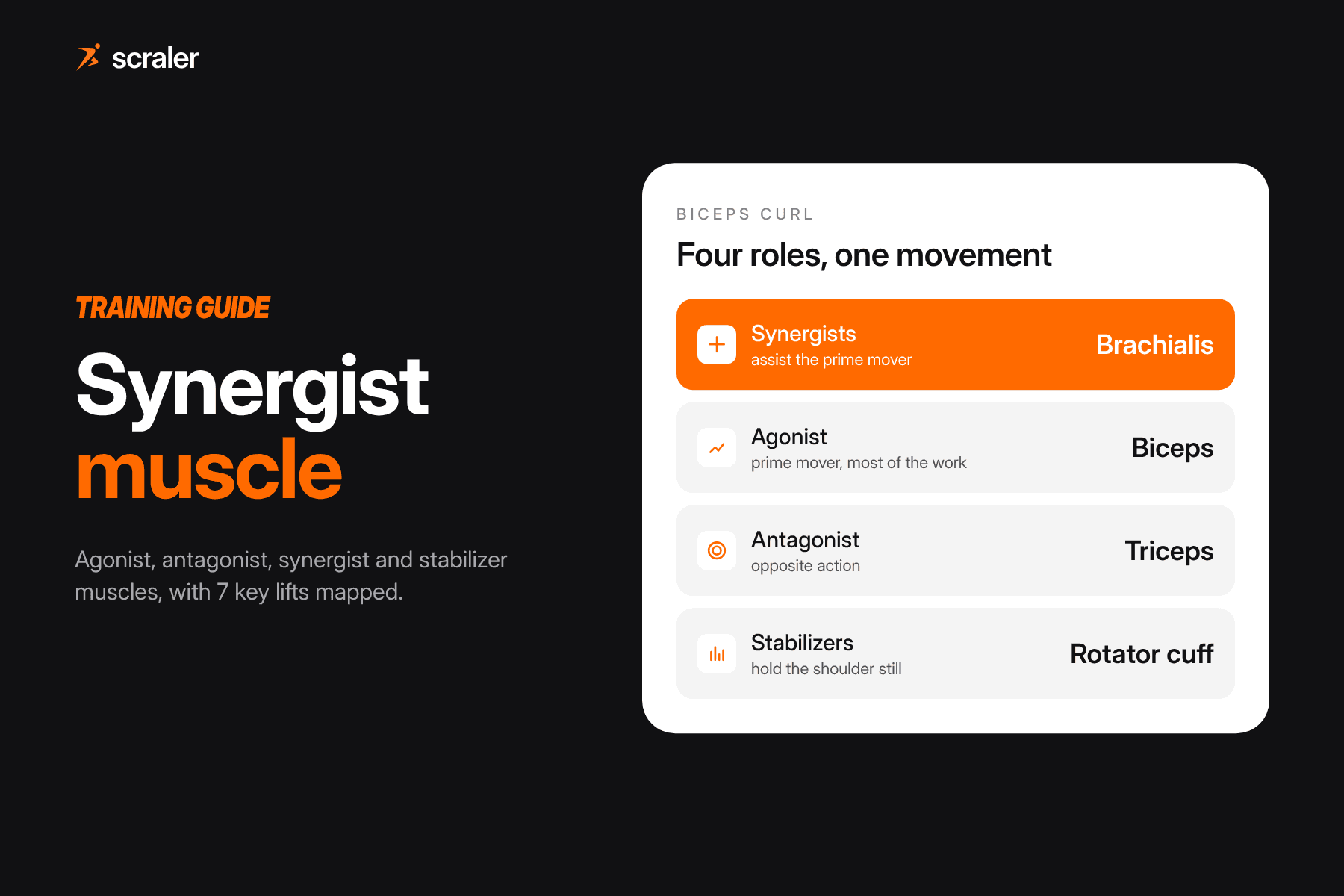
- Four roles, one movement: the agonist (prime mover) does most of the work, synergists assist it, the antagonist has the opposite action, and stabilizers (fixators) hold a joint still.
- Roles belong to a movement, not to a muscle. The triceps is the antagonist in a curl and the agonist in a pushdown.
- Agonist and antagonist supersets save time: a 2025 meta-analysis of 19 studies found supersets shortened sessions without lowering training volume, with similar long-term strength and muscle gains.
- Synergistic dominance, where a helper muscle takes over for a weak prime mover, is a coaching concept with little direct research. Use it as a reason to look closer, not as a diagnosis.
What is a synergist muscle?
A synergist is a muscle that helps the prime mover produce a movement. OpenStax Anatomy & Physiology, the open university textbook, uses lifting a cup as the example: the biceps brachii is the prime mover that bends the elbow, and because the brachialis assists it, the brachialis is called a synergist in that action. The brachioradialis in the forearm helps as well.
The synergist definition in one line: a muscle that contributes to the same movement as the agonist, without being the main driver. Synergists add force, help steer the joint, or cancel an unwanted side action of the prime mover. In a squat, for example, the adductors work with the glutes and quadriceps to drive you up.
One detail matters for coaches: roles are defined per movement. A muscle is not "a synergist" in general. It is a synergist in a specific action, at a specific joint. Change the movement and the same muscle can be the agonist, the antagonist or a stabilizer.
What are agonist, antagonist, synergist and stabilizer muscles?
- Also called
- Prime mover
- What it does
- The main muscle producing the movement
- Biceps curl example
- Biceps brachii bends the elbow
- Also called
- Helper, assistant mover
- What it does
- Assists the agonist in the same movement
- Biceps curl example
- Brachialis and brachioradialis
- Also called
- Opposing muscle
- What it does
- Has the opposite action of the agonist
- Biceps curl example
- Triceps brachii, which straightens the elbow
- Also called
- Fixator
- What it does
- Holds a bone or joint still so the agonist can work
- Biceps curl example
- Deltoids and rotator cuff keep the upper arm in place
| Role | Also called | What it does | Biceps curl example |
|---|---|---|---|
| Agonist | Prime mover | The main muscle producing the movement | Biceps brachii bends the elbow |
| Synergist | Helper, assistant mover | Assists the agonist in the same movement | Brachialis and brachioradialis |
| Antagonist | Opposing muscle | Has the opposite action of the agonist | Triceps brachii, which straightens the elbow |
| Stabilizer | Fixator | Holds a bone or joint still so the agonist can work | Deltoids and rotator cuff keep the upper arm in place |
Agonist muscle (prime mover)
The agonist muscle is the principal muscle responsible for an action. OpenStax notes that several muscles may be involved in a movement, but the main one is called the prime mover, or agonist. In a bench press that is the pectoralis major. A systematic review of EMG studies on the bench press found the pectoralis major and triceps showed more activity than the anterior deltoid.
Antagonist muscle
An antagonist muscle has the opposite action of the prime mover. StatPearls names the triceps brachii as the muscle that antagonizes the biceps: one bends the elbow, the other straightens it. During a curl the triceps lengthens as the elbow bends. When the movement reverses, so do the labels. In a triceps pushdown, the triceps becomes the agonist and the biceps the antagonist.
Stabilizer muscles and the fixator muscle
Stabilizer muscles hold a joint or bone in place while another joint moves. Anatomy textbooks call this role a fixator muscle: OpenStax describes the fixator as a type of synergist that stabilizes a bone so the prime mover can work from a steady base. The rotator cuff is the classic example. StatPearls describes its four muscles as the dynamic stabilizers of the shoulder that hold the head of the humerus against the socket. In a curl, they keep the upper arm still so that all the motion happens at the elbow.
How do agonist and antagonist muscles work together?
Agonist and antagonist muscles sit on opposite sides of a joint and pull in opposite directions. Common pairs:
- Biceps and triceps at the elbow (flexion vs extension).
- Quadriceps and hamstrings at the knee (extension vs flexion).
- Gluteus maximus and iliopsoas at the hip. StatPearls describes the iliopsoas as the primary hip flexor, the glutes extend the hip.
- Pectoralis major and posterior deltoid at the shoulder, bringing the arm across the body vs pulling it back.
- Hip abductors and adductors, moving the leg out and in. See abduction vs adduction for those movements.
While the agonist shortens, the antagonist lengthens and helps control the speed of the movement. On the way down in a curl, the biceps is still working, now lengthening under load. That is an eccentric contraction, explained in concentric vs eccentric.
Which muscles are agonists, antagonists, synergists and stabilizers in common exercises?
The table gives a simplified classification for seven staple lifts. Exact roles shift with grip, stance, depth and technique, so read it as a coaching map, not a lab result. Where a study backs a row, it is noted below the table.
- Agonist (prime mover)
- Pectoralis major
- Synergists
- Triceps brachii, anterior deltoid
- Antagonists
- Posterior deltoid (shoulder), biceps (elbow)
- Stabilizers
- Rotator cuff, shoulder blade muscles
- Agonist (prime mover)
- Quadriceps, gluteus maximus
- Synergists
- Adductors (adductor magnus), hamstrings (hip extension)
- Antagonists
- Hip flexors (iliopsoas)
- Stabilizers
- Erector spinae, abdominals
- Agonist (prime mover)
- Gluteus maximus, hamstrings, quadriceps
- Synergists
- Adductor magnus
- Antagonists
- Hip flexors (iliopsoas)
- Stabilizers
- Erector spinae, latissimus dorsi, abdominals, grip muscles
- Agonist (prime mover)
- Latissimus dorsi
- Synergists
- Biceps brachii, brachialis, lower trapezius
- Antagonists
- Deltoids (raising the arm), triceps (elbow)
- Stabilizers
- Rotator cuff, abdominals, erector spinae
- Agonist (prime mover)
- Biceps brachii
- Synergists
- Brachialis, brachioradialis
- Antagonists
- Triceps brachii
- Stabilizers
- Deltoids, rotator cuff, forearm muscles
- Agonist (prime mover)
- Deltoids (anterior and middle)
- Synergists
- Triceps, upper trapezius, serratus anterior
- Antagonists
- Latissimus dorsi (shoulder), biceps (elbow)
- Stabilizers
- Rotator cuff, abdominals, erector spinae
- Agonist (prime mover)
- Gluteus maximus
- Synergists
- Hamstrings, adductor magnus
- Antagonists
- Hip flexors (iliopsoas)
- Stabilizers
- Abdominals, quadriceps holding the knee angle
- Squat: in a 2019 training study, 10 weeks of squats grew the quadriceps, adductors and gluteus maximus, but hamstring volume did not change in either group. The hamstrings extend the hip but also cross the knee, so their length barely changes in a squat, which may explain why they did not grow.
- Deadlift: a 2020 systematic review of deadlift EMG found the erector spinae and quadriceps were more active than the glutes and hamstrings. The erectors work hard, but their job is to keep the spine from rounding, which makes them stabilizers. In the Romanian deadlift the hamstrings were more active than the erectors.
- Pull-up: a 2010 EMG study measured high latissimus dorsi activity in both pull-ups and chin-ups. The chin-up (palms facing you) drew more biceps and pectoralis major, the pull-up more lower trapezius.
- Overhead press: StatPearls describes the serratus anterior working with the trapezius to rotate the shoulder blade upward, which is what lets the arm go overhead. In a 2013 study, the standing dumbbell press gave the highest deltoid activity but the lowest 1RM, and the barbell drew more triceps.
- Hip thrust: a 2015 EMG study in 13 trained women found higher gluteus maximus and biceps femoris activity in the barbell hip thrust than in the back squat, with similar quadriceps (vastus lateralis) activity.
Need loads for these lifts? The one rep max calculator estimates a 1RM from any set, and the warm-up set calculator builds the ramp up to your working weight.
What is synergistic dominance and why does it matter for coaching?
Synergistic dominance is a term from corrective exercise courses, used in NASM course material and by the Brookbush Institute. It describes a synergist doing more than its share because the prime mover is weak or inhibited. The standard example: the gluteus maximus underperforms during hip extension and the hamstrings (biceps femoris) take over.
How we use it in practice (our own coaching practice, not a study protocol):
- Watch where the client feels it. If a hip thrust is "all hamstrings" and a squat is "all lower back", check setup first: foot position, depth, bar path.
- Change the exercise before the person. Cue, regress the load or pick a variation that puts the prime mover in a better position before labelling anything weak.
- Retest with a number. Use a rep count at a fixed load, or the client's rating, to see whether a change worked.
Do agonist and antagonist supersets work?
An agonist and antagonist superset (also called a paired set) alternates two exercises for opposing muscles, such as a bench press with a row, or a curl with a triceps pushdown. One muscle group rests while the other works. Here is what the research shows:
- Time: a 2025 meta-analysis by Zhang, Weakley and colleagues found supersets cut session time and raised training efficiency by a large margin (SMD 1.74) without lowering overall training volume. Agonist and antagonist supersets even allowed more repetitions (SMD 0.68).
- Long term: in the same analysis, maximal strength, strength endurance and muscle growth were similar to traditional sets.
- Effort: supersets raised perceived exertion (SMD 0.77) and blood lactate. Sessions feel harder.
- Efficiency: in Robbins et al. 2010, 18 trained men alternating bench pulls and bench press throws did about twice the work per minute of traditional sets, with power, volume load and EMG maintained.
- Volume and fatigue: in Paz et al. 2017, 15 trained men lifted more volume in every set with paired sets of pulls and presses, and also showed more fatigue.
One caveat: the 2010 review by the same Robbins group concluded the practical value of paired sets for boosting performance in the moment is limited. The strongest case is time. You get the same work done in less of it.
How do you use muscle roles in program design?
The rules below are our own coaching practice, built on the definitions and studies above.
- 1.Balance agonists and antagonists across the week. Match pushing with pulling and knee-dominant with hip-dominant work. A workout split makes the balance easy to check day by day.
- 2.Pair opposites when time is short. Bench press with a row, overhead press with a pull-up, curl with a pushdown. Keep heavy compound pairs to a minute or two between exercises so both get quality sets.
- 3.Count synergist volume. Every bench press also trains the triceps and anterior deltoid, every pull-up the biceps. Account for it before adding a lot of direct arm work.
- 4.Train stabilizers through the main lifts first. Standing presses, carries and single-leg work load the trunk and shoulder stabilizers. Add direct rotator cuff or core work where a lift shows a clear gap.
- 5.Use pairs and circuits for conditioning days. Alternating opposing muscle groups lets clients keep moving without one area failing first. Our full body circuit workout is built this way.
Pair this with a plan that adds load over time, covered in progressive overload, and effort targets from RIR meaning. For a ready layout, start from the workout plan template.
How do you program supersets in Scraler?
In the Scraler workout builder you link two exercises into a superset and the block moves, edits and repeats as one unit. Supersets alternate set by set. Circuits get rounds and rest between rounds. Clients train the block in the app in the order you set and log every set as they go.
The exercise library is searchable by muscle, including primary and secondary muscles, so finding the antagonist partner for an exercise takes a few seconds. Exercises can carry demo videos, so clients can check technique before they start.
Link exercises into supersets that alternate set by set or into circuits with rounds, and let clients train the block in the app.
See workout planningFrequently asked questions
- What is a synergist muscle?
- A synergist muscle assists the prime mover (agonist) in producing a movement. In elbow flexion, the biceps brachii is the prime mover and the brachialis and brachioradialis are synergists.
- What is the difference between an agonist and a synergist?
- The agonist is the main muscle producing a movement. A synergist contributes to the same movement but is not the main driver, for example the triceps and anterior deltoid during a bench press driven by the pectoralis major.
- What is an example of agonist and antagonist muscles?
- The biceps and triceps at the elbow. In a biceps curl the biceps is the agonist and the triceps the antagonist. In a triceps pushdown the roles reverse. Quadriceps and hamstrings at the knee are another common pair.
- What are stabilizer muscles?
- Stabilizer muscles hold a joint or bone still so another joint can move. The rotator cuff, which holds the head of the humerus in the shoulder socket, and the trunk muscles during a squat or deadlift are common examples.
- Is a fixator the same as a stabilizer?
- Yes, in practice. Anatomy textbooks such as OpenStax describe the fixator as a type of synergist that stabilizes a bone so the prime mover can work. Coaches usually call the same role a stabilizer.
- What is a prime mover?
- The prime mover is another name for the agonist: the principal muscle responsible for a given movement, such as the gluteus maximus in a hip thrust or the latissimus dorsi in a pull-up.
- Are agonist and antagonist supersets good for muscle growth?
- They appear to work as well as traditional sets. A 2025 meta-analysis of 19 studies found similar long-term strength and muscle growth with supersets, shorter sessions, and more repetitions with agonist and antagonist pairs, though sessions felt harder.