Concentric vs Eccentric: Muscle Actions, Tempo and What the Research Says
Concentric vs eccentric: a concentric contraction is when a muscle shortens while it produces force, like the biceps curling a dumbbell up. An eccentric contraction is when the muscle lengthens under load, like lowering that dumbbell back down. A third action, isometric, produces force with no change in length, such as pausing at the bottom of a squat.

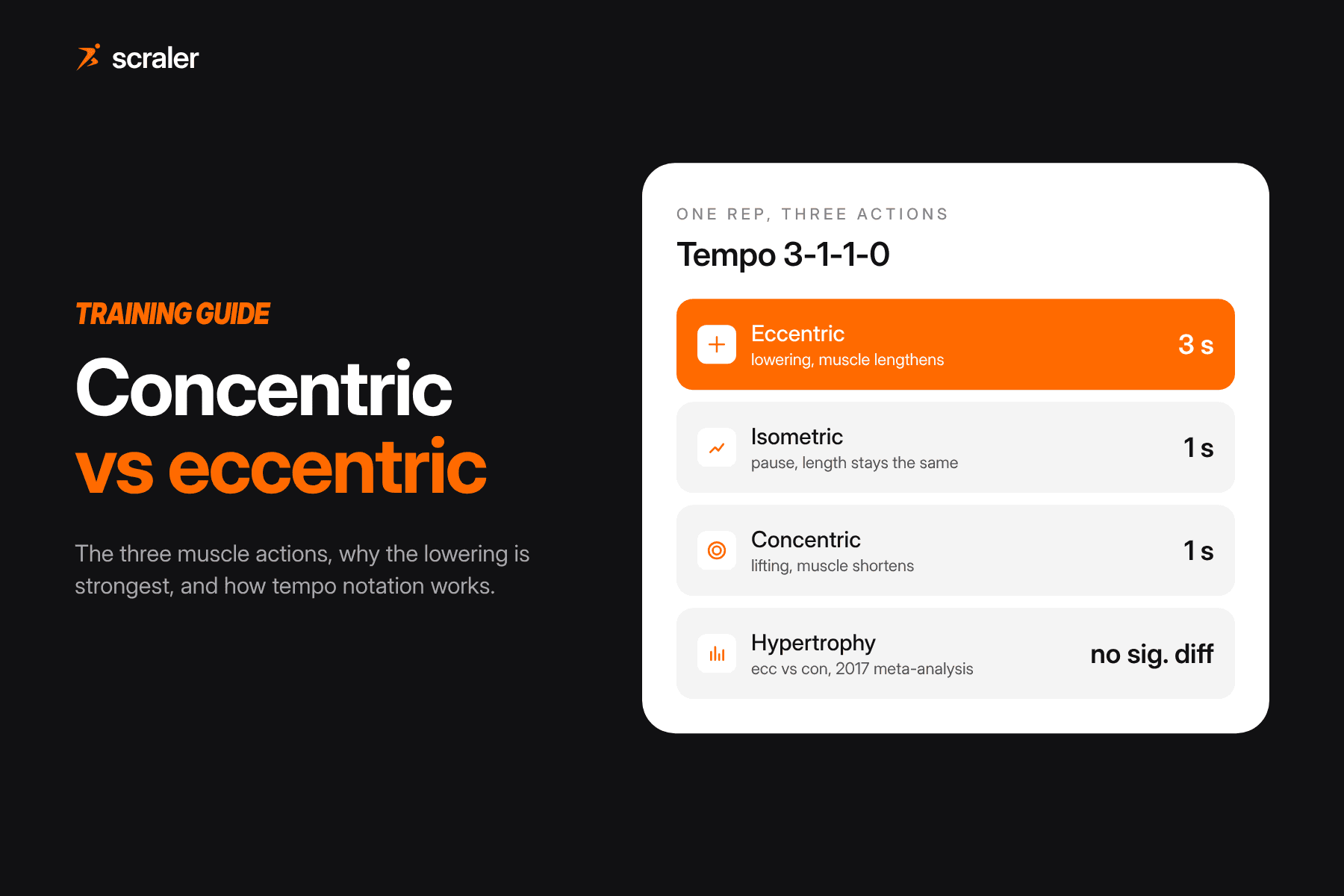
- Concentric = muscle shortens (the lift). Eccentric = muscle lengthens under control (the lowering). Isometric = force without movement (the pause or hold).
- Muscles produce more force when lengthening than when shortening at the same speed, and eccentric work uses less energy per unit of force. That is why you can lower more than you can lift.
- Unaccustomed eccentric work causes the most muscle soreness (DOMS, peaking 24 to 72 hours later), but one bout protects against the next: the repeated bout effect.
- For muscle growth, two meta-analyses found no significant difference between eccentric and concentric training. Program both, and use tempo notation like 3-1-1-0 to control the lowering.
What is the difference between concentric and eccentric?
Every rep of a strength exercise has phases, and in each one the working muscle does one of three things. OpenStax's Anatomy and Physiology textbook uses the biceps as the example: when you raise a weight toward your body the elbow angle closes and the biceps shortens. That is a concentric contraction. When you lower the weight under control the elbow angle opens and the biceps lengthens while still holding tension. That is an eccentric contraction.
The muscle is "contracting" in both cases, in the sense that it is producing force. The difference is the direction of its length change. Concentric and eccentric are both called isotonic actions, because a load moves while the muscle length changes. The third type, the isometric contraction, produces tension with no change in joint angle, like holding a plank or pausing a squat.
- Muscle shortens while producing force
- Usually the lifting or "up" phase
- Joint angle closes for the working muscle
- Produces less force than eccentric at a given speed
- Muscle lengthens while producing force
- Usually the lowering or "down" phase
- The muscle brakes the load against gravity
- Strongest action and the main cause of soreness
Concentric and eccentric examples: squat, curl and push-up
The easiest way to label a phase is to ask which muscle is working and whether it is getting shorter or longer. In most exercises the eccentric phase is the one where gravity would win if you let go.
- Eccentric phase (lengthening)
- Sitting down into the squat: quads and glutes lengthen
- Isometric phase (no movement)
- A pause at the bottom
- Concentric phase (shortening)
- Standing back up: quads and glutes shorten
- Eccentric phase (lengthening)
- Lowering the dumbbell: biceps lengthens
- Isometric phase (no movement)
- Holding the weight halfway
- Concentric phase (shortening)
- Curling the weight up: biceps shortens
- Eccentric phase (lengthening)
- Lowering the chest to the floor: chest and triceps lengthen
- Isometric phase (no movement)
- Holding just above the floor
- Concentric phase (shortening)
- Pushing back up: chest and triceps shorten
- Eccentric phase (lengthening)
- Lowering from the bar: lats and biceps lengthen
- Isometric phase (no movement)
- Holding the chin over the bar
- Concentric phase (shortening)
- Pulling up: lats and biceps shorten
- Eccentric phase (lengthening)
- Hinging down: hamstrings lengthen
- Isometric phase (no movement)
- Pausing below the knee
- Concentric phase (shortening)
- Driving the hips forward: hamstrings shorten
- Eccentric phase (lengthening)
- Lowering the heels below the step
- Isometric phase (no movement)
- Holding at the top
- Concentric phase (shortening)
- Rising onto the toes
| Exercise | Eccentric phase (lengthening) | Isometric phase (no movement) | Concentric phase (shortening) |
|---|---|---|---|
| Back squat | Sitting down into the squat: quads and glutes lengthen | A pause at the bottom | Standing back up: quads and glutes shorten |
| Biceps curl | Lowering the dumbbell: biceps lengthens | Holding the weight halfway | Curling the weight up: biceps shortens |
| Push-up | Lowering the chest to the floor: chest and triceps lengthen | Holding just above the floor | Pushing back up: chest and triceps shorten |
| Pull-up | Lowering from the bar: lats and biceps lengthen | Holding the chin over the bar | Pulling up: lats and biceps shorten |
| Romanian deadlift | Hinging down: hamstrings lengthen | Pausing below the knee | Driving the hips forward: hamstrings shorten |
| Calf raise | Lowering the heels below the step | Holding at the top | Rising onto the toes |
Notice that the label depends on the muscle, not the direction of travel. On a squat the quads work eccentrically on the way down. On a pull-up the lats work eccentrically on the way down too, even though that rep starts with the pull. In our own practice we use exercises with almost no lowering phase, like a sled push, when a client needs work without much soreness.
What is an isometric contraction?
An isometric contraction is the muscle producing force while its length and the joint angle stay the same. Planks, wall sits, a paused bench press and the hold at the top of a pull-up are all isometric. In the OpenStax definition this also covers trying to lift a weight that is too heavy to move: the muscle works hard but nothing travels.
In practice, isometrics show up in three places: as the pause digit in a tempo prescription, as holds for core and positional strength, and in rehab when moving through a full range is not yet comfortable. If you want to read more about structuring these phases over a training block, see the periodization guide.
Why are eccentric contractions stronger?
You can lower more weight than you can lift. A 2019 review in Frontiers in Physiology by Hody and colleagues summarises the two properties behind that. First, at a given movement speed, eccentric contractions generate greater force than other contraction types. Second, they need less motor unit activation and use less oxygen and energy to produce that force.
That efficiency has a cost. The same review explains that producing high force with fewer active fibres puts a high mechanical stress on each fibre, which can lead to small focal lesions in the muscle. That is the link between eccentric work and soreness.
Why do eccentric exercises cause more muscle soreness (DOMS)?
Delayed onset muscle soreness (DOMS) is the stiffness and tenderness that shows up a day or two after unfamiliar training. A 2003 review in Sports Medicine by Cheung, Hume and Maxwell notes that eccentric activities cause micro-injury more often and more severely than other muscle actions, and that soreness typically peaks 24 to 72 hours after exercise and is gone within 5 to 7 days.
The good news is that the body adapts fast. A 2003 review by McHugh describes the repeated bout effect: a single bout of eccentric exercise protects against muscle damage from the next eccentric bout. Hody and colleagues likewise name repeated submaximal eccentric sessions, with intensity raised step by step, as the most useful way to prevent the adverse effects.
Our own coaching practice follows that: in a client's first two weeks, or when we add a new eccentric-heavy exercise like Nordic curls, we start with one or two easy sets and add volume only once the soreness from the previous session has settled. Soreness on its own is not a sign of a good session, and it is a poor reason to skip the lowering phase.
Is eccentric training better for strength and muscle growth?
For strength, eccentric training has an edge when it uses heavier loads. A 2009 systematic review and meta-analysis by Roig and colleagues in the British Journal of Sports Medicine pooled 20 randomised controlled trials. When eccentric training was done at higher intensities than concentric training, total strength and eccentric strength increased more. The authors put the advantage down mainly to the higher loads possible eccentrically, and found the strength gains were more specific to the trained action.
For muscle size, the difference is small or absent. Roig and colleagues found larger gains in muscle girth with heavy eccentric training, but only a trend for cross-sectional area measured by MRI or CT. A 2017 meta-analysis by Schoenfeld and colleagues found a larger effect for eccentric actions (mean growth 10.0% vs 6.8%), but the difference was not statistically significant (effect size difference 0.25, 95% CI -0.03 to 0.52). A 2025 meta-analysis by da Silva and colleagues, with 26 studies and 682 participants, also found no significant difference and rated the certainty of evidence as very low.
- What it pooled
- 20 RCTs, healthy adults
- Main finding
- Heavier eccentric training raised total and eccentric strength more; more muscle girth, only a trend for cross-sectional area
- What it pooled
- RCTs comparing eccentric and concentric training
- Main finding
- Eccentric 10.0% vs concentric 6.8% growth, not statistically significant
- What it pooled
- 26 studies, 682 participants
- Main finding
- No significant difference in hypertrophy; very low certainty
- What it pooled
- 8 studies on repetition duration
- Main finding
- Similar hypertrophy from 0.5 to 8 s per rep; very slow reps over 10 s look worse
| Study | What it pooled | Main finding |
|---|---|---|
| Roig et al. 2009, Br J Sports Med | 20 RCTs, healthy adults | Heavier eccentric training raised total and eccentric strength more; more muscle girth, only a trend for cross-sectional area |
| Schoenfeld et al. 2017, J Strength Cond Res | RCTs comparing eccentric and concentric training | Eccentric 10.0% vs concentric 6.8% growth, not statistically significant |
| da Silva et al. 2025, J Strength Cond Res | 26 studies, 682 participants | No significant difference in hypertrophy; very low certainty |
| Schoenfeld et al. 2015, Sports Med | 8 studies on repetition duration | Similar hypertrophy from 0.5 to 8 s per rep; very slow reps over 10 s look worse |
The practical reading: do not drop either phase. Normal training already contains both, and the authors of the 2017 analysis recommend including eccentric and concentric actions in hypertrophy programs. Extra eccentric emphasis is a tool for specific goals, not a replacement for regular sets. Load and effort still matter most, which is why we pair tempo with progressive overload and an effort target like RIR.
How does tempo notation work (3-1-1-0)?
Tempo notation tells a client how long each phase of a rep should take. A 2021 review in Sports Medicine by Wilk, Zajac and Tufano recommends a four-digit format: eccentric, pause, concentric, pause. Each digit is seconds.
- 1.First digit: eccentric. The lowering phase. A 3 means three seconds down.
- 2.Second digit: pause at the bottom. The isometric transition after the lowering. A 1 means a one-second hold.
- 3.Third digit: concentric. The lifting phase. A 1 means one second up.
- 4.Fourth digit: pause at the top. The transition before the next rep. A 0 means go straight into the next rep.
So a squat at 3-1-1-0 is three seconds down, a one-second pause in the hole, one second up and no rest at the top: about five seconds per rep, or 40 seconds for a set of 8. A common coaching convention is an X for an explosive concentric ("3-1-X-0"), meaning lift as fast as possible with control. Because pull-ups and rows start with the concentric, some programs flip the order for those lifts. We keep the eccentric digit first on every exercise so clients only ever read one format; that is our convention, not a universal rule.
How slow is too slow? A 2015 meta-analysis by Schoenfeld, Ogborn and Krieger found similar muscle growth with repetition durations from 0.5 to 8 seconds, in studies taken to muscular failure, while very slow reps over 10 seconds appeared inferior. The 2021 tempo review found that neither slow nor fast tempo alone was clearly better for hypertrophy, with slower eccentrics combined with faster concentrics looking most favourable.
How do coaches program eccentric training?
The table below is our own coaching practice, built on the research above. It is a starting point, not a study prescription.
- Tempo or method we use
- 3-1-1-0 or 3-0-1-0
- Why
- A slower lowering makes positions visible and keeps loads modest
- Tempo or method we use
- 2-0-1-0 to 3-0-1-0
- Why
- Controlled lowering without slowing reps toward the 10 s range
- Tempo or method we use
- 2-0-X-0, or a paused rep (2-2-X-0)
- Why
- Intent to move the bar fast; pauses remove the bounce
- Tempo or method we use
- Lift with two limbs, lower with one (e.g. leg press, calf raise), 4 to 5 s down
- Why
- Uses the eccentric strength advantage without a spotter
- Tempo or method we use
- Nordic curls, slow heel drops, 3 to 5 s eccentrics
- Why
- Follows the injury research below; volume ramps up slowly
- Tempo or method we use
- Normal tempo, fewer sets
- Why
- Recover fatigue; avoid new eccentric stress
| Goal or situation | Tempo or method we use | Why |
|---|---|---|
| New client, learning a lift | 3-1-1-0 or 3-0-1-0 | A slower lowering makes positions visible and keeps loads modest |
| General muscle growth | 2-0-1-0 to 3-0-1-0 | Controlled lowering without slowing reps toward the 10 s range |
| Strength, main lifts | 2-0-X-0, or a paused rep (2-2-X-0) | Intent to move the bar fast; pauses remove the bounce |
| Eccentric overload | Lift with two limbs, lower with one (e.g. leg press, calf raise), 4 to 5 s down | Uses the eccentric strength advantage without a spotter |
| Rehab or prehab | Nordic curls, slow heel drops, 3 to 5 s eccentrics | Follows the injury research below; volume ramps up slowly |
| Deload week | Normal tempo, fewer sets | Recover fatigue; avoid new eccentric stress |
Two rules keep this from going wrong. Tempo changes how heavy a weight feels, so when you slow the eccentric, drop the load and keep the effort target (for example 2 RIR) the same. And change one thing at a time: if the tempo goes from 2-0-1-0 to 4-0-1-0, keep sets and reps steady that week. If a client logs every set on paper, the workout log template has room for a tempo column; to set loads, the one rep max calculator and RPE calculator give a starting weight. The lighter weeks are covered in deload week.
Does eccentric training help prevent injuries?
The strongest evidence is for the hamstrings. A 2019 meta-analysis by van Dyk, Behan and Whiteley in the British Journal of Sports Medicine pooled 15 studies with 8,459 athletes. Programmes that included the Nordic hamstring exercise, a kneeling exercise where the athlete lowers the body forward as slowly as possible, had an injury risk ratio of 0.49 (95% CI 0.32 to 0.74). Looking only at the eight randomised trials, the ratio was 0.52. The authors conclude these programmes reduce hamstring injuries by up to 51%. Most programmes combined the Nordic with other exercises, so its effect on its own is harder to pin down.
Eccentric loading also has a long history in tendon rehab. In a 1998 study, Alfredson and colleagues gave 15 recreational athletes with chronic Achilles tendinosis, who had not improved with conventional treatment, 12 weeks of heavy eccentric calf training. All 15 were back to their pre-injury running level after the 12 weeks. It was a small study without randomisation, so treat it as the origin of the method rather than proof. Injury rehab belongs with a physiotherapist; as a coach, your job is to run the programme they set and report back.
How do you add tempo to a workout in Scraler?
In the Scraler workout builder each exercise can show a Tempo column next to reps, weight, rest, RPE and RIR, and you type a tempo per set, for example 3120 or 3-1-1-0. The same per-set tempo field is in the training plan builder, so a whole block can progress from 3-0-1-0 in week one to 2-0-X-0 by week four.
On the client side, the tempo appears on each set row in the app ("Tempo 3-1-1-0"), next to the reps and effort target, so the client does not have to remember a note from the session. Combine it with an RIR column and the client knows how slow to lower the weight and how hard the set should feel.
Add a tempo, RIR or RPE target to any set in the workout builder and let clients see it on every rep they log.
See workout planningFrequently asked questions
- What is the difference between concentric and eccentric?
- In a concentric contraction the muscle shortens while producing force, such as curling a dumbbell up. In an eccentric contraction the muscle lengthens while producing force, such as lowering the dumbbell under control. Most exercises have both phases in every rep.
- Is going down concentric or eccentric?
- For most exercises, going down is eccentric, because the working muscle lengthens to brake the weight against gravity. On a squat the quads and glutes work eccentrically on the way down and concentrically on the way up.
- What is an example of an eccentric contraction?
- Lowering into a squat, lowering a dumbbell after a curl, lowering your chest in a push-up and lowering from a pull-up bar are all eccentric contractions. The Nordic hamstring curl is an exercise built almost entirely on the eccentric phase.
- What is an isometric contraction?
- An isometric contraction is when the muscle produces force without changing length or joint angle. Planks, wall sits and a pause at the bottom of a squat are isometric. In tempo notation the second and fourth digits are isometric pauses.
- Why are you stronger in the eccentric phase?
- At a given speed, muscles generate more force when lengthening than when shortening, and eccentric contractions need less motor unit activation and energy for the same force. That is why you can lower a weight you cannot lift.
- Does eccentric training build more muscle?
- Not clearly. A 2017 meta-analysis found 10.0% growth with eccentric vs 6.8% with concentric training, but the difference was not statistically significant, and a 2025 meta-analysis of 26 studies also found no significant difference. Include both phases.
- What does tempo 3-1-1-0 mean?
- Tempo 3-1-1-0 means three seconds lowering (eccentric), a one-second pause at the bottom, one second lifting (concentric) and no pause at the top. Each rep takes about five seconds.
- Why do eccentric exercises make you so sore?
- Eccentric work produces high force with fewer active fibres, which causes small muscle micro-injuries. Soreness typically peaks 24 to 72 hours later and fades within 5 to 7 days, and one bout protects you against damage from the next.