RIR Meaning: Reps in Reserve Explained for Coaches (With RPE Chart)
RIR meaning: RIR stands for reps in reserve, the number of extra reps you could still have done with good form when you stopped a set. 2 RIR means you ended the set with two reps left. RIR maps onto the RIR-based RPE scale, where RPE equals 10 minus RIR, so 2 RIR is RPE 8.

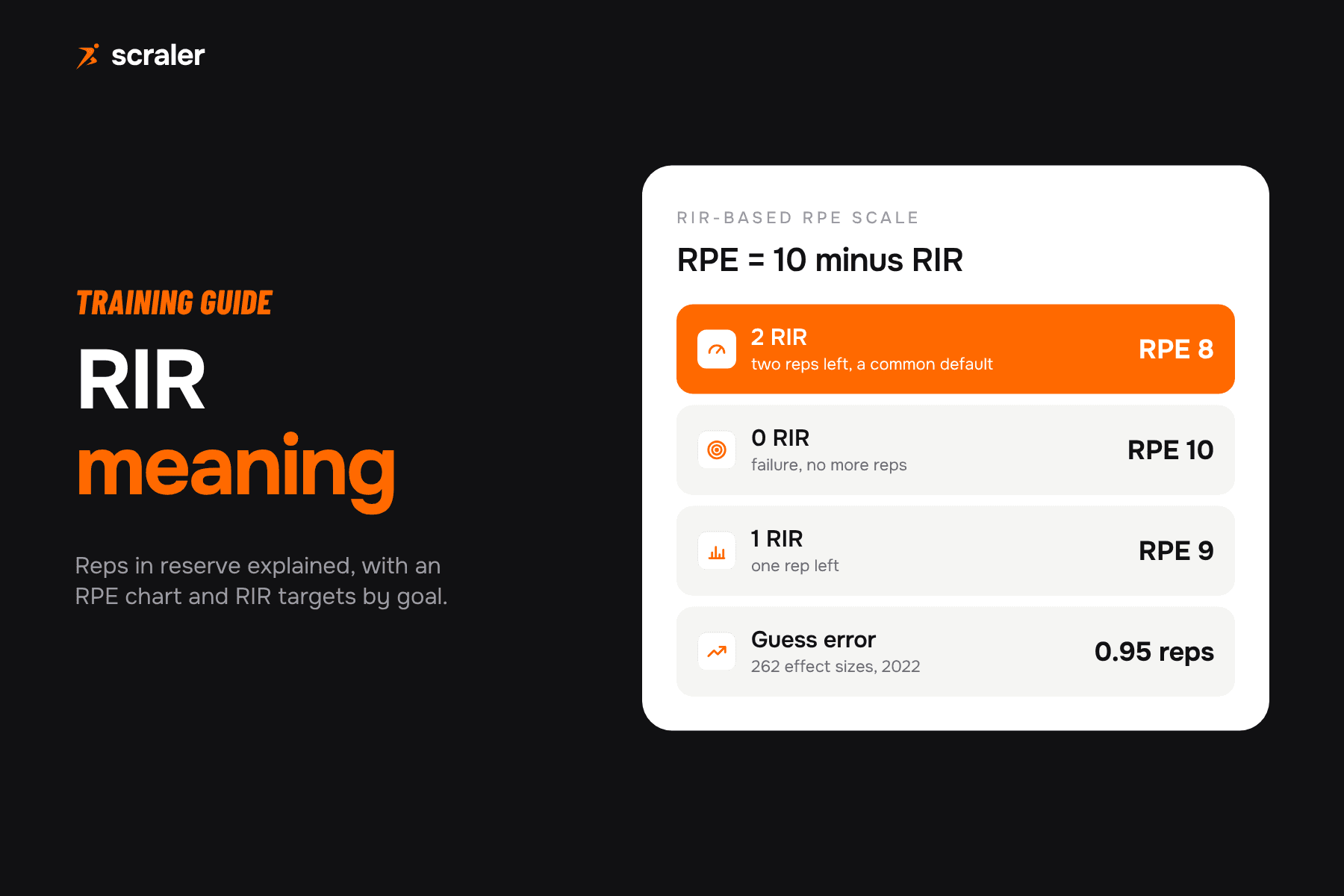
- RIR is a count of reps left in the tank. 0 RIR is failure, 1 RIR is one rep left, 2 RIR is two left. On the RIR-based RPE scale, RPE = 10 minus RIR.
- People are decent but imperfect at guessing it. A 2022 meta-analysis found lifters underpredicted their reps to failure by about one rep (0.95), and guesses got better closer to failure.
- You rarely need 0 RIR. Training to failure gave only a trivial edge for muscle growth in a 2023 meta-analysis, and strength gains looked similar across a wide range of RIR in a 2024 analysis.
- Write an RIR target on each working set, have clients log the RIR they actually hit, and treat a target that keeps slipping as a fatigue signal at the check-in.
What is RIR? The RIR meaning in the gym
RIR is short for reps in reserve. At the end of a set, the lifter asks one question: how many more clean reps could I have done? That number is the RIR. If a client squats 8 reps and could have done 10, the set was 2 RIR. If they could not have done a ninth rep, it was 0 RIR, which is failure.
So the RIR gym meaning is simply a way to describe how hard a set was by how close it came to failure. A program that says "3 x 8 at 2 RIR" tells the client to pick a weight they can lift for 8 reps while keeping about two in the tank. The load is not fixed. If they feel strong, the weight goes up. On a bad day it comes down, and the effort stays the same. That is why RIR is called a form of autoregulation.
What is RIR in lifting? The RIR-based RPE scale
RIR became a standard in weightlifting and powerlifting through the RIR-based RPE scale. In a 2016 study, Zourdos and colleagues had 29 lifters rate sets on a 1 to 10 scale where each number matched a rep count: RPE 10 = 0 RIR, RPE 9 = 1 RIR "and so forth". Fifteen were experienced squatters with about 5 years of training and fourteen were novices with less than half a year.
Two findings matter for coaches. First, the experienced lifters gave a higher rating at a true 1RM than the novices did, so beginners tended to underrate a maximal effort. Second, in the experienced group, bar speed and RPE moved closely together (r = -0.88): the slower the rep, the higher the rating. The authors concluded the scale "is a practical method to regulate daily training load".
The same research group then wrote a practical guide for coaches (Helms, Cronin, Storey and Zourdos, 2016). It uses RIR descriptors for ratings 5 to 10 and plain effort descriptors below that, and shows how to adjust the load set by set to what the athlete can do that day.
What do 0, 1, 2 and 3 RIR mean? RIR vs RPE chart
- RPE
- RPE 10
- What it means at the end of the set
- No more reps possible. This is failure
- Where coaches use it
- Occasional last sets on safe exercises, testing
- RPE
- RPE 9
- What it means at the end of the set
- One more rep was possible
- Where coaches use it
- Heavy top sets, the end of a training block
- RPE
- RPE 8
- What it means at the end of the set
- Two more reps were possible
- Where coaches use it
- A common default for working sets
- RPE
- RPE 7
- What it means at the end of the set
- Three more reps were possible
- Where coaches use it
- Early in a block, technique work, newer clients
- RPE
- RPE 5 to 6
- What it means at the end of the set
- Four to six reps left, the bar still moves fast
- Where coaches use it
- Warm-ups, deload weeks, practice
| RIR | RPE | What it means at the end of the set | Where coaches use it |
|---|---|---|---|
| 0 RIR | RPE 10 | No more reps possible. This is failure | Occasional last sets on safe exercises, testing |
| 1 RIR | RPE 9 | One more rep was possible | Heavy top sets, the end of a training block |
| 2 RIR | RPE 8 | Two more reps were possible | A common default for working sets |
| 3 RIR | RPE 7 | Three more reps were possible | Early in a block, technique work, newer clients |
| 4 to 6 RIR | RPE 5 to 6 | Four to six reps left, the bar still moves fast | Warm-ups, deload weeks, practice |
The mapping in the first two columns comes from the RIR-based RPE scale. The last column is our own coaching practice. 1 RIR meaning: you stopped one rep short of failure. 2 RIR meaning: you stopped two reps short. To turn a rating into a load, or check what RPE 8 for 5 reps means as a percentage of max, use the RPE calculator. It needs a 1RM, which you can estimate with the one rep max calculator.
RIR vs RPE: what is the difference?
- A count: how many reps were left
- Concrete question for beginners: "how many more could you do?"
- Written as 0, 1, 2, 3 RIR
- Lower number = harder set
- A 1 to 10 rating of how hard the set was
- On this scale, each number is defined by RIR
- Written as RPE 7, 8, 9, 10
- Higher number = harder set
On the RIR-based scale they describe the same effort, so RPE 8 and 2 RIR are the same set. The only trap is direction: RIR counts down as a set gets harder, RPE counts up. Pick one convention per program and write it at the top, so a client never has to guess whether "8" is a rating or a rep count.
How accurate are people at estimating RIR?
The best answer comes from a 2022 meta-analysis by Halperin and colleagues. Pooling 262 effect sizes from 12 study clusters, it found that people underpredicted how many reps they had left by 0.95 reps on average (95% CI 0.17 to 1.73). In other words, a set a client calls 2 RIR was, on average, closer to 3 RIR. The results varied a lot between studies, and the authors call people "imperfect" at predicting proximity to failure.
- Closer to failure is more accurate. Predictions made with fewer reps left, and on lower rep counts, were closer to the truth.
- Later sets were slightly more accurate, though that effect was trivial.
- Training status did not clearly matter. Experienced and newer lifters were similarly imperfect, and upper versus lower body exercises made no clear difference.
How close to failure should a RIR workout go?
Not all the way, most of the time. A 2023 meta-analysis by Refalo and colleagues (Sports Medicine 53(3), 15 studies) found only a trivial advantage for training to failure over stopping short for muscle growth (effect size 0.19, 95% CI 0.00 to 0.37). When failure was defined strictly as momentary muscular failure, there was no advantage at all.
A 2024 meta-regression by Robinson and colleagues, which included many of the same authors, looked at RIR as a continuous dose. Strength gains were similar across a wide range of RIR. Muscle growth improved as sets ended closer to failure. The authors call the analysis exploratory, and the RIR values in it were estimated, not measured.
Put together: for strength, you can leave reps in the tank and lose little. For muscle size, sets should be genuinely hard, but the step from 1 RIR to 0 RIR buys very little and costs recovery. That is the case for a RIR workout built mostly on 1 to 3 RIR working sets.
How do you program RIR targets by goal and experience?
The table below is our own coaching practice, built on the research above. It is a starting point, not a study prescription.
- RIR target on working sets
- 3 to 4 RIR
- Why
- They are learning the movement and tend to underrate hard sets. Effort climbs as technique settles
- RIR target on working sets
- 1 to 3 RIR, down to 0 to 1 on the last set of safe isolation work
- Why
- Growth improves closer to failure, but failure itself adds little
- RIR target on working sets
- 1 to 3 RIR
- Why
- Strength gains looked similar across a wide RIR range, so heavy load matters more than grinding
- RIR target on working sets
- 0 to 1 RIR on top sets
- Why
- Short phases only, with a spotter or safety bars
- RIR target on working sets
- 4 or more RIR
- Why
- Keeps the movement pattern while fatigue drops
| Client or goal | RIR target on working sets | Why |
|---|---|---|
| New client, first 4 to 8 weeks | 3 to 4 RIR | They are learning the movement and tend to underrate hard sets. Effort climbs as technique settles |
| Muscle growth (hypertrophy) | 1 to 3 RIR, down to 0 to 1 on the last set of safe isolation work | Growth improves closer to failure, but failure itself adds little |
| Strength, main lifts | 1 to 3 RIR | Strength gains looked similar across a wide RIR range, so heavy load matters more than grinding |
| Peaking or testing | 0 to 1 RIR on top sets | Short phases only, with a spotter or safety bars |
| Deload week | 4 or more RIR | Keeps the movement pattern while fatigue drops |
Most coaches also move RIR across a block: start a phase at 3 RIR, work toward 1 RIR over a few weeks, then deload. That fits neatly into the phases described in our periodization guide, and the lighter week at the end is covered in deload week. Within each week, RIR tells you when to add load: if the target was 2 RIR and the client logs 4 RIR on every set, the weight is too light. That is how RIR drives progressive overload without guessing.
How to teach clients to judge RIR
- 1.Ask the question after every working set: "How many more good reps could you have done?" Write the answer down.
- 2.Calibrate on a safe exercise. Once in a while, on a machine or a dumbbell move, have the client predict their RIR and then keep going to a technical stop. The gap between guess and reality is their personal bias.
- 3.Watch the bar speed. In the 2016 study, slower reps went with higher ratings. A grinding final rep is rarely 3 RIR.
- 4.Use ranges early. "2 to 3 RIR" is easier to hit than an exact number and fits the roughly one rep error the research found.
All four steps are coaching practice, not study protocols. Never run the calibration on a heavy barbell squat or bench without a spotter.
How do coaches use RIR in check-ins?
For online and hybrid clients, the logged RIR is often the only window into how hard a session really was. We use it in three ways at the weekly check-in:
- Target versus actual. The plan said 2 RIR. Did the client log 2? A steady 4 means the loads are light. A steady 0 means they are too heavy, or the client is going to failure out of habit.
- Drift over weeks. The same load at the same reps that slides from 2 RIR to 0 RIR across two or three weeks, alongside poor sleep or energy scores, is a fatigue signal. That is a reason to hold or deload, not to add.
- One effort question in the form. "Rate your hardest set this week in reps in reserve" is quick to answer and easy to compare week to week.
Our client check-in form template has a training section where this question fits, next to the 1 to 5 ratings for sleep, energy and soreness. If clients log sets on paper, the workout log template has an effort column for each set.
How do you set RIR targets in Scraler?
In the Scraler workout builder you can switch on an RIR column, an RPE column, or both, for each exercise and set a target per set: 3 RIR on the first set, 2 on the next, 1 on the last. Loads can also be written as a percentage of 1RM, so a target such as 75% at 2 RIR gives the client a starting weight and an effort to adjust it by.
When you run a session live with a client, the log shows each set's target next to last session's numbers, so you see "8 reps, RPE 8" while you type in the weight and reps. For the weekly review, check-ups let you build a form once with rating scales and open questions, send it on a schedule and read every answer in one screen.
Add RIR or RPE targets to any set in the workout builder, prescribe by % of 1RM, and review how hard every session felt at the weekly check-up.
See workout planningTo collect the effort question every week without chasing clients, see client check-ups.
Frequently asked questions
- What does RIR mean?
- RIR means reps in reserve: the number of extra reps you could still have done with good form when you ended a set. A set of 8 where you could have done 10 is 2 RIR. A set where no further rep was possible is 0 RIR, which is failure.
- What does 1 RIR mean?
- 1 RIR means you stopped the set with one good rep left. On the RIR-based RPE scale it equals RPE 9. Coaches use it for heavy top sets and the hardest weeks of a training block.
- What does 2 RIR mean?
- 2 RIR means you finished the set with two good reps left, which equals RPE 8. It is a common default for working sets because it is hard enough to drive progress without the recovery cost of going to failure.
- What is RIR in weightlifting?
- In weightlifting and powerlifting, RIR is the basis of the RIR-based RPE scale published by Zourdos and colleagues in 2016, where RPE 10 is 0 reps in reserve, RPE 9 is 1 and so on. Lifters use it to set the day's load by effort instead of a fixed weight.
- Is RIR the same as RPE?
- On the RIR-based scale they describe the same effort in two formats: RPE equals 10 minus RIR. RIR counts the reps left and goes down as a set gets harder, while RPE is a 1 to 10 rating that goes up.
- How accurate is RIR?
- Reasonably, but not exactly. A 2022 meta-analysis of 262 effect sizes found people underpredicted their reps to failure by about one rep on average, with large differences between studies. Estimates were better closer to failure, and training status did not clearly change accuracy.
- What RIR should you train at for muscle growth?
- Most working sets at 1 to 3 RIR is a sound default. A 2024 analysis found muscle growth improved closer to failure, while a 2023 meta-analysis found training all the way to failure gave only a trivial extra benefit.
- Should beginners use RIR?
- Yes, with wider targets such as 3 to 4 RIR while they learn the lifts. In the 2016 RIR scale study, novices rated a true max lower than experienced lifters did, so ask the question after every set and calibrate on safe exercises.