Abduction vs Adduction: The Difference, Joint by Joint (With Exercises)
Abduction vs adduction: abduction moves a body part away from the midline of the body, and adduction moves it back toward or across the midline. Lifting your arm out to the side is shoulder abduction; lowering it back is shoulder adduction. Both happen in the frontal plane, at the shoulder, hip, wrist, fingers and toes.

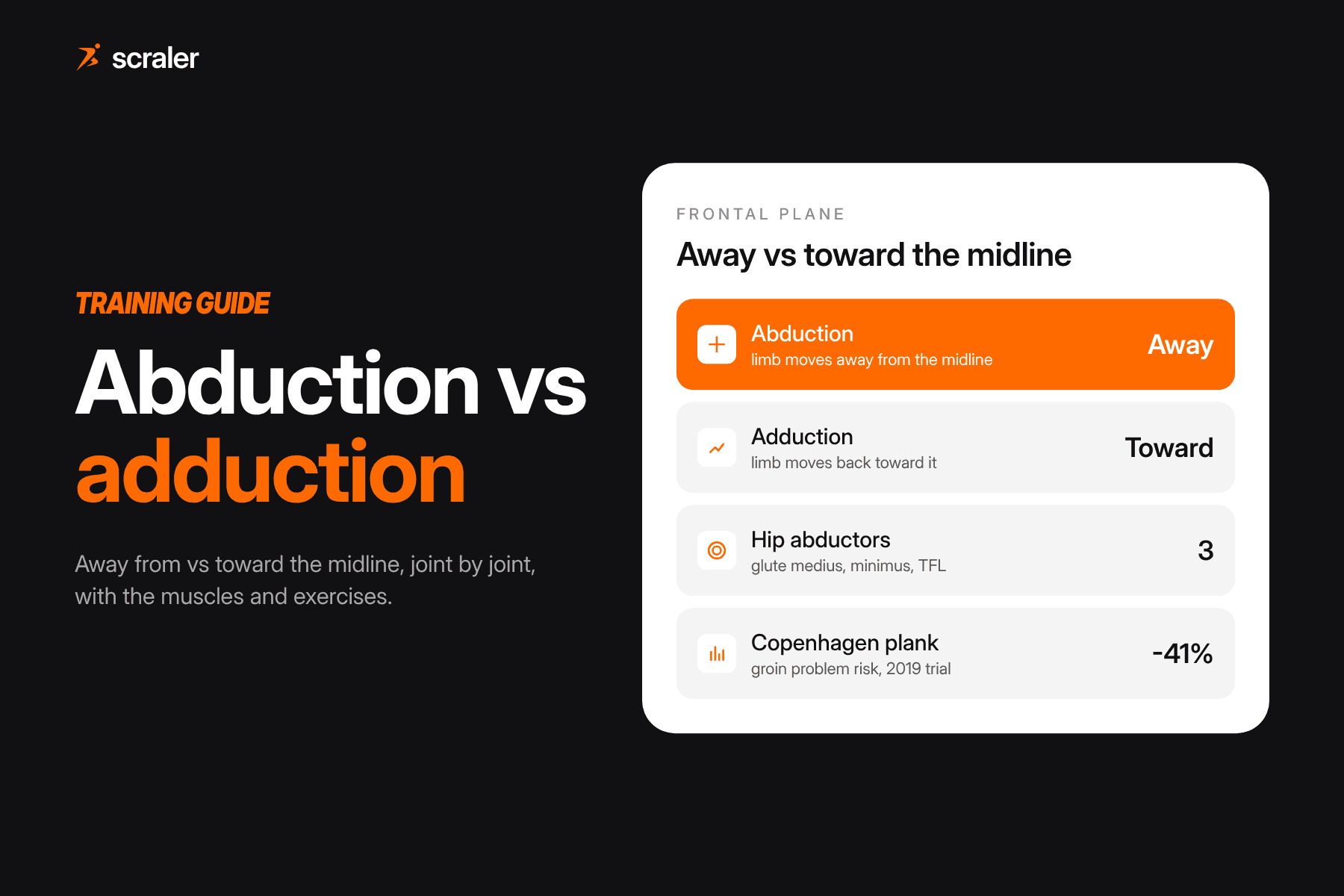
- Abduction = away from the midline. Adduction = toward it. Both are side to side movements in the frontal plane, measured from standard anatomical position.
- Fingers and toes use their own reference line: the middle finger for the hand, the second toe for the foot. At the wrist the terms are radial deviation (abduction) and ulnar deviation (adduction).
- The main hip abductors are gluteus medius, gluteus minimus and tensor fasciae latae. The hip adductors are adductor longus, brevis and magnus, pectineus and gracilis.
- Train both. A 2019 trial with 652 football players found a single Copenhagen adduction exercise cut the risk of groin problems by 41%. The seated machines are fine accessories, not the whole plan.
What is the difference between abduction and adduction?
The difference is direction. Picture a line running straight down the middle of the body, from the head to between the feet. Abduction moves a limb sideways, away from that line. Adduction moves it back toward the line, or past it. OpenStax Anatomy and Physiology defines both as movements in the coronal, or frontal, plane: abduction moves a limb laterally away from the body, adduction moves it medially toward or across the midline.
Every direction is judged from standard anatomical position: standing upright, arms by the sides, palms facing forward. That matters because the same word describes the same movement whether a client is standing, lying on a bench or hanging from a bar. A side-lying leg raise and a standing cable kick out to the side are both hip abduction.
- Away from the midline
- Arm out to the side, leg out to the side
- Spreading the fingers or toes
- Wrist: radial deviation (toward the thumb)
- Toward or across the midline
- Arm back to the side, legs squeezed together
- Bringing the fingers or toes together
- Wrist: ulnar deviation (toward the little finger)
How do you remember abduction vs adduction?
Two tricks work for most clients and students. This is our own teaching practice, not a textbook rule:
- AB = taken away. To be abducted is to be taken away. Abduction takes the limb away from the body.
- ADD = added back. ADDuction ADDs the limb back to the body. If you can say "add it back", you know which one it is.
- For the hand: PAD and DAB. Anatomy students use this one for the small hand muscles: Palmar interossei ADduct, Dorsal interossei ABduct.
Which joints can abduct and adduct?
OpenStax lists the shoulder, hip, wrist, the knuckle joints of the hand (metacarpophalangeal) and the matching joints of the foot (metatarsophalangeal). Horizontal abduction and adduction at the shoulder and hip are a separate pair in a different plane. Here is how each one looks:
- Abduction
- Arm out to the side
- Adduction
- Arm back down to the side
- Reference line
- Midline of the body
- Gym example
- Lateral raise / wide grip pulldown
- Abduction
- Leg out to the side
- Adduction
- Leg back in, or across the other leg
- Reference line
- Midline of the body
- Gym example
- Hip abduction machine / Copenhagen plank
- Abduction
- Spreading the fingers
- Adduction
- Squeezing the fingers together
- Reference line
- The middle finger
- Gym example
- Rubber band finger spreads (abduction)
- Abduction
- Spreading the toes
- Adduction
- Drawing the toes together
- Reference line
- The second toe
- Gym example
- Toe spreading in foot drills
- Abduction
- Radial deviation: hand tilts to the thumb side
- Adduction
- Ulnar deviation: hand tilts to the little finger side
- Reference line
- Forearm in anatomical position
- Gym example
- Hammer grip wrist tilts with a light bar
- Abduction
- Arm raised in front swings out to the side
- Adduction
- Arm swings back across the body
- Reference line
- Transverse plane, limb raised to about 90 degrees
- Gym example
- Reverse fly / chest fly
Two exceptions trip people up. The thumb works at right angles to the fingers: in thumb abduction it moves forward, away from the palm, to a perpendicular position. And horizontal abduction and adduction happen in the transverse plane, the flat plane you would see from above, usually described with the arm raised to about 90 degrees. A reverse fly is horizontal abduction; a chest fly or a push-up is horizontal adduction. When a limb traces a full circle, as in arm circles, that is circumduction: flexion, adduction, extension and abduction in sequence.
Hip abduction vs adduction: which muscles do the work?
At the hip the two groups sit on opposite sides of the thigh, so "outer thigh" and "inner thigh" are a fair shorthand for clients.
- Main muscles
- Gluteus medius, gluteus minimus, tensor fasciae latae
- Also worth knowing
- Medius and minimus run from the ilium to the top of the femur (greater trochanter). TFL also helps flex the hip
- Main muscles
- Adductor longus, adductor brevis, adductor magnus, pectineus, gracilis
- Also worth knowing
- Longus and pectineus also flex the hip, magnus also extends it, gracilis also bends the knee
| Movement | Main muscles | Also worth knowing |
|---|---|---|
| Hip abduction | Gluteus medius, gluteus minimus, tensor fasciae latae | Medius and minimus run from the ilium to the top of the femur (greater trochanter). TFL also helps flex the hip |
| Hip adduction | Adductor longus, adductor brevis, adductor magnus, pectineus, gracilis | Longus and pectineus also flex the hip, magnus also extends it, gracilis also bends the knee |
The adductors are not one-trick muscles. OpenStax notes they can rotate the thigh inward or outward depending on where the foot is placed, and that the adductor magnus helps extend the hip. That is why heavy squats, lunges and deadlifts already load the inner thigh in a way the seated adductor machine does not. For how muscles pair up as movers and brakes, see agonist, antagonist and synergist muscles.
Which muscles abduct and adduct the shoulder?
- Abduction: the supraspinatus and the middle deltoid work together. Textbooks such as StatPearls often credit the supraspinatus with the first 15 degrees, though EMG shows it stays active throughout, and the deltoid supplies most of the force. A lateral raise is mostly a middle deltoid exercise for that reason.
- Adduction: mainly the latissimus dorsi, teres major and pectoralis major. A wide grip pulldown or pull-up pulls the arms down and in toward the body, which is shoulder adduction.
- Horizontal adduction: the pectoralis major does most of it, which is why chest flyes and presses train the chest. Horizontal abduction (reverse flyes, band pull-aparts, face pulls) works the rear deltoid and upper back.
In the hand, the dorsal interossei spread the fingers away from the middle finger and the palmar interossei pull them back in. The foot mirrors this around the second toe. At the wrist, the flexor carpi radialis helps tilt the hand toward the thumb (radial deviation) and the flexor carpi ulnaris toward the little finger (ulnar deviation).
What are the best abduction exercises?
For the glutes, the clearest data point comes from a 2009 EMG study by DiStefano and colleagues. Of 12 common exercises tested in 21 healthy, active people, side-lying hip abduction produced the highest gluteus medius activity. The single-leg squat and single-leg deadlift produced the most gluteus maximus activity. EMG shows how hard a muscle is working, not how much it will grow, so we use it to choose exercises, not to promise results.
- Movement
- Hip abduction
- How we use it (coaching practice)
- Bodyweight starter, 2 to 3 sets of 12 to 20, toes pointing forward
- Movement
- Hip abduction (seated)
- How we use it (coaching practice)
- Easy to load and progress, 2 to 3 sets of 10 to 20 at the end of a lower body day
- Movement
- Hip abduction (standing)
- How we use it (coaching practice)
- Ankle cuff, stand tall, also trains balance on the standing leg
- Movement
- Hip abduction
- How we use it (coaching practice)
- Warm-up or finisher, band above the knees or around the feet
- Movement
- Hip abduction with outward rotation
- How we use it (coaching practice)
- Rehab-friendly, low load, good for beginners
- Movement
- Shoulder abduction
- How we use it (coaching practice)
- Main middle deltoid exercise, 3 sets of 10 to 20
- Movement
- Horizontal shoulder abduction
- How we use it (coaching practice)
- Rear deltoids and upper back, balances pressing volume
| Exercise | Movement | How we use it (coaching practice) |
|---|---|---|
| Side-lying hip abduction | Hip abduction | Bodyweight starter, 2 to 3 sets of 12 to 20, toes pointing forward |
| Hip abduction machine | Hip abduction (seated) | Easy to load and progress, 2 to 3 sets of 10 to 20 at the end of a lower body day |
| Cable hip abduction | Hip abduction (standing) | Ankle cuff, stand tall, also trains balance on the standing leg |
| Banded lateral walk | Hip abduction | Warm-up or finisher, band above the knees or around the feet |
| Clamshell | Hip abduction with outward rotation | Rehab-friendly, low load, good for beginners |
| Dumbbell or cable lateral raise | Shoulder abduction | Main middle deltoid exercise, 3 sets of 10 to 20 |
| Reverse fly, band pull-apart, face pull | Horizontal shoulder abduction | Rear deltoids and upper back, balances pressing volume |
What are the best adduction exercises?
The best studied adductor exercise is the Copenhagen plank, also called the Copenhagen adduction. In a 2019 cluster-randomised trial, Harøy and colleagues gave 18 Norwegian semi-professional football teams this one exercise, three times a week in a 6 to 8 week preseason and once a week through a 28 week season. Compared with 17 control teams (652 players in total), groin problems averaged 13.5% versus 21.3% of players during the season, a 41% lower risk (odds ratio 0.59).
- Movement
- Hip adduction
- How we use it (coaching practice)
- Top knee on a bench, hold or lift reps. The regression for most clients
- Movement
- Hip adduction
- How we use it (coaching practice)
- Top foot on the bench. Only once the short lever is easy and pain free
- Movement
- Hip adduction (seated)
- How we use it (coaching practice)
- Simple, loadable, 2 to 3 sets of 10 to 20
- Movement
- Hip adduction (standing)
- How we use it (coaching practice)
- Ankle cuff, pull the leg across the body
- Movement
- Hip adduction
- How we use it (coaching practice)
- Bottom leg lifts, top foot planted in front. Home friendly
- Movement
- Shoulder adduction
- How we use it (coaching practice)
- Main back exercises in any program
- Movement
- Horizontal shoulder adduction
- How we use it (coaching practice)
- Main chest exercises
| Exercise | Movement | How we use it (coaching practice) |
|---|---|---|
| Copenhagen plank, short lever | Hip adduction | Top knee on a bench, hold or lift reps. The regression for most clients |
| Copenhagen plank, long lever | Hip adduction | Top foot on the bench. Only once the short lever is easy and pain free |
| Hip adduction machine | Hip adduction (seated) | Simple, loadable, 2 to 3 sets of 10 to 20 |
| Cable hip adduction | Hip adduction (standing) | Ankle cuff, pull the leg across the body |
| Side-lying adduction | Hip adduction | Bottom leg lifts, top foot planted in front. Home friendly |
| Wide grip pulldown, pull-up | Shoulder adduction | Main back exercises in any program |
| Chest fly, push-up, bench press | Horizontal shoulder adduction | Main chest exercises |
The trial was run on male football players, so treat the 41% as evidence that adductor strength work is worth doing, not as a number you can promise every client. We still add a Copenhagen variation for clients who run, play field sports, or have had a groin strain before, starting with the short lever.
Are hip abduction and adduction machines worth it?
Yes, as accessories. This is our own coaching view. The seated machines isolate one movement, let a client add load in small steps, and are easy to learn in a single session, which is useful for beginners, for clients who cannot yet balance on one leg, and as a finisher at the end of a lower body day.
- What they do well: steady, measurable progression. If a client goes from 30 to 45 kg over a block, you know the muscles got stronger.
- What they miss: the hip abductors mostly work while standing on one leg, to keep the pelvis level. The seated machine trains them without that balance demand. Pair it with a standing or single-leg option such as cable abduction, step-ups or single-leg deadlifts.
- What they will not do: "spot reduce" fat from the outer or inner thigh. Sell them to clients as strength and joint support work, not as thigh slimmers.
- For knee pain clients: the 2019 patellofemoral pain clinical practice guideline recommends exercise that combines hip and knee targeted work. Hip abductor exercises fit that, but a client with ongoing knee pain should be assessed by a physiotherapist first.
How should personal trainers program abduction and adduction?
The notes below are our own coaching practice, built on the anatomy and studies above.
- 1.Screen first. A fitness assessment with a single-leg squat or step-down shows whether the knee caves in or the hip drops. That is a cue to add abductor work early.
- 2.One of each, most weeks. In a lower body or full body day, one abduction and one adduction exercise for 2 to 3 sets each is enough for most clients. Put them after the main lifts, not before.
- 3.Watch the cheats. On hip abduction, clients lean the trunk or roll the hips back so the front of the hip does the work. Keep the toes pointing forward and the pelvis still. On lateral raises, stop the shrug and the swing.
- 4.Progress with a plan. Add reps first, then load, as in any progressive overload scheme. For Copenhagen planks, progress hold time, then reps, then lever length.
- 5.Place it in the split. Abduction and adduction accessories fit any workout split; in a full body circuit a banded lateral walk works as an active rest station.
- 6.Respect pain. Groin pain during a Copenhagen plank is a reason to regress to the short lever or stop, not to push through.
For effort, write a target on each accessory set, for example 2 to 3 reps in reserve. Our RIR guide explains how to teach clients to judge it.
How do you program abductor and adductor work in Scraler?
In the Scraler workout builder, each exercise can carry a video, so a client sees how a Copenhagen plank or cable abduction should look before they try it. If the library does not have the exact variation you coach, create it as your own custom exercise with your own video. Each exercise has a notes field for cues such as "toes forward, pelvis still", and you can link exercises into supersets or circuits, for example a lateral walk paired with a Copenhagen plank as a finisher.
Add abduction and adduction exercises with videos and coaching notes, group them into supersets, and send the plan to every client in minutes.
See workout planningFrequently asked questions
- What is the difference between abduction and adduction?
- Abduction moves a body part away from the midline of the body, such as raising the arm out to the side. Adduction moves it back toward or across the midline, such as lowering the arm or squeezing the legs together. Both happen in the frontal plane.
- How do you remember abduction vs adduction?
- Abduction takes the limb away, like being abducted. ADDuction ADDs the limb back to the body. For the hand, anatomy students use PAD and DAB: palmar interossei adduct, dorsal interossei abduct.
- What is hip abduction vs hip adduction?
- Hip abduction moves the leg out to the side, mainly with the gluteus medius, gluteus minimus and tensor fasciae latae. Hip adduction brings the leg back in or across the other leg, mainly with the adductor longus, brevis and magnus, the pectineus and the gracilis.
- Which muscles are the abductors and adductors?
- At the hip, the abductors are the gluteus medius, gluteus minimus and tensor fasciae latae, and the adductors are the adductor longus, brevis and magnus, pectineus and gracilis. At the shoulder, the supraspinatus and middle deltoid abduct, and the latissimus dorsi, teres major and pectoralis major adduct.
- What is an example of abduction motion?
- A dumbbell lateral raise (shoulder abduction), a side-lying leg raise or the hip abduction machine (hip abduction), spreading your fingers (finger abduction) and tilting the hand toward the thumb (radial deviation, wrist abduction).
- What is horizontal abduction and adduction?
- They are movements in the transverse plane, usually with the arm raised to about 90 degrees in front of the body. Swinging the arm out to the side, as in a reverse fly, is horizontal abduction. Bringing it back across the chest, as in a chest fly or push-up, is horizontal adduction.
- Are the hip abduction and adduction machines worth using?
- As accessories, yes. They make it easy to load and progress the outer and inner thigh muscles. They do not train balance on one leg and do not burn fat from the thighs, so pair them with standing or single-leg exercises and a Copenhagen plank.
- Is the Copenhagen plank good for the adductors?
- Yes. In a 2019 trial with 652 male football players, a program built on the Copenhagen adduction exercise lowered the risk of groin problems by 41%. Start with the short lever version, with the knee on the bench.
Keep reading