Group Fitness Class Ideas: 25 Formats Trainers Can Run (and Charge For)
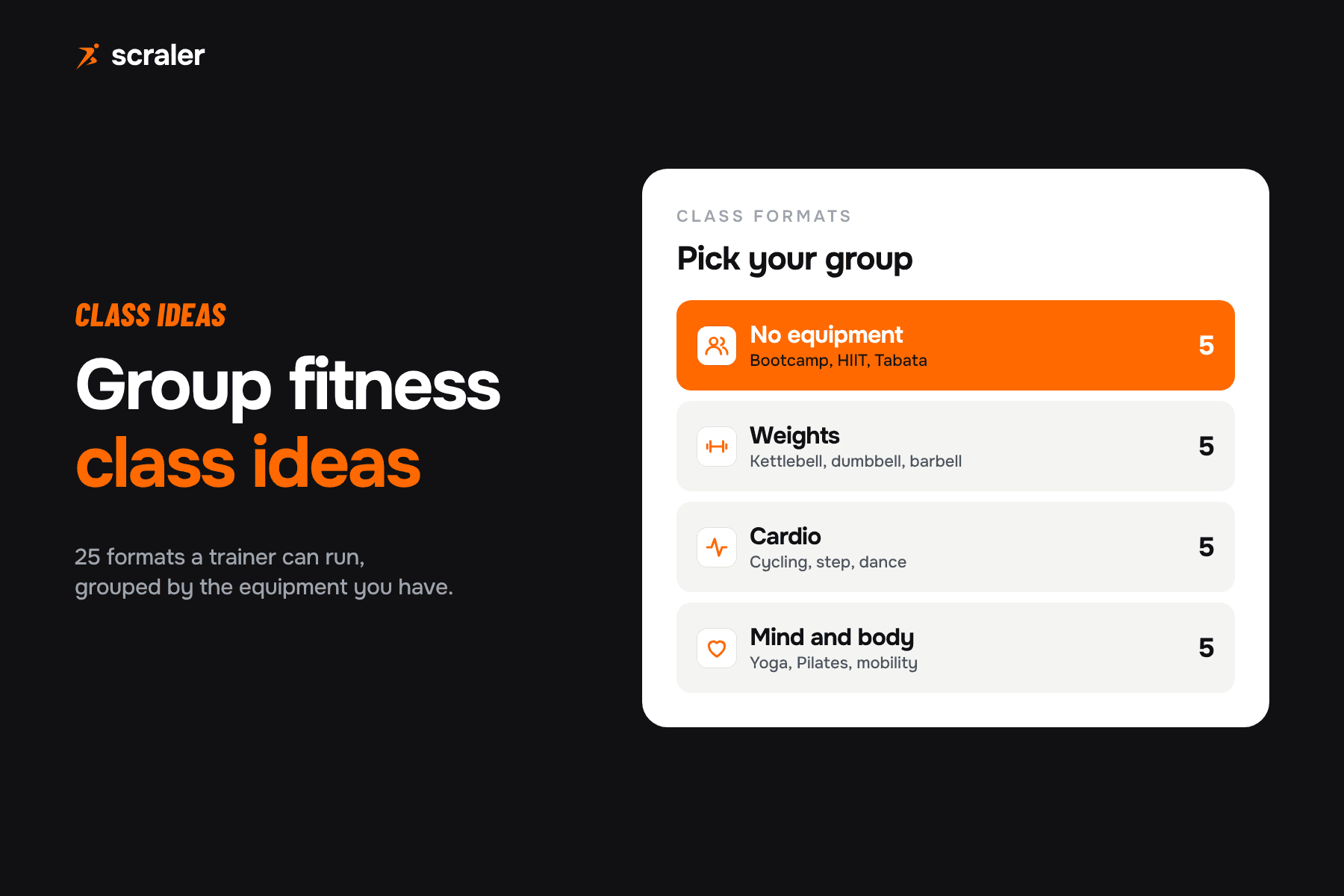
A group fitness class is a coached workout for several people at once, run to a plan and a timetable. The easiest ones to start are bootcamp, HIIT, kettlebell and mat Pilates: little equipment, easy to scale. Below are 25 formats grouped by equipment, with the group size that suits each.

- Pick a format by the equipment and space you have, then by the group size it supports.
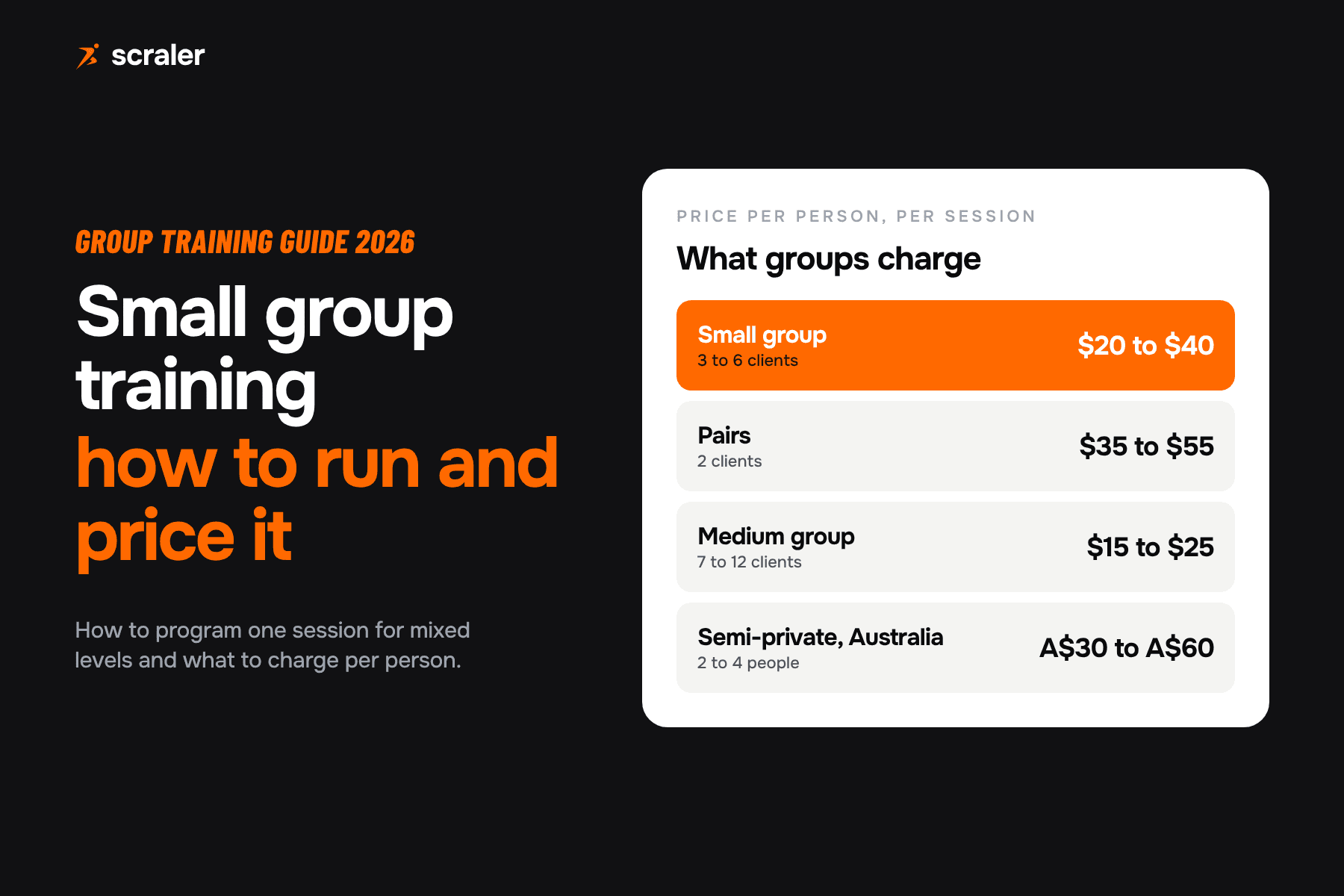
- Technical formats work best at 4 to 10 people, bootcamp and circuits up to about 20. Coaches charge about $20 to $40 per person for small groups and $15 to $25 for medium ones.
- Plan every class with options for different fitness levels. It is a core task of the job on O*NET.
- Book, collect payment and track attendance in one tool so a class does not turn into admin.
This list is for trainers who want to add classes. Most people searching for a group fitness class are looking for one to attend, so if that is you, check your local studios. If you teach, use this as a menu. The class list and group sizes below are our guidance, built from what small studios and trainers commonly run. The price ranges come from a published coaching guide.
What are the best group fitness class ideas?
There are 25 below, in five groups. Each line says what the class is and the group size that tends to work.
No equipment
- Bootcamp. Stations or intervals mixing body weight strength and cardio. Works from 6 to 20 people.
- HIIT intervals. Short hard efforts with set rest, timed on a clock. 6 to 16 people.
- Tabata. Eight rounds of 20 seconds on, 10 seconds off, per exercise. Easy to explain to newcomers.
- Circuit training. Rotating stations the whole room can follow. Scales to any group size your space allows.
- Calisthenics. Push, pull and squat progressions with a rig or a floor. 4 to 10 people so you can coach form.
Weights
- Kettlebell class. Swings, goblet squats, presses and carries. 4 to 10 people, with enough room to swing.
- Dumbbell full body. Simple pairs of dumbbells and a clear plan. A good first strength class for 6 to 14 people.
- Barbell pump. Light barbell sets to music. One bar per person, so size it to your rack.
- Strength and conditioning. Compound lifts plus finishers. Small groups of 4 to 8 keep it coachable.
- Sandbag training. Cleans, carries and squats with sandbags. Cheap to equip and good for beginners.
Cardio
- Indoor cycling. Set by the number of bikes. Intervals, hills and rhythm rides.
- Step aerobics. Choreographed step patterns on adjustable platforms.
- Dance fitness. Choreography to music. Needs floor space and a sound system.
- Boxing cardio. Pad or bag rounds with technique cues. Pair up on pads if you lack bags.
- Rowing intervals. Rower pyramids and relays. Limited by the machines you own.
Mind and body
- Yoga. Flow or slow classes. Mats and a quiet room.
- Mat Pilates. Core and control work on the floor. 6 to 12 people.
- Mobility. Joint and hip routines with bands and foam rollers. A good add-on for strength clients.
- Barre. Low-impact, small-range moves at a rail or chair.
- Core and balance. Short, steady classes that suit beginners and older adults.
Outdoors and special groups
- Park bootcamp. The same plan as indoor bootcamp, with no rent. Check local rules for commercial use of public space.
- Run club. Paced groups with a coach at the front. 6 to 15 runners.
- Older adult strength. Chair and light-weight strength with a slower pace. Check each person's health first.
- Partner workouts. Pairs share the weights and swap work, which makes a small room feel social.
- Beginner basics. A fixed 6 week course teaching the main lifts and movements to new members.
How many people should be in a group fitness class?
It depends on what you coach. The more technical the exercise, the smaller the room. These are rules of thumb, not data:
- Group size
- 4 to 10
- Why
- You need to see every rep and correct form
- Group size
- 6 to 20
- Why
- The plan runs the room, and you coach by exception
- Group size
- Set by equipment and floor space
- Why
- Everyone follows the front
- Group size
- 6 to 12
- Why
- Quiet, and you can walk the room to adjust people
- Group size
- 4 to 8
- Why
- More individual attention and slower progressions
| Class type | Group size | Why |
|---|---|---|
| Barbell, kettlebell, calisthenics | 4 to 10 | You need to see every rep and correct form |
| Bootcamp, HIIT, circuits | 6 to 20 | The plan runs the room, and you coach by exception |
| Cycling, dance, step | Set by equipment and floor space | Everyone follows the front |
| Yoga, Pilates, mobility | 6 to 12 | Quiet, and you can walk the room to adjust people |
| Beginner and older adult classes | 4 to 8 | More individual attention and slower progressions |
How do you plan a group fitness class?
O*NET lists the core tasks for group fitness instructors, and two of them are the planning job: plan routines, pick music and movements for each set of muscles based on what participants can do, and offer alternatives during classes to accommodate different levels of fitness. A simple 45 minute plan covers that.
- 1Welcome and brief, 3 minutes
Name the plan, the equipment and any injuries to flag.
- 2Warm-up, 7 minutes
Raise heart rate and open the joints you will use.
- 3Main block, 25 minutes
Three or four exercises or stations, each with an easier and a harder option.
- 4Finisher, 5 minutes
One short, hard effort everyone can scale.
- 5Cool-down, 5 minutes
Slow the breathing and stretch what you worked.
Give every exercise a regression and a progression, and say them out loud. Mixed-ability rooms work when nobody has to ask for an easier version. Our guide to small group personal training goes deeper on programming for mixed levels.
How much should you charge for a group fitness class?
The MyPTHub group pricing guide gives per person, per session ranges: pairs $35 to $55, small groups of 3 to 6 $20 to $40, medium groups of 7 to 12 $15 to $25, and live online groups $15 to $30. Its example shows why coaches run groups: one client at $60 is $60 an hour, while six clients at $25 is $150 from the same time block.
For packs, memberships and a full pricing model, read how to price small group personal training. To turn classes into steady income, sell them as a monthly membership, as in our personal training packages guide.
A sample 4 week course to start with
- Focus
- Learn the basics
- Example class
- Squat, hinge, push, pull and carry at light loads
- Focus
- Build volume
- Example class
- Same patterns, more sets and a short finisher
- Focus
- Add intensity
- Example class
- Heavier loads or faster intervals with clear options
- Focus
- Test and celebrate
- Example class
- Repeat week 1 and compare, then offer the next course
| Week | Focus | Example class |
|---|---|---|
| 1 | Learn the basics | Squat, hinge, push, pull and carry at light loads |
| 2 | Build volume | Same patterns, more sets and a short finisher |
| 3 | Add intensity | Heavier loads or faster intervals with clear options |
| 4 | Test and celebrate | Repeat week 1 and compare, then offer the next course |
A fixed course like this gives newcomers a clear start date and an end point, and it gives you a natural moment to invite them into the next one.
What equipment should you buy first?
Start with what the first class needs, not the whole menu. A bodyweight class costs nothing. For the rest, add one piece at a time as bookings justify it:
- First equipment to buy
- A timer, cones and a speaker
- Why
- The plan runs on a clock and a space
- First equipment to buy
- Two or three weights per person, in a few sizes
- Why
- Different strength levels share one room
- First equipment to buy
- Mats, bands and foam rollers
- Why
- Cheap and storable
- First equipment to buy
- Bikes, rowers or step platforms
- Why
- One machine per person, so it limits your class size
| Class | First equipment to buy | Why |
|---|---|---|
| Bootcamp, HIIT, circuits | A timer, cones and a speaker | The plan runs on a clock and a space |
| Kettlebell, dumbbell | Two or three weights per person, in a few sizes | Different strength levels share one room |
| Mat Pilates, yoga, mobility | Mats, bands and foam rollers | Cheap and storable |
| Cardio classes | Bikes, rowers or step platforms | One machine per person, so it limits your class size |
How do you fill and keep a group fitness class?
- Fix the timetable. The same class at the same time every week is easier to remember and to book.
- Name the class by the result. "Beginner strength, 6 weeks" tells a newcomer what they get, which "Class 3" does not.
- Run a short course first. Six weeks with a start date creates a reason to sign up now.
- Cap the room. A full class feels popular, and a waitlist gives you your next class.
- Learn names and offer options. People return to a class where the coach knows them.
- Message no-shows. A short note after a missed class keeps people from drifting away.
None of this needs a studio. Many trainers start with one weekly outdoor class and use it to feed one to one and small group clients, which our personal trainer marketing guide covers in more depth. To keep people coming back, send the timetable and one tip by email, as our fitness newsletter guide shows.
Do you need a certification to teach group fitness?
Requirements depend on where you work and what your insurer asks for. Group-specific credentials exist: ACE lists a Group Fitness Instructor certification, and ACSM lists a Group Exercise Instructor (ACSM-GEI) that renews with 45 CECs and a $60 fee. If you also want a personal training credential, see personal trainer certification. Whatever you teach, cover yourself with personal trainer insurance and screen new people with a PAR-Q before their first class.
How do you book and bill group fitness classes?
A class falls apart on admin: who is booked, who paid, who turned up. Use one place for the timetable and payments. Scraler's scheduling lets you run group appointments where several clients share a session, each with their own price, payment link and payment status. Premium, at $69 a month, adds payments through Stripe and a landing page builder to sell the class. Our guide to scheduling software for personal trainers compares the options. If you want a short push to fill a new class, try one of our fitness challenge ideas.
Group appointments and booking from $49 a month, with payment links and payment status per client on Premium at $69.
See schedulingFrequently asked questions
- What are some easy group fitness class ideas for beginners?
- Bootcamp, circuit training, mat Pilates, dumbbell full body and a fixed 6 week beginner basics course. They need little equipment and are easy to scale up or down.
- How many people should be in a group fitness class?
- About 4 to 10 for technical work like kettlebells or barbells, and 6 to 20 for bootcamp or circuits. These are rules of thumb: your space and how well you can see every person set the limit.
- How much do group fitness classes cost per person?
- MyPTHub puts small groups of 3 to 6 at $20 to $40 per person per session, medium groups of 7 to 12 at $15 to $25, and live online groups at $15 to $30.
- What equipment do I need to start group classes?
- Bodyweight formats need none. A set of kettlebells or dumbbells, a few mats and a speaker cover most other classes. Bikes, rowers and step platforms are limited by how many you own.
- Do group fitness instructors need a certification?
- It depends on where you work and your insurer. ACE and ACSM both offer group instructor certifications. Check what the studio or gym where you teach requires.