Personal Trainer Packs: 12 Package Examples, Pricing and a Template
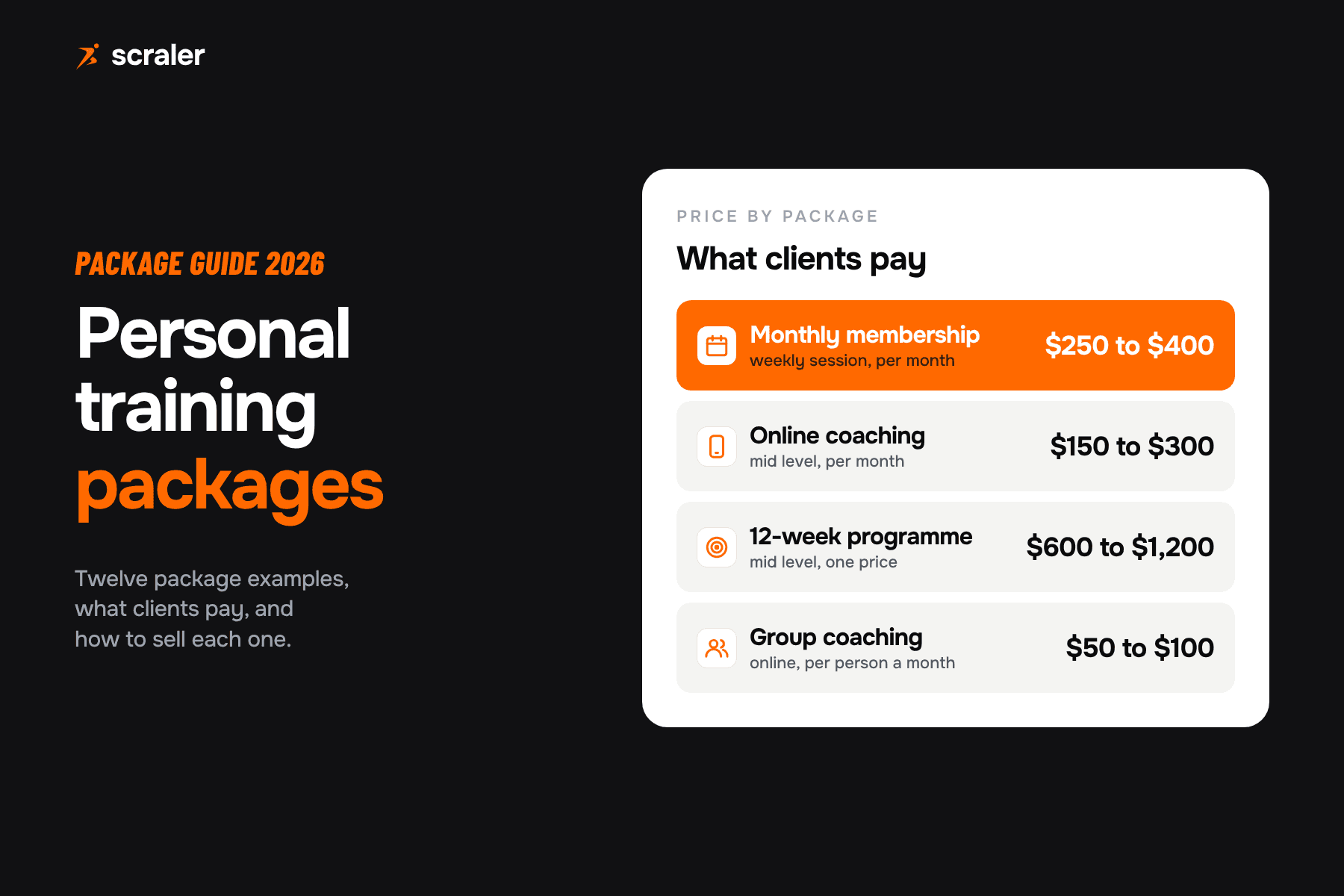
A personal trainer pack is a bundle of sessions or coaching sold at one price. The main personal training packages are session packs, monthly memberships, online coaching, hybrid, group and fixed-term programmes. In 2026 a monthly in-person package costs about $250 to $400, mid-level online coaching $150 to $300 a month, and a 12 week programme $600 to $1,200.

- There are five core ways to package training: session pack, monthly membership, online only, hybrid, and a nutrition add-on. The 12 examples below are variations of these.
- Monthly in-person packages average $250 to $400 (trainwell). Online coaching at mid level is $150 to $300 a month, and $250 to $400 with nutrition and video calls (FitBudd).
- Subscriptions give steady monthly income. Packs and fixed-term programmes give a lower barrier to entry but need a renewal step.
- Offer three tiers, not twelve. A good, better, best ladder is easier to sell than a long menu.
This is the pillar guide to packaging. It covers every common way to bundle your time, with prices from public sources we checked on 7 October 2026. Where a number is our own sum, it is called a worked example. For the hybrid structures in detail, see hybrid personal training packages.
What is a personal trainer pack?
A personal trainer pack, also called a personal training package, bundles your service into one product with one price. The client does not buy an hour, they buy an outcome or a period: ten sessions, a month of coaching, a 12 week programme. You get money upfront or on a schedule, and the client gets a clear scope.
Packages solve two problems at once. For the client, they answer "what do I get for this price?" For you, they replace one off bookings with income you can plan around. There are five core structures, and the rest of this guide is variations on them.
What are 12 examples of personal training packages?
Here are twelve packages that trainers sell today, grouped from the simplest to the most complete. Prices are US dollars. "Mid level" means the middle tier of the FitBudd 2026 benchmark, between new coaches and established specialists.
- What the client gets
- One hour, pay as you go
- Typical price
- $55 to $65
- Basis
- Thumbtack, Bark averages
- What the client gets
- Ten sessions paid upfront
- Typical price
- $675 at a $75 rate, 10% off
- Basis
- Worked example
- What the client gets
- Twenty sessions paid upfront
- Typical price
- $1,275 at a $75 rate, 15% off
- Basis
- Worked example
- What the client gets
- A set number of sessions, billed monthly
- Typical price
- $250 to $400 a month
- Basis
- trainwell
- What the client gets
- Group sessions in person
- Typical price
- $20 to $40 per person a session
- Basis
- trainwell
- What the client gets
- Programme and group support
- Typical price
- $50 to $100 per person a month
- Basis
- FitBudd, mid level
- What the client gets
- App programme, check-ins, chat
- Typical price
- $150 to $300 a month
- Basis
- FitBudd, mid level
- What the client gets
- Adds nutrition, video calls, habits
- Typical price
- $250 to $400 a month
- Basis
- FitBudd, mid level
- What the client gets
- Pay per online session
- Typical price
- $75 to $150 a session
- Basis
- FitBudd, mid level
- What the client gets
- Fixed term, one outcome
- Typical price
- $600 to $1,200
- Basis
- FitBudd, mid level
- What the client gets
- App coaching plus sessions
- Typical price
- $110 to $480 a month
- Basis
- Worked example
- What the client gets
- One workout plan, no coaching
- Typical price
- $75 to $150
- Basis
- FitBudd, mid level
| Package | What the client gets | Typical price | Basis |
|---|---|---|---|
| 1. Single session | One hour, pay as you go | $55 to $65 | Thumbtack, Bark averages |
| 2. 10 session pack | Ten sessions paid upfront | $675 at a $75 rate, 10% off | Worked example |
| 3. 20 session pack | Twenty sessions paid upfront | $1,275 at a $75 rate, 15% off | Worked example |
| 4. Monthly membership | A set number of sessions, billed monthly | $250 to $400 a month | trainwell |
| 5. Small group training | Group sessions in person | $20 to $40 per person a session | trainwell |
| 6. Online group coaching | Programme and group support | $50 to $100 per person a month | FitBudd, mid level |
| 7. Online coaching | App programme, check-ins, chat | $150 to $300 a month | FitBudd, mid level |
| 8. Online coaching with nutrition | Adds nutrition, video calls, habits | $250 to $400 a month | FitBudd, mid level |
| 9. Video call sessions | Pay per online session | $75 to $150 a session | FitBudd, mid level |
| 10. 12 week programme | Fixed term, one outcome | $600 to $1,200 | FitBudd, mid level |
| 11. Hybrid | App coaching plus sessions | $110 to $480 a month | Worked example |
| 12. Standalone plan | One workout plan, no coaching | $75 to $150 | FitBudd, mid level |
The worked examples use a $75 session rate. The pack discounts of 10% and 15% are an example, not a market standard. Thumbtack notes that packs of five, 10 and 20 sessions give room for discounts, and Bark tells clients to ask for a discount on sessions paid upfront.
How much do personal training packages cost?
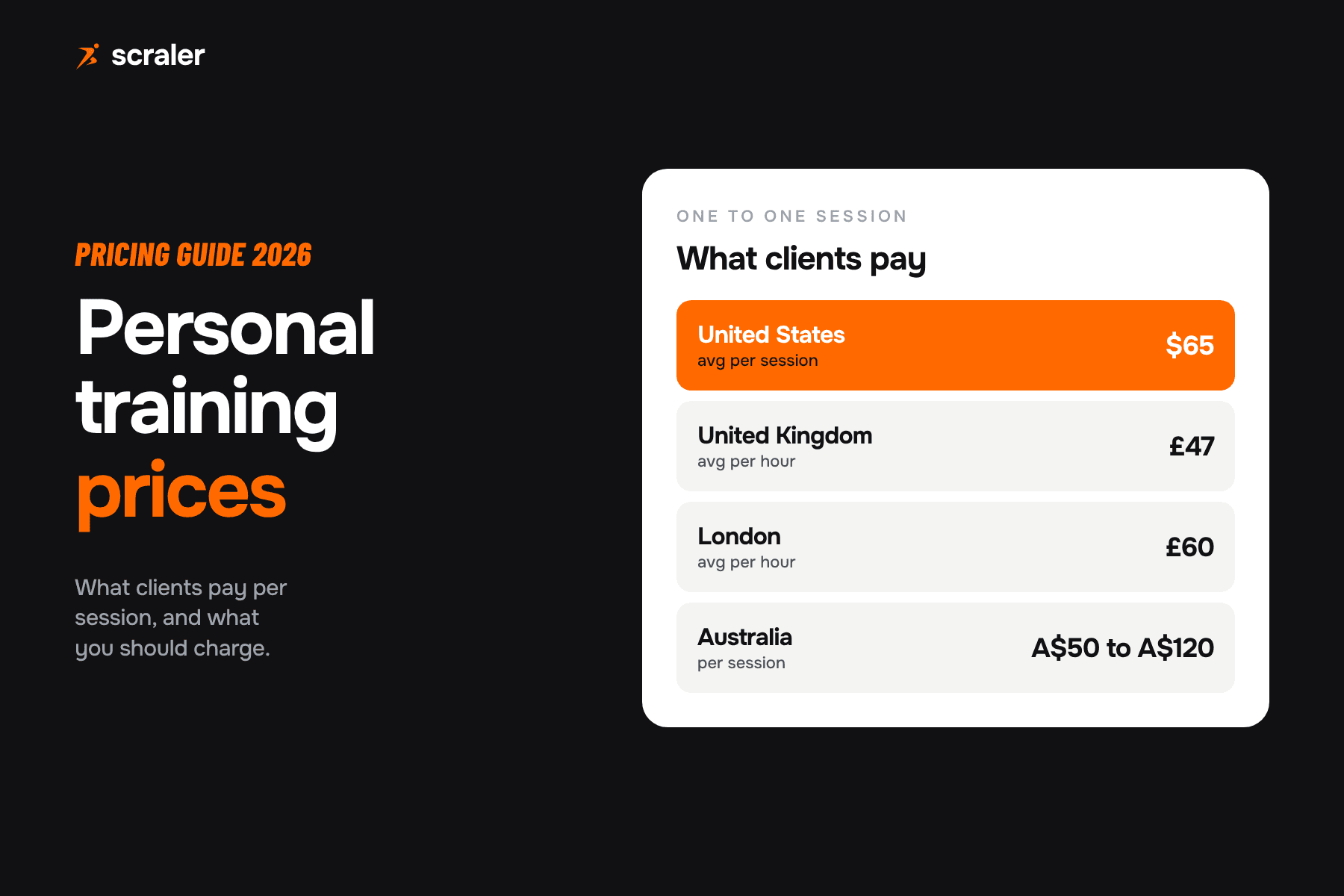
Start with the single session, because every pack is built on it. The Thumbtack cost guide gives a US average of $55 an hour, and Bark gives $65 a session. trainwell puts monthly packages at $250 to $400, which is roughly one session a week at those rates. In the UK, Bark puts the average at £47 an hour.
Online prices follow a different logic, because you sell a service and not an hour. FitBudd's 2026 pricing benchmarks split every model into three levels:
- Entry
- $75 to $150
- Mid level
- $150 to $300
- Experienced
- $300 to $500+
- Entry
- $150 to $250
- Mid level
- $250 to $400
- Experienced
- $400 to $800+
- Entry
- $50 to $75
- Mid level
- $75 to $150
- Experienced
- $150 to $300+
- Entry
- $300 to $600
- Mid level
- $600 to $1,200
- Experienced
- $1,200 to $3,000+
- Entry
- $30 to $60
- Mid level
- $50 to $100
- Experienced
- $75 to $200
| Online model | Entry | Mid level | Experienced |
|---|---|---|---|
| Monthly, check-ins and programming | $75 to $150 | $150 to $300 | $300 to $500+ |
| Monthly, with nutrition, calls, habits | $150 to $250 | $250 to $400 | $400 to $800+ |
| Per video session | $50 to $75 | $75 to $150 | $150 to $300+ |
| 12 week package | $300 to $600 | $600 to $1,200 | $1,200 to $3,000+ |
| Group coaching, per person a month | $30 to $60 | $50 to $100 | $75 to $200 |
For a full price guide by country, and how to work out your own rate, read personal training prices in 2026. The personal trainer rate calculator turns your income target and costs into a session rate you can build packs from.
Should you sell session packs or a monthly membership?
Both work. They suit different clients, and most trainers end up selling both. A session pack is easy to say yes to. A membership is easier to run. Whichever you sell, write the terms down in a personal training contract.
- Low commitment, good for a first purchase
- Money arrives upfront, but in chunks
- The client has to decide to renew
- Sessions can expire, which you need a policy for
- Predictable income you can plan around
- Billed automatically, nobody rebuys a pack
- The client stays until they cancel
- Needs clear cancellation and pause terms
FitBudd makes the same point for online coaching. Monthly subscriptions give predictable revenue and long client relationships, but you must deliver every month. Fixed-term packages create urgency and a clear finish line, but revenue arrives in chunks and you need a plan to turn finishers into subscribers. Its suggestion: use the package as the entry point, then offer a lower-cost ongoing subscription to clients who complete it.
That is a good default. A 12 week programme gets the client a result. The membership keeps the result, and keeps them as a client.
How do you package online personal training?
Online packages usually come in three shapes. The first is a monthly subscription with a programme in an app, check-ins and chat. The second is a fixed-term programme of 8, 12 or 16 weeks with one outcome, such as a transformation, a postpartum return or a race. The third is per-session video coaching, which works best as an add-on to a subscription for clients who want extra time with you. For tier prices and what is left per client, see online personal trainer pricing.
Three rules keep online packages clean. State exactly what is included: how many check-ins, how fast you reply, how often the programme changes. Put the check-in on a schedule inside the app so it does not depend on your memory. And price the package for the hours you actually spend. FitBudd's own example: at $150 a month and two hours a week on a client, you earn about $18.75 an hour before costs.
If you are moving in-person clients to this model, move in-person clients online walks through the switch. If you also want the best apps to run it, see best apps for personal trainers.
How do you add nutrition coaching to a package?
Nutrition is the easiest upgrade to sell, because clients already ask about food. There are two ways to package it. As a tier, it sits in the middle of your ladder: training plus a meal plan, macro targets and food check-ins. As an add-on, it is a monthly fee on top of any base package, so a session pack client can add it without changing anything else.
The FitBudd benchmarks give a sense of the size of the step. At mid level, the monthly subscription with nutrition, video calls and habit coaching is $250 to $400, against $150 to $300 without. Using the midpoints, $325 against $225, the step is about $100 a month (our calculation). It covers more than meals, so your own add-on can be smaller if you only add a meal plan and food check-ins.
The client gets a plan built around their targets, recipes they can cook, and a person who looks at their food log. For the method behind the plan, see nutrition coaching software and the free macro calculator.
Build the meal plan in the same place as the programme, and give clients recipes and macro targets in their app.
See the meal plannerWhere do hybrid packages fit?
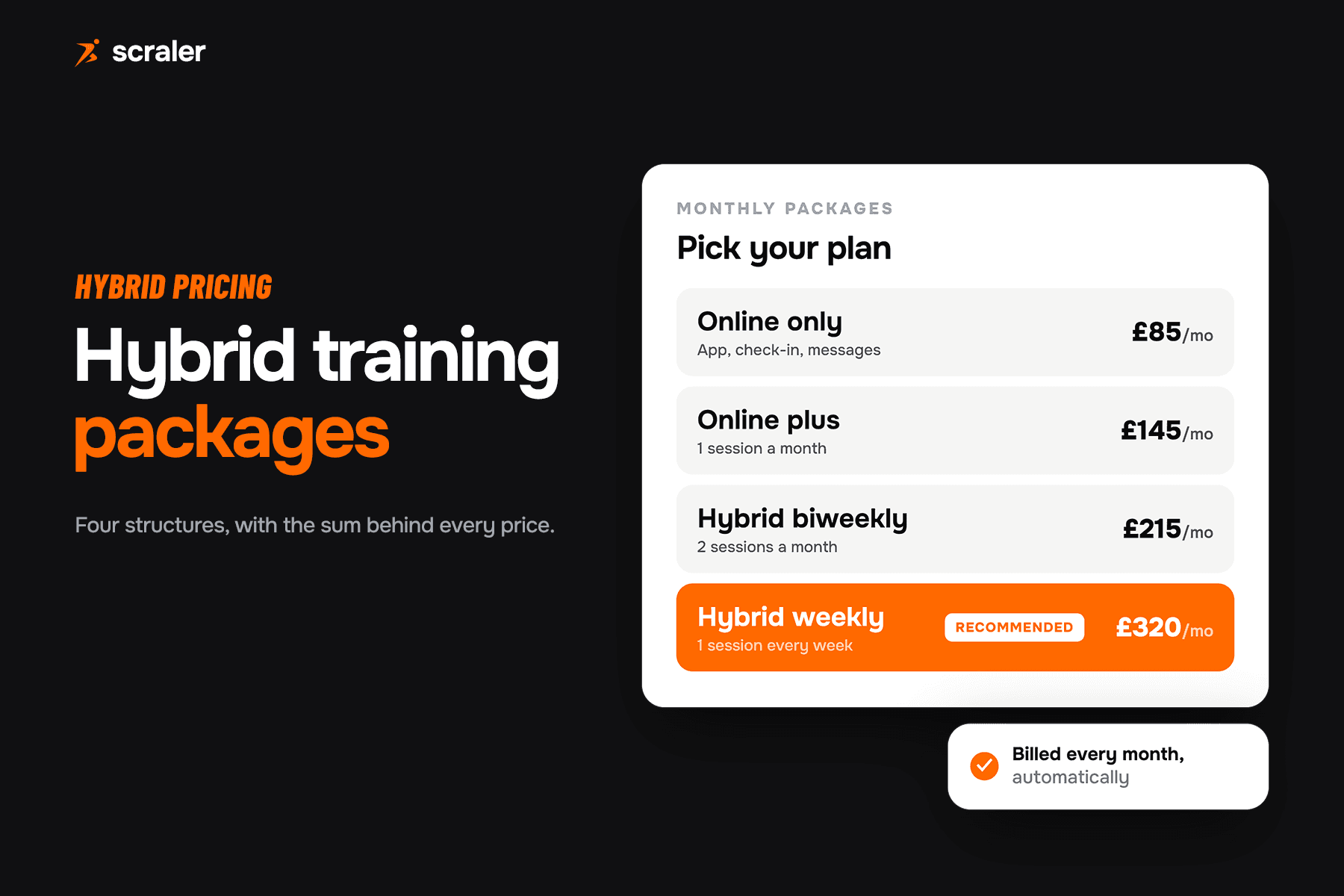
Hybrid packages sit at the top of the ladder. The client gets app coaching every week plus a set number of in-person sessions. The price is the coaching layer plus sessions times your session rate. At a $75 rate, our worked examples run from $110 a month for online only up to $400 to $480 for a weekly session plus the app.
We do not repeat the arithmetic here. The full breakdown, with GBP, USD and EUR tables, is in hybrid personal training packages, and the schedule and app side are in the hybrid personal training guide.
How do you build a good, better, best package ladder?
Pick three packages, not twelve. Each tier adds one clear thing to the one below it, and the price rises with the value, not with your hours. Three options give the client an easy middle choice, and many pick it.
- Online programme
- Weekly check-in
- Chat support
- Everything in Good
- Meal plan and macro targets
- Food log feedback
- Everything in Better
- A weekly in-person session
- Monthly reassessment
The prices above are a worked example. The best tier uses the weekly hybrid anchor from our hybrid packages post, and the good tier sits inside the online range. The jumps are 50% and 78%. Keep the first jump small so that the step up feels easy, and make the top tier the one that is truly different, because it includes your time in the room.
How do you sell packages and track them in Scraler?
A package only works if the money and the delivery stay in sync. In Scraler you create each package as a plan: a session pack, a monthly membership or a subscription. The client pays through Stripe, the plan renews on its own, and it sits next to their programme, meal plan, check-ins and chat. Payments are part of the Premium plan, which starts at $69 a month.
- One place for the offer. Packs, memberships and subscriptions are created as plans, with the price and what is included.
- Billing without chasing. Stripe collects the payment, so you do not send reminders for the next block.
- Delivery in the same app. The programme, meal plan and check-ins are assigned to the client, and the client sees them in their client app.
- Scheduling. Appointment types let clients book the sessions that come with a pack or hybrid package.
Create your packages as plans, bill clients automatically through Stripe, and deliver the programme and check-ins in the same app.
See the finance featuresIs there a free package menu template?
Yes. We made a one page package menu. It has three tiers with space for the name, price, what is included and who it suits, plus a line for your cancellation terms. Fill it in, then use it as the basis for your price page or your consultation. It is a planning sheet, not a contract, so if you need terms for sessions that expire or refunds, check them with a local professional. Our hybrid personal training contract post covers the clauses to think about.
One A4 page, three tiers, fillable layout. Print it or fill it in on screen.
Frequently asked questions
- What is a personal trainer pack?
- A personal trainer pack is a bundle of sessions or coaching sold at one price, such as ten sessions upfront, a monthly membership or a 12 week programme. Packs lower the price per session and give the trainer income that is easier to plan.
- How much is a personal training package?
- In the US, trainwell puts monthly in-person packages at $250 to $400. Online coaching at mid level costs $150 to $300 a month, or $250 to $400 with nutrition and video calls, and a 12 week programme costs $600 to $1,200, according to FitBudd.
- Are session packs cheaper than single sessions?
- Usually. Thumbtack notes that packs of five, 10 and 20 sessions give room for discounts, and Bark advises asking for one when paying upfront. How much you discount is your choice. The example in this guide uses 10% and 15%.
- How many package options should a trainer offer?
- Three. A good, better, best ladder is simple to explain and easy to choose from. Add a session pack only if you want an entry product for new clients.
- What should a nutrition coaching package include?
- Calorie and macro targets, a meal plan or recipes, a food log you review, and a regular check-in. Price it as a tier above training only, or as a monthly add-on to any base package.
- Can I sell packages and memberships through one app?
- Yes. In Scraler you create packs, memberships and subscriptions as plans, clients pay through Stripe, and the programme, meal plan and check-ins sit in the same client record. Payments are included from the Premium plan.