Personal Trainer Insurance: What Cover You Need and What It Costs
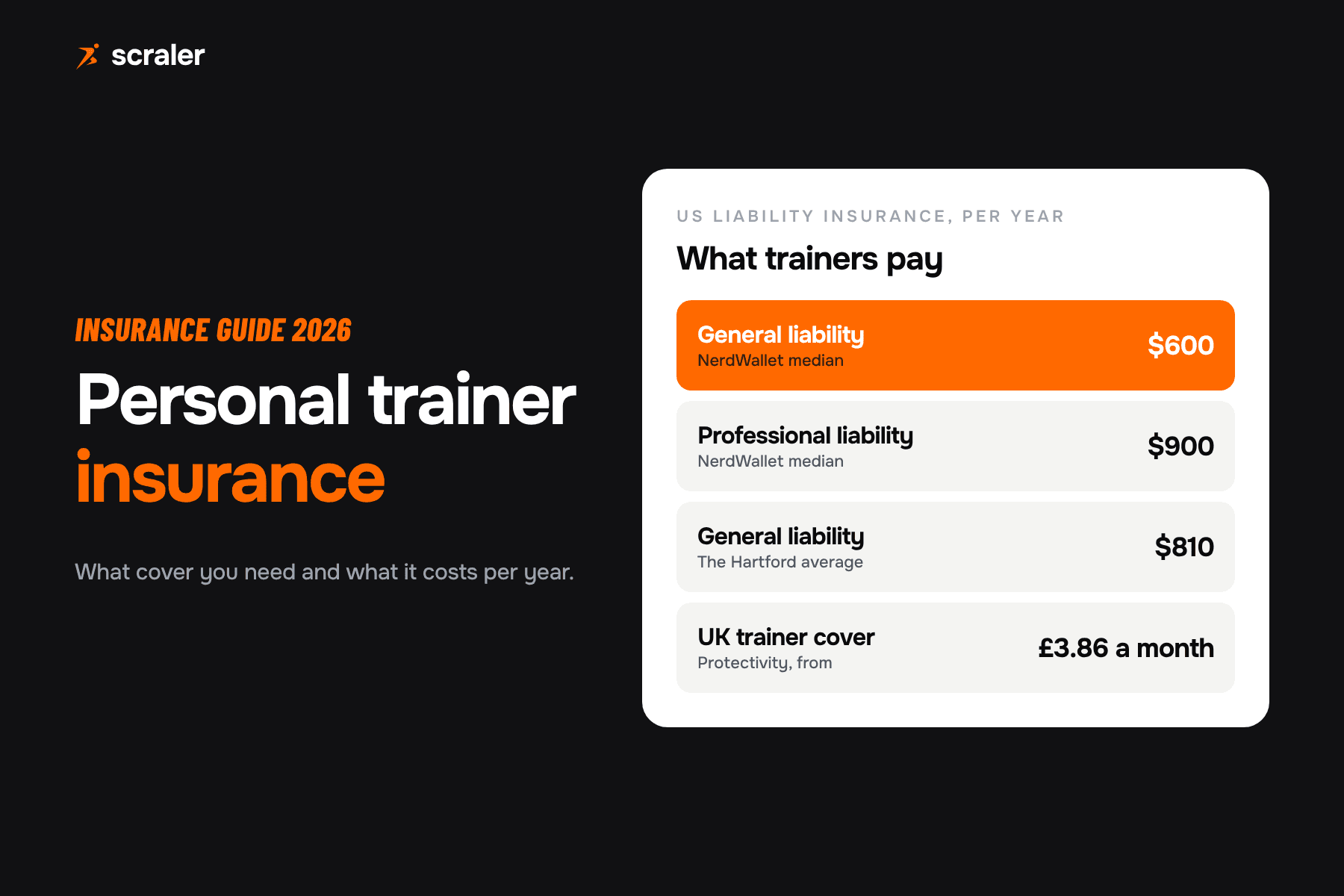
Liability insurance for personal trainers pays when a client says they were hurt in your session, their property was damaged, or your advice caused harm. Most US trainers buy general and professional liability. NerdWallet puts the median at $600 and $900 a year, and Insureon at $350 and $500.

- Buy at least general liability and professional liability. NerdWallet says NASM gives the same advice.
- US medians sit between $350 and $600 a year for general liability and $500 to $900 for professional liability, depending on the source.
- Liability cover does not pay for your own injury, your employees or, at some insurers, nutrition advice. Check each exclusion.
- Gyms and studios often ask for a certificate of insurance before you train anyone, and sometimes to be named an additional insured.
Insurance is the line in your budget that feels optional until a client trips over a kettlebell. This guide explains what each type of cover means in plain words, what the published numbers say it costs, and what to check before you buy. Every price comes from an insurer or comparison page we read on 7 October 2026, and we name each one.
Do personal trainers need liability insurance?
In practice, yes. No single US law says every trainer must carry it, but most of the people who control where you can train do. Next Insurance notes that many gyms and studios want proof of liability insurance before they let you train in their space. In the UK, Insure4Sport says most gyms will not let you work without cover and tells you to check the level your venue requires before your first session.
Cover through an employer or a gym is not a safe substitute. NerdWallet says an employer policy may give limited cover and will not cover independent services you provide, and recommends your own policy. FitSmallBusiness adds that a gym policy may exclude independent contractors, so read the wording or ask the gym in writing. A signed personal training contract with a waiver sits next to the policy, not in place of it.
Online coaches are not exempt either. FitSmallBusiness points out that if someone can be injured by your virtual or video training, you can be sued. Next says its personal trainer policy covers most forms of online training, and Insure4Sport offers online cover for classes of up to 30 people. Check how each insurer defines online work before you rely on it.
What is the difference between general and professional liability insurance?
General liability covers accidents. Professional liability covers mistakes in your work. Most trainers need both, and several insurers sell them together. Thimble puts the split this way: general liability responds to bodily injury and property damage, and professional liability protects against claims of errors and omissions and negligence, in other words doing your job improperly.
- What it pays for
- Legal and settlement costs when a client or other third party is injured or their property is damaged
- Example from the insurers
- A client trips over a barbell and breaks an arm, or you drop a weight on their laptop (NerdWallet)
- What it pays for
- Defense and judgments when a client says your instruction or advice caused harm
- Example from the insurers
- A client hurts their back on weighted push-ups and blames your coaching (Thimble)
- What it pays for
- Most insurers bundle the two for trainers
- Example from the insurers
- Thimble, Next and Protectivity sell a trainer policy that includes both, and Hiscox sells each as a trainer policy
| Cover | What it pays for | Example from the insurers |
|---|---|---|
| General liability (UK: public liability) | Legal and settlement costs when a client or other third party is injured or their property is damaged | A client trips over a barbell and breaks an arm, or you drop a weight on their laptop (NerdWallet) |
| Professional liability (UK: professional indemnity) | Defense and judgments when a client says your instruction or advice caused harm | A client hurts their back on weighted push-ups and blames your coaching (Thimble) |
| Both together | Most insurers bundle the two for trainers | Thimble, Next and Protectivity sell a trainer policy that includes both, and Hiscox sells each as a trainer policy |
The Hartford adds that general liability also covers reputational harm, which NerdWallet describes as advertising injury such as libel or slander. Limits matter as much as the type. Next sells general liability at $500,000, $1 million and $2 million per occurrence, and Insure4Sport sells UK public liability from £1m up to £10m. If a claim runs past your limit you pay the difference.
What does personal trainer insurance cover, and what does it not?
The pattern across the insurers we read is the same. Liability policies protect you against what clients and other third parties claim. They do not protect you, your staff or your kit.
- Your own injury. Thimble says its policy covers non-employee bodily injury only. NerdWallet explains that workers' compensation can cover your medical bills and part of your lost income, even as a sole proprietor.
- Employees. Workers' compensation covers them, and NerdWallet notes most states require it once you have staff.
- Your equipment. Next lists commercial property for gear and space damaged by fire or theft. Insure4Sport includes £250 of equipment cover free and lets you raise it.
- Nutrition advice. Insurance Canopy states that diet guidelines, meal plans and supplement recommendations are not covered by its professional liability and need a separate add-on. Insure4Sport covers nutritional advice only if it is part of your PT qualification.
- Data breaches. NerdWallet says cyber cover is worth considering if you store client health or card data.
That nutrition point matters if you sell meal plans or macros. If you add nutrition to your services, tell your insurer. Read your policy, and ask in writing whether it covers the services you actually sell.
How much does personal trainer insurance cost?
In the US, general liability costs about $350 to $810 a year at the averages and medians we found, and professional liability about $500 to $900. The sources differ because they measure different things: Insureon uses the median of trainers who applied for quotes, NerdWallet uses Coverdash broker data, and The Hartford publishes an insurer average.
- General liability
- $600 a year
- Professional liability
- $900 a year
- General liability
- $350 a year ($29 a month)
- Professional liability
- $500 a year ($42 a month)
- General liability
- $810 a year
- Professional liability
- Not published
- General liability
- $120 to $1,200 a year
- Professional liability
- $500 to $1,800 a year
- General liability
- From $159 a year or $15 a month
- Professional liability
- Included in the base policy
| Source | General liability | Professional liability |
|---|---|---|
| NerdWallet (Coverdash data), median | $600 a year | $900 a year |
| Insureon, median of quote applicants | $350 a year ($29 a month) | $500 a year ($42 a month) |
| The Hartford, average | $810 a year | Not published |
| FitSmallBusiness, range at $1m / $2m limits | $120 to $1,200 a year | $500 to $1,800 a year |
| Insurance Canopy, base policy with both | From $159 a year or $15 a month | Included in the base policy |
A worked example, not a quote: add the NerdWallet medians and you get $600 + $900 = $1,500 a year, or $125 a month. Add the Insureon medians and you get $350 + $500 = $850 a year, about $71 a month. Plan with the higher number and be pleasantly surprised if the quote is lower.
Several factors move the price. Next lists where you train, one to one versus group, whether you hire staff, your annual revenue, your limits and deductible, and your claims history. NerdWallet adds your certifications and number of employees. A home trainer with no staff will usually pay less than someone who rents a studio and employs coaches. NerdWallet also reports a 6% discount at Ergo Next for NASM-certified trainers.
What does it cost in the UK and Australia?
In the UK, Protectivity advertises personal trainer cover from £3.86 a month. Its example quote, dated 1 October 2024 on its page, was £1,000,000 public liability, £1,000,000 professional indemnity and £500 of equipment cover. It says your own quote may be higher or lower, so treat it as a floor. Insure4Sport does not publish a price and says the cost depends on the level of cover you choose. We did not find a price on an Australian insurer page we could read, so we are not quoting one. Get two or three quotes.
What other insurance might a personal trainer need?
Liability is the base. The rest depends on how you work. NerdWallet suggests looking at extra cover when you employ staff, own expensive equipment or rent space.
- When it applies
- You have employees, or you want income cover for your own injury
- Published cost
- Insureon: $55 a month, $659 a year
- When it applies
- Bundles liability with property for a studio or equipment
- Published cost
- Insureon: $59 a month, $702 a year
- When it applies
- You rent a space or own equipment and a landlord asks for it
- Published cost
- FitSmallBusiness: $200 to $800 a year
- When it applies
- You drive between clients in a company vehicle
- Published cost
- Insureon: $245 a month
- When it applies
- You store client health or card data
- Published cost
- Insureon: $129 a month
- When it applies
- You sell supplements or equipment
- Published cost
- No figure on a page we read
- When it applies
- Defense costs if a client sues over alleged misconduct
- Published cost
- Insurance Canopy: add-on from $10.33 to $14.46 a month
| Cover | When it applies | Published cost |
|---|---|---|
| Workers' compensation | You have employees, or you want income cover for your own injury | Insureon: $55 a month, $659 a year |
| Business owner's policy | Bundles liability with property for a studio or equipment | Insureon: $59 a month, $702 a year |
| Commercial property | You rent a space or own equipment and a landlord asks for it | FitSmallBusiness: $200 to $800 a year |
| Commercial auto | You drive between clients in a company vehicle | Insureon: $245 a month |
| Cyber | You store client health or card data | Insureon: $129 a month |
| Product liability | You sell supplements or equipment | No figure on a page we read |
| Sexual abuse liability | Defense costs if a client sues over alleged misconduct | Insurance Canopy: add-on from $10.33 to $14.46 a month |
How do you choose a personal trainer insurance policy?
- 1.List what you sell. One to one, small group, online programs, meal plans, supplements, retreats. Each one can change what the insurer will cover.
- 2.Ask your venue what it requires. A gym may set a minimum limit and ask to be named as an additional insured. Thimble says additional insureds can be added at no extra cost, and Next lets you generate a certificate of insurance online.
- 3.Pick limits you can defend. Compare the tiers, for example Next's $500,000, $1 million and $2 million per occurrence.
- 4.Get two or three quotes for the same limits. Compare price per year, deductible and exclusions side by side. NerdWallet recommends comparing multiple quotes for similar policies.
- 5.Read the exclusions. Look for nutrition advice, online work, children, group size and where you can train. Thimble says its cover works wherever you train, in the gym, at a client's home or in a park.
- 6.Check how you can pay and cancel. Thimble sells by the hour, day, month or year, which can suit part-time trainers, and Insure4Sport lets you pay monthly on annual policies over £30.
Keep the certificate with your business records and renew it before it lapses.
What paperwork should you keep alongside your insurance?
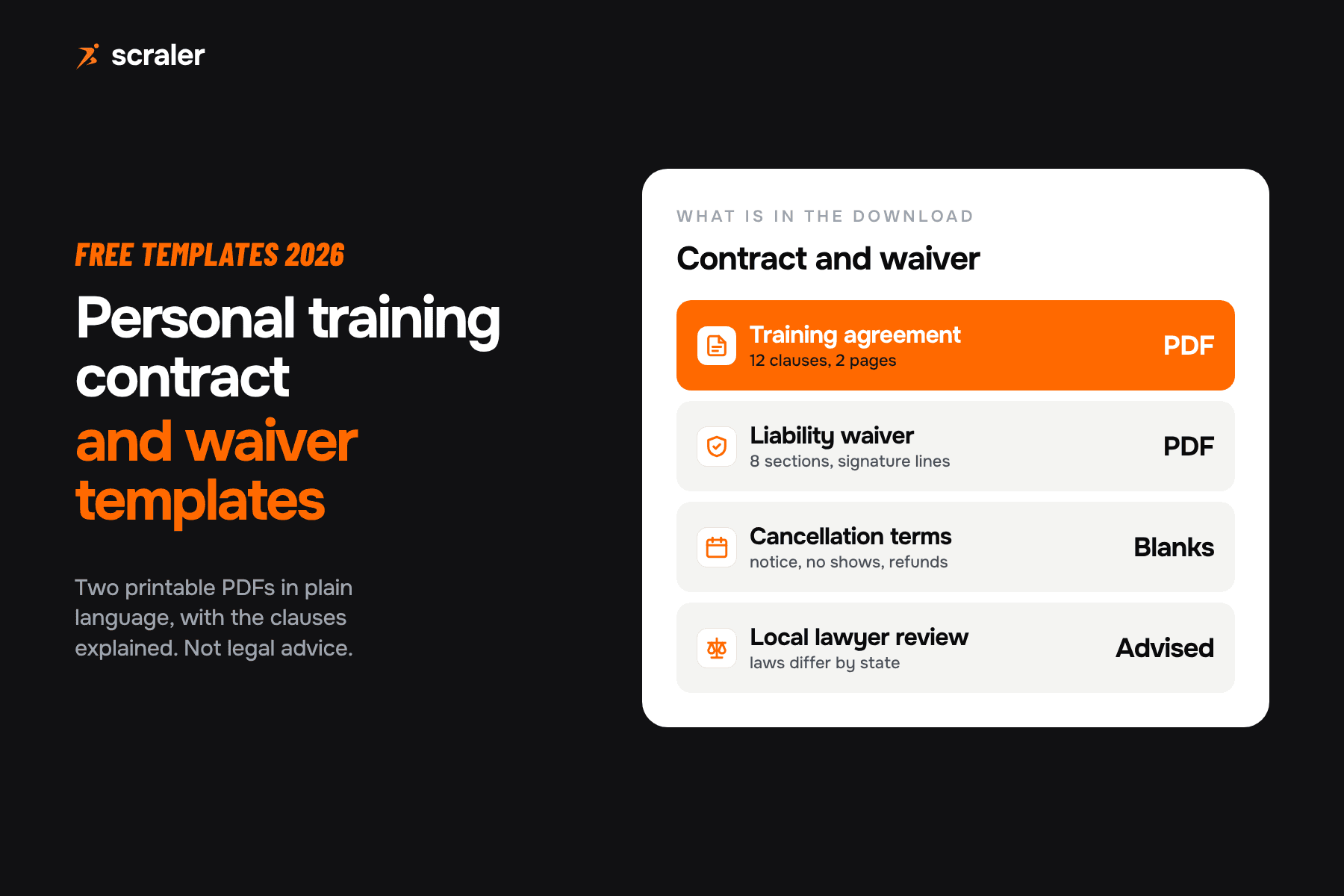
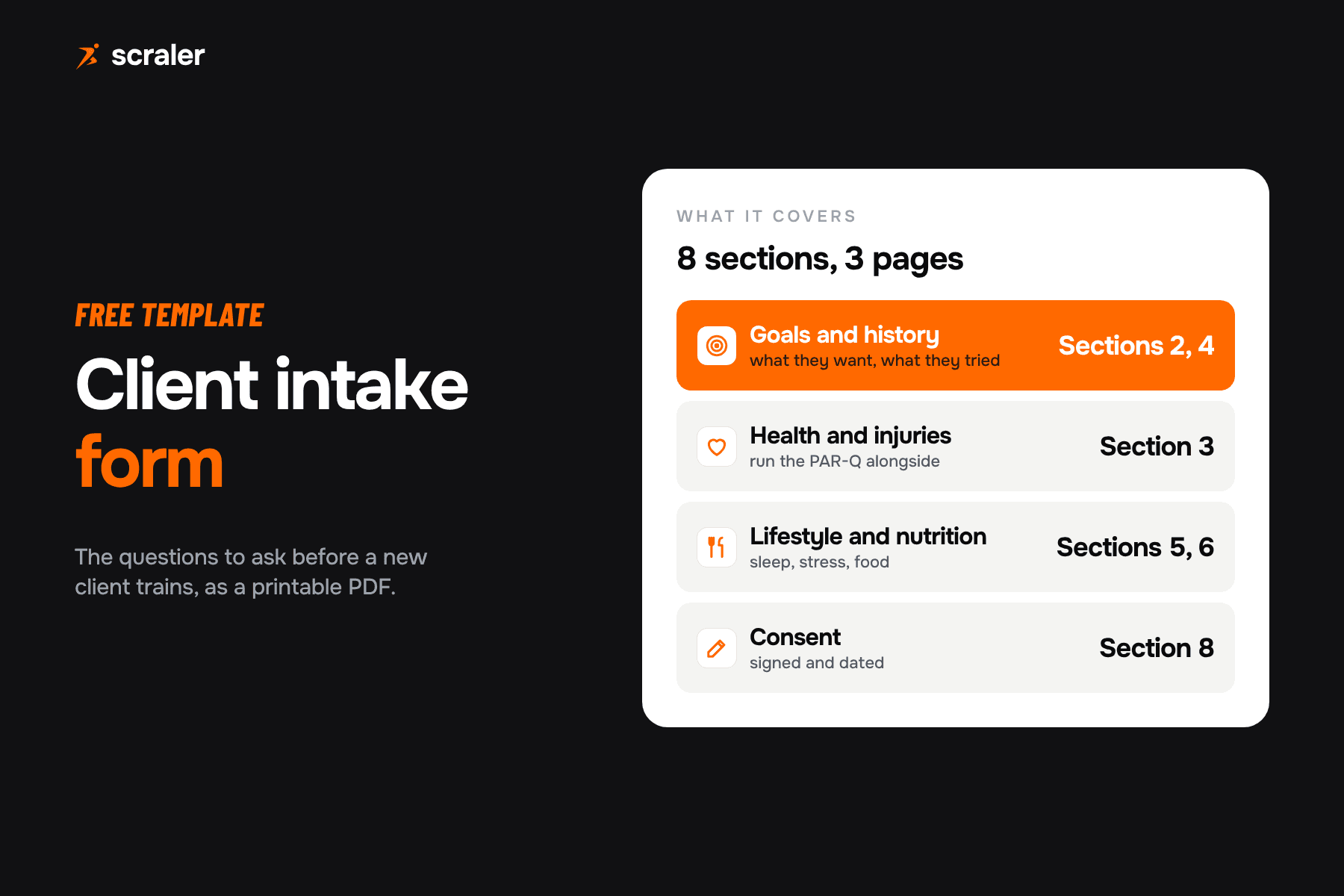
Insurance pays after something goes wrong. Paperwork lowers the odds it does and shows you acted carefully. Keep a signed waiver or client agreement, a health screen such as a PAR-Q, an intake form with injuries and goals, and notes on any change to the client's health. Our client intake form template and PAR-Q form template are free, and the hybrid personal training contract guide shows what to put in a client agreement. A waiver helps but does not remove your duty of care, and what holds up differs by jurisdiction, so have a local professional review the wording.
In Scraler, clients fill in your onboarding forms, such as a PAR-Q, when they sign up. Their answers, progress photos and your private notes sit together on one profile, so you can find the right form in seconds when a gym or an insurer asks.
Collect onboarding forms at sign-up, keep the answers next to the programme and check-ins, and find them again in one click.
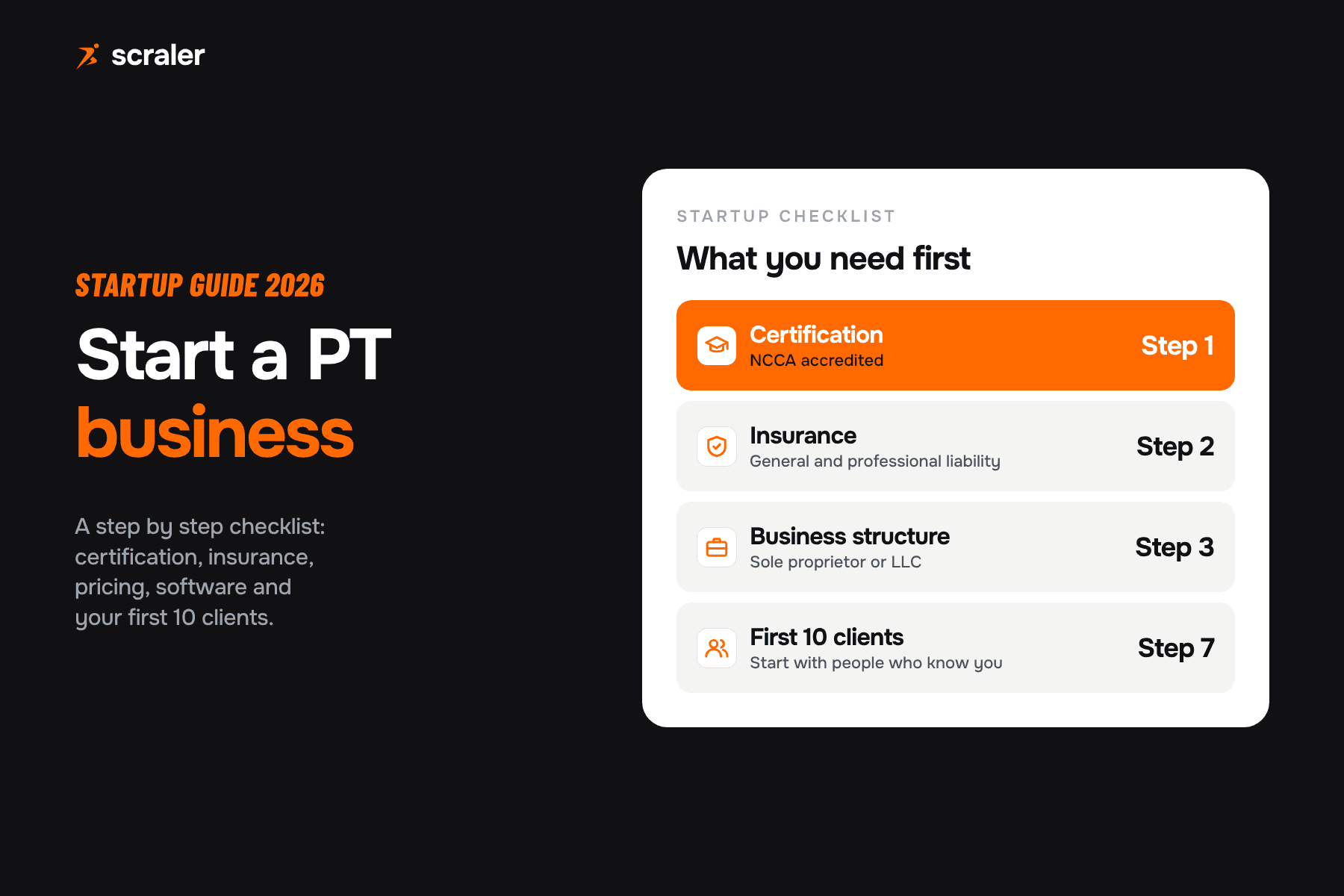
See client managementInsurance is also a business cost, so build it into your rate. The personal trainer rate calculator lets you add insurance to your yearly costs, and what personal training costs in 2026 shows what clients pay. If you are still setting up, how to start a personal training business puts insurance in order with the other steps.
Frequently asked questions
- How much is liability insurance for a personal trainer?
- In the US, NerdWallet puts the median at $600 a year for general liability and $900 for professional liability. Insureon reports medians of $350 and $500. In the UK, Protectivity advertises cover from £3.86 a month. Your quote depends on your limits, location, services and claims history.
- Do I need insurance if I train at a gym?
- Yes, in most cases. Many gyms require proof of your own liability insurance, and NerdWallet says an employer or gym policy may give limited cover and not cover independent services. FitSmallBusiness warns that a gym policy may exclude independent contractors. Ask the gym what its policy covers.
- Does personal trainer insurance cover online coaching?
- Often, but check the wording. Next says its policy covers most forms of online training, and Insure4Sport covers online classes of up to 30 people. FitSmallBusiness notes that online and video trainers can still be sued. Ask your insurer in writing how it defines online work.
- Does personal trainer insurance cover nutrition advice?
- It depends on the insurer. Insurance Canopy states that diet guidelines, meal plans and supplement recommendations are not covered by its professional liability and need an add-on. Insure4Sport covers nutritional advice if it is part of your PT qualification. Check before you sell meal plans.
- What is a certificate of insurance?
- It is a document that proves you hold a policy. Gyms, studios and landlords often ask for one, and sometimes ask to be named as an additional insured. Next and Thimble let you download a certificate online after you buy.
- Is general liability enough for a personal trainer?
- Usually not on its own. NerdWallet and The Hartford both name general and professional liability as the two most important covers, because general liability handles accidents and professional liability handles claims about your advice or instruction. Add workers' compensation if you hire staff.