How to Start a Personal Training Business: Step-by-Step Checklist (2026)
To start a personal training business, get an accredited certification, insure yourself, register a business structure, set your prices, use a waiver and health screen, pick your software and sign your first 10 clients. A lean setup costs about $1,800 in year one, before registration fees.

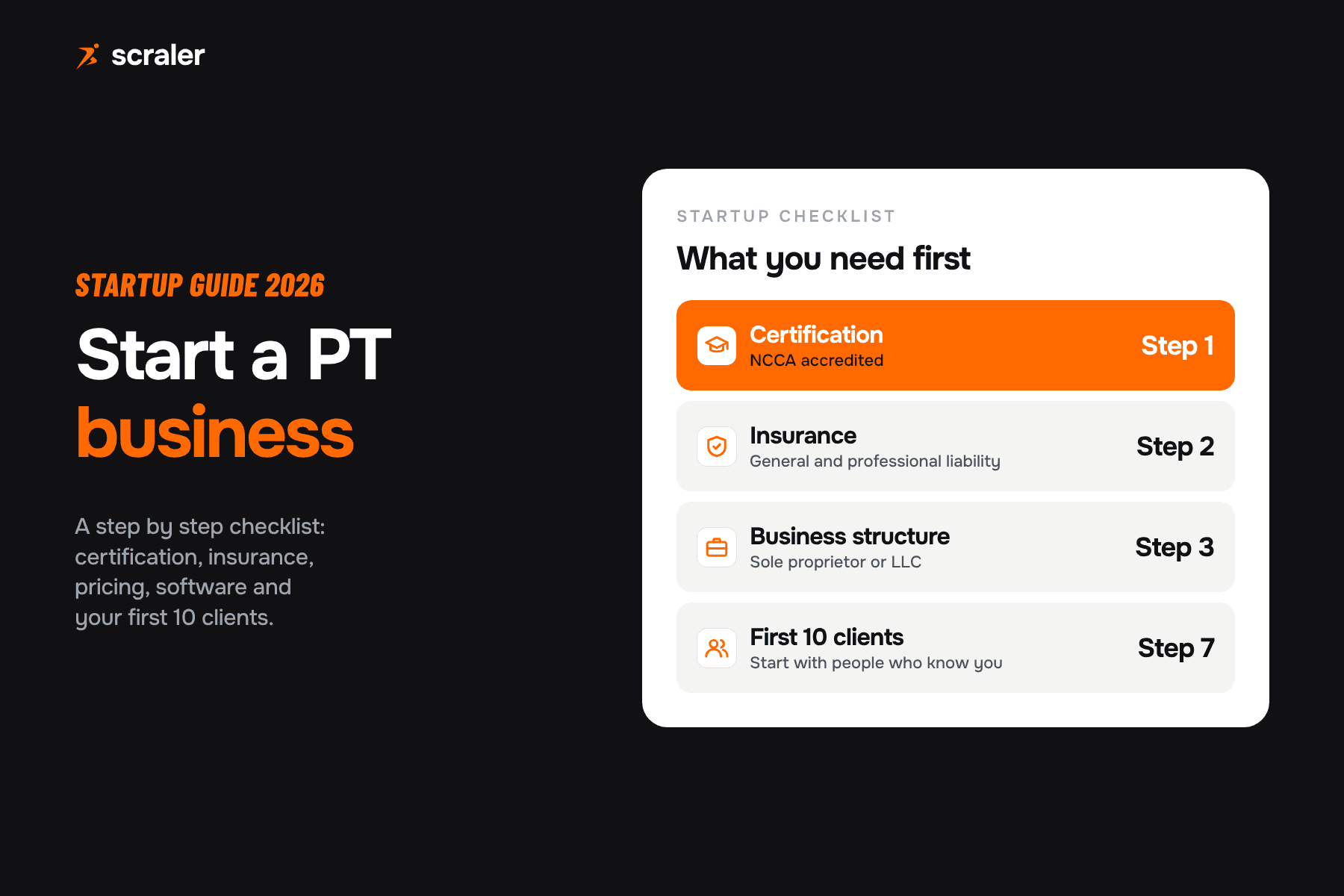
- Seven steps, in order: certify, insure, register, price, screen, set up software, win 10 clients.
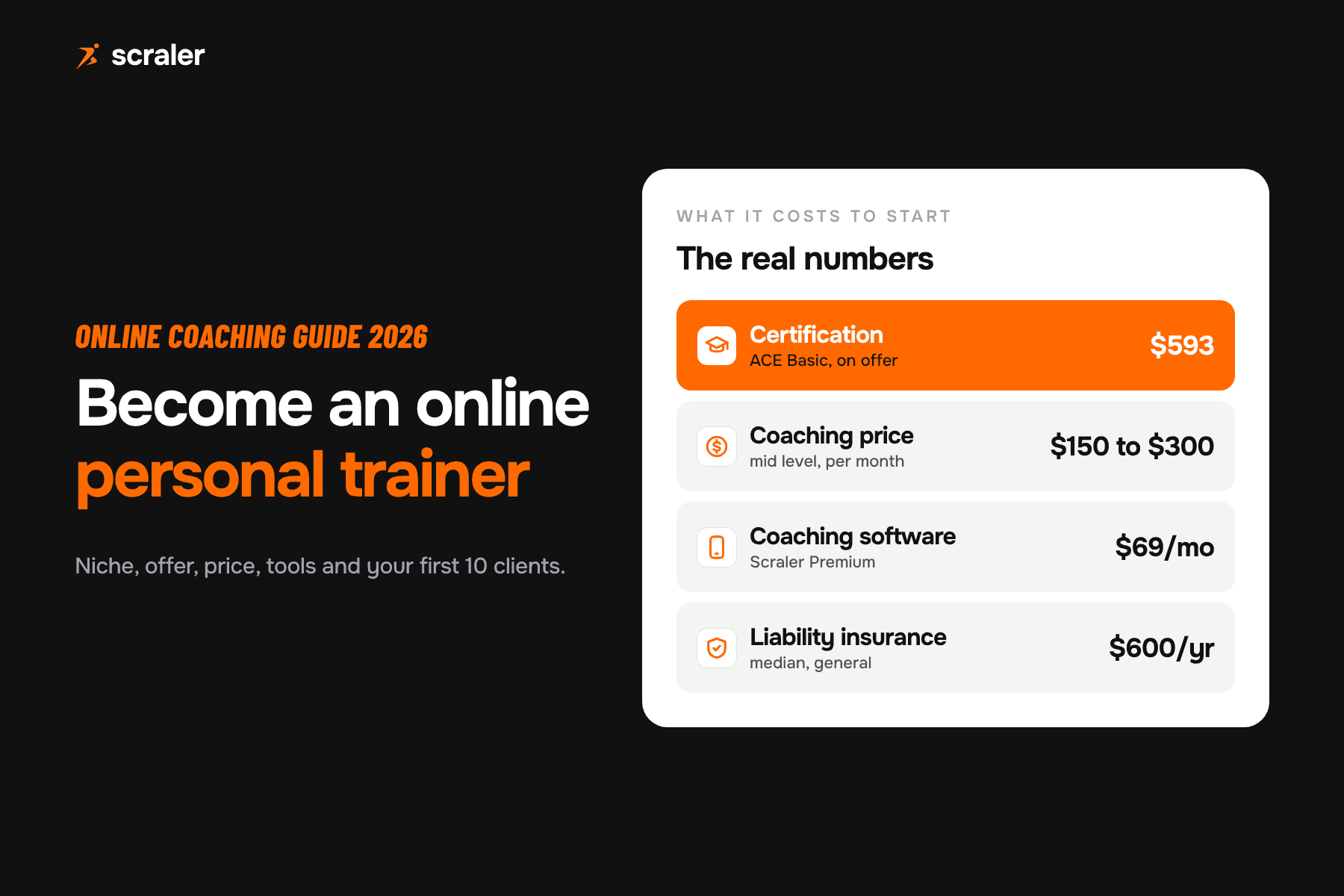
- The three fixed costs we could check add up to $1,781 in year one: ACE Basic at $593, general liability at $600 and Scraler Plus at $588. That is a worked example.
- At the $55 national average session price, 33 sessions cover those costs. Ten clients booking weekly get there in just over three weeks.
- Your first 10 clients usually come from people who already know you, so plan the outreach before you plan the logo.
This is the checklist we would follow if we were starting from nothing. It covers the legal and money basics, then the part most guides skip: the systems you need so the business runs without you chasing admin. We read the prices on provider pages on 7 October 2026 and say where a number is our own worked example. Rules differ by country, state and city, so confirm the legal steps locally.
How do you start a personal training business?
In seven steps. You can do some in parallel, but the order below avoids the usual mistakes, such as taking a paying client before you have cover or a waiver.
- 1Get certified
An NCCA accredited certification, plus CPR and AED.
- 2Insure yourself
General and professional liability.
- 3Pick a structure
Sole proprietor or LLC, then a federal tax ID if you need one.
- 4Set your prices
Single sessions, packs and memberships.
- 5Use a waiver and intake
A health screen before the first session.
- 6Choose your software
Programs, payments and check-ins in one place.
- 7Win your first 10 clients
Start with people who already know you.
What certification do you need to be a personal trainer?
Look for an accredited certification: ACE and NASM list NCCA accreditation, and ISSA lists an NCCPT accredited exam. Three common routes, with the prices we saw on each provider's page: If you plan to coach nutrition as well, see how to become a nutrition coach and the difference between a dietitian vs nutritionist.
- Price we saw
- Basic $989 list, $593.40 at 40% off. Plus $701.40. Advantage $1,049.40.
- Notes
- Basic is a digital study program with an NCCA accredited exam option
- Price we saw
- $47 a month, listed as up to 55% off
- Notes
- Needs a high school diploma or GED, plus CPR and AED before the exam. Exam: 120 questions, two hours, closed book, pass at 70
- Price we saw
- $89 a month for 12 months
- Notes
- Certified Personal Trainer program with an NCCPT accredited exam
| Provider | Price we saw | Notes |
|---|---|---|
| ACE | Basic $989 list, $593.40 at 40% off. Plus $701.40. Advantage $1,049.40. | Basic is a digital study program with an NCCA accredited exam option |
| NASM | $47 a month, listed as up to 55% off | Needs a high school diploma or GED, plus CPR and AED before the exam. Exam: 120 questions, two hours, closed book, pass at 70 |
| ISSA | $89 a month for 12 months | Certified Personal Trainer program with an NCCPT accredited exam |
These are sale and payment plan prices that change often, so check the page before you buy and see what the exam fee covers. Do not pick on price alone. Pick on the exam format you will pass, the accreditation and how the study material fits you. Then book your CPR and AED course, which NASM requires before the exam. We did not verify CPR prices, so check local providers. Our personal trainer certification guide compares more providers and how to choose between them.
What insurance does a personal trainer need?
At minimum, general liability and professional liability. NerdWallet says trainers should have both, and notes that NASM gives the same advice. General liability covers things like a client injury or damage to property. Professional liability covers claims that your instruction or advice was wrong. Our guide to insurance for personal trainers explains each type of cover.
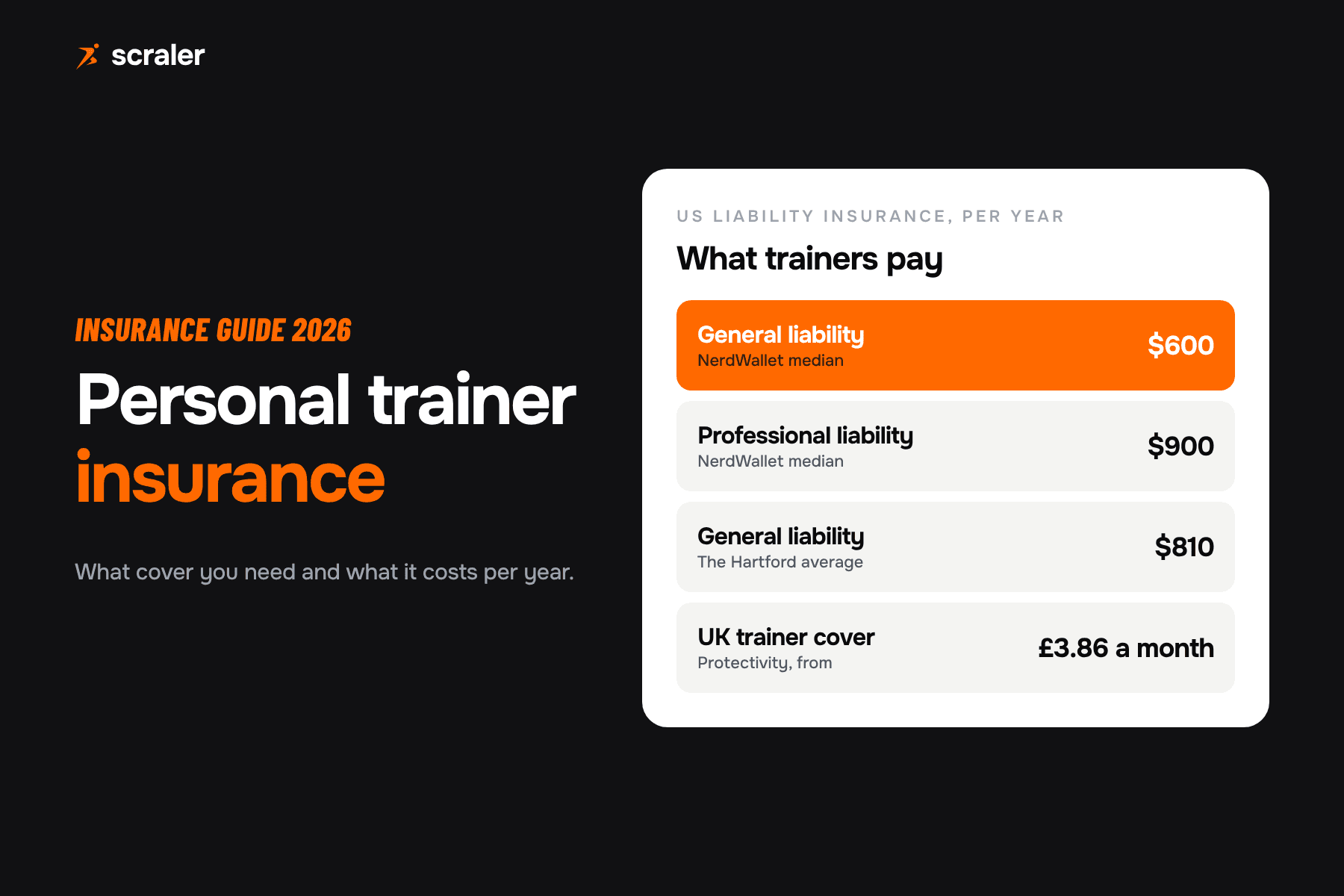
NerdWallet, using data from the broker Coverdash, puts the median at $600 a year for general liability and $900 a year for professional liability. Your price depends on where you train, whether you work one to one or in groups, your revenue and your claims history. Get quotes from at least two providers, and ask for a certificate of insurance you can show a gym or venue.
Do you need an LLC to start a personal training business?
No. The U.S. Small Business Administration (SBA) says you are automatically a sole proprietor if you trade without registering any other structure. It is easy to form and suits low risk businesses and owners testing an idea. The catch is that there is no separate legal entity.
An LLC protects your personal assets, such as your home and savings, in most cases if the business is sued. LLC members still pay self-employment tax. A federal tax ID (EIN) is free to apply for, according to the SBA, and you need one if you hire staff or form a corporation or partnership. Filing fees and rules differ by state, so check yours. Many trainers start as sole proprietors, carry liability insurance and move to an LLC when income or risk grows.
What goes in a PT business plan?
A PT business plan can be one page. It answers six questions, and each has a number or a decision attached: If you are opening your own space, use our gym business plan template and check how much it costs to start a gym.
- 1.Who do you serve? One client type, for example busy parents or beginners over 40. A niche is easier to market to.
- 2.What do you sell? In person sessions, online coaching, small group training or a hybrid of them. Online-only coaching has its own guide: how to become an online personal trainer.
- 3.What do you charge? A price per session and per month, set from your income target (next section).
- 4.What does it cost to run? Insurance, certification, software, venue fees and marketing.
- 5.What do you need to earn? A yearly income target, worked back to a number of clients.
- 6.How do the first 10 clients find you? Named people and named channels, not "social media".
On income, O*NET, using BLS 2025 wage data, lists the median US exercise trainer at $47,160 a year or $22.67 an hour. The 10th percentile is $28,800 and the 90th is $83,100. Independent trainers can land on either side of that, because they keep what a gym would take but pay for their own costs and unbilled hours.
Here are the fixed costs we could verify, as a worked example of year one. The total is our own sum, not a market figure.
- Figure
- $593.40
- Source
- ACE program page, 40% off $989
- Figure
- $600 a year
- Source
- NerdWallet, Coverdash median
- Figure
- $588 a year ($49 a month)
- Source
- Scraler pricing
- Figure
- $1,781.40
- Source
- Our sum of the three rows above
- Figure
- $900 a year, not in the total
- Source
- NerdWallet, Coverdash median
- Figure
- Varies, not in the total
- Source
- Check locally
| Cost | Figure | Source |
|---|---|---|
| Certification (ACE Basic) | $593.40 | ACE program page, 40% off $989 |
| General liability insurance | $600 a year | NerdWallet, Coverdash median |
| Coaching software (Scraler Plus) | $588 a year ($49 a month) | Scraler pricing |
| Worked example total | $1,781.40 | Our sum of the three rows above |
| Professional liability insurance | $900 a year, not in the total | NerdWallet, Coverdash median |
| Business registration, CPR, venue, equipment | Varies, not in the total | Check locally |
How much should a new personal trainer charge?
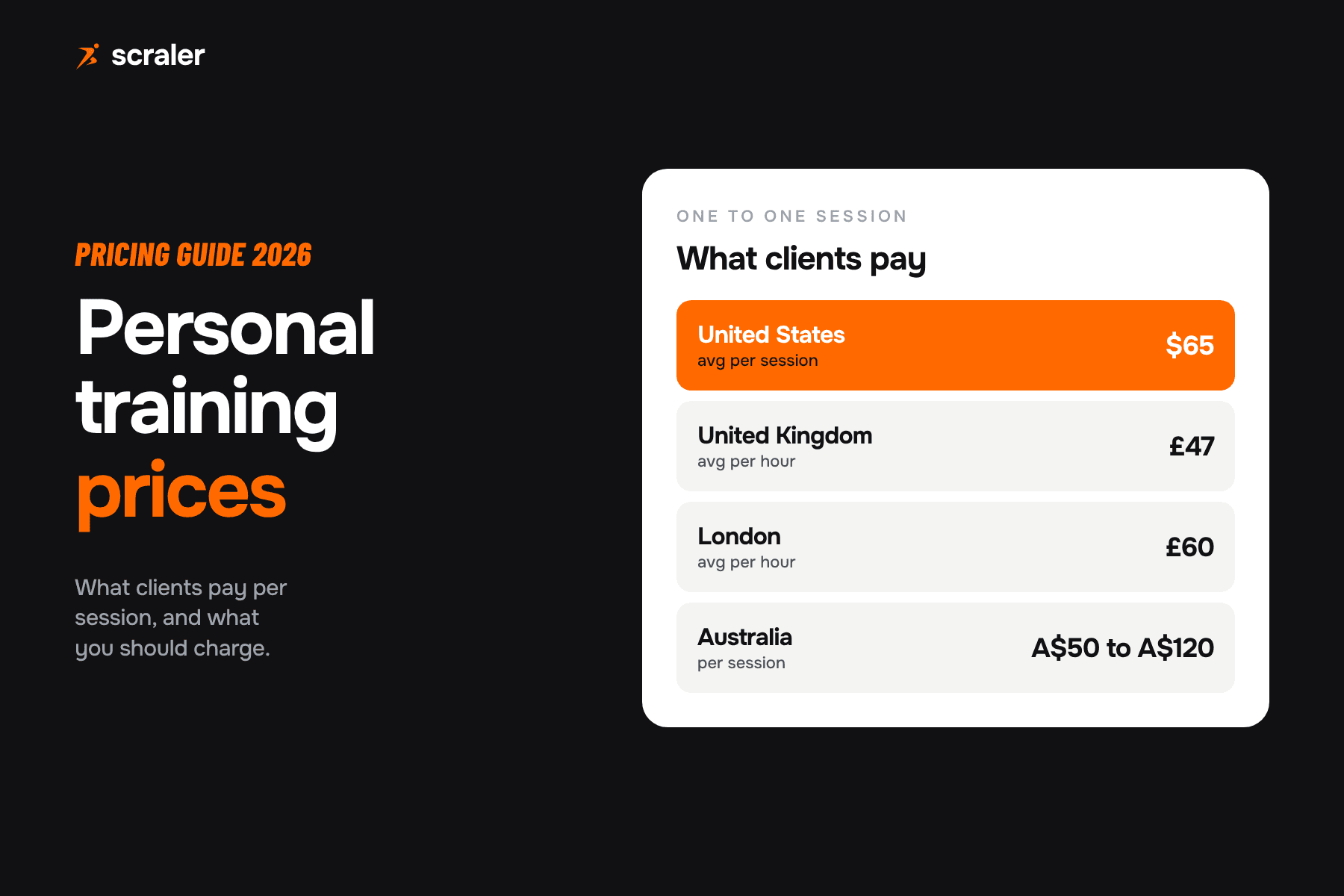
Check the local average, then work from your own numbers. Thumbtack lists a US national average of $55 an hour, and Bark lists $65 a session. Our guide to personal training prices breaks this down by country and format, and shows how packs and memberships lower the price per session while stabilizing your income.
The free personal trainer rate calculator turns your income target, costs and billable hours into a rate. Do not underprice to win your first clients. Offer a fixed intro package instead, so the discount has an end date and the full price stays visible.
What waiver and health screening do you need?
Before the first session, collect a signed waiver and a short health screen. The screen tells you whether the client should see a doctor before training. Our free PAR-Q template covers the screening questions, and the hybrid personal training contract guide shows what to put in a client agreement. Our personal training contract template includes a separate waiver.
Waivers help but they do not remove your duty of care, and what holds up differs by jurisdiction. Have a local professional review the wording. This is not legal advice.
What software does a personal training business need?
Four jobs need a system from day one: delivering programs, taking payments, checking in with clients and keeping client records. You can start with a spreadsheet, a payment link and a chat app, but each client you add multiplies the admin. One platform that handles all four keeps the work you do between sessions small. Our guide to personal trainer software compares the options.
Scraler's Plus plan costs $49 a month for up to 50 clients and includes the workout and meal plan builders and a branded subdomain. Premium at $69 adds unlimited AI generation, payments and the landing page builder, so move up when you start selling packs online. The Basic plan is view only with no active clients, so it will not run a business. To compare the market, read our roundup of the best apps for personal trainers.
Scraler holds client profiles, programs, check-ins, chat, scheduling and, on Premium, Stripe payments in one app, so a new trainer can run a full client list from the first week.
See client managementHow do you get your first 10 clients?
From people who already know and trust you. Cold advertising is slow and expensive before you have results and reviews. Work through these in order: Our personal trainer marketing guide covers the full path from content to booked call.
- 1.Write a list of 50 names. Friends, family, coworkers, old teammates and anyone who has asked you about training.
- 2.Message each one personally. Offer a free first session or a short assessment, and ask who else they know.
- 3.Sell a fixed intro package. Four sessions at a clear price, with the full price shown.
- 4.Ask for a referral and a review after the first month, while the client is excited.
- 5.Convert to a membership. Move good clients from packs to a monthly plan so income is predictable.
Here is how fast the costs come back. These are worked examples, not survey data:
The $1,781.40 divided by $55 is 32.4, so 33 sessions. At $65 it is 27.4, so 28 sessions. Ten clients who each book one session a week produce 10 sessions a week, which gets you to 33 in just over three weeks. After that, the sessions are income rather than setup cost. A weekly session is only the start: the next step is turning those clients into members, which our guide to hybrid personal training packages walks through.
Frequently asked questions
- How much does it cost to start a personal training business?
- In our worked example, the three fixed costs we could verify come to $1,781 in year one: ACE Basic at $593.40, general liability insurance at a $600 median and Scraler Plus at $588. Professional liability (a $900 median), business registration, CPR training, venue fees and equipment come on top and vary.
- Do I need a certification to be a personal trainer?
- Requirements depend on where you work. Look for an accredited certification: ACE and NASM list NCCA accreditation, and ISSA lists an NCCPT accredited exam. Check local rules and what your insurer and any gym you work in require.
- Do I need insurance before my first client?
- Yes, get it before you train anyone for pay. NerdWallet says trainers should carry at least general and professional liability, and the median premiums it cites are $600 and $900 a year.
- Should I start as a sole proprietor or an LLC?
- Many trainers start as sole proprietors because it is automatic and simple. An LLC adds personal asset protection in most cases but you still pay self-employment tax. Ask an accountant or local authority which fits your state.
- How long does it take to get my first 10 clients?
- It depends on your network and effort. If you message a list of 50 people personally and offer a fixed intro package, a few weeks to a few months is realistic. We have no survey data on the average, so treat that as experience, not a statistic.
- What software do I need to run a personal training business?
- You need a way to deliver programs, take payments, run check-ins and store client records. Scraler Plus at $49 a month covers programs, check-ins and client records for up to 50 clients; taking payments needs Premium at $69. Our app roundup compares the alternatives.