Dietitian vs Nutritionist vs Nutrition Coach: What's the Difference?
The difference between a dietitian and a nutritionist is legal protection and training. "Dietitian" is a protected title that needs a graduate degree, supervised practice and a national exam, and it covers treating medical conditions. "Nutritionist" is not protected in most states. A nutrition coach works on habits and general guidance.

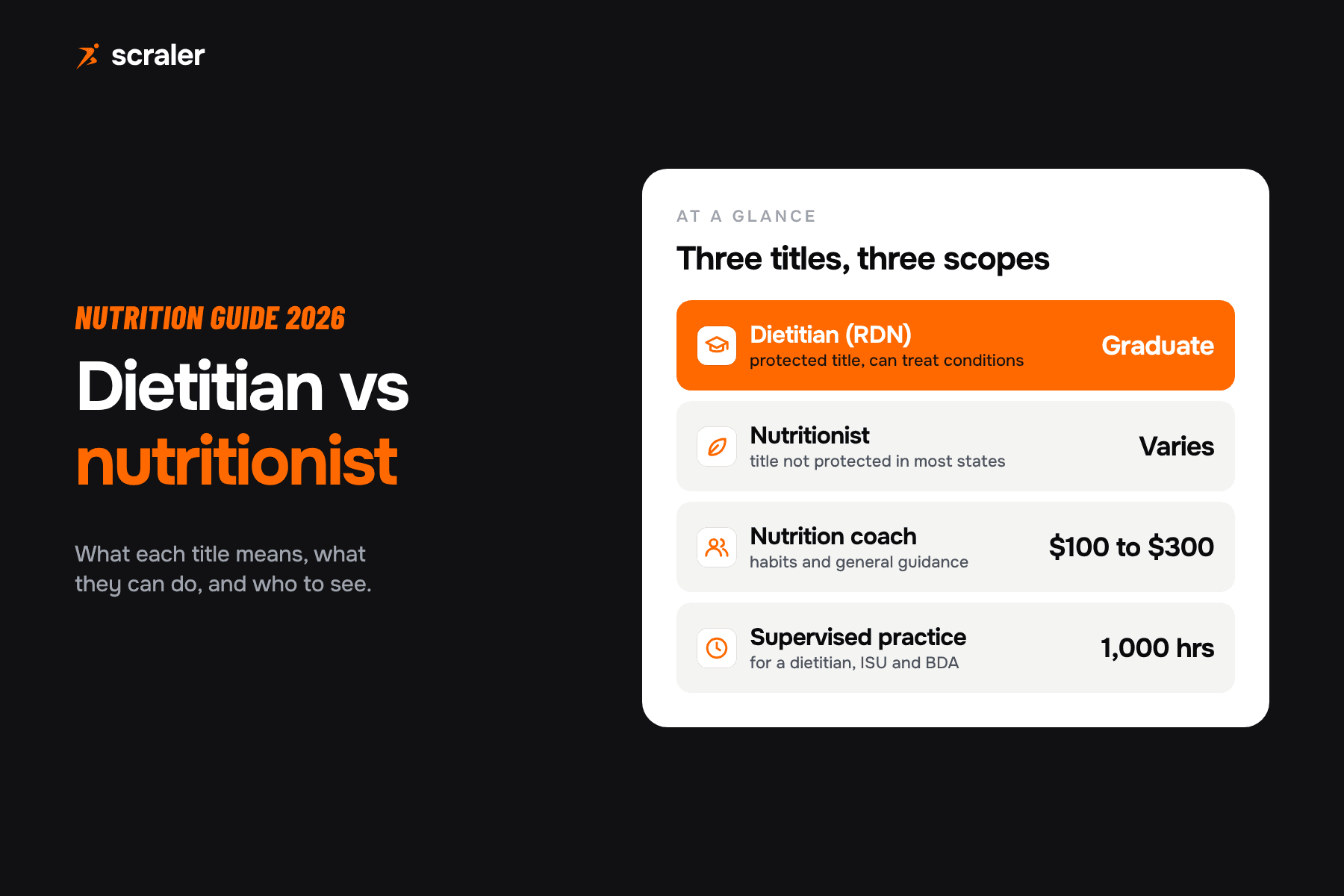
- A registered dietitian (RD or RDN) is the one of the three trained and credentialed to provide medical nutrition therapy everywhere in the US; a few states also license credentialed nutritionists. Since 1 January 2024 new candidates need a graduate degree to sit the RD exam.
- Nutritionist is not a protected title in most US states, the UK or Australia, so check the person's actual training and credential.
- Nutrition coaches work on habits, targets and accountability with healthy adults. They do not treat diseases or use the RD title.
- See a dietitian for a diagnosis, a doctor referral or insurance cover. See a coach for a plan and weekly check-ins.
- Coaches: stay inside your scope, refer out when a client has a medical condition, and say what you are on your site.
The three titles get used as if they mean the same thing. They do not, and the gap matters most to the person who has a health condition and to the coach who wants to stay on the right side of the law. This guide uses the Commission on Dietetic Registration, the Academy of Nutrition and Dietetics, the British Dietetic Association and Dietitians Australia as sources, all read on 7 October 2026. It is general information, not legal or medical advice.
Dietitian vs nutritionist vs nutrition coach: what is the difference?
A dietitian holds a credential. A nutritionist may or may not. In the US, the Commission on Dietetic Registration (CDR), the credentialing agency of the Academy of Nutrition and Dietetics, awards the RD and RDN credentials to people who meet academic and supervised practice requirements and pass a registration exam. CDR describes them as a legally protected designation.
"Nutritionist" has no such gate. Idaho State University's dietetics department says the title is not legally protected in most states, and that a nutritionist may have a degree, a certification or no formal education at all. Boston University puts it more bluntly: nearly anyone who has taken a nutrition course can use it.
Credentialed dietitians can also call themselves nutritionists, which is where the confusion starts. CDR's own wording is that all registered dietitians are nutritionists, but not all nutritionists are registered dietitians.
- Dietitian (RD, RDN)
- Yes, by law
- Nutritionist
- Not in most states
- Nutrition coach
- No
- Dietitian (RD, RDN)
- Graduate degree for new candidates since 2024
- Nutritionist
- None to a full degree
- Nutrition coach
- None required
- Dietitian (RD, RDN)
- Yes, accredited program (ISU: 1,000+ hours)
- Nutritionist
- Not standard
- Nutrition coach
- No
- Dietitian (RD, RDN)
- Yes, CDR
- Nutritionist
- Only for optional credentials such as CNS
- Nutrition coach
- Course exam, varies
- Dietitian (RD, RDN)
- Yes
- Nutritionist
- Not usually (depends on state licence)
- Nutrition coach
- No
- Dietitian (RD, RDN)
- Eligible
- Nutritionist
- Rarely
- Nutrition coach
- No, client pays
| Dietitian (RD, RDN) | Nutritionist | Nutrition coach | |
|---|---|---|---|
| Title protected | Yes, by law | Not in most states | No |
| Degree | Graduate degree for new candidates since 2024 | None to a full degree | None required |
| Supervised practice | Yes, accredited program (ISU: 1,000+ hours) | Not standard | No |
| National exam | Yes, CDR | Only for optional credentials such as CNS | Course exam, varies |
| Can provide medical nutrition therapy | Yes | Not usually (depends on state licence) | No |
| Insurance reimbursement | Eligible | Rarely | No, client pays |
The nutrition coach column describes what the role is, not a regulated profession. No exam or license is attached to the title in the sources we read, so what a coach knows depends on the course they took and the experience since. If you train clients as well, the legal and insurance basics are in how to start a personal training business.
What can a registered dietitian do that others cannot?
A registered dietitian can provide medical nutrition therapy, which means treating a medical condition with food as part of a care plan. The Academy lists hospitals, private practice, community health, sports nutrition, industry and research as typical settings, and says RDNs in healthcare administer medical nutrition therapy as part of the care team.
- Treat conditions. Diabetes, kidney disease, digestive disorders, food allergies and eating disorders belong with a dietitian, not a coach.
- Work in clinical settings. ISU notes nutritionists are not qualified for clinical roles, while RDNs are.
- Bill insurance. RDNs are eligible for reimbursement. ISU says nutritionists are rarely reimbursed.
- Be licensed. The Academy says many states have regulatory laws for dietitians. CDR notes some states, California and Arizona among them, do not license dietitians, so rules differ by state.
The training is long on purpose. Under CDR rules, people who first become eligible for the RD exam on or after 1 January 2024 need a graduate degree, ACEND-accredited coursework and ACEND-accredited supervised practice. ISU puts supervised practice at 1,000+ hours. The exam is offered at more than 250 Pearson test centers, and for people who become eligible from 2027 CDR has set a lifetime limit of 8 attempts.
The US labor data shows how established the profession is. O*NET, using 2025 wage data, lists dietitians and nutritionists with a median of $76,400 a year and 86,300 people employed.
What can a nutritionist do?
It depends entirely on who they are. Some nutritionists hold a master's degree in nutrition science and a credential such as the Certified Nutrition Specialist. Others finished a weekend course. Because the title itself carries no standard, ISU says nutritionists typically provide general nutrition advice and are not qualified for clinical roles.
The practical rule: ask what the person trained in and which body certifies them. A credential you can look up is worth more than the word "nutritionist" on a website. In the UK, the British Dietetic Association points out that "nutritionist", "diet expert" and "nutrition consultant" are not legally or voluntarily regulated, and that only people on the voluntary register can use "registered nutritionist".
What does a nutrition coach do?
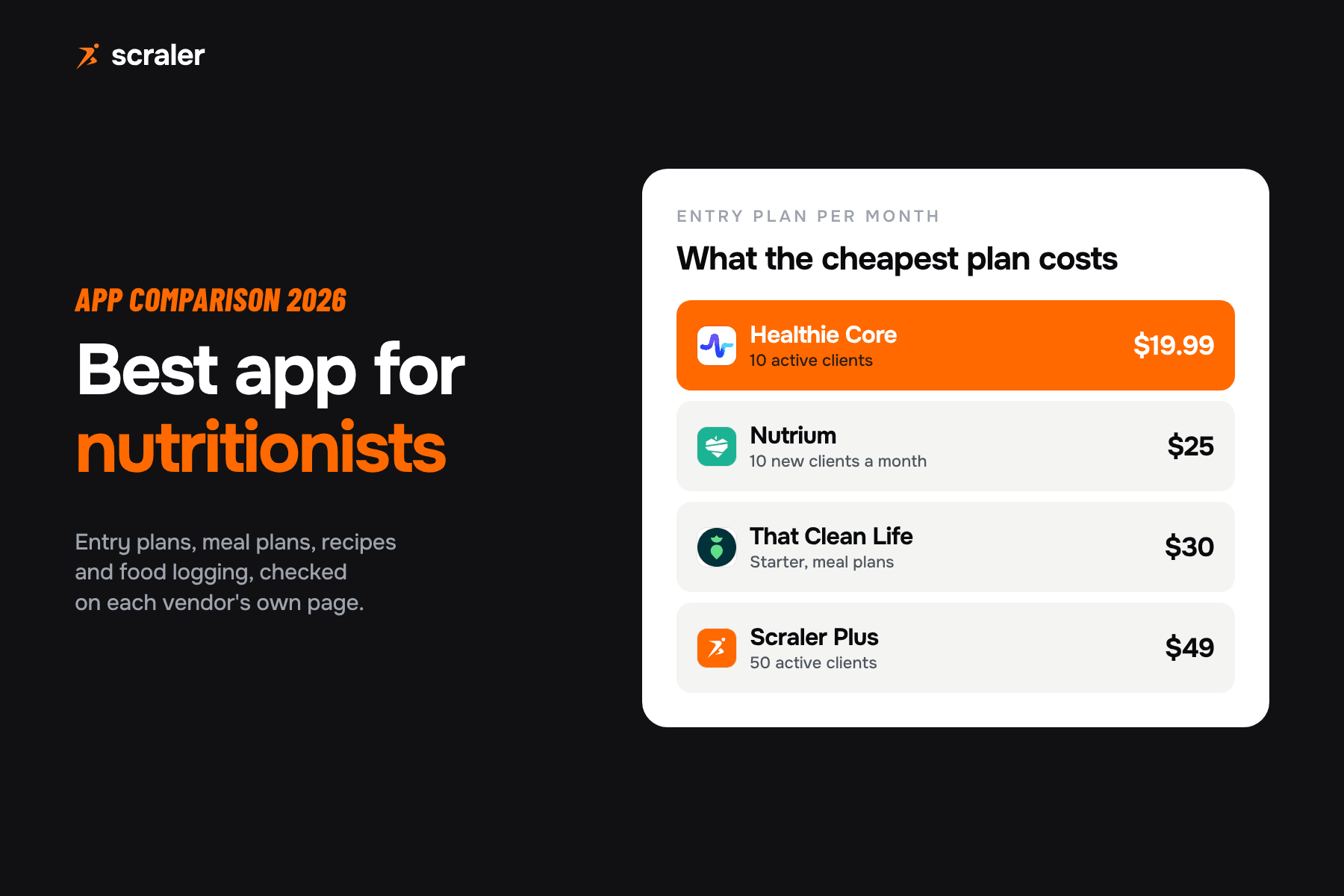
A nutrition coach helps healthy adults change what they eat and keep changing it. That means setting calorie and macro targets, building meal plans, running weekly check-ins, and adjusting when the scale or the client's energy says something is off. The skill is behavior change and accountability as much as nutrition knowledge. For the tools that do this, see best apps for nutritionists.
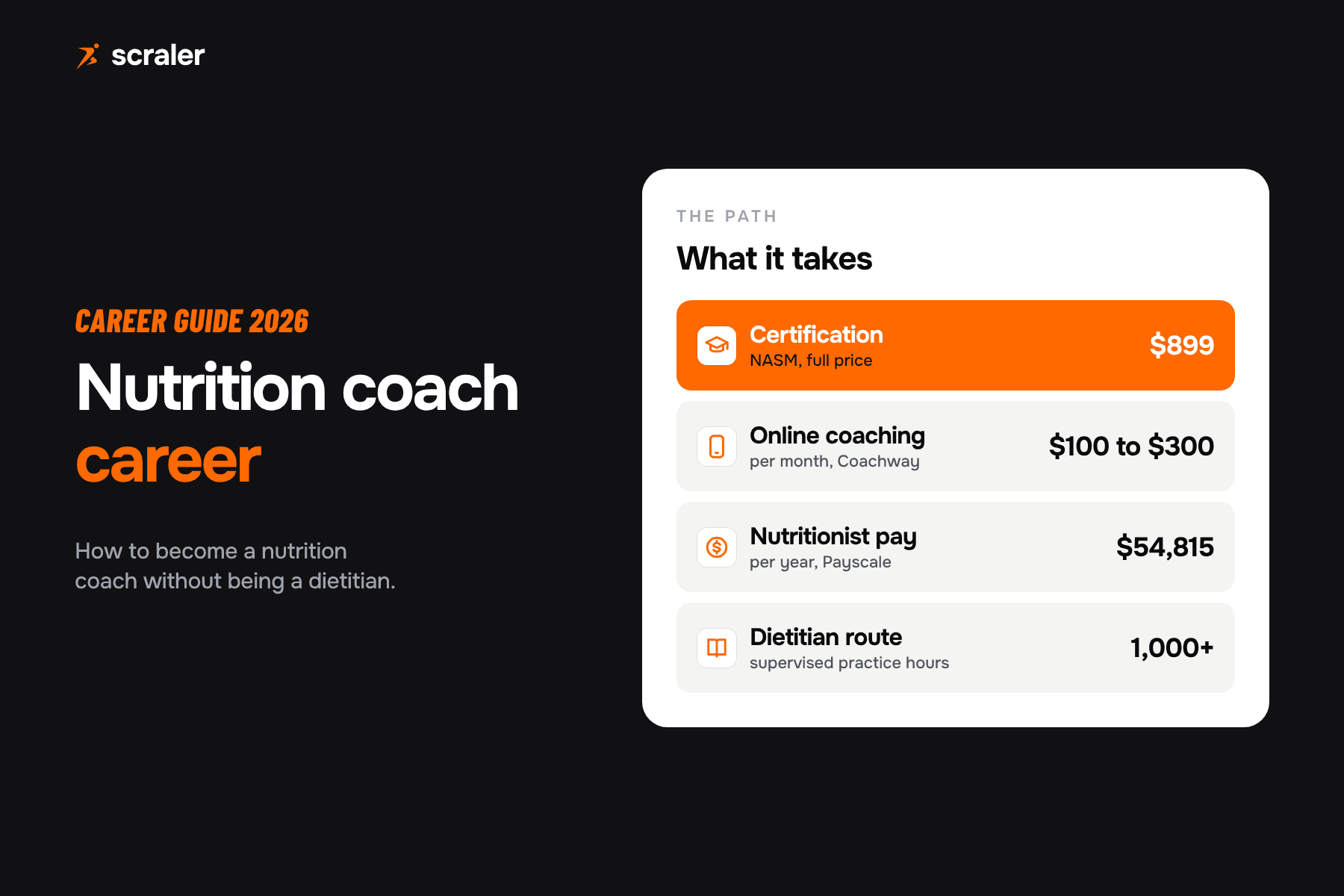
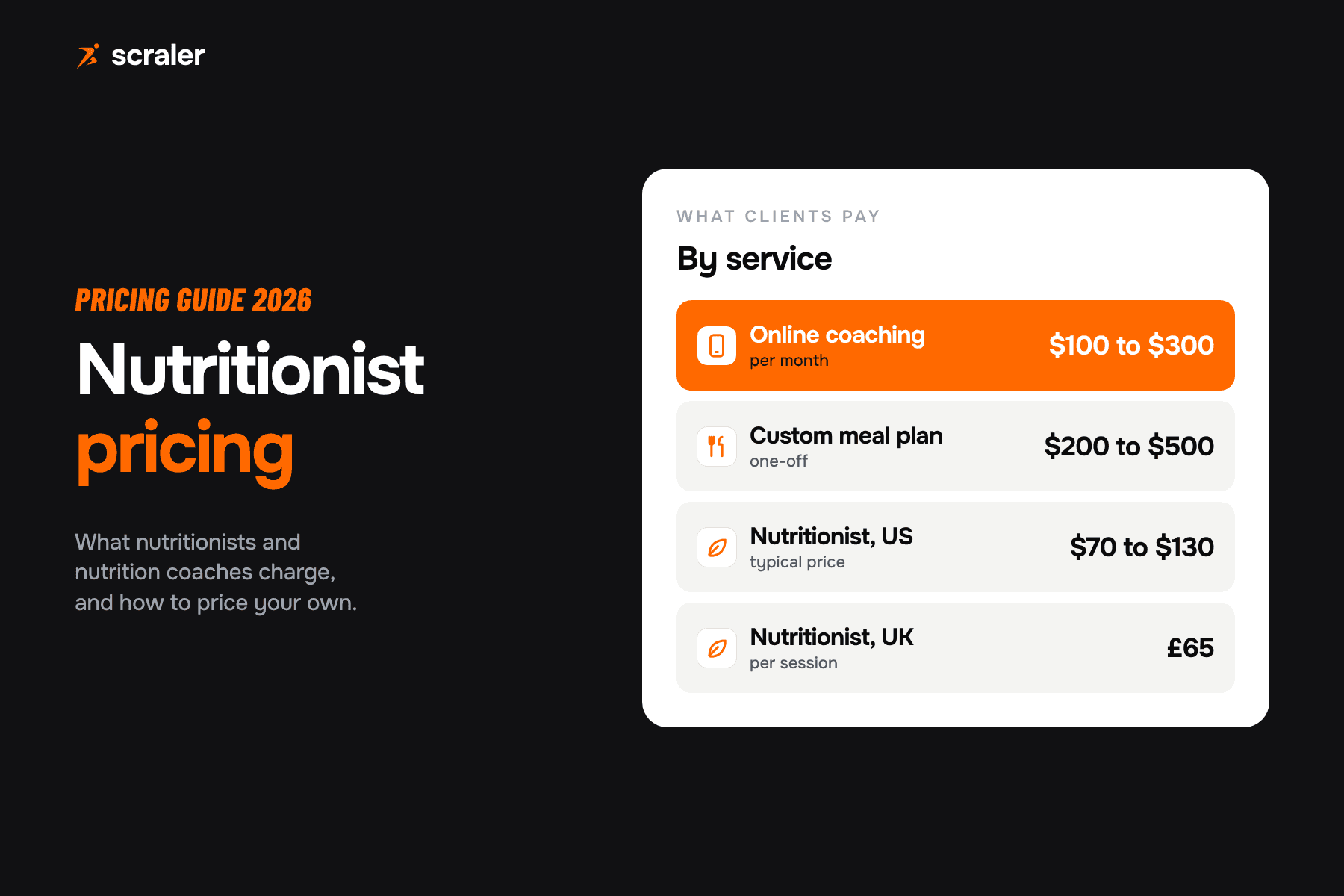
It is also a business. Coachway's October 2026 guide puts most online nutrition coaching at $100 to $300 a month, with self-guided plans at $50 to $100 and premium one to one coaching at $300 to $600 or more. For entry cost, NASM lists its nutrition certification at $899 and states that the course is not accredited by a third-party accrediting body, which is a good reminder to read what a certificate actually is before you pay for it. Our own guides cover how to become a nutrition coach and what to charge.
Scraler gives nutrition coaches a meal planner, recipe library, macro targets and weekly check-ins, so a plan and its follow-up live in one client app.
See the meal plannerWho should you see for which problem?
Start with one question: is there a diagnosis or a doctor involved? If yes, book a dietitian. If not, a coach or a well-trained nutritionist can work. This is our own decision guide, not medical advice.
- See
- Dietitian
- See
- Dietitian
- See
- Nutrition coach
- See
- Nutrition coach
- See
- Credentialed nutritionist, or a coach
- See
- Sports dietitian or a coach who works with them
| Your situation | See |
|---|---|
| Diabetes, kidney disease, IBS, food allergy or an eating disorder | Dietitian |
| A doctor referral, or you want insurance to pay | Dietitian |
| Fat loss, muscle gain or better habits, no medical condition | Nutrition coach |
| You know what to eat but need accountability and weekly adjustments | Nutrition coach |
| General questions about healthy eating | Credentialed nutritionist, or a coach |
| Training for a sport at a high level | Sports dietitian or a coach who works with them |
If you are a trainer, this table is also a referral map. Many clients ask their trainer about food. You can give general guidance inside your scope and know exactly when to hand off. Our macro calculator and TDEE calculator are free starting points for healthy adults, and a personalized nutrition plan guide shows how to turn the numbers into a plan.
Is "nutritionist" a protected title in the US, UK and Australia?
In none of the three is "nutritionist" a clean legal title. In the US it is not protected in most states. In the UK the British Dietetic Association says dietitian is the only protected nutrition title, regulated by the HCPC, and the BDA states the dietitian degree includes 1,000 hours of on-the-job training. In Australia Dietitians Australia says anyone can call themselves a nutritionist, while dietitians are self-regulated and the Accredited Practising Dietitian credential is recognized by Medicare, the Department of Veterans' Affairs and many private insurers.
The UK also has a voluntary Registered Nutritionist route through the Association for Nutrition: an accredited degree plus three or more years of experience shown in a portfolio, per the BDA. It is a real credential, but it is voluntary and separate from the dietitian title. Nutritional therapist is a third title, also not statutory.
How do you check a credential?
- 1.Ask for the credential, not the title. RD, RDN, RNutr, APD or CNS name a body you can look up. "Nutritionist" alone does not.
- 2.Use the register. CDR has a verification tool for US dietitians, the HCPC register covers UK dietitians, and Dietitians Australia keeps a register of Accredited Practising Dietitians.
- 3.Check your state or country. Licensing rules differ, and some states do not license dietitians at all.
- 4.Match the person to the problem. A coach with a great track record in fat loss is still not the right person for kidney disease.
How should coaches describe themselves?
Say what you do and what you trained in, in plain words. "Nutrition coach" with your certification named is honest and clear. Avoid "dietitian" unless you are one, avoid "nutritionist" if your state restricts it, and never imply you treat medical conditions. Put your scope and your referral rule on your website and in your onboarding form, and ask new clients about diagnoses and medication up front.
The good news for coaches is that the split is useful, not a threat. Dietitians treat conditions. Coaches deliver the daily structure that makes any plan stick. Plenty of clients need both. If you run the coaching side from one platform, meal plans and macro tracking stay in the same place as check-ins and chat, and our nutrition coaching software guide compares the tools.
Frequently asked questions
- Is a nutritionist the same as a dietitian?
- No. A dietitian holds a protected credential (RD or RDN in the US) earned through a degree, supervised practice and a national exam. A nutritionist may hold a degree or a credential, or none, because the title is not protected in most states. All registered dietitians are nutritionists, but not all nutritionists are registered dietitians.
- Is a nutrition coach the same as a nutritionist?
- Not exactly. Both titles are unprotected in most places, so the real difference is the role. A nutrition coach works on habits, targets and accountability with healthy adults. A nutritionist may give broader nutrition advice, depending on their training. A coach cannot provide medical nutrition therapy, and a nutritionist usually cannot unless they are a registered dietitian or hold a state licence that allows it.
- Can a nutrition coach give meal plans?
- Usually yes, for healthy adults, and many coaches sell meal plans and macro targets. Rules differ by state and country, and some places restrict individualized plans for medical conditions. Refer clients with a diagnosis to a dietitian and check local rules with a professional.
- Do you need a degree to be a nutritionist?
- In most US states, no, because the title is not protected. A degree helps a lot for credibility and is required for credentials such as the dietitian route, where new candidates need a graduate degree since 1 January 2024. Check your own state, since some regulate who may give nutrition advice.
- Does insurance cover a dietitian or a nutritionist?
- Registered dietitians are eligible for insurance reimbursement in the US, according to Idaho State University, and Dietitians Australia says Medicare and many private insurers recognize Accredited Practising Dietitians with a GP care plan. Nutritionists are rarely reimbursed, and nutrition coaching is normally paid by the client directly.
- Who should I see for weight loss, a dietitian or a nutrition coach?
- If you have no medical condition, either can work, and a coach adds weekly accountability. If you have diabetes, kidney disease, an eating disorder or a doctor's instructions, see a registered dietitian first.