How to Create a Personalized Nutrition Plan for Clients
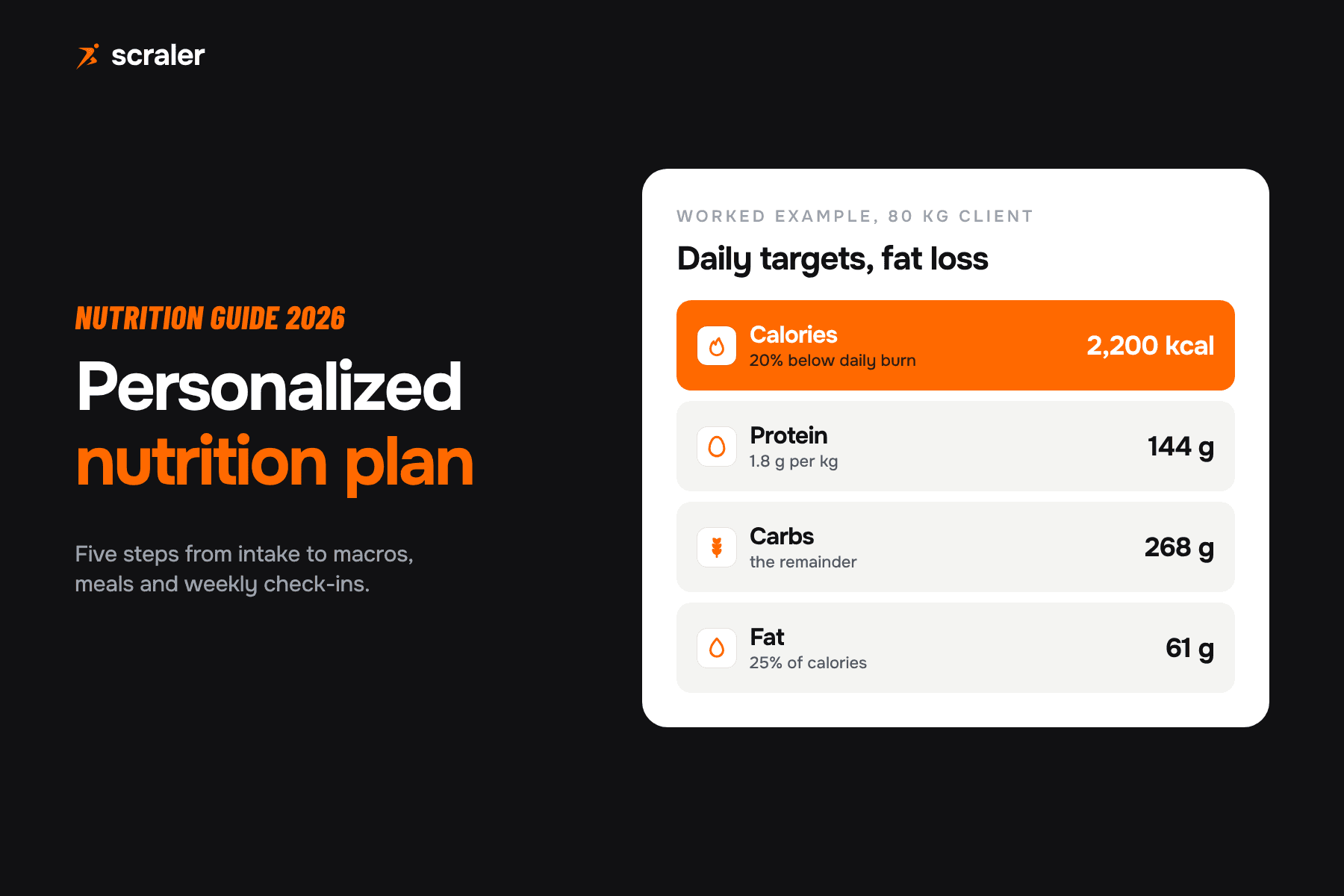
A personalized nutrition plan turns one client's goal, body and routine into daily targets and meals they can follow. Build it in five steps: intake, calorie target, macros, meal structure, then weekly check-ins. In our worked example, an 80 kg client losing fat gets 2,200 kcal with 144 g protein, 268 g carbs and 61 g fat.

- Five steps: intake, calorie target, macros, meal structure, check and adjust. Do them in that order.
- Set calories with the Mifflin St Jeor equation and an activity factor. Treat the result as a starting point and adjust from the client's weight trend.
- Set protein first. The ISSN position stand puts most exercising people at 1.4 to 2.0 g per kg of body weight a day.
- Turn macros into four or so meals the client would actually cook, and check in every week.
This guide is for coaches who write nutrition plans for clients. It follows one example client from first questionnaire to weekly check-in, and shows the arithmetic at each step. The figures from research come from position stands and guidelines we read on 7 October 2026. Anything we calculated is labelled a worked example.
What is a personalized nutrition plan?
A personalized nutrition plan is a set of daily targets and meals built for one person. It starts from their goal, size, training and routine, not from a template. Two clients can want the same thing, fat loss, and still need different calories, different meal timing and different foods, because one works night shifts and the other cooks for a family.
The science behind it is less contested than the internet suggests. The International Society of Sports Nutrition (ISSN) reviewed diets and body composition and concluded that a wide range of dietary approaches can be similarly effective, and that individualization and environmental considerations are essential. In plain terms: the plan the client can keep following beats the perfect plan they quit.
How do you create a personalized nutrition plan for a client?
Work through five steps in order. Each one sets the input for the next, so skipping ahead to meals before you have targets is how plans end up generic.
Step 1: What should you ask in the intake?
The intake gives you the inputs for the calculation and the limits for the meals. Ask for:
- Body and goal. Age, sex, height, weight, and a specific goal with a time frame, such as fat loss, muscle gain, performance or maintenance.
- Training. Sessions a week, type, and how active their job is. Job activity matters as much as the gym.
- History. What they have tried, what worked, what they could not stick to, and any past weight changes.
- Food. Allergies, intolerances, foods they refuse or love, religious or ethical rules, and who cooks.
- Routine. Work hours, meal times, how many meals they want, budget and how much time they have to cook.
- Health flags. Medical conditions, medication, pregnancy, and anything that means you should refer them.
Send this as a form before the first call, so the call itself is about decisions. A short questionnaire inside the client's app beats a PDF they have to email back. Our client intake form template has the questions ready to copy.
Step 2: How do you set a client's calorie target?
Calories decide the direction of body weight. The NHS puts it simply: weight stays stable when the calories you use match the calories you eat and drink, and changes when they do not. Your job is to estimate the client's daily burn, then set a target above, at or below it.
Estimate resting energy with the Mifflin St Jeor equation, published in 1990 from 498 healthy adults. In that study the older Harris-Benedict equation overestimated measured resting energy by 5%. For a man: 10 x weight in kg + 6.25 x height in cm - 5 x age + 5. For a woman, use -161 at the end instead of +5. Then multiply by an activity factor. We use 1.2 for sedentary up to 1.9 for athletes, and 1.55 for three to five sessions a week. Our TDEE calculator and Mifflin St Jeor calculator do the sum for you.
- Sum
- 10 x 80 + 6.25 x 180 - 5 x 35 + 5
- Result
- 1,755 kcal
- Sum
- 1,755 x 1.55
- Result
- 2,720 kcal
- Sum
- 2,720 x 0.8 = 2,176, rounded
- Result
- 2,200 kcal
| Step | Sum | Result |
|---|---|---|
| Resting energy (Mifflin St Jeor) | 10 x 80 + 6.25 x 180 - 5 x 35 + 5 | 1,755 kcal |
| Daily burn, activity 1.55 | 1,755 x 1.55 | 2,720 kcal |
| Fat loss target, about 20% below | 2,720 x 0.8 = 2,176, rounded | 2,200 kcal |
The activity factor and the 20% deficit are assumptions for this example, not research findings. Treat the number as a first estimate. The ISSN notes that slower rates of weight loss can better preserve lean mass as people get leaner, and in one study it cites, 0.7% of body weight a week did better than 1.4%. So a lean client should get a smaller deficit than a client with more fat to lose. For muscle gain, the same review suggests smaller surpluses for advanced trainees and larger ones for beginners.
Step 3: How do you set macros for a client?
Set protein first, then fat, then let carbs fill the rest. That order works because protein has a research-backed target and carbs are the flexible part.
- Protein. The ISSN position stand on protein and exercise says 1.4 to 2.0 g per kg of body weight a day is sufficient for most exercising people. For lean, resistance-trained clients in a deficit, the diets position stand says 2.3 to 3.1 g per kg of fat-free mass may be needed to hold on to muscle.
- Fat. Take a share of calories. The US Dietary Guidelines range for adults is 20 to 35%. Our example uses 25%.
- Carbs. Whatever calories remain. The guideline range is 45 to 65% of calories. For endurance clients, the ISSN nutrient timing paper reports 5 to 12 g per kg a day, with 8 to 10 g per kg for athletes training at moderate to high intensity for 12 hours a week or more.
The calories per gram are 4 for protein, 4 for carbs and 9 for fat. For our 80 kg client at 2,200 kcal: protein at 1.8 g per kg is 144 g, or 576 kcal. Fat at 25% is 550 kcal, or 61 g. The remaining 1,074 kcal is carbs, or 268 g. The macro calculator and protein calculator let a client check the same maths.
- Calories (example)
- 2,200 kcal
- Protein
- 26% (1.8 g/kg)
- Fat
- 25%
- Carbs
- 49%
- Calories (example)
- 2,700 kcal
- Protein
- 19% (1.6 g/kg)
- Fat
- 25%
- Carbs
- 56%
- Calories (example)
- 2,950 kcal
- Protein
- 20% (1.8 g/kg)
- Fat
- 25%
- Carbs
- 55%
- Calories (example)
- 3,200 kcal
- Protein
- 14% (1.4 g/kg)
- Fat
- 25%
- Carbs
- 61% (6.1 g/kg)
These splits are a worked example for one 80 kg client, not a prescription. The calorie levels are assumptions. The point is the method: fix protein from body weight, pick a fat share, and let the goal and training decide the carbs.
Step 4: How do you turn macros into a meal plan?
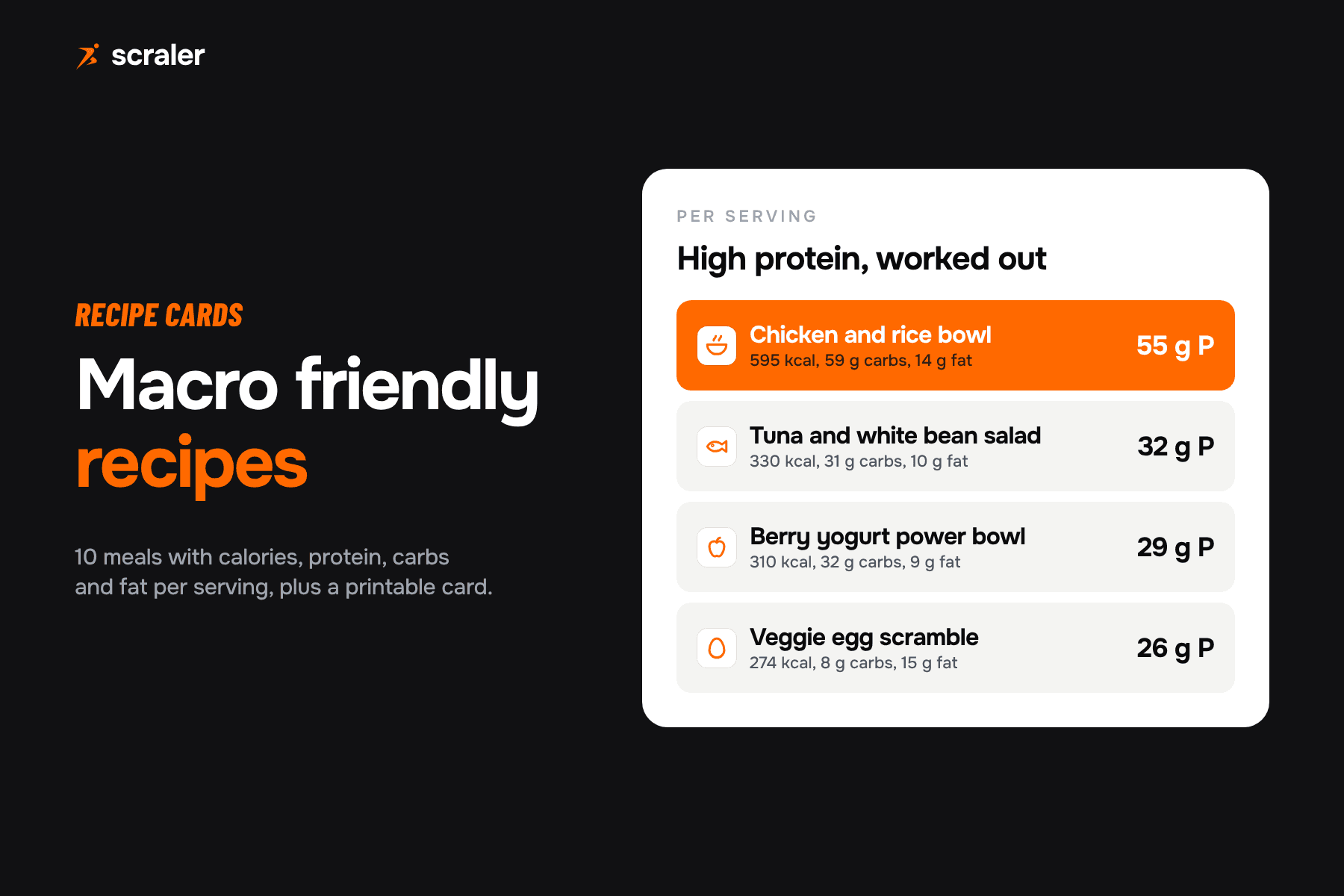
Targets are numbers. Clients eat meals. Divide the day into the number of eating moments that fit their routine, then fill each with foods and recipes they like. For our client, four meals of about 550 kcal each is a clean starting point. Our meal plan template gives you a weekly grid to fill, and our macro friendly recipes come with the numbers worked out.
- Calories
- about 550 kcal
- Protein
- 36 g
- Carbs
- 67 g
- Fat
- 15 g
- Calories
- 2,200 kcal
- Protein
- 144 g
- Carbs
- 268 g
- Fat
- 61 g
Meals do not have to be equal. A client who trains in the evening might want a larger dinner and a lighter lunch. What matters is that the day adds up and the meals fit the diary. Build the plan from recipes the client can cook on a normal Tuesday, give them swaps for each meal, and include the foods they named in the intake. A healthy grocery list by food group helps the client shop for the week.
If you want a tool to do this at scale, see nutrition coaching software for how the main options compare.
Step 5: How do you check and adjust the plan?
The first plan is a hypothesis. The client's body tells you whether it was right. Run a weekly check-in with four things:
- 1.Weight trend. The average over the week, not a single morning.
- 2.Adherence. How many days they hit their targets, and which meals they skipped or changed.
- 3.Training and energy. Performance in sessions, hunger, sleep and mood.
- 4.One change. Move calories by a small step, or swap a meal, never several things at once.
If the weight trend is not moving in the direction you planned for two to three weeks and adherence is good, adjust the calories. If adherence is the problem, adjust the plan to the client, not the client to the plan. That is what personalization means in practice.
How do you build personalized nutrition plans in Scraler?
In Scraler the five steps live in one place, so the plan does not end up spread over a spreadsheet, a PDF and a chat thread.
- Intake. Send a questionnaire as a check-in, and review the answers in the client record.
- Macros. Set calorie and macro targets per client with macro management, and change them when the trend says so.
- Meals. Build the meal plan from the recipe library, or use your own recipes, and assign it to the client.
- Recipes and cookbooks. Group recipes into cookbooks the client can open in their app.
- AI drafts. On Premium, AI meal generation drafts a plan from the targets that you then edit.
- Check-ins. Weekly check-ins collect weight and adherence, and chat covers the questions in between.
Set the targets, assign the meal plan, and review the weekly check-in in the same client record.
See the meal plannerNutrition coaching also changes what you can charge. If you are working out how to price it, personal training prices shows what clients pay for coaching with and without nutrition.
Related guides
- Meal plan template: a free weekly planner with macro targets and day totals.
- Macro friendly recipes: ten recipes with calories and macros per serving.
- Healthy grocery list: a printable food shopping ideas list by food group.
- How to make a cookbook: turn your recipes into a product for clients.
- Best apps for nutritionists: the apps that build and deliver the plan.
Frequently asked questions
- What is a personalized nutrition plan?
- It is a set of daily calorie and macro targets plus meals, built for one person from their goal, body, training and routine. A good one is also built around the foods they like and can cook.
- How do you calculate calories for a client?
- Estimate resting energy with the Mifflin St Jeor equation, multiply by an activity factor to get daily burn, then set the target above, at or below it for the goal. For a 35 year old man at 80 kg and 180 cm, resting energy is 1,755 kcal and daily burn at an activity factor of 1.55 is about 2,720 kcal.
- How much protein should a client eat?
- The ISSN position stand says 1.4 to 2.0 g per kg of body weight a day is sufficient for most exercising people. Lean, resistance-trained clients in a calorie deficit may need more, 2.3 to 3.1 g per kg of fat-free mass according to the ISSN diets review.
- What macro split is best?
- There is no single best split. The ISSN found that a wide range of approaches can work equally well for body composition. Set protein from body weight, keep fat and carbs inside the US Dietary Guidelines ranges of 20 to 35% and 45 to 65% of calories, and choose the balance the client can keep.
- How often should you update a nutrition plan?
- Review it every week at the check-in, and change one thing at a time. If the weight trend has not moved the way you planned for two to three weeks and the client followed the plan, adjust the calories.
- Can a personal trainer write a nutrition plan?
- It depends on your country and certification. For healthy adults, many trainers give general nutrition coaching. For medical conditions, disordered eating, pregnancy or a clinical diet, refer the client to a registered dietitian or their doctor.