Gym and Fitness Studio Business Plan Template (Free PDF and Excel)
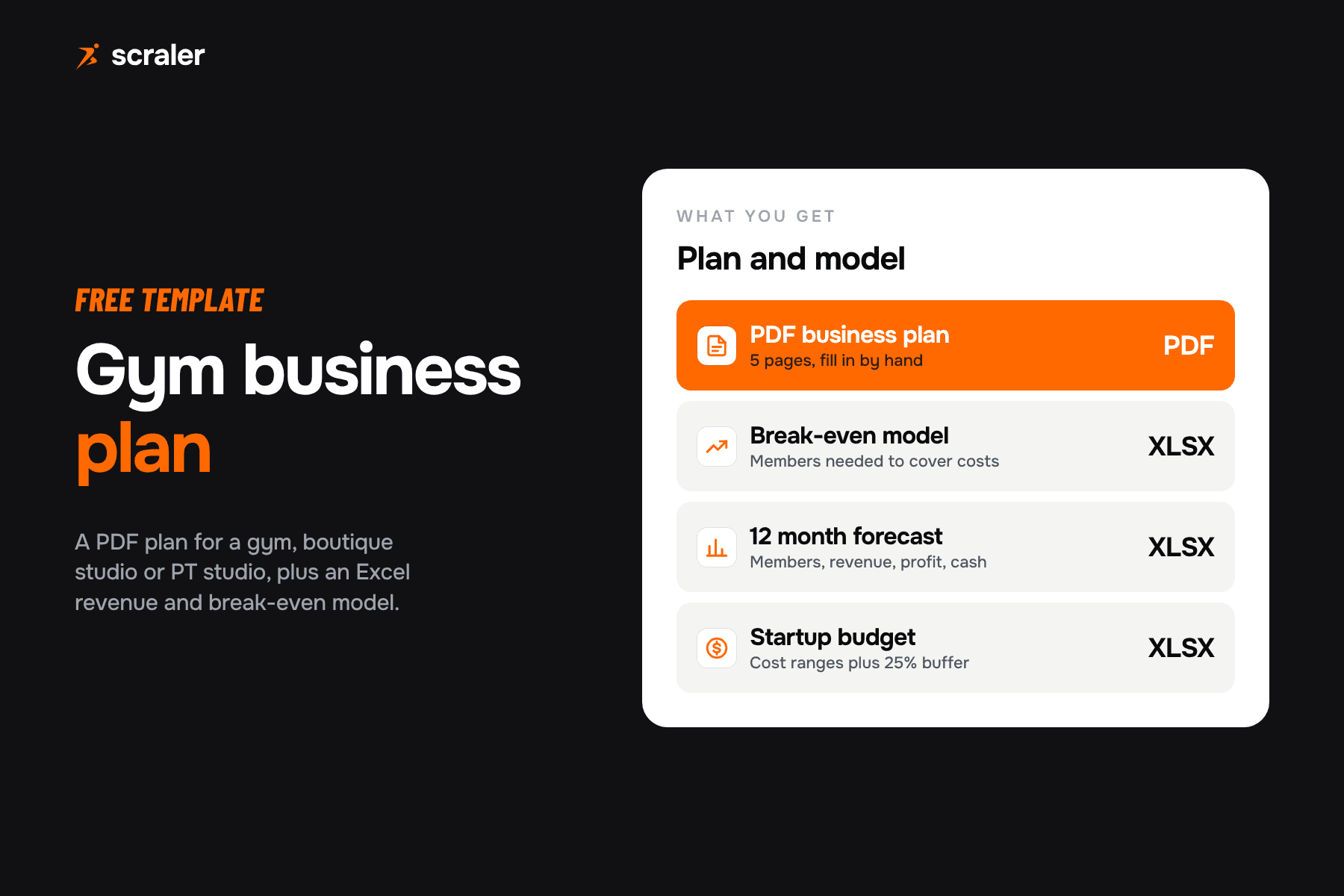
A gym business plan is a short document that shows who you will serve, what you will sell, what it costs to open and when you break even. Below is a free template for a gym, boutique studio or PT studio: a 5 page PDF following the SBA outline and an Excel revenue and break-even model.

- Use the SBA traditional outline if you need a loan. Use a one page lean plan if you only need to think straight.
- If you need a loan, put the most work into the funding request and the financial projections.
- Break-even members = fixed costs divided by what each member leaves after variable costs. The Excel does this for you.
- In the worked example the gym breaks even at 100 members and turns profitable in month 8, after a cash low of about $23,500.
Most trainers skip the plan because it feels like homework. A good one is two things: a way to find out whether the numbers work before you sign a lease, and a document a bank or investor will take seriously. This page gives you both a fillable PDF and a spreadsheet model, then explains each section in plain language. Download them first, then read on while you fill them in.
A 5 page PDF plan for a gym, boutique studio or PT studio, plus an Excel model with a break-even calculator, a 12 month forecast and a startup budget. Example numbers are marked and meant to be replaced.
What goes in a gym business plan?
The U.S. Small Business Administration describes two common formats. A traditional plan uses a standard structure and goes into detail in each section, and it can run to dozens of pages. A lean startup plan keeps only the key points, can take as little as one hour and is typically one page. The SBA suggests the traditional format if you are detail oriented or plan to request financing from traditional sources. It also says you do not have to stick to the exact outline.
Our PDF uses those eight sections and adds a ninth, operations, because a gym or studio lives and dies on its lease, equipment and insurance. Each section has a prompt for a gym and one for a PT studio, so you can use the same template for either.
How do you fill in each section of the gym business plan template?
- 1.Executive summary. One page on what you open, for whom, where, what it costs and why it will work. The SBA says to include financial information if you are asking for financing. Write it last.
- 2.Company description. Format, size, hours, legal structure and what makes you different. Be specific about the problem you solve for a clear group of members.
- 3.Market analysis. Who lives or works close enough to join, who already trains them and what they charge. Visit three competitors and write down their prices and class times.
- 4.Organization and management. Who does what. Name the people, their certifications and experience, and who is paid and who is owner pay.
- 5.Services and pricing. Memberships, class packs, personal training, day passes. If you are unsure about prices, read personal training prices and use the personal trainer rate calculator.
- 6.Marketing and sales. How members find you, how an enquiry turns into a paid member, and how you keep them past month three.
- 7.Funding request. How much you need, whether it is debt or equity, and what it pays for. The SBA asks for the amount over the next five years and a clear use of funds.
- 8.Financial projections. A forecast for year one, monthly or quarterly, and a longer outlook if you ask for a loan. This is where the Excel model helps.
If you want a one page version, the SBA lean format works well for a PT studio: it covers elements such as customer segments, value proposition, channels, cost structure and revenue streams on a single sheet. Start there if you are still deciding whether to open.
How do you work out your break-even point?
The SBA defines the break-even point as the point where total cost and total revenue are equal. For a gym that means a number of members. The formula is simple: fixed costs divided by contribution per member, rounded up. Contribution is the average price a member pays minus the variable cost of serving them.
Here is a worked example, not survey data. A small gym has fixed costs of $10,500 a month: rent $3,000, utilities $600, staff and owner pay $4,500, insurance $400, software $150, marketing $1,000, equipment maintenance $500 and $350 of other costs. The average membership is $110 and each member costs $5 a month in payment fees and supplies. Contribution is $105. $10,500 / $105 = 100 members, or $11,000 of revenue a month.
- Studio or gym
- $10,500
- PT studio
- $5,400
- Studio or gym
- $110
- PT studio
- $210
- Studio or gym
- $5
- PT studio
- $10
- Studio or gym
- $105
- PT studio
- $200
- Studio or gym
- 100
- PT studio
- 27
- Studio or gym
- 120
- PT studio
- 35
| Worked example | Studio or gym | PT studio |
|---|---|---|
| Fixed costs per month | $10,500 | $5,400 |
| Average price per member | $110 | $210 |
| Variable cost per member | $5 | $10 |
| Contribution per member | $105 | $200 |
| Break-even members | 100 | 27 |
| Members for a target profit ($2,000 and $1,500) | 120 | 35 |
Notice how different the two studios are. The PT studio needs fewer members because each pays more, but each member takes more of your time. Check that your break-even number fits in your space and your diary. If it needs 90% of your capacity, the plan is fragile.
How much cash do you need before you turn a profit?
Break-even is not the same as being out of the woods. Members arrive over months, so you lose money first. In the same worked example the gym opens with 30 pre-sold members, adds 12 a month and loses 5% of members a month. Revenue passes costs in month 8, but the cumulative loss peaks at about $23,500 in month 7. That is the working capital you need on top of the startup costs.
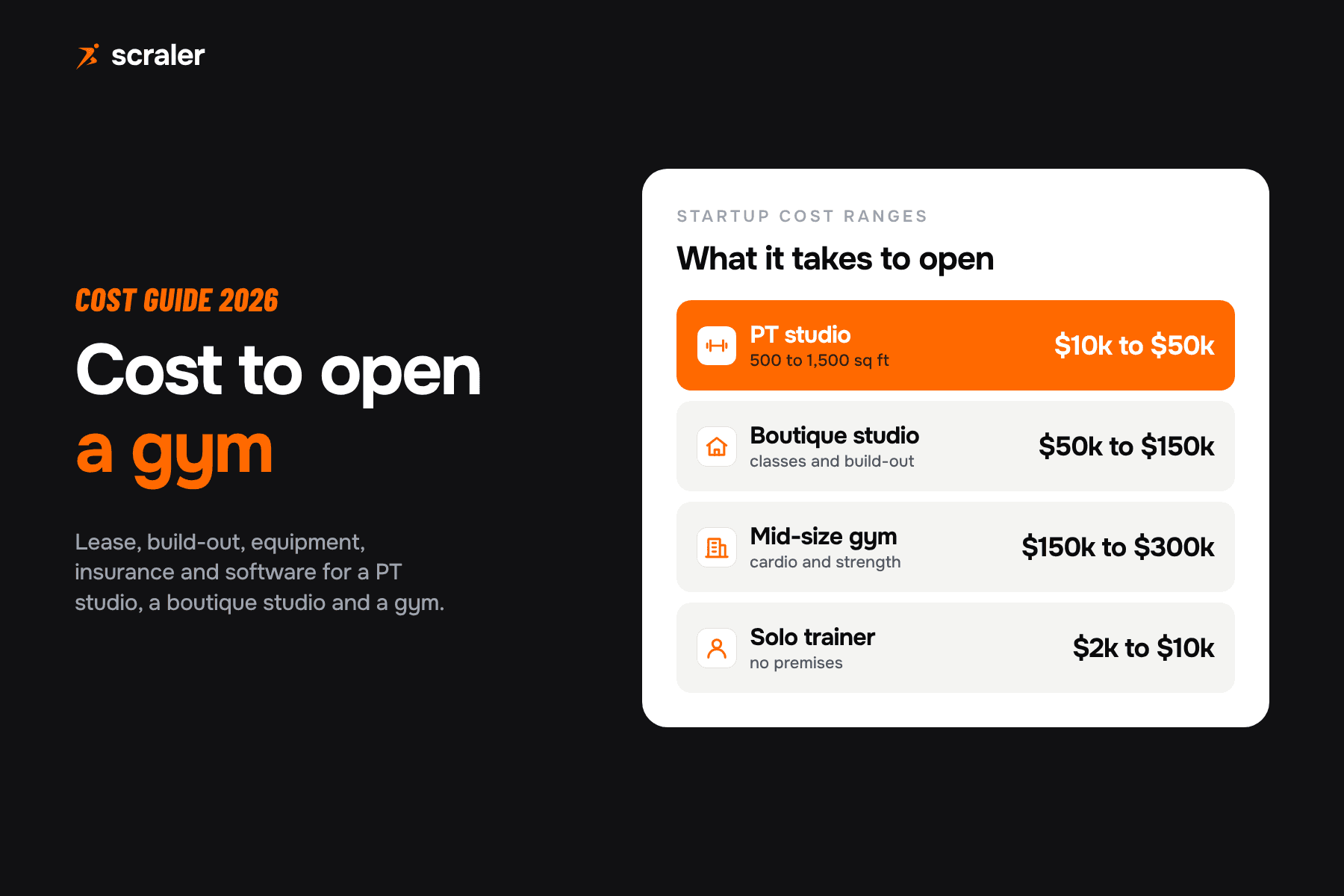
The startup side has its own numbers. A cost guide we checked, StartCosts (updated 1 February 2026), puts a PT studio at $10,000 to $50,000, a boutique studio at $50,000 to $150,000 and a mid-size gym at $150,000 to $300,000. Trainerize recommends adding an extra 25% as a buffer. The Excel has a startup budget sheet with each line and a column for your own quotes. For the full line by line breakdown, read how much it costs to open a gym. If you are weighing a franchise instead, low-cost gym franchises lists the fees and total investment.
How is a PT studio plan different from a gym plan?
The sections are the same, the weight is different. A gym plan is mostly about space and volume: a large lease, equipment, locker rooms and enough members to fill them. StartCosts puts a mid-size gym at $150,000 to $300,000 to open, and a PT studio at $10,000 to $50,000 for a small private space of 500 to 1,500 square feet. A PT studio plan is mostly about your own time and price: how many clients you can train in a week, what each pays and how many hours that leaves for admin.
- Gym: focus the market section on the catchment area and competitors with a similar price. Spend most of the financial section on lease, build-out, equipment and staffing.
- Boutique studio: focus on class capacity, instructor cost per class and how often a member attends. Build-out and sound can matter more than equipment.
- PT studio: focus on your weekly capacity, price per session or membership, and the mix of one to one and small group training. Our guide to personal training prices helps you set the price.
What mistakes do gym business plans make?
- Assuming full membership on day one. Members arrive over months. Model the ramp, as the 12 month forecast does, and plan cash for the slow start.
- Ignoring churn. In the worked example, 5% of members leave each month, so the gym has to keep adding 12 just to grow. Plan how you will keep members, not only win them.
- Leaving out owner pay. If you do not pay yourself in the plan, the break-even number is too low.
- No buffer. Trainerize recommends adding 25% on top of startup and monthly costs. Surprises always come up.
- Payroll too high. Punchpass suggests keeping payroll at or below 20% of revenue, whether you pay contractors or employees. Check your own ratio against it.
- One scenario only. Run a cautious case. If it still works, the plan holds up.
How do you use the Excel model?
- Break-even sheet. Replace the orange example inputs with your fixed costs, average price and variable cost. It shows break-even members, break-even revenue and the members you need for a target profit.
- Break-even chart. Revenue against total cost as members grow. The lines cross at your break-even point.
- 12 month forecast. Set opening members, new members a month and churn. It shows the first profitable month and the lowest cumulative cash.
- Startup budget. Published ranges for a PT studio, a boutique studio and a mid-size gym, a column for your quotes and a 25% buffer.
Run it three times: a cautious case with fewer new members, a realistic case and a good case. If the cautious case still survives, you have a plan. If you are still choosing a business model, how to start a personal training business covers the lower-cost route, and the personal trainer income calculator shows what a solo trainer earns.
Scraler runs scheduling, packages and memberships billed through Stripe, programs, check-ins and a branded client app for studio teams, so the software line in your plan stays small.
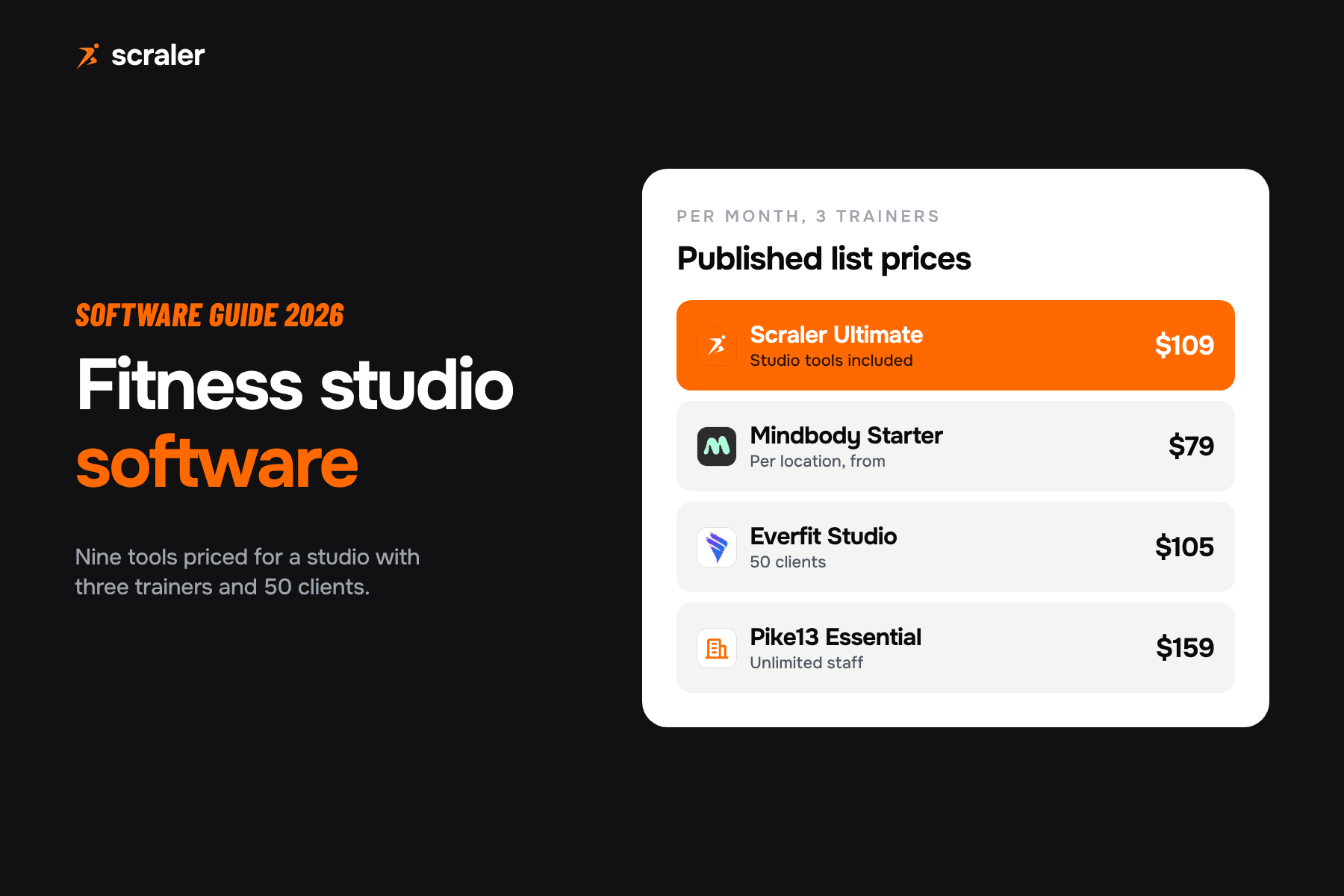
See studio featuresNot sure what software belongs in the plan? Our fitness studio software guide compares what small studios use and what it costs.
Frequently asked questions
- What should a gym business plan include?
- The eight sections of the SBA traditional plan: executive summary, company description, market analysis, organization and management, services and pricing, marketing and sales, funding request and financial projections. Add operations, because your lease, equipment and insurance matter for a gym.
- How long should a gym business plan be?
- A traditional plan can be dozens of pages, according to the SBA. A lean plan is typically one page. For a PT studio or a small gym, 5 to 10 pages with a solid financial section is usually enough.
- How do you calculate break-even for a gym?
- Divide your monthly fixed costs by what each member leaves after variable costs. In the worked example, $10,500 / ($110 minus $5) = 100 members. Round up, then check it fits your space.
- Do I need a business plan to open a PT studio?
- Not legally, but you will want one. It forces you to test the numbers before you sign a lease, and a lender or landlord may ask for it. A one page lean plan is a good start.
- Is the template free?
- Yes. Both the PDF and the Excel model are free to download and use. The numbers in the examples are not real data, so replace them with your own quotes before you use them.