Small Group Personal Training: Group Exercise Programming and Pricing
Group exercise programming means writing one session that works for several clients at different levels: a shared warm-up and main lift, with an easier and a harder option for each exercise. Small group personal training runs it with 2 to 6 clients, usually at $20 to $40 per person per session.

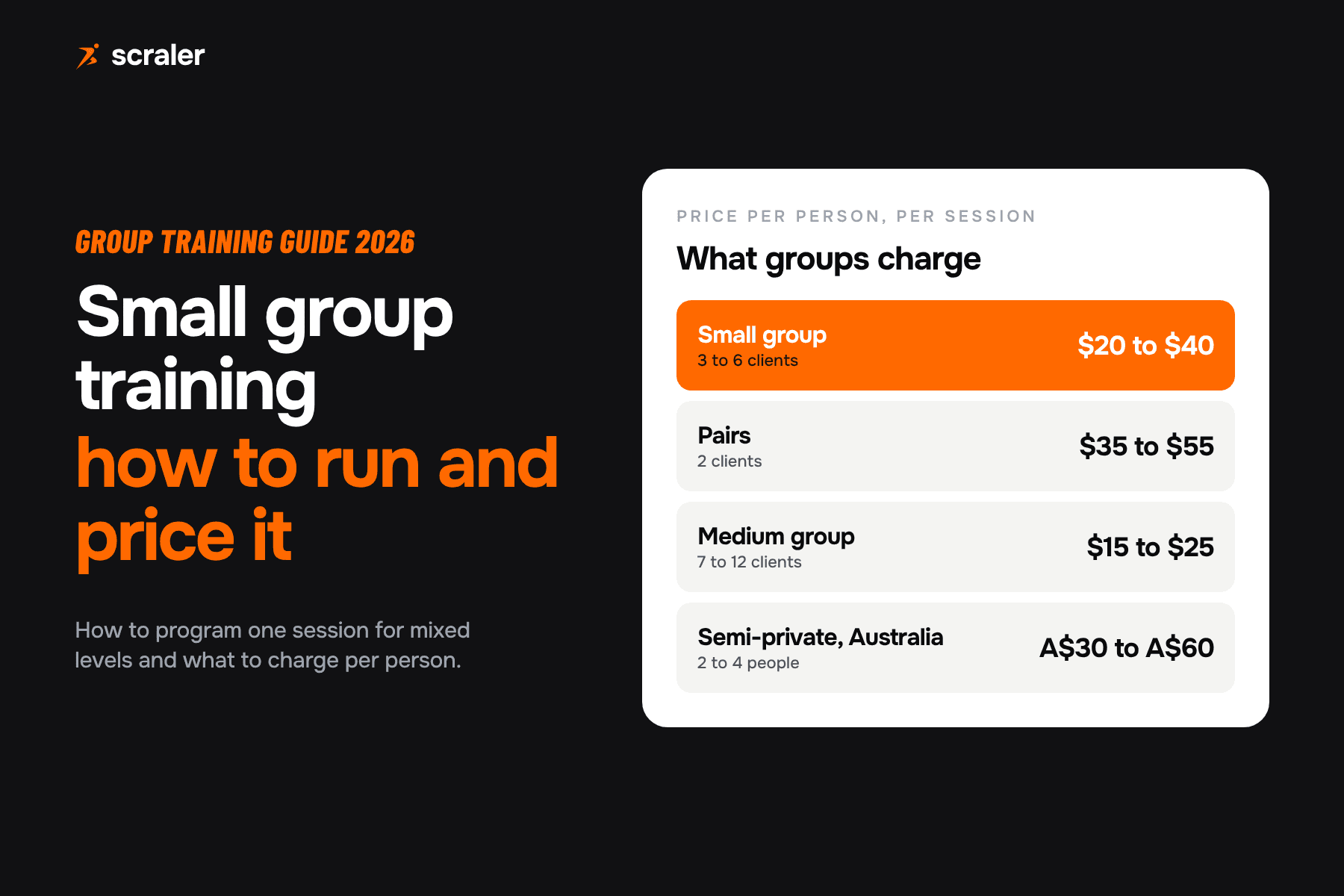
- Small group personal training is 2 to 6 clients in one session. Pairs usually pay $35 to $55 each, groups of 3 to 6 pay $20 to $40 each.
- Program one movement pattern per block and scale it with a regression and a progression, not three different workouts.
- In the worked example, one hour earns $75 one to one and $120 with four clients at $30. Three clients at $30 already beat one to one.
- Set the rules before the first session: group size cap, how missed sessions are handled, and who can join mid package.
This guide is for trainers who want to add groups without turning into a class instructor. It covers what small group personal training is, how to program a session for mixed levels, what to charge, and how to handle the admin. Market prices come from pages we read on 7 October 2026. Anything we calculated ourselves is a worked example and is labelled that way. For the tools that run the admin side, see our guide to personal trainer software.
What is small group personal training?
Small group personal training is a coached session for a handful of clients who train together on a plan you wrote for them. It sits between a one to one session and a class. Each person still gets a program, cues and load changes from you. The group shares your time and the price.
The labels overlap. "Semi-private" usually means 2 to 4 people. Yellow Pages Australia describes it as 2 to 4 people, and Georgetown University Campus Recreation runs small group training in groups of 2 to 4. MyPTHub calls 2 clients "pairs", 3 to 6 "small group" and 7 to 12 "medium group". Pick the labels your clients understand and put the group size on the sales page.
It is also a real product, not a discount. Speakeasy of Strength in New York sells small group personal training as its version of one to one training. Its pitch is that clients are not tied to one trainer's schedule and can afford to train more often. That is a fair summary of why clients buy it.
How do you do group exercise programming for mixed levels?
Write one session, then scale it. Everyone does the same movement pattern in the same block, and each exercise has a regression and a progression. A squat block might offer a box squat, a goblet squat and a front squat. You coach one block, not three workouts. Our workout plan template has the columns to write the regressions and progressions down.
- 1.Group by goal and level, not by friendship. Two people who both want to build a first pull-up will share a session better than two friends with different goals. Use your client intake form to place each person.
- 2.Share the warm-up and the main lift. This is where your cueing time goes. Everyone moves together, and you walk the room.
- 3.Scale with load and variation, not with extra exercises. Give each client their own weight or variation on the same pattern. Use RPE so a beginner and an advanced client can both work at "two reps left" without a shared number.
- 4.Use stations for accessories. Two or three stations keep everyone busy while you spot the main lifts. Choose stations that need little coaching.
- 5.Keep a plan per client. The session is shared, the progression is not. Log each client's load, so next week's weight is not a guess.
- 6.Repeat the structure, change the content. Clients relax when the format is familiar. Rotate the exercises every few weeks and keep the blocks.
A WHO fact sheet notes that muscle strengthening benefits everyone, which is why a strength based group works for mixed ages and levels as long as the load is individual. Programming for 4 people takes the same hour as programming for 1 if you build a template once and reuse it.
How much should you charge for small group personal training?
Charge per person, and charge less than your one to one rate. The market guides we read put pairs at $35 to $55 per person and groups of 3 to 6 at $20 to $40 per person. Larger groups of 7 to 12 sit at $15 to $25. trainwell also gives $20 to $40 per person for group sessions in the US.
- Typical price per person
- $35 to $55 per session
- Source
- MyPTHub
- Typical price per person
- $20 to $40 per session
- Source
- MyPTHub
- Typical price per person
- $15 to $25 per session
- Source
- MyPTHub
- Typical price per person
- $20 to $40 per session
- Source
- trainwell
- Typical price per person
- A$30 to A$60 per session
- Source
- Yellow Pages Australia
- Typical price per person
- A$15 to A$40 per session
- Source
- Yellow Pages Australia
- Typical price per person
- $15 to $30 per session
- Source
- MyPTHub
- Typical price per person
- $80 to $200 per month
- Source
- MyPTHub
| Format | Typical price per person | Source |
|---|---|---|
| Pairs (2 clients) | $35 to $55 per session | MyPTHub |
| Small group (3 to 6) | $20 to $40 per session | MyPTHub |
| Medium group (7 to 12) | $15 to $25 per session | MyPTHub |
| Group, US | $20 to $40 per session | trainwell |
| Semi-private (2 to 4), Australia | A$30 to A$60 per session | Yellow Pages Australia |
| Group, Australia | A$15 to A$40 per session | Yellow Pages Australia |
| Online group, live calls | $15 to $30 per session | MyPTHub |
| Online group, ongoing program | $80 to $200 per month | MyPTHub |
For context, a one to one session averages $55 an hour on Thumbtack and $65 a session on Bark in the US, and £47 an hour on Bark UK. A big city one to one hour is $125 or more. Your group price should sit clearly under your own one to one rate, but not so low that it looks like a class pass.
There are two common ways to set the number. Georgetown takes a flat 20% off its one to one package price for group training and charges each participant separately. Or start from the market range above and check it against your costs with the free personal trainer rate calculator.
How much more can you earn per hour with small groups?
More, as long as the group fills. The worked example below uses a $75 one to one rate and group prices inside the ranges above. One client pays $75. Two clients at $45 each pay $90. Four clients at $30 pay $120. Six clients at $25 pay $150. The client pays less each time and you earn more for the hour.
Revenue per hour is not profit. Groups need more equipment, more floor space and more of your attention in the room. Count a second rack, a bigger rent share or an assistant before you assume the top row of the chart.
Which group format should you offer?
Start with the format that fits your space and the way you coach. Pairs or a small group of 4 is an easy place to start, because the coaching quality stays close to one to one. If you want ideas for what to run in a bigger group, see our list of group fitness class ideas. Our guide to personal trainer scheduling software covers taking bookings and payment for each session.
- Each client gets real coaching and their own load.
- Easiest to program, because levels are close.
- Price closer to your one to one rate.
- Works in a rented corner of a gym.
- Needs more space and equipment.
- Coaching becomes more general, closer to a class.
- Price per person is lower, so you need a full room.
- Best with a fixed timetable and an assistant.
An online group is a fourth option. You run live calls or an ongoing program with an app, check-ins and chat. MyPTHub lists $15 to $30 per person per live session or $80 to $200 per person per month. It pairs well with an in-person group as a hybrid. See hybrid personal training packages for how to bundle it.
How do you run and sell small group sessions?
The programming is the easy part. The rules are what keep a group running. Georgetown's published rules are a good model: groups of 2 to 4, each participant pays individually, a missed session is still deducted from the package, and new participants cannot join until the current package runs out.
- Fix the slots. Groups work on a recurring time, such as Tuesday and Thursday at 6:30. Clients plan around it.
- Cap the size. Set a maximum you can coach well and a minimum that pays. Use the break-even above.
- Sell packs or a membership. A 10 session pack or a monthly plan for two sessions a week is easier to bill than single drop-ins. See personal training packages.
- Write the missed session rule. If a client skips, the session is used. That protects the others.
- Run a group chat. It handles "see you all at 6" messages and keeps people accountable between sessions.
- Screen new clients. Use an intake form and a PAR-Q before anyone joins a group.
In Scraler, a group appointment books several clients into one session. Each participant has their own price, payment link and payment status (Paid, Unpaid or Refunded) on their row in the session details. A group chat takes two or more clients and works for classes, challenge groups and small group programs.
Book several clients into one session, track who has paid, and keep a group chat running between sessions.
See the scheduling featuresWhen is one to one still the better choice?
Keep one to one for clients with injuries, rehab needs, very specific competition goals or a big gap in level from everyone else. Also keep it for people who will not train with others. Many trainers run a mix: a few one to one clients at a premium rate and one or two groups that fill the quieter hours. Check the pricing logic in our guide to personal training prices before you set either number.
Frequently asked questions
- What is semi-private personal training?
- Semi-private personal training is coached training for a very small group, usually 2 to 4 people. Yellow Pages Australia describes it as 2 to 4 people at around A$30 to A$60 per person. Each client still gets an individual program and attention.
- How many people should be in a small group personal training session?
- Most sources use 2 to 6. MyPTHub calls 2 clients a pair and 3 to 6 a small group. Georgetown caps its small group training at 4. Choose a size you can coach well, and test it with your heaviest lifts, because that is where you need to watch everyone.
- How much does small group personal training cost per person?
- In the guides we read, pairs cost $35 to $55 per person per session and groups of 3 to 6 cost $20 to $40. In Australia, semi-private is A$30 to A$60 per person. Georgetown discounts its package price by 20% for group training.
- How do you program a group with different fitness levels?
- Use one movement pattern per block and give each client a regression or progression, plus their own load. Use RPE to set effort, so different strengths can work at the same intensity. Keep the warm-up and main lift shared, and use stations for accessories.
- Is group personal training worth it for the trainer?
- It can be. In the worked example, a $75 one to one hour earns $75 and four clients at $30 earn $120. It stops paying if the group is half empty, so set a minimum size and count your extra costs for space and equipment.
- What happens when a client misses a group session?
- Decide this before the first session and write it down. A common rule, used in Georgetown's program, is that the missed session is still deducted from the package. That keeps the price fair for the rest of the group.