Superset: Types, Drop Sets and How to Program Them
A superset is two exercises done back to back with little or no rest between them, followed by a rest after the pair. Bench press, then straight into a row, then rest 90 seconds and repeat. Supersets, drop sets, giant sets and rest-pause sets all do the same job: the same work in less time.

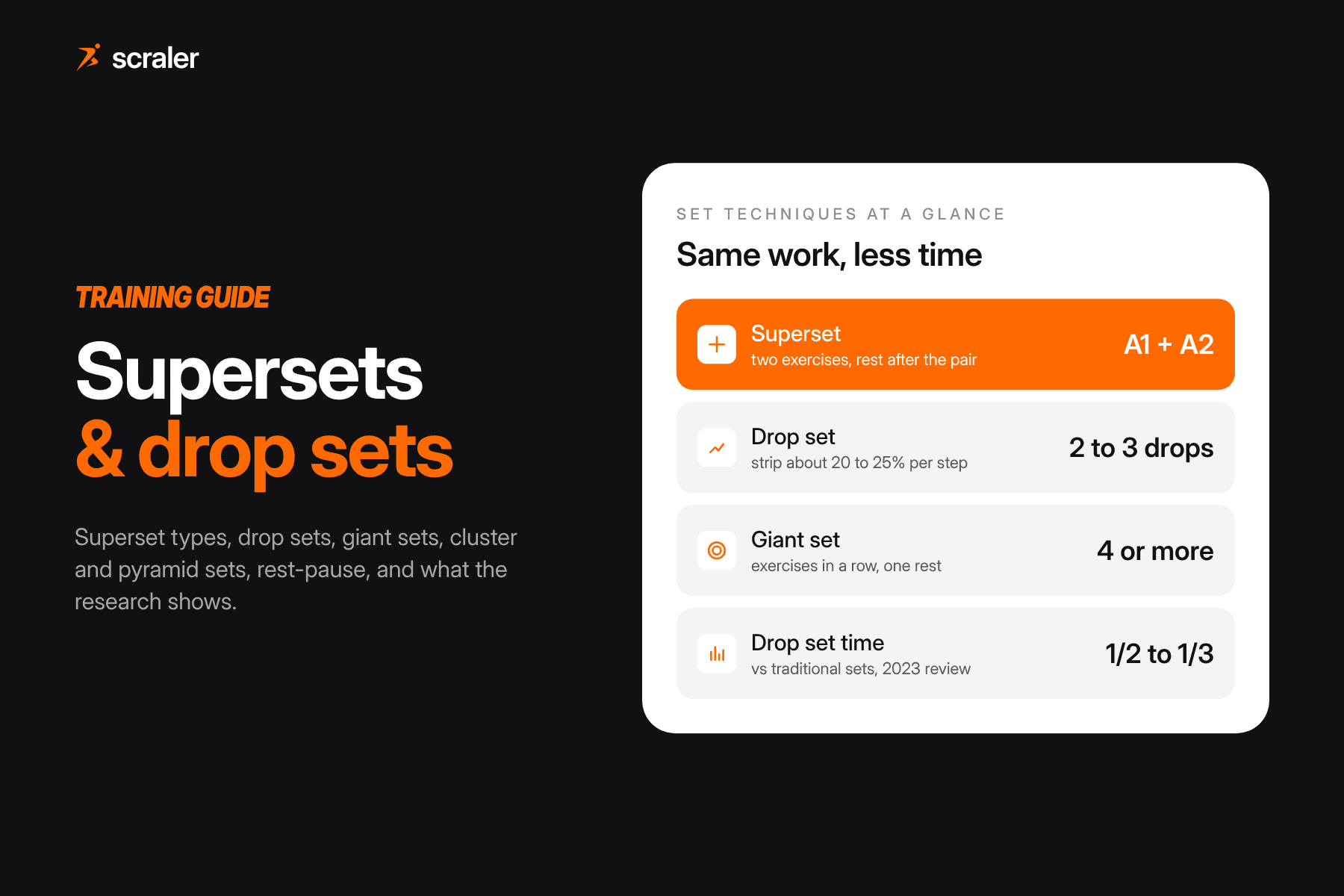
- A superset = two exercises in a row, rest after the pair. Three exercises is a tri-set, four or more is a giant set.
- Opposing muscle pairs (bench press and row) keep training volume close to straight sets. Pairs for the same muscle cut the load you can lift on the second exercise.
- Research on supersets, drop sets and rest-pause points the same way: sessions get much shorter, long-term strength and muscle gains stay similar, and the work feels harder.
- A drop set takes a set close to failure, cuts the load and keeps going. Our coaching rule: drop about 20 to 25% per step, 2 to 3 drops, on the last set of an exercise only.
What is a superset?
A superset is two exercises performed one after the other with no planned rest between them. The rest comes after both are done. Programs usually write it with letters and numbers: A1 bench press, 8 reps, A2 seated row, 10 reps, rest 90 seconds, 4 rounds. Everything with the same letter is one block.
The same idea scales up. Three exercises in a row is a tri-set, four or more is a giant set, and a long chain of stations is a circuit. What changes between them is how many exercises share one rest period. A superset is not the same as an EMOM: in a superset the rest is a set number of seconds, in an EMOM workout the clock decides it.
What are the types of supersets?
These are the common ways to pair exercises. The difference is which muscles the two exercises share, and that decides how much load and volume you keep on the second one.
- Example pair
- Bench press + seated row
- What happens
- One muscle group rests while the opposite one works
- Best for
- Saving time on strength and muscle work
- Example pair
- Bench press + push-up
- What happens
- The same muscle works twice, so the second exercise is weaker
- Best for
- Extra fatigue for one muscle, hypertrophy blocks
- Example pair
- Goblet squat + chin-up
- What happens
- Two unrelated areas, very little interference
- Best for
- Full body sessions, busy gyms, general fitness
- Example pair
- Leg extension, then squat
- What happens
- An isolation move tires a muscle before the compound lift
- Best for
- Targeting one muscle; not for heavy strength work
- Example pair
- Squat, then leg extension
- What happens
- The compound lift goes first, the isolation move finishes the muscle
- Best for
- Hypertrophy blocks that keep the big lift strong
| Type | Example pair | What happens | Best for |
|---|---|---|---|
| Agonist and antagonist (paired set) | Bench press + seated row | One muscle group rests while the opposite one works | Saving time on strength and muscle work |
| Same muscle (compound set) | Bench press + push-up | The same muscle works twice, so the second exercise is weaker | Extra fatigue for one muscle, hypertrophy blocks |
| Upper and lower body | Goblet squat + chin-up | Two unrelated areas, very little interference | Full body sessions, busy gyms, general fitness |
| Pre-exhaust | Leg extension, then squat | An isolation move tires a muscle before the compound lift | Targeting one muscle; not for heavy strength work |
| Post-exhaust | Squat, then leg extension | The compound lift goes first, the isolation move finishes the muscle | Hypertrophy blocks that keep the big lift strong |
The agonist and antagonist superset is the best studied and the one most trainers start with. We cover the muscle roles and the research on paired sets in detail in synergist muscle, so here is the short version: opposing pairs save time and keep volume, and sessions feel harder.
A compound set (two exercises for the same muscle) works the other way. The second exercise starts on a tired muscle, so the client lifts less on it. That is the point when the goal is local fatigue on one muscle, and a problem when the goal is lifting heavy. Upper and lower pairs sit in between: almost no interference, and a natural fit for full body sessions.
Do supersets save time and still build muscle?
Yes, for most goals. The research agrees that supersets save time, and the long-term results look similar to straight sets.
- Efficiency. In a 2017 crossover study by Weakley and colleagues, 14 resistance-trained men did the same exercises as traditional sets, supersets and tri-sets. The tri-set gave greater training efficiency and higher effort ratings, yet a lower perceived load for the session as a whole. Supersets and tri-sets also raised blood lactate.
- Volume. A 2025 meta-analysis by Zhang, Weakley and colleagues (19 studies, 313 participants) found supersets allowed a similar total number of reps as traditional sets in a shorter session. Agonist and antagonist supersets even increased the reps completed; pairs for the same muscle group led to less volume load.
- Long term. In the same analysis, strength and muscle growth over weeks were similar to traditional sets.
- Time. A 2021 review by Iversen, Schoenfeld and colleagues on time-efficient training reports that supersets, drop sets and rest-pause training roughly halve training time compared with traditional sets while keeping volume. Most of the studies it draws on used untrained or recreationally active people.
The practical takeaway: supersets are a time tool, not a magic growth tool. The client does the same work, finishes sooner and works harder per minute. Long-term progress still comes from adding load or reps over time, covered in progressive overload.
What is a drop set?
A drop set is one set taken close to failure, followed straight away by a lighter load for more reps, with only the time it takes to change the weight in between. Strip a plate, move the pin, grab lighter dumbbells, and keep going. A double drop set has two drops, a triple has three.
The rules below are our own coaching practice: drop about 20 to 25% of the load per step, do 2 to 3 drops, and use it on the last set of an exercise. Machines, cables and dumbbells work best, because the change takes seconds. Heavy barbell squats and deadlifts are a poor fit.
A lat pulldown at 120 lb for 10 reps close to failure, then 90 lb for about 8, then 70 lb for about 6, gives 24 hard reps in roughly a minute. Done as straight sets with full rest, the same work takes several minutes.
Do drop sets work?
- Muscle growth. A 2023 meta-analysis by Sødal and colleagues (6 studies, 142 participants) found both drop set and traditional groups grew muscle, with no significant difference between them.
- Time. Some drop set protocols in that review took around half to one third of the time of traditional training.
- Strength. A 2022 meta-analysis by Coleman, Schoenfeld and colleagues concluded that drop sets and traditional sets appear to have similar effects on strength and hypertrophy.
- Trained lifters. In a 2017 trial by Angleri and colleagues in well-trained men, with total volume equated, drop sets gave no greater strength or muscle gains than traditional sets.
So drop sets build about as much muscle as normal sets, in much less time. They are not a shortcut to extra growth. Use them when time is short, or as a finisher once the main lifts are done.
What is a giant set?
A giant set links four or more exercises with no planned rest, then rests after the last one. It is usually aimed at one area, for example four shoulder exercises in a row, or spread across the body like a short circuit. A tri-set is the three-exercise version.
Our coaching practice: keep giant sets to light and moderate loads, put them at the end of a session, rest 2 to 3 minutes between rounds and do 2 to 4 rounds. Choose exercises the client can set up in seconds and that use the same spot in the gym. The Weakley study above shows why they feel brutal: more work per minute and higher effort ratings, even though the session ends sooner.
What is rest-pause training?
A rest-pause set takes one load close to failure, rests briefly (often 10 to 20 seconds), then does a few more reps with the same load, and repeats that once or twice. Where a drop set lowers the weight, rest-pause keeps it and shortens the break.
A 2019 study by Prestes and colleagues compared 6 weeks of rest-pause with traditional multiple sets in 18 trained people. Strength gains were similar. The rest-pause group gained more thigh muscle thickness and more leg press reps to failure, but not at the other sites measured. The Iversen review lists rest-pause with supersets and drop sets as one of the techniques that roughly halves training time.
What are cluster sets?
A cluster set splits a normal set into small chunks with short rests inside it. Instead of 6 straight reps, the client does 2 reps, rests 20 seconds, 2 reps, rests 20 seconds, 2 reps. The goal is the opposite of a drop set: less fatigue per rep, so bar speed and technique stay high. Coaches use them for heavy strength and power work.
Over the long term, cluster sets do not seem to beat normal sets. A 2021 meta-analysis by Davies, Haff, Latella and colleagues (29 studies) found no differences between cluster and traditional sets for strength, power or velocity, whatever the volume, training status or exercise type. Use them when quality per rep matters, for example a client returning from a layoff or an athlete in a power phase, not because they build more.
What are pyramid sets?
Pyramid sets change the load and reps from set to set. In an ascending pyramid the load goes up and the reps go down: 12, 10, 8, 6. A descending (reverse) pyramid starts heaviest after a warm-up and gets lighter: 6, 8, 10, 12. A triangle pyramid goes up and back down.
The same Angleri trial tested a crescent pyramid against traditional sets with total volume equated, and found no greater strength or muscle gains. Pyramids are a way to organize warm-up and working sets, not an extra growth stimulus. In practice, an ascending pyramid suits clients who need a gradual build-up to a heavy set, and a reverse pyramid suits lifters who want their best set while fresh.
When should you use each technique?
The table is our own coaching practice, based on the research above. Keep one or two techniques per session, not all of them.
- Use it when
- Time is short, main lifts included
- Avoid it when
- Max strength testing
- Typical dose
- 3 to 4 rounds, 60 to 120 s after each pair
- Use it when
- Extra fatigue for one muscle
- Avoid it when
- The second lift is heavy or technical
- Typical dose
- 2 to 3 rounds, end of session
- Use it when
- Full body sessions, shared equipment
- Avoid it when
- Both lifts are heavy and tiring
- Typical dose
- 3 to 4 rounds, 60 to 90 s after each pair
- Use it when
- Short sessions, isolation and machine work
- Avoid it when
- Heavy barbell lifts, beginners in week one
- Typical dose
- Last set only, 2 to 3 drops of 20 to 25%
- Use it when
- Conditioning, finishers, groups
- Avoid it when
- Heavy loads, complex lifts
- Typical dose
- 2 to 4 rounds, 2 to 3 min between rounds
- Use it when
- Trained clients, machines and dumbbells
- Avoid it when
- Spotter-dependent heavy lifts
- Typical dose
- 1 set plus 2 mini sets, 10 to 20 s pauses
- Use it when
- Heavy strength or power, technique focus
- Avoid it when
- Pure time saving
- Typical dose
- 2 to 3 reps per chunk, 15 to 30 s inside the set
- Use it when
- Building up to a heavy set
- Avoid it when
- Very short sessions
- Typical dose
- 3 to 5 sets, load changes each set
| Technique | Use it when | Avoid it when | Typical dose |
|---|---|---|---|
| Agonist and antagonist superset | Time is short, main lifts included | Max strength testing | 3 to 4 rounds, 60 to 120 s after each pair |
| Compound set (same muscle) | Extra fatigue for one muscle | The second lift is heavy or technical | 2 to 3 rounds, end of session |
| Upper and lower superset | Full body sessions, shared equipment | Both lifts are heavy and tiring | 3 to 4 rounds, 60 to 90 s after each pair |
| Drop set | Short sessions, isolation and machine work | Heavy barbell lifts, beginners in week one | Last set only, 2 to 3 drops of 20 to 25% |
| Giant set or tri-set | Conditioning, finishers, groups | Heavy loads, complex lifts | 2 to 4 rounds, 2 to 3 min between rounds |
| Rest-pause | Trained clients, machines and dumbbells | Spotter-dependent heavy lifts | 1 set plus 2 mini sets, 10 to 20 s pauses |
| Cluster set | Heavy strength or power, technique focus | Pure time saving | 2 to 3 reps per chunk, 15 to 30 s inside the set |
| Pyramid | Building up to a heavy set | Very short sessions | 3 to 5 sets, load changes each set |
Sample superset sessions
These four sessions were written by Scraler for this article. They are coaching examples, not study protocols. Warm up for 5 to 10 minutes first, and pick loads with 1 to 3 reps in reserve unless a set says otherwise. See RIR meaning for setting the effort.
1. 40 minute upper body antagonist session
- A1 Bench press, 4 x 6 to 8. A2 Chest-supported row, 4 x 8 to 10. Rest 90 s after each pair.
- B1 Overhead press, 3 x 8. B2 Lat pulldown, 3 x 10. Rest 75 s.
- C1 EZ bar curl, 3 x 10 to 12. C2 Cable triceps pushdown, 3 x 10 to 12. Rest 60 s.
2. 30 minute full body upper and lower session
- A1 Goblet squat, 3 x 10. A2 Assisted chin-up or ring row, 3 x 8. Rest 75 s.
- B1 Romanian deadlift, 3 x 8. B2 Dumbbell bench press, 3 x 10. Rest 75 s.
- C1 Reverse lunge, 2 x 8 per side. C2 Plank, 2 x 30 s. Rest 60 s.
3. Leg hypertrophy session with a drop set finisher
- A Back squat, ascending pyramid: 10, 8, 6 reps, then a back-off set of 8. Rest 2 to 3 min.
- B1 Leg press, 3 x 10. B2 Walking lunge, 3 x 10 per side. A compound set, rest 2 min.
- C Leg extension: 2 straight sets of 12, then a triple drop set on the last set (about 20 to 25% off each step).
4. Shoulder giant set finisher (10 minutes)
- A1 Dumbbell lateral raise, 12. A2 Face pull, 15. A3 Seated dumbbell press, 10. A4 Rear delt fly, 15.
- 3 rounds, 2 min rest between rounds. Light loads; stop the round if the press turns into a back bend.
For more layouts by day, see our workout split guide and the workout plan template.
How do you keep supersets and drop sets safe?
These rules are our own coaching practice:
- Put the heaviest, most technical lift first in a superset, or pair it with something easy. Never put a heavy squat after a hard set of lunges.
- Set up both stations before the first set. A superset that needs a walk across the gym is two straight sets with less rest.
- Keep drop sets and rest-pause off heavy barbell lifts without a spotter or safety arms.
- Count the fatigue. Drop sets, rest-pause and giant sets raise effort ratings. One or two such blocks per session is plenty for most clients.
- Start beginners on upper and lower pairs. They save time with the least loss of form, and the client learns to move between stations.
How do you build supersets in Scraler?
In the Scraler workout builder you group exercises into one block: drop an exercise card onto the middle of another to group them as a superset, or link two blocks that sit next to each other. A block of two exercises is labelled a superset, three or more a circuit. All exercises in the block share one round count (up to 20 rounds), and you can edit all rounds at once or one round at a time.
Each exercise has a row per set or round with columns you choose, such as reps, weight, rest, RPE, RIR or % 1RM. Scraler has no dedicated drop set, rest-pause or cluster set type, so we will not pretend it does. For a drop set, give the last sets descending weights and a rest of 0, and explain the technique in the exercise note, which the client sees. Pyramids work the same way, with a different load and rep target on each set.
In the client app the block stays grouped, the client logs each round, and a rest timer starts when they complete a set that has a rest value. You see every logged set in their profile.
Group exercises into blocks with shared rounds, set reps, weight and rest per set, and send the workout straight to every client's app.
See workout planningFrequently asked questions
- What is a superset?
- A superset is two exercises done back to back with no planned rest between them, followed by a rest after the pair. For example, bench press then a row, rest 90 seconds, and repeat for 3 or 4 rounds.
- What is the difference between a superset and a drop set?
- A superset links two different exercises. A drop set stays on one exercise: you take a set close to failure, lower the weight and keep going for more reps with almost no rest.
- Do supersets build muscle?
- Yes. A 2025 meta-analysis of 19 studies found supersets matched the volume of traditional sets in less time, with similar long-term strength and muscle gains. Pairs for opposing muscles keep volume best.
- Are drop sets good for hypertrophy?
- Drop sets build about as much muscle as traditional sets. A 2023 meta-analysis found no significant difference in growth, and some drop set protocols took around half to one third of the time.
- How much weight should you drop in a drop set?
- Our coaching rule is about 20 to 25% per drop, for 2 to 3 drops. Enough to get several more reps, not so much that the extra reps become easy.
- What is a giant set?
- A giant set is four or more exercises done in a row with no planned rest, followed by a rest after the last one. Three exercises is a tri-set.
- What is the difference between rest-pause and cluster sets?
- Rest-pause pushes one set close to failure, then adds mini sets after short pauses to squeeze out more reps. Cluster sets put short rests inside a set from the start, to keep each rep fast and fresh.
- How long should you rest between supersets?
- There is no rest between the two exercises. After the pair, our coaching practice is 60 to 120 seconds for opposing pairs and 2 to 3 minutes after giant sets or heavy compound pairs.