Tabata Workout: What Tabata Is, How It Works and 10 Workouts by Level
A Tabata workout is 20 seconds of hard work followed by 10 seconds of rest, repeated 8 times: 4 minutes in total. The format is named after Izumi Tabata, whose 1996 study used it on a stationary bike at an intensity far above what most "Tabata" classes ask for. This guide explains the protocol, the honest difference between the study and the class version, and gives 10 ready workouts.

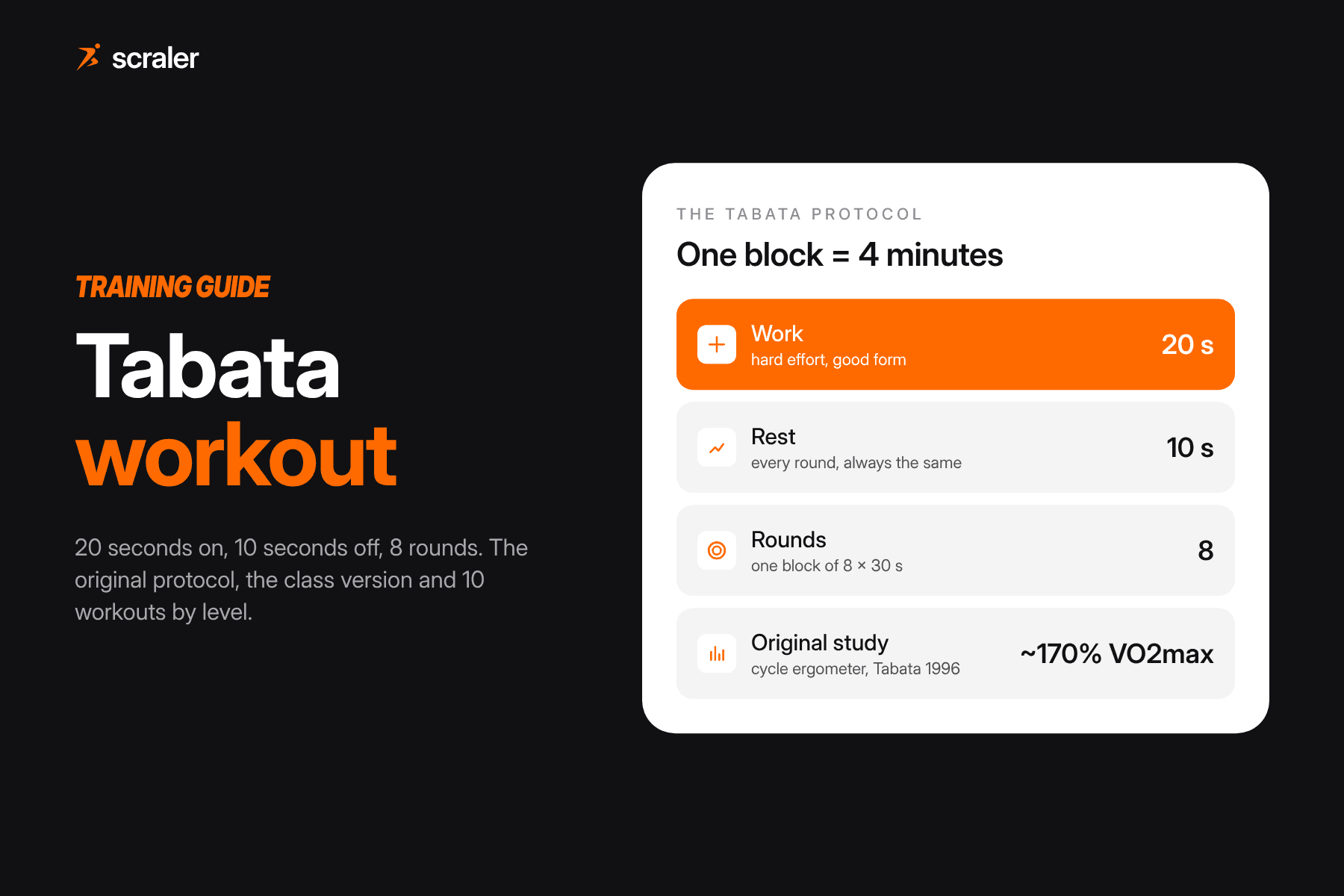
- Tabata = 20 s work, 10 s rest, 8 rounds, 4 minutes. Those 8 rounds make one Tabata block.
- The original study used a cycle ergometer at about 170% of VO2max, hard enough that subjects were exhausted by set 7 or 8. Most classes keep the timing but not that intensity.
- Tabata is one kind of HIIT. An EMOM fixes reps per minute, an AMRAP fixes only the total time, Tabata fixes both the work and rest windows.
- Our coaching rule: pick simple, low-skill moves the client can repeat fast with good form, and use 2 to 4 blocks per session with 1 to 2 minutes of rest between them.
What is a Tabata workout?
Tabata is an interval format with fixed timing: 20 seconds of work, 10 seconds of rest, 8 rounds. One block lasts 4 minutes. During each 20 second window the client works as hard as they can with good form, and during the 10 seconds they recover just enough to go again. The work-to-rest ratio is 2:1, so the rest never catches up with the fatigue.
- Work
- 20 seconds
- Rest
- 10 seconds
- Rounds
- 8
- One block
- 4 minutes
Where does Tabata come from?
The name comes from a 1996 study by Izumi Tabata and colleagues in Medicine and Science in Sports and Exercise. On a cycle ergometer, a group of seven subjects did 7 to 8 sets of 20 seconds at about 170% of VO2max, with 10 seconds of rest between sets, 5 days a week for 6 weeks. The load was set so they were exhausted in the 7th or 8th set. A second group rode for 60 minutes at 70% of VO2max on the same schedule.
After 6 weeks, VO2max in the interval group rose by 7 ml/kg/min and anaerobic capacity by 28%. The steady state group improved VO2max by about 5 ml/kg/min, but its anaerobic capacity did not change significantly. A 1997 follow-up by the same group concluded that this 20:10 protocol, taken to exhaustion, may tax both the anaerobic and the aerobic system almost maximally. Keep the size in mind: these were small groups, and the results apply to that protocol on a bike.
Original Tabata vs a typical Tabata class
Here is the honest part. 170% of VO2max is supramaximal: the effort asks for more oxygen than the body can deliver, which is why subjects could not finish more than 7 or 8 sets. In a 2019 review, Tabata notes that in the original protocol this intensity stays the same from the first session to the last, and he separates that from the many other 20:10 workouts that carry his name.
Most "Tabata" sessions in gyms and apps keep the clock but not the intensity. Squats, burpees or mountain climbers at a hard but sustainable effort for all 8 rounds, then a short rest and another block. A 2013 study by Emberts and colleagues measured one such session: four 4 minute bodyweight blocks with 1 minute of rest between them. Heart rate averaged about 86% of maximum, and estimated energy use was 240 to 360 kcal for the 20 minutes. That is hard training, but it is a different stimulus from the 1996 protocol.
- Original protocol (1996)
- Cycle ergometer, load set in the lab
- Typical Tabata class
- Bodyweight, kettlebells, bike, rower
- Original protocol (1996)
- About 170% of VO2max, constant
- Typical Tabata class
- Hard but sustainable, varies per person
- Original protocol (1996)
- 7 to 8, ending in exhaustion
- Typical Tabata class
- All 8, usually completed
- Original protocol (1996)
- One
- Typical Tabata class
- Often 2 to 4, with rest between
- Original protocol (1996)
- Lab study, small groups
- Typical Tabata class
- Gyms, classes, home workouts
| Original protocol (1996) | Typical Tabata class | |
|---|---|---|
| Equipment | Cycle ergometer, load set in the lab | Bodyweight, kettlebells, bike, rower |
| Intensity | About 170% of VO2max, constant | Hard but sustainable, varies per person |
| Rounds | 7 to 8, ending in exhaustion | All 8, usually completed |
| Blocks per session | One | Often 2 to 4, with rest between |
| Setting | Lab study, small groups | Gyms, classes, home workouts |
Neither version is wrong. Just do not promise a client the 1996 results from a bodyweight class, and do not call a gentle 20:10 circuit "the most effective workout in 4 minutes".
How does a Tabata workout work? A worked example
Take a beginner block that alternates two moves. The client starts an interval timer set to 20 seconds on, 10 seconds off, 8 rounds:
- Clock
- 0:00 to 0:30
- Work (20 s)
- Bodyweight squats
- Rest (10 s)
- Stand, breathe
- Clock
- 0:30 to 1:00
- Work (20 s)
- Incline push-ups
- Rest (10 s)
- Stand, breathe
- Clock
- 1:00 to 1:30
- Work (20 s)
- Bodyweight squats
- Rest (10 s)
- Stand, breathe
- Clock
- 1:30 to 2:00
- Work (20 s)
- Incline push-ups
- Rest (10 s)
- Stand, breathe
- Clock
- 2:00 to 4:00
- Work (20 s)
- Keep alternating
- Rest (10 s)
- Stand, breathe
| Round | Clock | Work (20 s) | Rest (10 s) |
|---|---|---|---|
| 1 | 0:00 to 0:30 | Bodyweight squats | Stand, breathe |
| 2 | 0:30 to 1:00 | Incline push-ups | Stand, breathe |
| 3 | 1:00 to 1:30 | Bodyweight squats | Stand, breathe |
| 4 | 1:30 to 2:00 | Incline push-ups | Stand, breathe |
| 5 to 8 | 2:00 to 4:00 | Keep alternating | Stand, breathe |
A simple way to track effort is to count reps in each 20 second window and log the lowest round. If a client does 14 squats in round 1 and 9 in round 7, that drop is normal. If the count falls to 4, the move or the effort was too hard for 8 rounds. Next time, the goal is a higher lowest round, not a higher first round.
Tabata vs HIIT vs EMOM vs AMRAP
- What is fixed
- 20 s work, 10 s rest, 8 rounds
- What the client controls
- Reps inside each 20 s
- Typical length
- 4 minutes per block
- What is fixed
- Any hard work and rest intervals the coach sets
- What the client controls
- Effort within each interval
- Typical length
- 10 to 30 minutes
- What is fixed
- Reps at the top of every minute
- What the client controls
- Speed, so how much rest is left
- Typical length
- 8 to 30 minutes
- What is fixed
- Total time only
- What the client controls
- Pace, rest and total work
- Typical length
- 5 to 20 minutes
| Format | What is fixed | What the client controls | Typical length |
|---|---|---|---|
| Tabata | 20 s work, 10 s rest, 8 rounds | Reps inside each 20 s | 4 minutes per block |
| HIIT (general) | Any hard work and rest intervals the coach sets | Effort within each interval | 10 to 30 minutes |
| EMOM | Reps at the top of every minute | Speed, so how much rest is left | 8 to 30 minutes |
| AMRAP | Total time only | Pace, rest and total work | 5 to 20 minutes |
Tabata vs HIIT: HIIT is the umbrella term for any training that alternates hard intervals with recovery. Tabata is one specific HIIT protocol with fixed timing. Tabata vs EMOM: in an EMOM workout the work is a rep count and the rest is whatever is left of the minute, so fitter clients earn more rest. In Tabata the rest is always 10 seconds and fitter clients simply do more reps. Tabata vs AMRAP: an AMRAP workout fixes only the total time, and the client decides when to rest.
How do you pick exercises for a Tabata workout?
The clock rewards speed, and speed under fatigue is where technique breaks. These rules are our own coaching practice:
- 1.Low skill, big muscle groups. Squats, lunges, push-ups, kettlebell swings, mountain climbers, bike or rower sprints. They are easy to start in a 10 second rest and hard to get badly wrong.
- 2.No complex or heavy lifts. Olympic lifts, heavy deadlifts and box jumps for height do not belong in a 20:10 clock when the client is tired.
- 3.Quick setup. Any move that needs more than a few seconds to set up eats the 10 second rest. Keep equipment in reach and the load fixed for the whole block.
- 4.One or two moves per block. One move for 8 rounds is the simplest. Alternating two moves (odd and even rounds) gives each muscle group close to 40 seconds before it works again.
- 5.Cardio machines work well. A bike, rower or ski erg is the closest you get to the original protocol, and form breakdown is less risky than with loaded moves.
How many Tabata blocks should a session have?
If the effort really matches the original protocol, one block to exhaustion is the whole session. For the class version, our coaching guideline is 2 to 4 blocks with 1 to 2 minutes of rest between them, after a 5 to 10 minute warm-up. That gives 8 to 16 minutes of interval work, which is close to the 20 minute session in the Emberts study. As a finisher after strength work, 1 to 2 blocks is enough.
Also our coaching practice: hard interval days need easier days around them, so for most clients 2 to 3 Tabata sessions a week is plenty, alongside strength training. If you want longer, steadier conditioning, a full body circuit workout is the better tool.
10 Tabata workouts by level
These ten workouts were written by Scraler for this article. They are coaching examples, not study protocols. Every block is 8 rounds of 20 s work and 10 s rest. Rest 1 to 2 minutes between blocks and warm up first.
1. Beginner bodyweight Tabata (2 blocks, 9 minutes)
- Block 1: bodyweight squats to a box (odd rounds), incline push-ups on a bench (even rounds)
- Block 2: marching high knees (odd), glute bridges (even)
- Steady effort, not all out. The goal is to finish all 8 rounds with good form.
2. Low impact Tabata (3 blocks, 14 minutes)
- Block 1: step-back lunges, alternating legs
- Block 2: standing punches with light dumbbells (odd), squat to calf raise (even)
- Block 3: dead bugs (odd), bird dogs (even)
- No jumping, so it suits heavier clients, sore knees and apartments.
3. Bike Tabata (1 to 2 blocks)
- Every round: hard sprint on an air bike or spin bike, easy pedaling in the rest
- The closest a gym session gets to the 1996 setup. For fit clients only, and without a lab test nobody knows whether the effort is near 170% of VO2max.
4. Kettlebell Tabata (2 blocks, 9 minutes)
- Block 1: two-hand kettlebell swings, all 8 rounds
- Block 2: goblet squats (odd), plank (even)
- Use one bell for the whole session. Stop if the swing turns into a squat or a lower back lift.
5. Full body bodyweight Tabata (4 blocks, 19 minutes, intermediate)
- Block 1: jumping jacks (odd), push-ups (even)
- Block 2: reverse lunges (odd), mountain climbers (even)
- Block 3: squat jumps (odd), plank shoulder taps (even)
- Block 4: skater hops (odd), hollow hold (even)
- Similar structure to the Emberts study session: four blocks, 1 minute rest between.
6. Rower and burpee Tabata (2 blocks, intermediate)
- Block 1: rower sprints, all 8 rounds
- Block 2: burpees, all 8 rounds
- Rest 2 minutes between blocks. Log the lowest calorie count on the rower and the lowest burpee round.
7. Core Tabata finisher (1 block)
- Odd rounds: dead bugs
- Even rounds: side plank, switching sides each even round
- A 4 minute finisher after a strength session. Controlled reps, no rushing.
8. Lower body Tabata (3 blocks, 14 minutes, intermediate)
- Block 1: dumbbell goblet squats
- Block 2: alternating reverse lunges (odd), glute bridges (even)
- Block 3: kettlebell swings (odd), wall sit (even)
- Keep the load light enough for 8 full rounds. Track effort with heart rate zones if the client wears a monitor.
9. Advanced conditioning Tabata (4 blocks, 22 minutes)
- Block 1: air bike sprints
- Block 2: burpees (odd), kettlebell swings (even)
- Block 3: ski erg or rower sprints
- Block 4: squat jumps (odd), push-ups (even)
- For trained clients only. Rest 2 minutes between blocks and end the session if form breaks down.
10. Group class Tabata (4 blocks, 4 stations)
- Station 1: dumbbell thrusters
- Station 2: bike or jumping jacks
- Station 3: renegade rows
- Station 4: sit-ups
- Each person does one full block at a station, then rotates in the 1 minute rest. Everyone works at their own load and pace. More formats in group fitness class ideas.
For one-to-one clients, a Tabata block fits well at the end of a session after the main lift. Our personal training session ideas show where finishers sit next to warm-ups and strength work.
How do you scale a Tabata workout?
The table is our own coaching practice. Change one thing at a time, and keep the 20:10 timing for as long as you can: once you change it, the workout is no longer Tabata.
- Scale down
- One block, steady effort, low impact moves
- Scale up
- Add a second block after 2 to 3 weeks
- Scale down
- Easier variation or lighter load
- Scale up
- n/a
- Scale down
- n/a
- Scale up
- Harder variation, more effort, or a bike sprint block
- Scale down
- No jumping: step-backs, marches, bike
- Scale up
- Add range of motion before speed
- Scale down
- Same clock, each person picks their variation
- Scale up
- Advanced people add load, not blocks
- Scale down
- Halve the blocks
- Scale up
- n/a
| Situation | Scale down | Scale up |
|---|---|---|
| New client | One block, steady effort, low impact moves | Add a second block after 2 to 3 weeks |
| Rep count crashes after round 3 | Easier variation or lighter load | n/a |
| Finishes all rounds easily | n/a | Harder variation, more effort, or a bike sprint block |
| Joint pain or high body weight | No jumping: step-backs, marches, bike | Add range of motion before speed |
| Mixed group | Same clock, each person picks their variation | Advanced people add load, not blocks |
| Deload or busy week | Halve the blocks | n/a |
Is Tabata safe?
A Tabata block is as safe as the moves and effort in it. These rules are our own coaching practice:
- Screen first. New clients should complete a health questionnaire such as our PAR-Q form template before high-intensity intervals.
- Warm up properly. 5 to 10 minutes of easy cardio and the same moves at low effort before the first block.
- Build up. Start new clients with one block at a steady effort. All-out sprints come after a few weeks of regular training.
- Form beats reps. A client who slows down in round 6 is doing it right. A client whose knees cave or back rounds to keep the count is not.
- Stop on warning signs. Chest pain, dizziness or unusual breathlessness ends the session.
How do you program a Tabata workout in Scraler?
Scraler has no dedicated Tabata or interval clock, and we will not pretend it does. What the workout builder does have: you can group exercises into a circuit block and set the number of rounds (up to 20), give each exercise a duration per round instead of reps, set a rest value, and add a note. For a Tabata of squats and push-ups, build a two-exercise circuit with 4 rounds, set each exercise to 20 seconds with 10 seconds of rest, and write "20 s on, 10 s off, use an interval timer" in the note.
In the client app the block shows as one group and the client logs each round. A rest timer starts when they complete a set that has a rest value, but tapping through 10 second rests is not practical, so clients run the 20:10 clock on an interval timer app or the gym clock. If the reps column is on, they log reps per round afterwards, and you see the results in their profile.
Group exercises into rounds, set time and rest per exercise, and send the workout straight to every client's app.
See workout planningFrequently asked questions
- What is a Tabata workout?
- A Tabata workout is 20 seconds of hard work followed by 10 seconds of rest, repeated for 8 rounds. One block takes 4 minutes. Most sessions use 2 to 4 blocks with a short rest between them.
- Where does the name Tabata come from?
- From Izumi Tabata, who led a 1996 study on a cycle ergometer. The interval group did 7 to 8 sets of 20 seconds at about 170% of VO2max with 10 seconds of rest, 5 days a week for 6 weeks.
- Is a Tabata class the same as the original protocol?
- Usually not. The original was supramaximal: about 170% of VO2max on a bike, ending in exhaustion by set 7 or 8. Most classes keep the 20:10 timing at a hard but sustainable effort for all 8 rounds.
- What is the difference between Tabata and HIIT?
- HIIT is any training that alternates hard intervals with recovery. Tabata is one specific HIIT protocol: 20 seconds on, 10 seconds off, 8 rounds.
- Is Tabata better than EMOM?
- Neither is better in general. Tabata fixes both the work and rest windows and suits short, hard conditioning. An EMOM fixes reps per minute and suits skill work, strength density and paced conditioning.
- How many Tabata rounds should I do?
- One block is 8 rounds. Our coaching guideline is 2 to 4 blocks per session with 1 to 2 minutes of rest between them, or 1 to 2 blocks as a finisher after strength work.
- Can beginners do Tabata?
- Yes, with simple low impact moves, a steady effort instead of all-out sprints, and one or two blocks. A block of box squats and incline push-ups is a good start.
- How many calories does a Tabata workout burn?
- It depends on the person and the effort. One study of a 20 minute bodyweight Tabata session in trained volunteers estimated 240 to 360 kcal from heart rate, so treat any number as a rough guide.