AMRAP Workout: What AMRAP Means, How to Score It and 10 Workouts by Level
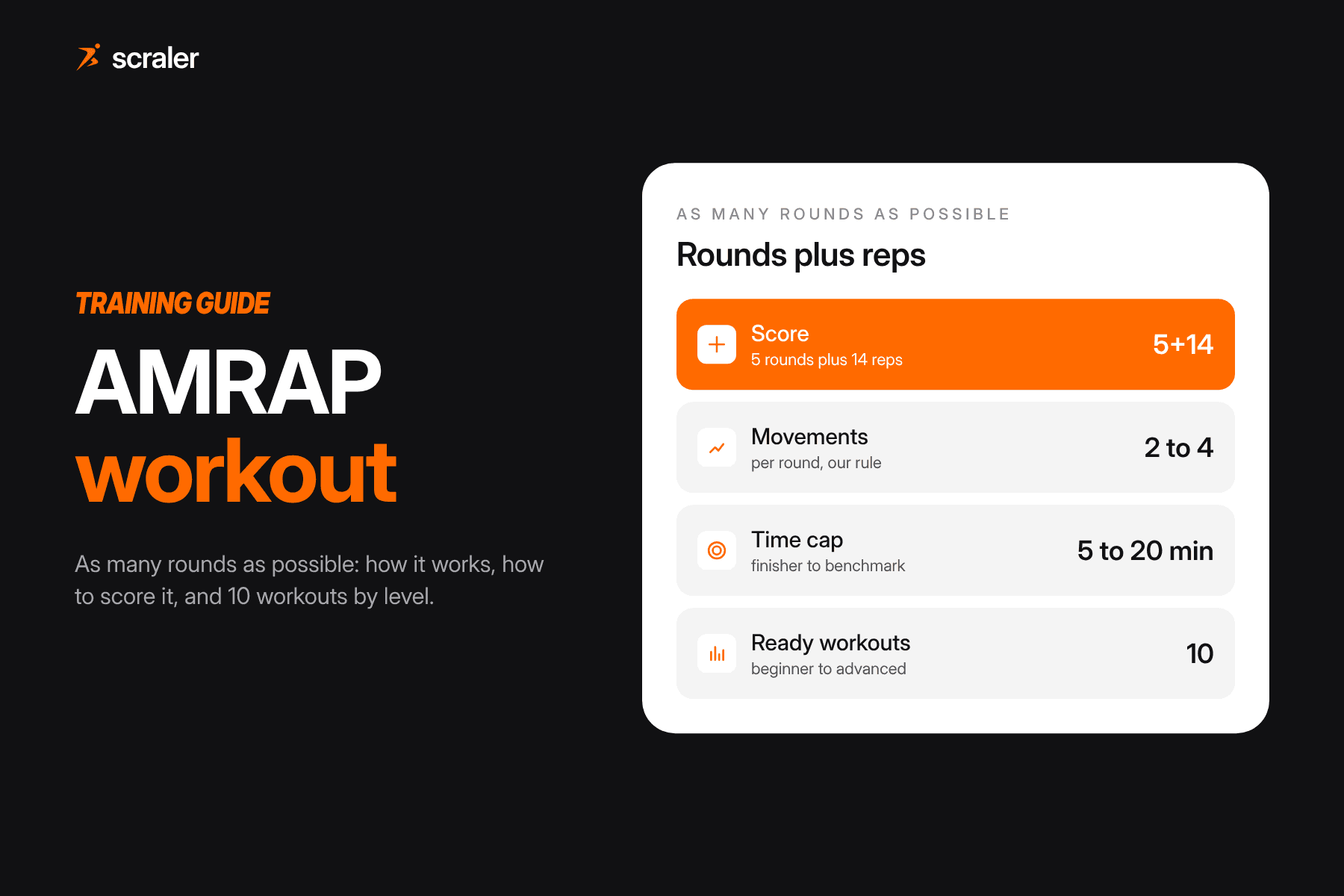
AMRAP stands for as many rounds as possible (or as many reps as possible). You get a time cap and a short list of exercises with set reps, and you cycle through them for as many rounds as you can before the clock runs out. The score is the rounds finished plus the extra reps, written as 5+14.

- AMRAP = as many rounds (or reps) as possible. Only the time is fixed. The client chooses the pace and the rest, and the score is the work done.
- Score it as rounds plus reps (5+14), or as total reps. Write down the movements, loads and any scaling, or next month's score means nothing.
- Our coaching rule: 2 to 4 movements, reps that make one round take 1 to 3 minutes, and a time cap of 5 to 20 minutes.
- An EMOM fixes the time and the reps per minute. Tabata is a fixed 20 s on, 10 s off for 8 rounds. In our coaching practice the AMRAP is the best of the three for retesting fitness over weeks.
What does AMRAP mean?
AMRAP is short for as many rounds as possible or as many reps as possible. Both versions share one rule: the time or the effort is fixed, and the amount of work is the result. That makes an AMRAP a format and a test at the same time.
- As many rounds as possible. The common meaning in CrossFit boxes, classes and personal training. "AMRAP 12: 10 goblet squats, 10 push-ups, 10 kettlebell swings" means 12 minutes, cycling through those three exercises as many times as you can.
- As many reps as possible. A single set taken close to failure, often written as "5+" in strength programs. "3 x 5+" means two sets of 5 and a last set of as many good reps as possible. The rep count tells you whether the load can go up next week.
This guide is mostly about the first meaning, the timed AMRAP workout. The rep version comes back in the section on strength AMRAP sets.
How does an AMRAP workout work? A worked example
Take "AMRAP 12: 10 goblet squats, 10 push-ups, 10 kettlebell swings". One round is 30 reps. The client starts a 12 minute timer and works through the list, resting only when they choose to. Here is what it can look like for a client who slows down as fatigue builds:
- Round took
- 1:50
- Clock at end of round
- 1:50
- Reps so far
- 30
- Round took
- 2:00
- Clock at end of round
- 3:50
- Reps so far
- 60
- Round took
- 2:10
- Clock at end of round
- 6:00
- Reps so far
- 90
- Round took
- 2:20
- Clock at end of round
- 8:20
- Reps so far
- 120
- Round took
- 2:30
- Clock at end of round
- 10:50
- Reps so far
- 150
- Round took
- 1:10 left
- Clock at end of round
- 12:00
- Reps so far
- 164 (10 squats, 4 push-ups)
| Round | Round took | Clock at end of round | Reps so far |
|---|---|---|---|
| 1 | 1:50 | 1:50 | 30 |
| 2 | 2:00 | 3:50 | 60 |
| 3 | 2:10 | 6:00 | 90 |
| 4 | 2:20 | 8:20 | 120 |
| 5 | 2:30 | 10:50 | 150 |
| Part of 6 | 1:10 left | 12:00 | 164 (10 squats, 4 push-ups) |
The score is 5+14: five full rounds plus 14 reps into the sixth, or 164 reps in total. The numbers are an illustration, but the pattern is typical. Rounds get slower, and the only way to a better score next time is to keep moving. That is what makes an AMRAP hard: nobody tells the client when to rest.
AMRAP vs EMOM vs Tabata: what is the difference?
- What is fixed
- Total time only
- What the client controls
- Pace and rest. The score is rounds or reps done
- Typical use
- Conditioning, finishers, retesting fitness over weeks
- What is fixed
- Time and reps per minute
- What the client controls
- How fast they work, so how much rest they get
- Typical use
- Skill practice, strength density, paced conditioning
- What is fixed
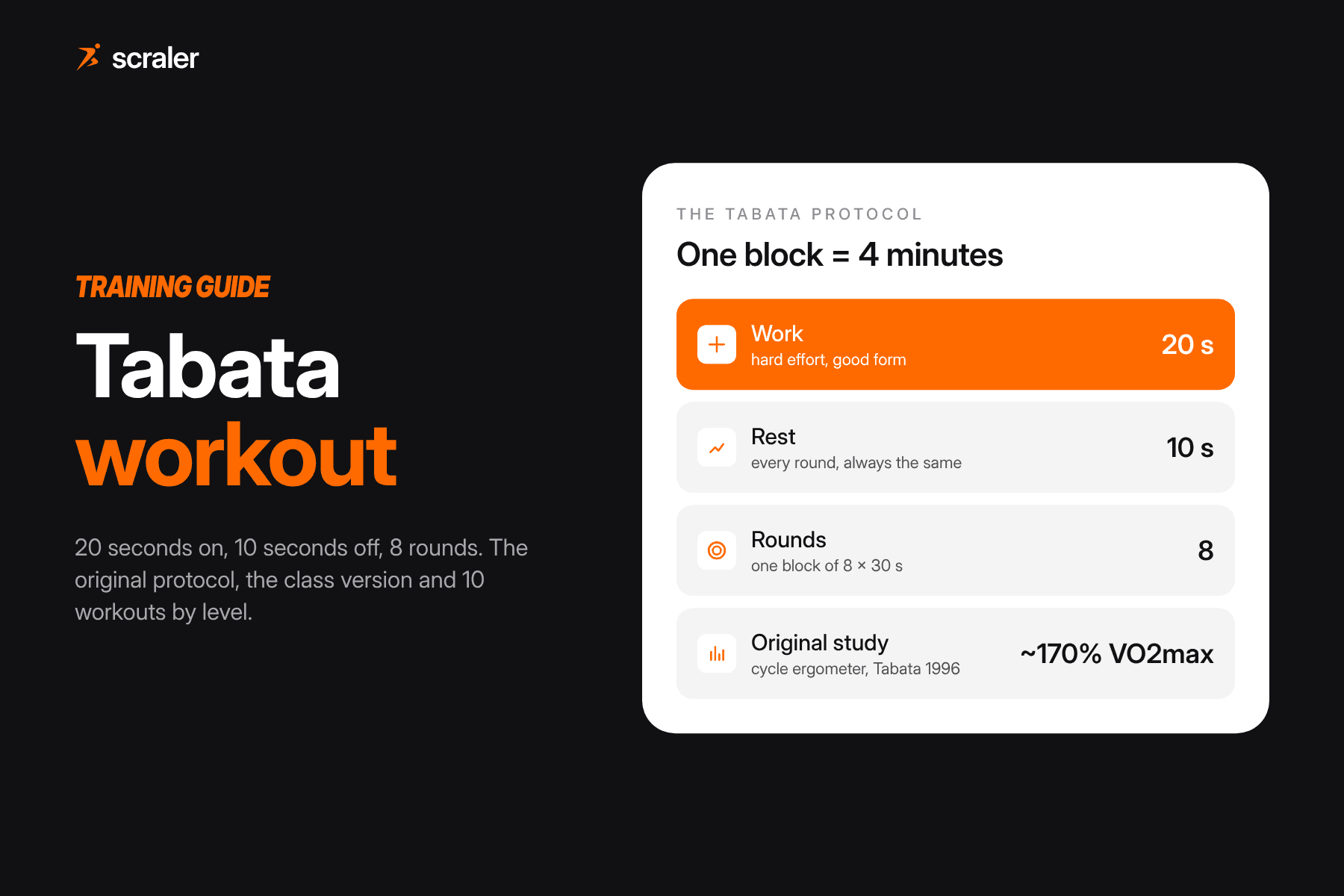
- 20 s work, 10 s rest, 8 rounds (4 minutes)
- What the client controls
- Reps inside each 20 s
- Typical use
- Short, very hard conditioning blocks
- What is fixed
- The work (for example 3 rounds)
- What the client controls
- Pace and rest. The score is the finish time
- Typical use
- Benchmarks with a clear finish line
| Format | What is fixed | What the client controls | Typical use |
|---|---|---|---|
| AMRAP (as many rounds or reps as possible) | Total time only | Pace and rest. The score is rounds or reps done | Conditioning, finishers, retesting fitness over weeks |
| EMOM (every minute on the minute) | Time and reps per minute | How fast they work, so how much rest they get | Skill practice, strength density, paced conditioning |
| Tabata | 20 s work, 10 s rest, 8 rounds (4 minutes) | Reps inside each 20 s | Short, very hard conditioning blocks |
| For time | The work (for example 3 rounds) | Pace and rest. The score is the finish time | Benchmarks with a clear finish line |
For scoring, the difference that matters: in an AMRAP a fitter client does more work in the same time, so the score shows progress directly. In an EMOM everyone does the same work and a fitter client earns more rest. Our EMOM guide covers that trade-off in more depth, and the Tabata guide explains where the 20:10 format comes from and how far most classes are from the original study.
How do you score and track an AMRAP?
An AMRAP score is only useful if the next attempt is the same workout. These tracking rules are our own coaching practice:
- 1.Write the score as rounds plus reps. 5+14 is the standard notation. For a chart over time, also write the total reps (164), which is easier to compare.
- 2.Record the conditions. Exercise list, reps, loads, box height, and any scaling such as knee push-ups. "5+14 with a 16 kg bell" and "5+14 with a 12 kg bell" are not the same result.
- 3.Keep the movement standards fixed. Squat depth, chest to floor on push-ups, full hip extension on swings. A score that grows because reps got shorter is not progress.
- 4.Add a session RPE. Ask for one 0 to 10 rating of how hard the whole session was, given after it ends. That is the session RPE method from a 2001 study by Foster and colleagues. The same score at a lower RPE is also progress. Our RPE chart explains the scale.
- 5.Retest every 4 to 8 weeks. Repeat the exact AMRAP and compare. In between, train other workouts so the client does not just get good at one test.
- Workout
- AMRAP 12: 10 goblet squats, 10 push-ups, 10 swings
- Load and scaling
- 16 kg bell, knee push-ups
- Score
- 5+14
- Total reps
- 164
- Session RPE
- 8
- Workout
- Same
- Load and scaling
- 16 kg bell, knee push-ups
- Score
- 6+8
- Total reps
- 188
- Session RPE
- 8
- Workout
- Same
- Load and scaling
- 16 kg bell, full push-ups
- Score
- 5+20
- Total reps
- 170
- Session RPE
- 9
The week 12 score is lower than week 6, yet the client moved from knee push-ups to full push-ups. That is why the scaling column matters. Example log, not client data.
How do you choose movements and a time cap?
The rules below are our own coaching practice, not a study protocol:
- Use 2 to 4 movements. One movement is a rep test, more than four makes the round long and the transitions messy.
- Mix patterns. Pair a lower body movement, a push, a pull or hinge, and if you like a cardio piece. Back to back movements that hit the same muscle (thrusters then push presses) end the workout early.
- Size the reps so one round takes 1 to 3 minutes. Shorter rounds turn the workout into a sprint, longer rounds make it hard to keep count.
- Pick movements the client can do well while tired. Squats, push-ups, rows, swings, step-ups, carries and machines suit an AMRAP. Snatches and heavy cleans do not, because technique breaks first.
- Choose a load the client could do about twice as many reps with when fresh. Ten goblet squats per round means a bell they could squat about 20 times.
- Feels like
- A hard sprint, almost no rest
- Good for
- Finishers after strength work, short tests
- Feels like
- Steady hard effort with short breaks
- Good for
- The main conditioning block of a session
- Feels like
- Pacing matters more than speed
- Good for
- Benchmarks, longer conditioning, group classes
| Time cap | Feels like | Good for |
|---|---|---|
| 5 to 8 minutes | A hard sprint, almost no rest | Finishers after strength work, short tests |
| 10 to 15 minutes | Steady hard effort with short breaks | The main conditioning block of a session |
| 20 minutes | Pacing matters more than speed | Benchmarks, longer conditioning, group classes |
A 20 minute AMRAP of 5 pull-ups, 10 push-ups and 15 air squats is a well known benchmark, called "Cindy" in CrossFit. In a 2017 study in PLoS One, 34 healthy adults did that exact AMRAP, and their countermovement jump results were lower afterwards, a sign of muscular fatigue. Even a bodyweight AMRAP is real work, so plan it as a hard session, not a warm-up.
How do you scale an AMRAP by level?
One AMRAP can fit a whole group: the time cap stays, the reps, load or movement change. The table is our own coaching practice. Change one thing at a time.
- Time cap
- 6 to 10 minutes
- Movements
- 2 to 3 simple movements, low reps
- Example swap
- Box squat for air squat, incline push-up for push-up
- Time cap
- 10 to 15 minutes
- Movements
- 3 movements, moderate load
- Example swap
- Ring row for pull-up, step-up for box jump
- Time cap
- 12 to 20 minutes
- Movements
- 3 to 4 movements, heavier load or harder variations
- Example swap
- Full pull-ups, barbell work, burpees
- Time cap
- Same for everyone
- Movements
- Same movements
- Example swap
- Each person has their own load and variation
- Time cap
- Halve the time cap
- Movements
- Keep the reps
- Example swap
- Add time back over 2 to 3 weeks
| Level | Time cap | Movements | Example swap |
|---|---|---|---|
| Beginner | 6 to 10 minutes | 2 to 3 simple movements, low reps | Box squat for air squat, incline push-up for push-up |
| Intermediate | 10 to 15 minutes | 3 movements, moderate load | Ring row for pull-up, step-up for box jump |
| Advanced | 12 to 20 minutes | 3 to 4 movements, heavier load or harder variations | Full pull-ups, barbell work, burpees |
| Mixed group | Same for everyone | Same movements | Each person has their own load and variation |
| Return after a break | Halve the time cap | Keep the reps | Add time back over 2 to 3 weeks |
10 AMRAP workouts by level
These ten AMRAPs were written by Scraler for this article. They are coaching examples, not study protocols. Warm up for 5 to 10 minutes first, and write down the score and any scaling.
1. Beginner bodyweight AMRAP (8 minutes)
- 8 bodyweight squats to a box or bench
- 6 incline push-ups on a bench or wall
- 10 glute bridges
- A good first AMRAP for beginners: three easy patterns, no equipment, and a short cap.
2. Beginner dumbbell AMRAP (10 minutes)
- 8 goblet squats
- 6 single-arm dumbbell rows per side
- 10 dead bugs (5 per side)
3. Low impact AMRAP (12 minutes)
- 12 calories on the bike
- 10 step-ups (5 per side)
- 12 band pull-aparts
- No jumping, so it suits heavier clients and sore knees.
4. Kettlebell AMRAP (12 minutes, intermediate)
- 10 goblet squats
- 10 push-ups (knees to scale)
- 10 two-hand kettlebell swings
- The worked example above. Use one bell for squats and swings.
5. Cindy style bodyweight AMRAP (20 minutes, intermediate)
- 5 pull-ups (ring rows or band assisted to scale)
- 10 push-ups
- 15 air squats
- A classic benchmark. Retest every 6 to 8 weeks with the same scaling.
6. Dumbbell full body AMRAP (15 minutes, intermediate)
- 10 dumbbell thrusters
- 10 renegade rows (5 per side)
- 12 reverse lunges (6 per side)
7. Rower AMRAP (14 minutes, intermediate)
- 15 calories on the rower
- 10 box jumps (or step-ups)
- 10 sit-ups
- Track the heart rate zones if the client wears a monitor.
8. Barbell AMRAP (12 minutes, advanced)
- 5 deadlifts at a load the client could lift about 10 times
- 8 burpees
- 10 hanging knee raises
- Reset every deadlift on the floor. End the block if the back rounds.
9. Ladder AMRAP (10 minutes, advanced)
- 2 thrusters and 2 pull-ups, then 4 and 4, then 6 and 6, adding 2 each round
- The score is the last finished round plus reps. It gets hard fast, so pace the early rounds.
10. Partner AMRAP for groups (20 minutes)
- 20 wall balls, 20 step-ups, 20 calories on the rower or bike
- One partner works while the other rests. They swap whenever they want, and the pair scores total rounds.
- More formats like this are in group fitness class ideas.
For one-to-one clients, a short AMRAP works well as a finisher after the main lift. Our personal training session ideas and full body circuit workout guides show where it fits.
What is an AMRAP set in strength training?
An AMRAP set is a single set done for as many good reps as possible at a set load, usually the last set of the day. "Bench press 3 x 5+" means 5, 5, then as many as possible. How we use it, as coaching practice:
- Use it to adjust load. Far more reps than prescribed means the load can go up; just hitting the target means keep it.
- Stop at good form, not at failure. For most clients, end the set when the next rep would be slower or uglier, about 1 rep in reserve. See RIR meaning.
- Estimate a max safely. Weight and reps from an AMRAP set go into our one rep max calculator, so the client never has to test a true 1RM.
- Keep it to one set per lift. Several all-out sets in a row add fatigue without much extra information. Pair it with progressive overload week to week.
Is an AMRAP workout safe?
An AMRAP is as safe as the exercises and loads in it. The risk is the score: it rewards speed and skipped rest, and speed under fatigue is where technique breaks. These rules are our own coaching practice:
- Screen first. New clients should complete a health questionnaire such as our PAR-Q form template before high intensity work.
- No technical lifts for high reps. Keep Olympic lifts and heavy barbell work out of AMRAPs, or keep the reps low and the load moderate.
- Set movement standards before the clock starts, and no-rep a bad rep. Clients copy what you count.
- Teach pacing. The first round should feel easier than it needs to. Going all out in minute one usually means a lower score.
- Do not run hard AMRAPs every day. Two or three hard conditioning sessions a week is plenty for most clients, with a deload week when scores stall and RPE climbs.
How do you program an AMRAP in Scraler?
Scraler has no dedicated AMRAP clock or round counter, so we will not pretend it does. What the workout builder does have: you can group exercises into a circuit block and set the number of rounds (up to 20), give each exercise reps, a duration and rest, and add a note to an exercise. For a timed AMRAP, build the movements as one circuit, set the rounds a little above what the client is likely to reach, and write "AMRAP 12 minutes, log rounds plus reps" in the note.
For a strength AMRAP set, type "5+" in the reps field and the set is marked as AMRAP. In the client app the client logs the reps and weight of each set they do, can log an RPE if you switch that column on, and can add their own note on an exercise, which is where the 5+14 score goes. Clients run the time cap on their own timer or the gym clock, and you see what was logged in their profile.
Group exercises into rounds, mark AMRAP sets with 5+, and send the workout straight to every client's app.
See workout planningFrequently asked questions
- What does AMRAP stand for?
- AMRAP stands for as many rounds as possible, or as many reps as possible. In a timed AMRAP you repeat a list of exercises for as many rounds as you can before the time cap ends.
- How do you score an AMRAP?
- Write the full rounds plus the extra reps, such as 5+14 for five rounds and 14 reps into the sixth. For tracking over time, also note the total reps, the loads and any scaling.
- What is the difference between AMRAP and EMOM?
- An AMRAP fixes only the time, and the score is how much work you do. An EMOM fixes the time and the reps per minute, so the rest is whatever is left of each minute and a fitter person earns more rest.
- How long should an AMRAP workout be?
- Most AMRAPs last 5 to 20 minutes. 5 to 8 minutes suits a finisher, 10 to 15 minutes a main conditioning block, and 20 minutes a benchmark such as Cindy. Beginners do well with 6 to 10 minutes.
- Are AMRAP workouts good for beginners?
- Yes, with 2 or 3 simple movements, low reps and a short time cap. Teach pacing and movement standards first, so the score does not come from rushed reps.
- Should you rest during an AMRAP?
- Yes, when you need to. Short breaks are part of pacing. Most people get a better score by starting slower and taking short planned breaks than by going all out and stopping for long rests.
- What does 5+ mean in a workout?
- 5+ means do at least 5 reps, then as many more good reps as possible at that load. It is an AMRAP set, usually the last set of a lift, and the rep count guides next week's load.
- How often should you repeat the same AMRAP?
- Our coaching practice is to retest the same AMRAP every 4 to 8 weeks with the same loads and movement standards, and to train other workouts in between.