Corporate Wellness Program: How Trainers Build, Price and Sell One to Employers
A corporate wellness program is a paid package of health and fitness services an employer offers its staff, such as onsite classes, team challenges, 1:1 coaching and app-based training. For a trainer, it is a B2B contract: one company pays, many employees train. Sell it on participation and engagement, which trials support, not on health care savings.

- Employers buy a corporate wellness program for participation, morale and a benefit staff actually use. Promise those, and report them.
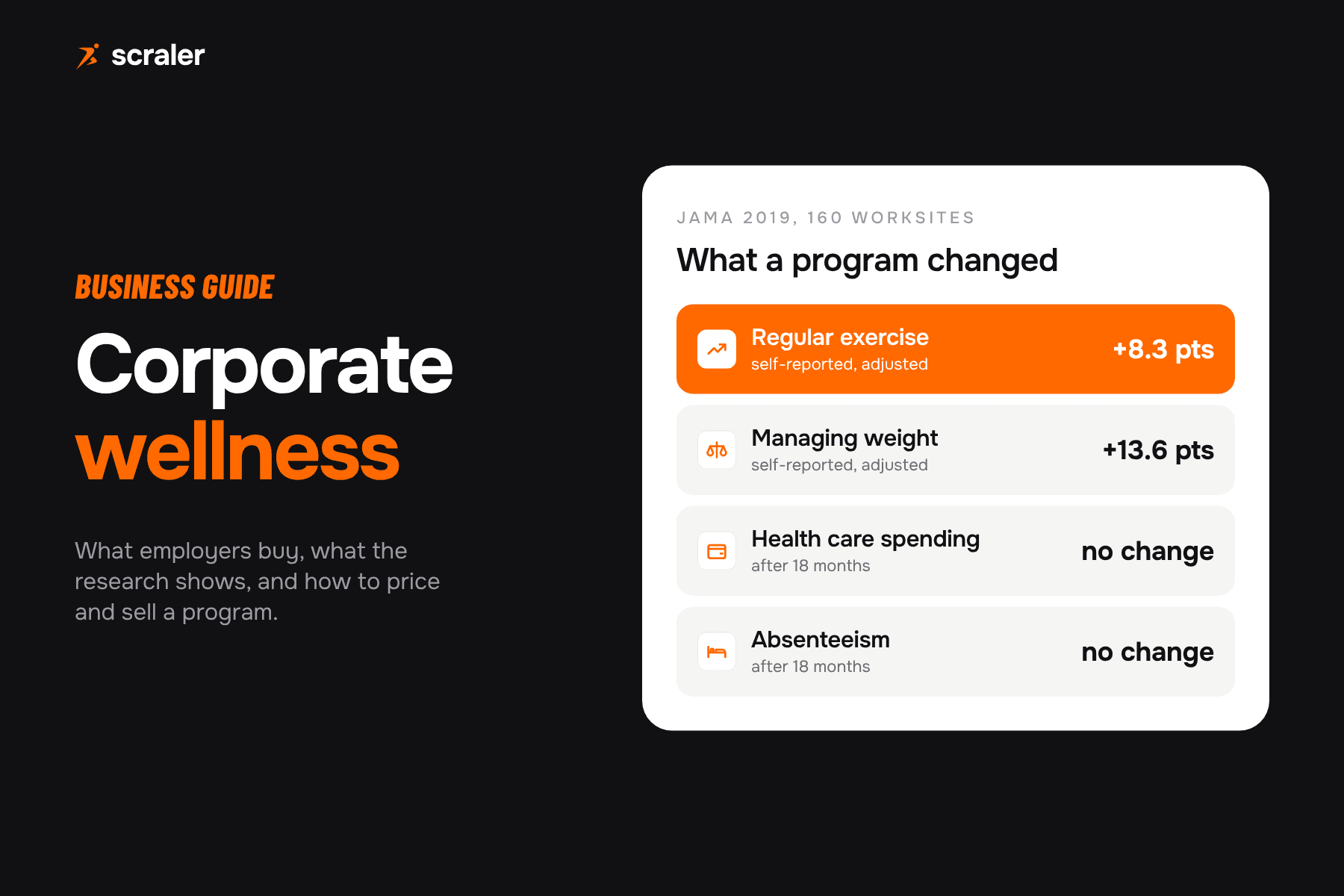
- Be honest about the evidence. A 160 worksite randomized trial raised self-reported exercise by an adjusted 8.3 percentage points but found no change in clinical markers, health spending or absenteeism after 18 months.
- Start with one format the company can say yes to quickly, such as a weekly onsite class or a 6 week team challenge, then add 1:1 and app coaching.
- Price per program or per month, not per head only. Build the quote from your hours, travel and a fixed setup fee, and put a minimum term in the contract.
- Report every month: sign-ups, attendance, completion and a short survey. That report is what renews the contract.
This guide is for personal trainers and studio owners who want to sell fitness to companies. It covers what employers are really buying, what the research says, the formats that work for a small team, a list of ideas, how to price a contract, what goes in the proposal and how to run and report it.
What is corporate wellness, and what do employers buy?
Corporate wellness is the umbrella term for anything an employer funds to improve staff health: screenings, fitness, nutrition, stress and sleep support, smoking cessation and sometimes chronic disease management. Large firms often buy it from insurers or platforms. Smaller and mid-sized companies, the ones a local trainer can reach, usually buy something simpler: a person who shows up, runs sessions and makes it easy for staff to take part.
It is a common benefit. The CDC-backed Workplace Health in America survey of 2,843 US worksites found that 46.1% of worksites with 10 or more employees offered some form of health or wellness program in 2017. Only 17.1% of comparable worksites (non-government, 50 or more employees, to match the 2004 survey) had a comprehensive program, up from 6.9% in 2004. So many companies have something, and most have room for more.
What the HR or people lead usually wants is concrete: a benefit staff use and talk about, something that helps hiring and retention, a team activity that is not another drinks night, and a number they can show leadership. Ask in the first call which of these matters most. It decides the format and the report.
Do corporate wellness programs work? What the research says
Partly, and the honest answer is your selling point. Two large randomized trials changed how the field talks about results.
- Song and Baicker, JAMA 2019. A cluster randomized trial at a US warehouse retail chain covered 160 worksites and 32,974 employees. Twenty worksites got an 8 module program on nutrition, physical activity and stress. After 18 months, employees there were more likely to report regular exercise (69.8% vs 61.9%, an adjusted difference of 8.3 percentage points) and actively managing their weight (69.2% vs 54.7%). There were no significant differences in clinical markers, health care spending, absenteeism, job performance or tenure.
- Jones, Molitor and Reif, Quarterly Journal of Economics 2019. The Illinois Workplace Wellness Study randomized nearly 5,000 university employees. The program raised health screening rates but had no significant effect on medical spending, other health behaviors or productivity after more than two years. People who signed up were already healthier and spent less on care the year before.
- RAND on PepsiCo, Health Affairs 2014. Over seven years, the disease management part of PepsiCo's program saved $3.78 in health care costs per $1 spent. The lifestyle part, the exercise and nutrition side a trainer would deliver, did not return more than it cost.
- More employees saying they exercise regularly
- More employees actively managing their weight
- Higher uptake of health screenings
- A visible, used benefit you can measure by attendance
- Lower health insurance costs from a fitness program
- Fewer sick days within 18 months to 2 years
- Better job performance or retention
- Guaranteed return on investment
What corporate fitness program formats can a trainer offer?
Corporate fitness programs come in four formats. Most contracts start with one and grow into a mix. Pick based on the company's space, shift patterns and how spread out the team is.
- Best for
- One office or site, a meeting room or car park
- What you need
- Portable kit, a fixed weekly slot, a booking list
- Watch out for
- Low turnout if the time clashes with meetings
- Best for
- Spread-out or remote teams, any fitness level
- What you need
- A tracking tool, a leaderboard, weekly updates
- Watch out for
- Only the keen staff joining; design for beginners
- Best for
- Leadership teams, a perk tier, staff with goals
- What you need
- Bookable slots, intake and screening forms
- Watch out for
- Your hours sell out fast; price it as an add-on
- Best for
- Several sites, shift workers, hybrid offices
- What you need
- A client app with programs, check-ins and chat
- Watch out for
- Drop-off after week 2 without regular contact
| Format | Best for | What you need | Watch out for |
|---|---|---|---|
| Onsite classes | One office or site, a meeting room or car park | Portable kit, a fixed weekly slot, a booking list | Low turnout if the time clashes with meetings |
| Team challenges | Spread-out or remote teams, any fitness level | A tracking tool, a leaderboard, weekly updates | Only the keen staff joining; design for beginners |
| 1:1 or small group coaching | Leadership teams, a perk tier, staff with goals | Bookable slots, intake and screening forms | Your hours sell out fast; price it as an add-on |
| Hybrid or app coaching | Several sites, shift workers, hybrid offices | A client app with programs, check-ins and chat | Drop-off after week 2 without regular contact |
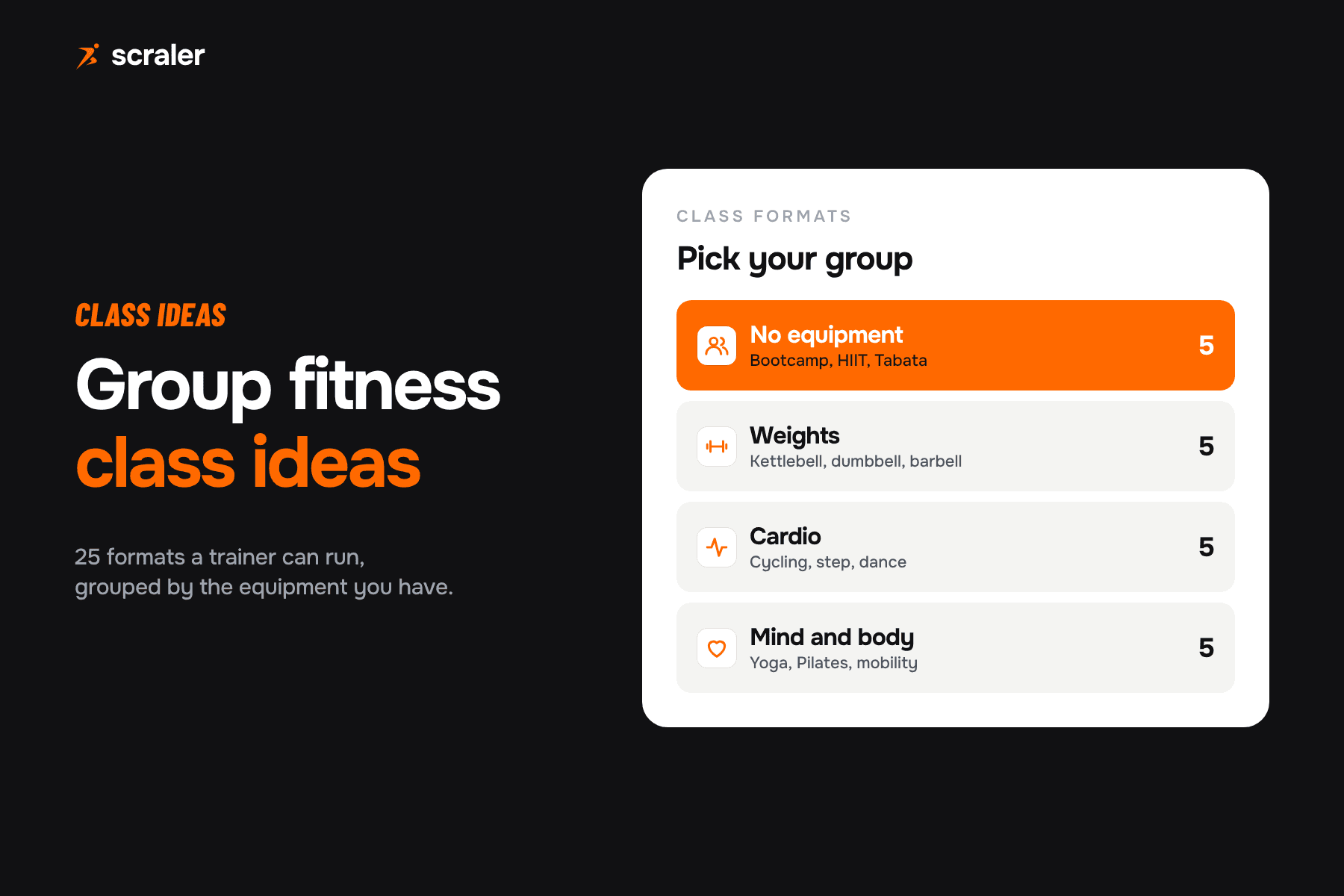
For class formats that work in a meeting room with little kit, see our group fitness class ideas. For the mix of in-person sessions and app programming, our guide to hybrid personal training covers how to structure the week. Hybrid suits corporate work because one trainer can serve staff at several sites without driving between them every day.
What are good corporate wellness ideas?
These workplace wellness program ideas are things a trainer or studio can run and charge for. Each works for 20 to 500 employees with small changes.
- 1.Lunchtime express class. 30 minutes, no showers needed: mobility, bodyweight circuits or core. Same day and time every week.
- 2.Before or after work strength class. 45 minutes with bands and dumbbells for staff who want real training.
- 3.Desk-break mobility. 10 minute guided sessions, in person or on video, twice a day for office teams.
- 4.Step challenge by team. Departments compete on average steps per person, so team size does not decide the winner.
- 5.6 week beginner strength course. A closed group, a test in week 1 and week 6, and a clear finish line.
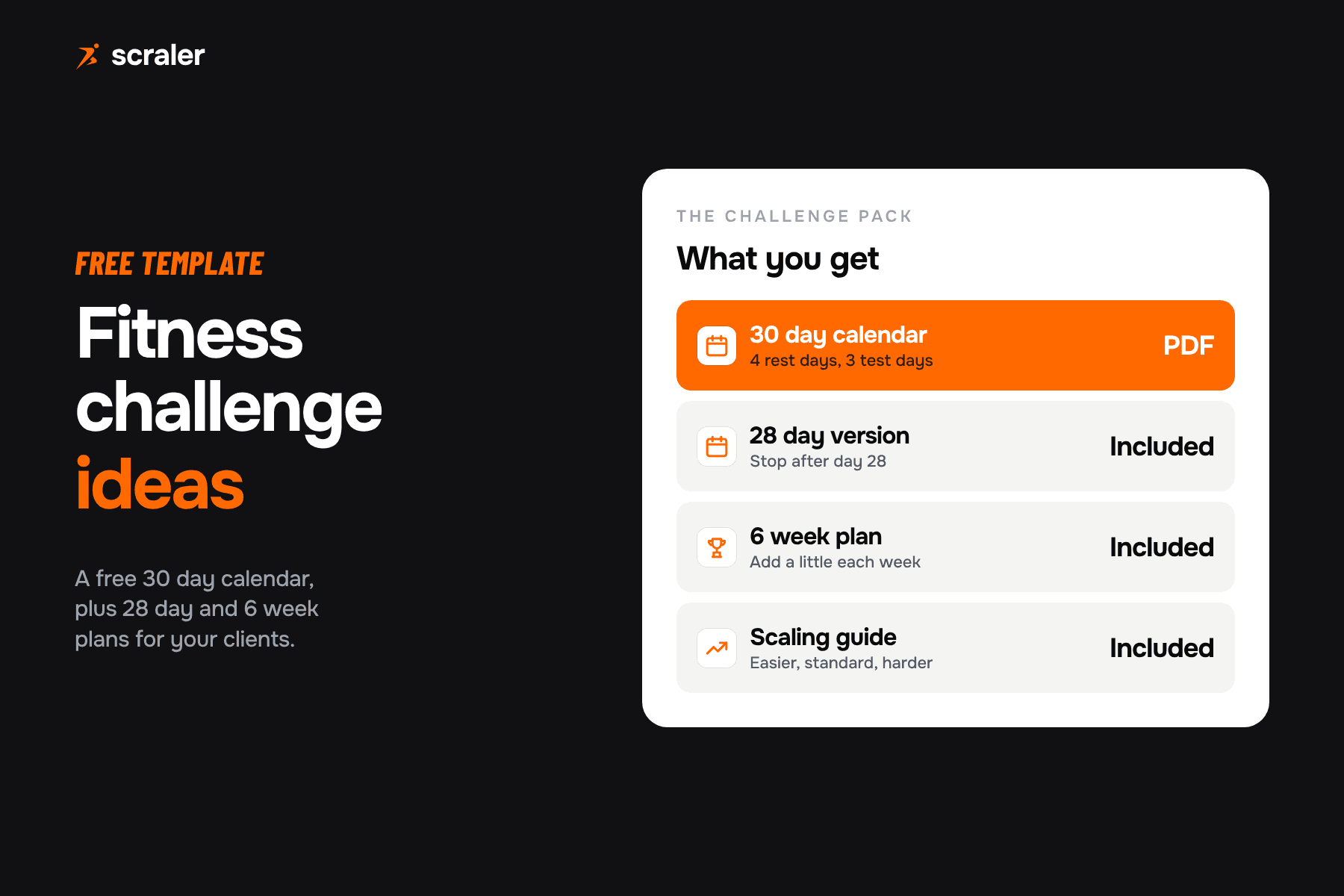
- 6.Habit challenge. One habit for 30 days, such as a daily walk, water target or lights out by 23:00. Our fitness challenge ideas include a free calendar you can adapt.
- 7.Fitness check days. Grip strength, a sit and reach test and a step test, repeated each quarter so staff see their own change.
- 8.1:1 coaching perk. A set number of sessions per employee per quarter, booked through your calendar.
- 9.Leadership coaching tier. Monthly 1:1 sessions and a training program for the senior team.
- 10.Nutrition workshop series. Practical topics such as protein at lunch or eating on shift work, within your scope of practice.
- 11.Run or walk club. A weekly group with a shared goal, such as a local 5K at the end of the quarter.
- 12.Onboarding wellness session. A welcome class for new hires, which HR can list as part of onboarding.
- 13.On-demand library. Recorded workouts staff can do at home or on the road, for remote and travelling teams.
- 14.Charity challenge. Total team minutes or kilometers unlock a company donation. Good for internal comms.
For a first contract, pair one recurring class with one 6 week challenge. The class gives the company a visible weekly moment, the challenge reaches people who will not come to a class. Both are easy to report.
Corporate wellness companies vs a local trainer: where do you fit?
Corporate wellness companies sell platforms: apps, screening, rewards and content at scale, often bundled with insurance. You will not beat them on breadth, and you do not need to. A local trainer or studio wins on what platforms struggle with: a real coach on site, sessions fitted to the company's building and schedule, and fast changes when something is not working.
- Target companies of 20 to 500 staff. Big enough to have a people budget, small enough that one decision maker can sign.
- Start local. Offices, warehouses, schools, clinics and agencies within a short drive of your studio.
- Use your network. Ask current clients who works in HR, operations or leadership. A warm intro beats a cold email.
- Work alongside a platform. If a company already has a wellness app, offer the in-person layer it lacks.
How do you price a corporate wellness program?
There is no reliable public benchmark for what small companies pay a trainer for corporate fitness, so build the price from your own costs and time. Three models work:
- Per session. A fixed fee per class or workshop. Simple for a trial, but income stops when the company cancels a week.
- Monthly retainer. A fixed monthly fee for a set number of classes, challenges and 1:1 hours. Best for you: predictable and easy to renew.
- Per employee per month. A fee per enrolled employee, usually on top of a base fee. Fits app or hybrid coaching that scales with head count.
Whatever the model, add a setup fee for the kickoff, intake forms and baseline testing, and set a minimum term of three months. Charge for travel time if the site is not next door. If you hire coaches to deliver it, start from their cost: the BLS puts the US median pay for fitness trainers and instructors at $22.20 an hour (May 2024), before payroll costs and your margin. Use the personal trainer rate calculator to work out your own hourly rate first.
- Your time
- 8 hours
- Example price
- $800 one-off
- Your time
- 2 hours a week, 24 hours
- Example price
- $2,400
- Your time
- 1 hour a week for 6 weeks, 6 hours
- Example price
- $600
- Your time
- 10 hours a month, 30 hours
- Example price
- $3,000
- Your time
- 1 hour a month, 3 hours
- Example price
- $300
- Your time
- 71 hours
- Example price
- $7,100
| Worked example: 150 employees, 12 weeks | Your time | Example price |
|---|---|---|
| Setup: kickoff talk, intake form, baseline fitness check day | 8 hours | $800 one-off |
| 1 onsite class a week, 45 minutes, plus travel | 2 hours a week, 24 hours | $2,400 |
| 6 week team step challenge with weekly updates | 1 hour a week for 6 weeks, 6 hours | $600 |
| 10 hours of 1:1 coaching a month, booked by staff | 10 hours a month, 30 hours | $3,000 |
| Monthly report to HR | 1 hour a month, 3 hours | $300 |
| Total for 12 weeks | 71 hours | $7,100 |
Tiers make the decision easier. Offer a starter, a standard and a full package, the same way you would for individual clients. Our guide to personal training packages explains how to stack tiers so the middle one sells.
- 1 onsite class a week
- Booking list and reminders
- Quarterly report
- 1 to 2 classes a week
- A team challenge each quarter
- Monthly report
- Kickoff and fitness check day
- Everything in Standard
- 1:1 coaching hours
- App programs and check-ins for enrolled staff
- Leadership tier
What goes in a corporate wellness proposal?
Keep it to two or three pages. HR will forward it to someone who did not join the call, so it must stand on its own.
- 11. The goal in their words
What they told you on the call, such as more staff moving, a team activity, a benefit for hiring.
- 22. Who it is for
Head count, sites, shifts, remote staff, and how you will reach people who do not train yet.
- 33. The program
Formats, schedule, length and what a typical week looks like for an employee.
- 44. What you will measure
Sign-ups, attendance, completion, a short start and end survey. No health cost promises.
- 55. Price and terms
Setup fee, monthly fee, minimum term, what is included, cancellation and payment terms.
- 66. Safety and paperwork
Health screening before training, your insurance, qualifications and how you handle employee data.
- 77. Next step
A start date, a kickoff session and who signs.
Screen every employee before they train, the same as any client. A PAR-Q at sign-up is the minimum. Tell the company you will not share individual health answers with them, only group numbers. That protects staff and makes them more willing to sign up.
How do you run and report a corporate wellness program?
The CDC Workplace Health Model uses four steps: assessment, planning and management, implementation and evaluation. It is written for employers, but it maps well onto how a trainer runs a contract.
- What you do as the trainer
- A short staff survey: interest, preferred times, current activity, barriers. Walk the site to see the space.
- What you do as the trainer
- Agree a contact person at the company, a schedule and the measures you will report.
- What you do as the trainer
- Kickoff session, screening and sign-up, then the weekly classes, challenge and coaching.
- What you do as the trainer
- Monthly report, end of term survey, and a renewal proposal based on what was used.
| CDC step | What you do as the trainer |
|---|---|
| Assessment | A short staff survey: interest, preferred times, current activity, barriers. Walk the site to see the space. |
| Planning and management | Agree a contact person at the company, a schedule and the measures you will report. |
| Implementation | Kickoff session, screening and sign-up, then the weekly classes, challenge and coaching. |
| Evaluation | Monthly report, end of term survey, and a renewal proposal based on what was used. |
The monthly report should fit on one page: number of employees signed up, sessions run, average attendance, challenge completion, one or two quotes from staff, and what you will change next month. Group numbers only. Send it on the same day each month so HR can paste it into their own update.
How do you manage corporate clients in a coaching app?
A corporate contract adds dozens of new people at once, so manual booking and spreadsheets break quickly. In Scraler, scheduling handles recurring classes per location, so a company site can be its own location with its own weekly class that employees book themselves. Check-ins send recurring forms with your own custom metrics, which is where the start and end survey and the fitness check results live. Habits run a challenge with a rising daily target, points and streaks, and the community challenge board, available from Premium, ranks the staff who opt in.
For billing, the finance manager, available from Premium, connects your Stripe account so you can send a payment request for the setup fee to the company contact, added as a client, and set up recurring subscriptions for employees who buy a 1:1 add-on. If several coaches deliver the contract, the studio manager on Ultimate gives each coach a login with their own clients and permissions.
Scraler scheduling lets employees book recurring classes at each company location, next to your 1:1 clients, check-ins and payments.
See schedulingFrequently asked questions
- What is a corporate wellness program?
- It is a set of health and fitness services an employer pays for and offers to staff, such as onsite classes, team challenges, 1:1 coaching, screenings and nutrition workshops. For a trainer it is a B2B contract: the company pays, employees take part.
- Do corporate wellness programs save employers money?
- Not reliably in the short term. A 160 worksite randomized trial in JAMA (2019) found more self-reported exercise and weight management but no significant change in health spending or absenteeism after 18 months. A RAND study of PepsiCo found savings from disease management, not from lifestyle programs.
- What are good employee wellness program ideas for a small company?
- A weekly lunchtime class, a team step challenge, a 6 week beginner strength course, desk-break mobility sessions and a quarterly fitness check day. They need little space or kit and are easy to measure by attendance and completion.
- How much should a personal trainer charge for corporate fitness?
- There is no reliable public benchmark. Build it from your hourly rate: a setup fee, a monthly retainer for classes and challenges, and add-ons such as 1:1 hours or per-employee app coaching. Set a minimum term of three months and charge for travel.
- What does a corporate wellness coach do?
- A corporate wellness coach plans and delivers health programs for a company's staff: classes, challenges, coaching and workshops. They also report participation to HR. Many are personal trainers or health coaches who work with companies alongside their own clients.
- What is a corporate personal trainer?
- A trainer hired by a company to coach its employees, either onsite, in a nearby studio or online. The company pays for the sessions as a staff benefit, often for a leadership team or as a 1:1 perk on top of group classes.
- How do I find companies for a corporate wellness program?
- Start with businesses of 20 to 500 staff near your studio, and ask current clients for an intro to their HR or operations lead. Offer a short trial, such as four weekly classes, and send a one page report at the end.
- How do you measure a corporate wellness program?
- Report sign-ups, attendance, challenge completion and a short start and end survey, plus repeat fitness tests if staff opt in. Share group numbers only, never individual health data. The CDC Workplace Health Model ends each cycle with an evaluation step for this reason.