Movement Screen for Personal Trainers: FMS, Overhead Squat Assessment and What the Research Says
A movement screen is a short set of basic movements, such as a squat, a lunge and an overhead reach, that you watch a client do before you write their program. The two best known are the Functional Movement Screen (7 tests scored 0 to 3, 21 points in total) and the overhead squat assessment. Research says they are reliable to score but weak at predicting injury, so use them as a baseline and a coaching conversation, not as a diagnosis.

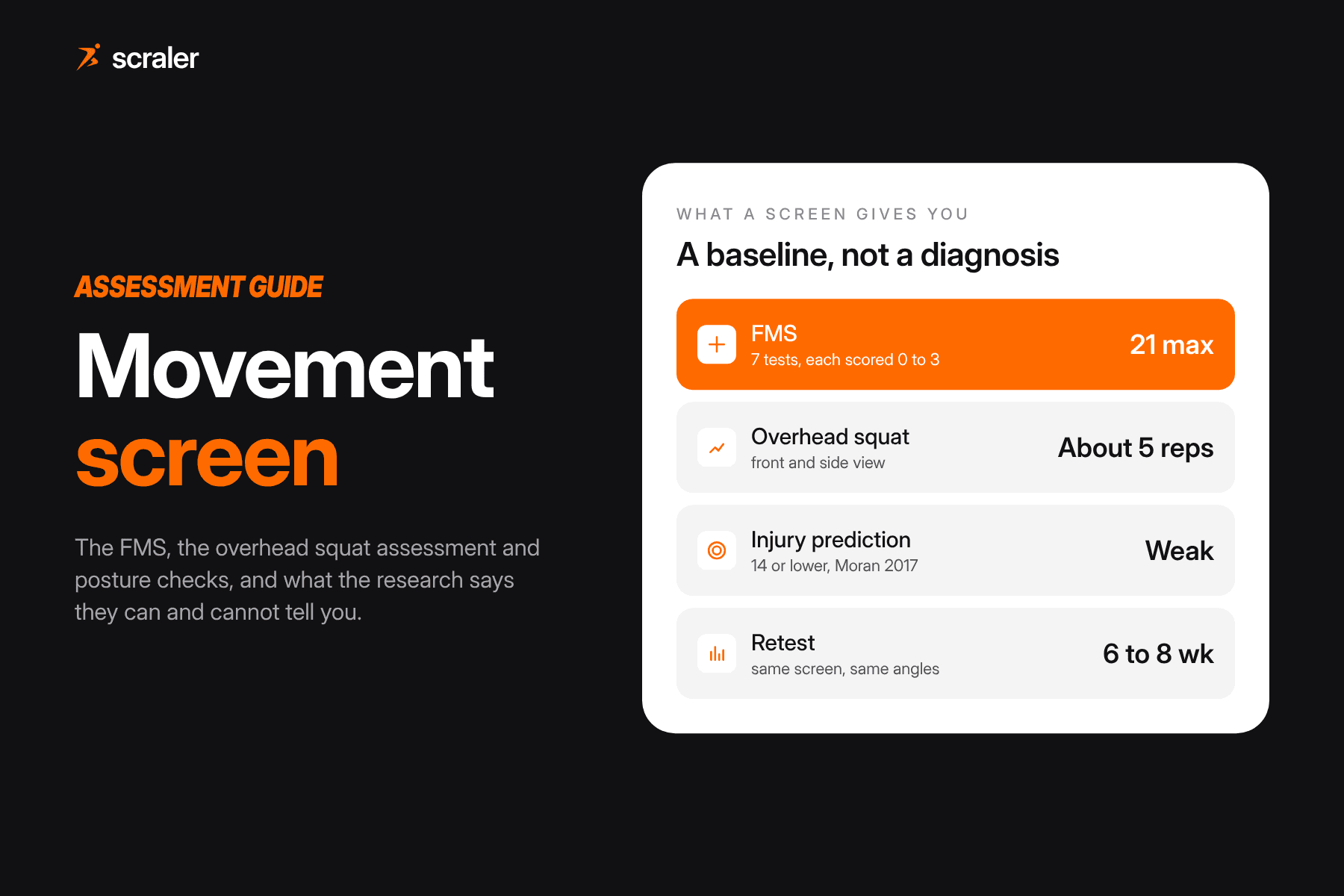
- A movement screen shows how a client moves today. It does not diagnose anything, and pain during a screen is a reason to refer, not to coach.
- The FMS has 7 tests, each scored 0 to 3, for a total out of 21. Trained raters score it consistently, with excellent reliability in a 2017 meta-analysis.
- A low FMS score (14 or lower) is a weak injury predictor. A 2017 review in the British Journal of Sports Medicine found the link too small to use the score that way.
- Posture on its own says little about pain. People with and without low back pain had the same lumbar curve in a 2014 meta-analysis.
- Our coaching practice: screen in under 15 minutes, film it, turn each finding into one program change, and retest the same way every 6 to 8 weeks.
What is a movement screen?
A movement screen is a set of simple, repeatable movements you watch a client perform, so you can see how they squat, lunge, reach, hinge and brace before you load those patterns. You are looking for three things: pain, movements the client cannot do at all, and big differences between the left and right side.
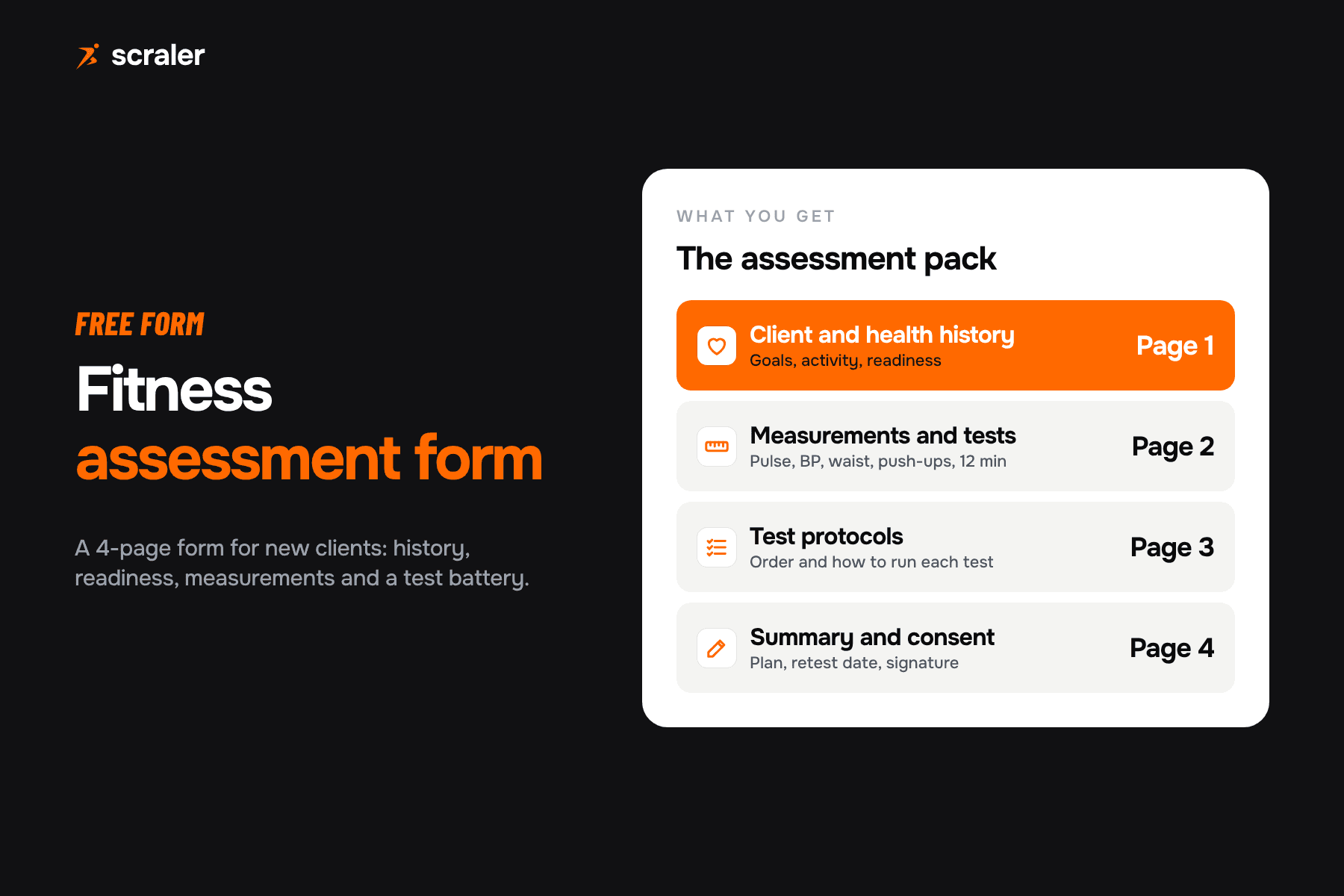
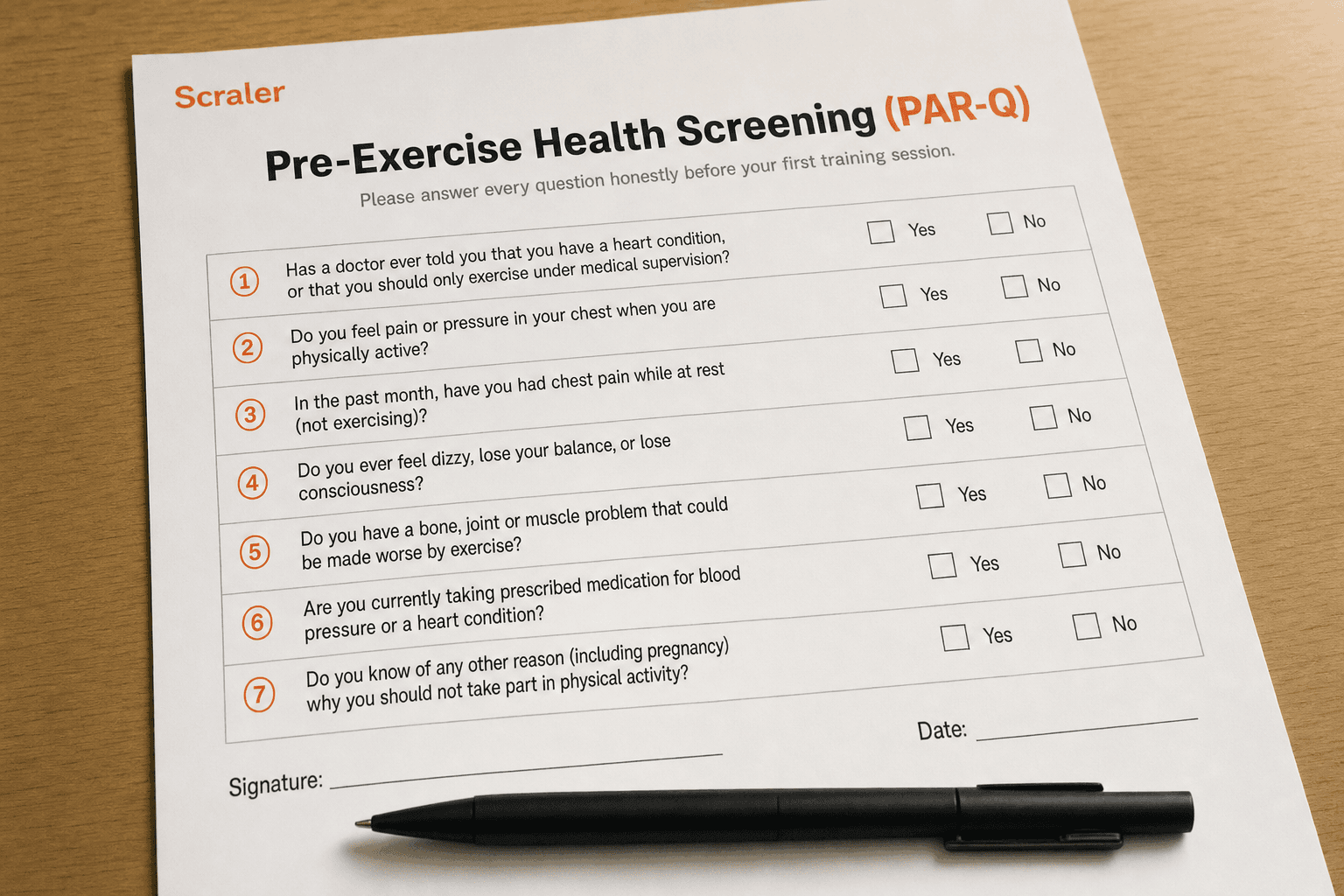
It sits between two other parts of onboarding. Health screening, such as the PAR-Q form, asks whether exercise is safe to start. Fitness testing, covered in our fitness assessment form guide, measures capacity: resting pulse, push-ups, sit-and-reach, a 12 minute run. A movement screen answers a third question: how well does this person move through the basic patterns you are about to train? All three feed the needs analysis, the step where you decide what the program must do.
- Question it answers
- Is it safe to start, or does a doctor need to see them first?
- Example
- PAR-Q+, health history
- Question it answers
- How well do they move through basic patterns today?
- Example
- Overhead squat, FMS, posture photos
- Question it answers
- How strong, fit and flexible are they?
- Example
- Push-ups, plank, 12 minute run
| Step | Question it answers | Example |
|---|---|---|
| Health screening | Is it safe to start, or does a doctor need to see them first? | PAR-Q+, health history |
| Movement screen | How well do they move through basic patterns today? | Overhead squat, FMS, posture photos |
| Fitness testing | How strong, fit and flexible are they? | Push-ups, plank, 12 minute run |
There is no single official movement screen. The FMS is a branded, certified system. The overhead squat assessment is taught in NASM courses. Many coaches build their own short screen from the same basic patterns. All three work, as long as you run it the same way every time.
What is the Functional Movement Screen (FMS)?
The Functional Movement Screen was described by Gray Cook, Lee Burton and Barb Hoogenboom in a two-part 2006 paper in the North American Journal of Sports Physical Therapy. Their aim was to fill the gap between medical screening and performance testing by checking whether a person has the basic movement needed for sport and training. FMS is a trademarked system with its own certification. Below we describe what it is. We do not reproduce its scoring criteria or score sheet.
The 7 FMS tests
- 1.Deep squat. A squat with the arms overhead. Looks at ankle, hip, upper back and shoulder mobility working together.
- 2.Hurdle step. Stepping over a low hurdle on one leg. Looks at single-leg balance and hip control.
- 3.In-line lunge. A split stance with the feet in one line. Looks at balance and control in a narrow base.
- 4.Shoulder mobility. Reaching behind the back with both hands. Looks at shoulder range on each side.
- 5.Active straight leg raise. Lying on the back and lifting one straight leg. Looks at hamstring length and control of the other leg.
- 6.Trunk stability push-up. A push-up from a set hand position. Looks at whether the trunk stays rigid while the arms push.
- 7.Rotary stability. On hands and knees, moving an arm and leg. Looks at trunk control against rotation.
How FMS scoring works
Each test is scored from 0 to 3, and the seven scores add up to a composite out of 21:
- Meaning
- Performs the pattern as described
- Meaning
- Completes the pattern, but with compensation
- Meaning
- Cannot complete the pattern
- Meaning
- Pain during the test, which means referral to a health professional
| Score | Meaning |
|---|---|
| 3 | Performs the pattern as described |
| 2 | Completes the pattern, but with compensation |
| 1 | Cannot complete the pattern |
| 0 | Pain during the test, which means referral to a health professional |
Tests done on both sides are scored left and right, so asymmetries show up, and short clearing tests check for pain. In our coaching practice the individual patterns, pain and asymmetries tell you more than the total. That matters, because the total is what most of the injury research is about.
What is the overhead squat assessment?
The overhead squat assessment is a single-movement screen taught by NASM. It is quicker than the full FMS, needs no kit, and is the screen most personal trainers learn first. As NASM describes it:
- Setup. Barefoot, feet about shoulder width apart and pointing straight ahead, arms raised overhead with the elbows straight.
- Movement. Squat to about chair height and stand back up, for about 5 reps.
- Views. Watch from the front and from the side. Some coaches add a view from behind.
- Checkpoint
- Feet
- Common compensation
- Feet flatten or turn out
- Checkpoint
- Knees
- Common compensation
- Knees move inward
- Checkpoint
- Low back
- Common compensation
- Low back arches
- Checkpoint
- Torso
- Common compensation
- Torso leans forward excessively
- Checkpoint
- Arms
- Common compensation
- Arms fall forward
- Checkpoint
- Hips and heels
- Common compensation
- Weight shifts to one side, heels lift
| View | Checkpoint | Common compensation |
|---|---|---|
| Front | Feet | Feet flatten or turn out |
| Front | Knees | Knees move inward |
| Side | Low back | Low back arches |
| Side | Torso | Torso leans forward excessively |
| Side | Arms | Arms fall forward |
| Back (optional) | Hips and heels | Weight shifts to one side, heels lift |
NASM links each compensation to muscles that are likely overactive or underactive, and to stretches and exercises that address them. Treat that as a hypothesis, not a finding. A forward lean can come from tight ankles, long legs relative to the torso, a lack of practice or fear of falling backward. The quickest way to tell which is a small change and a second try, covered below.
What about a postural assessment?
A postural assessment is a look at how the client stands still: head position, shoulder height, the curve of the low back, pelvis position and how the feet sit, from the front, side and back. Many trainers take photos against a plain wall for this, the same way as progress photos.
Be careful with what you conclude from it. In a 2014 meta-analysis by Laird and colleagues, people with low back pain had the same lumbar curve (lordosis angle) as people without it, across 8 studies. They did move their lower back through less range. A 2020 review of 41 systematic reviews by Swain and colleagues found that links between spine posture and low back pain have been reported, but none that explain pain as caused by posture.
So use posture photos as a baseline and a talking point, not as proof of a problem. "Your right shoulder sits a bit lower in the photo" is an observation. "Your posture is causing your back pain" is a claim the research does not support, and it is not a trainer's call to make.
What does the research say about movement screens?
Most of the research is on the FMS, because it has a standard score. Two questions matter for trainers: can different people score it the same way, and does a low score predict injury?
Reliability: mostly good when scored live
A 2017 meta-analysis by Bonazza and colleagues in the American Journal of Sports Medicine rated FMS interrater and intrarater reliability as excellent. A 2016 review by Moran and colleagues was more cautious: moderate evidence of acceptable reliability for composite scores given live, and conflicting evidence when different raters scored from video. In practice: score the same way each time, ideally the same coach, and film it so you can check yourself.
Injury prediction: weak
Bonazza and colleagues found that people with a composite of 14 or lower had higher odds of injury, an odds ratio of 2.74. They also flagged serious concerns about the test's validity. The more critical review is Moran and colleagues, 2017 in the British Journal of Sports Medicine. They found strong evidence of a link in male military personnel, but a small one (risk ratio 1.47), moderate evidence against using the score to predict injury in football (soccer), and concluded that the strength of the link does not support the composite score as an injury prediction tool.
For an everyday client the takeaway is simple. A low score is not a forecast that they will get hurt, and a high score is not a clean bill of health. Do not sell a screen as injury prevention. Sell it as what it is: a structured look at how someone moves, which you can repeat to show change.
How should personal trainers use a movement screen?
If a screen does not predict injury well, why bother? Because it does other jobs well. In our coaching practice it is useful for four things:
- A starting point for exercise choice. A client who cannot squat to chair height with heels down starts with a box squat or a goblet squat to a bench, not a back squat.
- A coaching conversation. Watching the video together is often the first time a client sees how they move. It makes the first block of the program make sense to them.
- A baseline you can retest. The same screen 6 to 8 weeks later shows change the scale does not.
- A pain filter. Pain in a simple movement is information you want before the first heavy session, and it is your cue to refer.
What it is not: a reason to hold a client back from lifting for weeks of corrective exercise, a sales tool built on fear ("your knees cave, you will get injured"), or something to interpret beyond your scope.
A simple movement screen order (under 15 minutes)
This order is our own coaching practice, not the FMS or NASM protocol. It uses basic patterns anyone can teach, and it does not repeat the fitness tests in our assessment form. Run it after the health questions and before any fitness testing.
- 1.Ask about pain first. "Is anything sore today, or is there a movement you avoid?" Skip any movement that hurts.
- 2.Posture photos. Front, side and back, standing relaxed against a plain wall. Same spot, same distance, every time.
- 3.Overhead squat, 5 reps. Film from the front, then 5 more from the side. Barefoot or in flat shoes, the same each retest.
- 4.Split squat or step-up, each side. Look for balance, knee path and whether one side looks very different from the other.
- 5.Hip hinge. A bodyweight hinge with a dowel along the back, touching head, upper back and tailbone. Watch whether the client can bend at the hips without the dowel leaving the back.
- 6.Overhead reach against a wall. Back and arms against the wall, raise the arms. Note how high the hands get without the low back arching off the wall.
- 7.Push-up or plank. Can the trunk stay straight while the arms work?
Score each movement on a simple 0 to 2 scale: 0 means pain, 1 means clear limitation or a big left to right difference, 2 means it looks fine. That scale is ours, not FMS scoring, and you only need it to compare the client with themselves. Write one line of notes per movement, keep the videos, and put the next retest date in the calendar before the client leaves.
What should you do with the findings?
Each finding should lead to one of three outcomes: refer, adjust the program, or note it and move on. Before deciding, test one change in the session. If a compensation disappears with a small regression, you have a coaching cue or an exercise choice, not a problem.
- Quick in-session check
- Small plate under the heels, or squat to a box
- Program change (our coaching practice)
- Goblet or box squat; ankle mobility in the warm-up
- Quick in-session check
- Cue "knees over toes", lighter load, slower lowering
- Program change (our coaching practice)
- Goblet squat, split squats and step-ups with a knee path cue
- Quick in-session check
- Repeat with arms forward instead of overhead
- Program change (our coaching practice)
- Landmine press before overhead press; a plank or dead bug in the warm-up
- Quick in-session check
- Wall reach to see how high the arms go
- Program change (our coaching practice)
- Keep overhead pressing light; add rows and upper back work
- Quick in-session check
- Repeat both sides slowly
- Program change (our coaching practice)
- More single-leg or single-arm work, starting with the weaker side
- Quick in-session check
- Stop that movement
- Program change (our coaching practice)
- Refer, and train around it only within what the professional clears
| Finding | Quick in-session check | Program change (our coaching practice) |
|---|---|---|
| Heels lift or forward lean in the squat | Small plate under the heels, or squat to a box | Goblet or box squat; ankle mobility in the warm-up |
| Knees move inward | Cue "knees over toes", lighter load, slower lowering | Goblet squat, split squats and step-ups with a knee path cue |
| Low back arches with arms overhead | Repeat with arms forward instead of overhead | Landmine press before overhead press; a plank or dead bug in the warm-up |
| Arms fall forward | Wall reach to see how high the arms go | Keep overhead pressing light; add rows and upper back work |
| Big left to right difference | Repeat both sides slowly | More single-leg or single-arm work, starting with the weaker side |
| Pain in any movement | Stop that movement | Refer, and train around it only within what the professional clears |
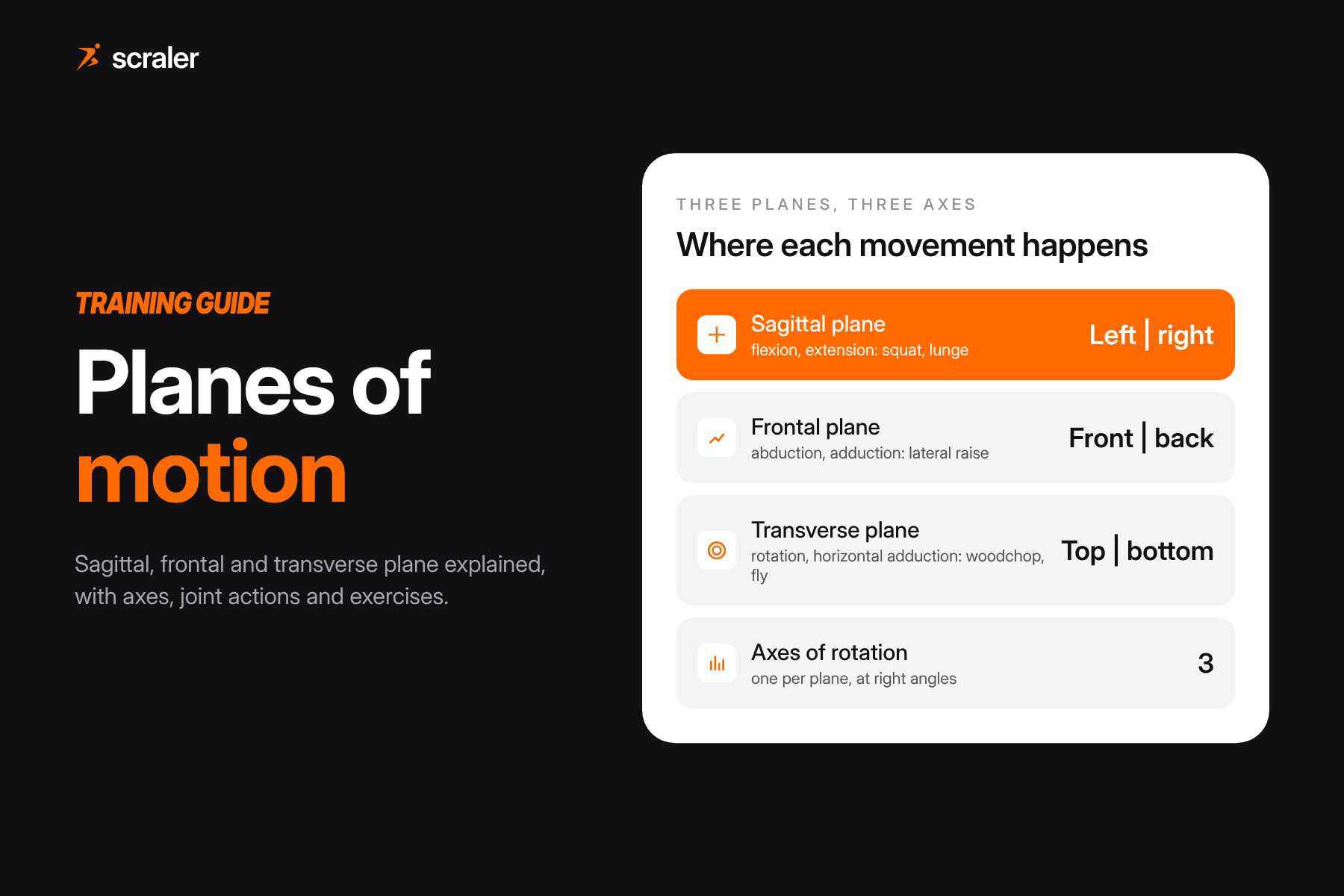
Keep training the pattern. A client with a limited squat still squats, just a version they can do well, and the regular training usually improves the screen more than a separate corrective routine. Progress the version over time with progressive overload, and see planes of motion if you want to balance the program across movement directions.
When should a trainer refer a client out?
Refer when what you see is outside a trainer's scope. Our referral list, as coaching practice:
- Pain during any screen movement, or pain that changes the way the client moves.
- Pain at rest, at night, or pain that has lasted weeks without improving.
- Numbness, tingling or weakness in an arm or leg.
- A recent injury or surgery that has not been cleared for exercise.
- Dizziness, chest pain or unusual breathlessness at any point. Stop and refer, as you would during fitness testing.
- Anything ticked on the health screening that the PAR-Q+ says needs a medical check.
Referring is not the end of the relationship. Ask the client to share what the physiotherapist or doctor says you can train, and build the program around that. A trainer who refers well tends to earn trust, and often referrals back.
How should you record and retest a movement screen?
A screen you cannot compare with the last one is a one-off opinion. These rules are our own coaching practice:
- 1.Film every movement from the same angles and distance. Video is the record, and you can score it again later.
- 2.Keep conditions the same: time of day, footwear, warm-up, and ideally the same coach.
- 3.Write the score and one note per movement, for example "Overhead squat 1: heels lift, fine with plate under heels."
- 4.Retest every 6 to 8 weeks, at the block boundary nearest that date, before the next block is written.
- 5.Show the client the before and after side by side. That is the moment the screen pays off.
How do you record movement screens in Scraler?
Scraler has no dedicated movement screen or FMS scoring module, so we will not pretend it does. What it has is a check-in template builder, which covers the recording and the retesting:
- Video questions. Add a video field per movement ("Overhead squat, 5 reps, front view"). The client films or picks a clip of up to 2 minutes on their phone, which suits online clients and retests at home.
- Photo questions for front, side left, side right and back, which works for posture photos. Photos can be compared side by side or with a slider between two dates.
- Rating and number questions for your scores. Switch on tracking and Scraler charts the answers over time, with a rating scale you set, so a 0 to 2 scale works.
- Recurring check-ins every so many days, weeks or months, so the retest goes out every 6 to 8 weeks without you remembering it.
- Your feedback as a written reply or a recorded video reply of up to 3 minutes on the submitted check-in. For in-person screens, the trainer notes on the client profile hold your findings.
A simple setup: one "Movement screen" template with a video field per movement, four posture photo fields and a tracked rating per movement. Send it at onboarding after the intake form, then set it to repeat. Regular weekly check-ins are a separate template, as in our client check-in form template.
Build a movement screen check-in with video, posture photos and tracked scores, then schedule the retest.
See check-insFrequently asked questions
- What is a movement screen?
- A movement screen is a short set of basic movements, such as a squat, lunge, hinge and overhead reach, that a trainer watches a client do to spot pain, limitations and left to right differences before writing a program. It is not a diagnosis.
- What are the 7 tests of the Functional Movement Screen?
- The deep squat, hurdle step, in-line lunge, shoulder mobility, active straight leg raise, trunk stability push-up and rotary stability test. Each is scored from 0 to 3, for a composite out of 21.
- What is a good FMS score?
- The main reviews used 14 out of 21 as the cut-off, with 14 or lower called low. But a 2017 review in the British Journal of Sports Medicine found the link between a low score and injury too weak to use for prediction, so compare a client with their own earlier scores instead.
- Does the FMS predict injury?
- Not well. One 2017 meta-analysis found higher odds of injury at 14 or lower, while another found the link small and not strong enough to use the score as an injury prediction tool. Use it as a baseline, not a forecast.
- What does the overhead squat assessment show?
- How the feet, knees, low back, torso and arms behave when the client squats to about chair height with the arms overhead, watched from the front and side for about 5 reps. Common compensations are feet turning out, knees moving inward, forward lean, an arching low back and the arms falling forward.
- Can a personal trainer do a postural assessment?
- A trainer can take posture photos and note what they see as a baseline. A trainer should not use posture to explain or diagnose pain. Research has not shown that posture causes low back pain, and pain belongs with a doctor or physiotherapist.
- Do you need FMS certification to screen clients?
- To use the FMS by name and its official scoring, the system offers its own certification. You can run a simple screen of basic movements without it, as long as you describe it as your own screen and run it the same way every time.
- How often should you repeat a movement screen?
- Our coaching practice is every 6 to 8 weeks, timed to the nearest end of a training block, with the same movements, camera angles and conditions, so the comparison means something.
Keep reading