Needs Analysis for Personal Trainers: From Client Assessment to Exercise Prescription
A needs analysis is the first step of program design: you work out what the activity demands and what the person brings, then write the program to close the gap. For personal training clients that means goals, training history, injuries, schedule, equipment and preferences, turned into an exercise prescription with FITT-VP.

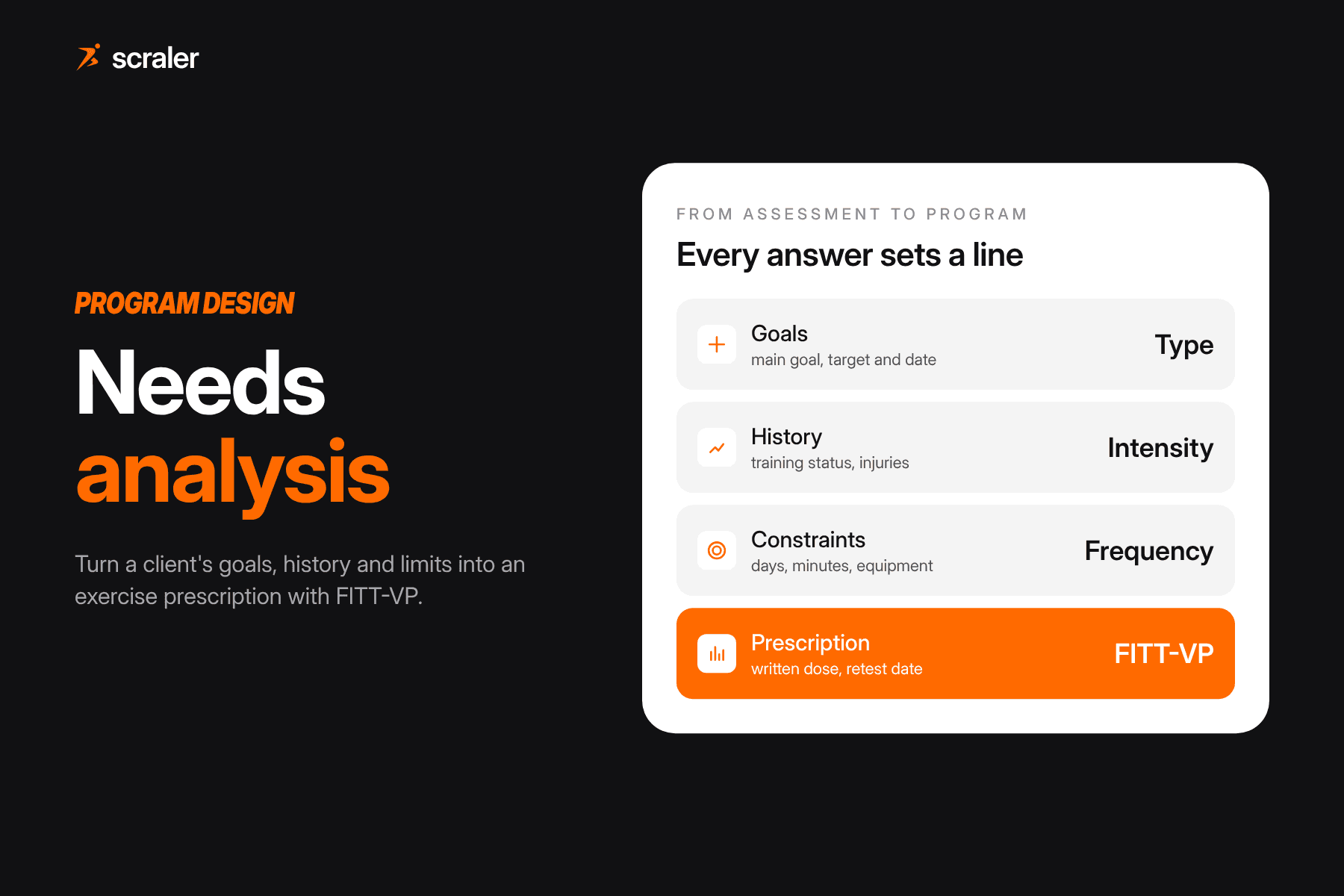
- In the NSCA model, a needs analysis has two parts: an evaluation of the sport or activity, and an assessment of the athlete.
- For a general client, the "sport" is their goal and daily life. The assessment covers training history, injuries, health screening, schedule, equipment and preferences.
- Every answer should change a line of the program. ACSM's FITT-VP (frequency, intensity, time, type, volume, progression) is the format that makes that visible.
- Our coaching practice: settle the constraints first, then the goal, then the preferences, and redo the analysis every 8 to 12 weeks or when something big changes.
What is a needs analysis in strength and conditioning?
In the NSCA textbook *Essentials of Strength Training and Conditioning* (4th edition, 2016), the program design chapter by Sheppard and Triplett starts with a needs analysis. Only after it come the other program variables: exercise selection, training frequency, exercise order, load and repetitions, volume, and rest periods. The point is simple: you cannot choose those variables well until you know what the program is for and who it is for.
The NSCA needs analysis has two parts:
- Movement analysis: which movement patterns, joint actions and muscles the sport uses
- Physiological analysis: which qualities it needs, such as strength, power, speed, endurance or muscle size
- Injury analysis: where athletes in that sport usually get hurt, and how
- Training status: how long and how consistently they have trained, and with what
- Physical testing and evaluation: strength, power, endurance and mobility tests that match the sport
- Primary training goal: the one quality the next phase is built around
The output is a gap: what the sport demands minus what the athlete has. The program is the plan to close that gap without getting the athlete hurt. If you are working toward the CSCS exam, our strength and conditioning coach guide covers the certification itself.
How do you adapt a needs analysis to personal training clients?
Most personal training clients do not play a sport. Their "sport" is the goal they came in with and the life they have to fit training into. So the two parts translate like this:
- For an athlete
- Sprinting, cutting, jumping, throwing
- For a personal training client
- What the goal and daily life ask for: lifting kids, stairs, a hike, a heavier squat
- For an athlete
- Power, speed, repeat sprint ability
- For a personal training client
- Fat loss, muscle, strength, endurance or general health, in order of priority
- For an athlete
- Typical injuries in the sport
- For a personal training client
- The client's own current pain and past injuries, plus a health screening
- For an athlete
- Years of structured training
- For a personal training client
- Training history: never, on and off, or consistent, and what they did
- For an athlete
- Sport-specific test battery
- For a personal training client
- A short baseline: movement, a strength or rep test, a cardio test, body measures
- For an athlete
- The quality for this phase
- For a personal training client
- One main goal with a measurable target and a date
- For an athlete
- Set by the team schedule
- For a personal training client
- Days and minutes available, equipment, location, preferences, sleep and stress
| NSCA part | For an athlete | For a personal training client |
|---|---|---|
| Movement analysis | Sprinting, cutting, jumping, throwing | What the goal and daily life ask for: lifting kids, stairs, a hike, a heavier squat |
| Physiological analysis | Power, speed, repeat sprint ability | Fat loss, muscle, strength, endurance or general health, in order of priority |
| Injury analysis | Typical injuries in the sport | The client's own current pain and past injuries, plus a health screening |
| Training status | Years of structured training | Training history: never, on and off, or consistent, and what they did |
| Physical testing | Sport-specific test battery | A short baseline: movement, a strength or rep test, a cardio test, body measures |
| Primary goal | The quality for this phase | One main goal with a measurable target and a date |
| (not in the athlete model) | Set by the team schedule | Days and minutes available, equipment, location, preferences, sleep and stress |
The last row is the one trainers skip. An athlete's schedule and equipment are fixed by the team. A client with two kids and a desk job has 45 minutes on three evenings and a home rack, and the program has to fit that before it can fit anything else.
Where the information comes from
- Health screening. A PAR-Q or similar questionnaire before any hard training. ACSM's screening model (Riebe et al., 2015) looks at current activity, signs or symptoms and known heart, metabolic or kidney disease, and the intensity the client wants to train at. Our PAR-Q form template covers this step. A yes answer is a referral question, not something the trainer interprets.
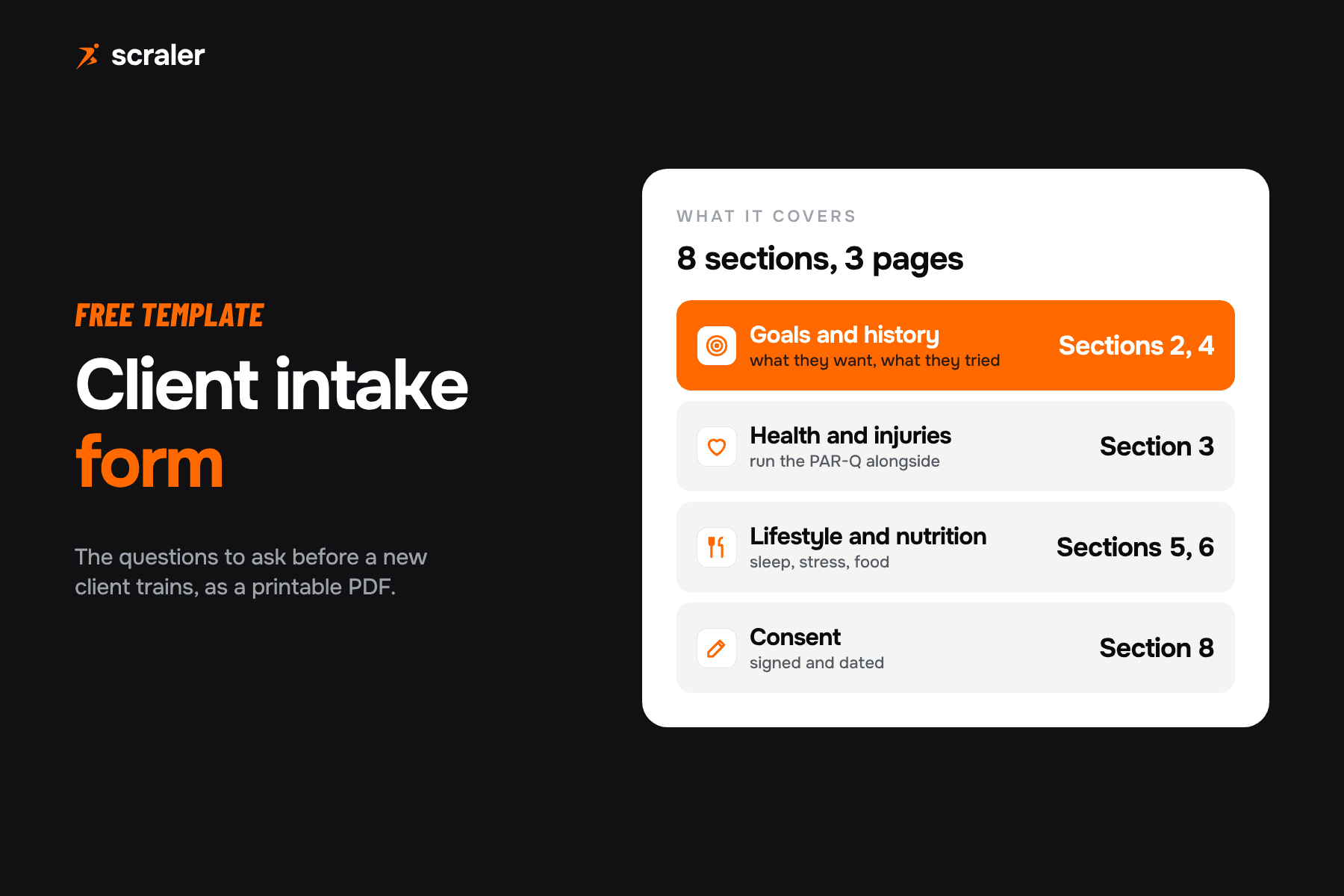
- Intake form. Goals, training history, injuries, lifestyle and preferences, filled in before the first session. Our client intake form template has the full question list and a free PDF.
- Consultation. The conversation that turns "lose weight" into "lose 6 kg by June and keep up with my kids on holiday". Probe the answers on the form.
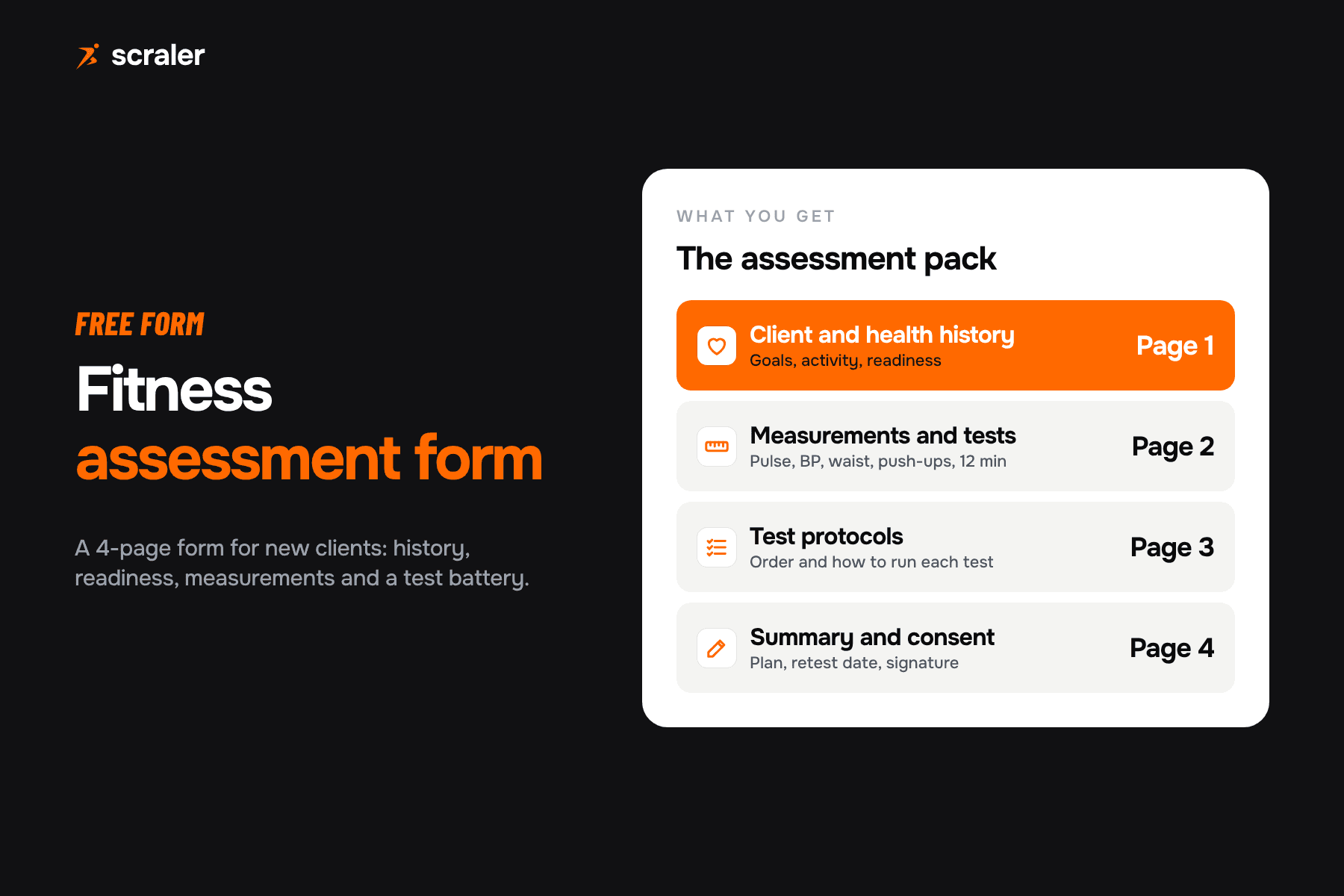
- Baseline assessment. A short test battery so the starting loads are not guesses. The fitness assessment form lists tests and the order to run them. Add a movement screen if you use one.
Needs analysis vs intake form vs fitness assessment
The three get mixed up because they happen in the same first week. They do different jobs:
- Job
- Collect what the client tells you
- Output
- Answers: goals, history, injuries, schedule, equipment
- Job
- Measure what the client can do
- Output
- Numbers: test results, measurements, movement notes
- Job
- Decide what the program must do
- Output
- Priorities and constraints, then a written prescription
| Step | Job | Output |
|---|---|---|
| Intake form and screening | Collect what the client tells you | Answers: goals, history, injuries, schedule, equipment |
| Fitness assessment | Measure what the client can do | Numbers: test results, measurements, movement notes |
| Needs analysis | Decide what the program must do | Priorities and constraints, then a written prescription |
An intake form full of answers is not a needs analysis yet. The analysis is the step where you read the answers and decide: this client trains three days, not four; squats go to a box because of the knee; the main goal is fat loss, so strength work keeps muscle while the walking and nutrition do the rest.
How do you turn a needs analysis into an exercise prescription?
An exercise prescription is the written dose: how often, how hard, how long, what kind, how much in total and how it changes. ACSM's *Guidelines for Exercise Testing and Prescription* organizes that dose as FITT-VP: frequency, intensity, time, type, volume and progression. Our FITT principle guide explains each letter with numbers for cardio, strength and flexibility. Here the question is narrower: which needs analysis answer sets which letter.
- Set mainly by
- Schedule, training status, recovery (sleep, stress, job)
- Question to answer
- How many days can they train, and how many can they recover from?
- Set mainly by
- Training status, screening, goal
- Question to answer
- How close to their limit can they safely and usefully work?
- Set mainly by
- Schedule
- Question to answer
- How many minutes does a session really have, including warm-up?
- Set mainly by
- Goal, equipment, injuries, preferences
- Question to answer
- Which exercises fit the goal, the kit and the body?
- Set mainly by
- Training status, time, goal
- Question to answer
- How many hard sets per muscle, or minutes of cardio, per week?
- Set mainly by
- Training status, goal deadline
- Question to answer
- What changes when, and what triggers the change?
| FITT-VP | Set mainly by | Question to answer |
|---|---|---|
| Frequency | Schedule, training status, recovery (sleep, stress, job) | How many days can they train, and how many can they recover from? |
| Intensity | Training status, screening, goal | How close to their limit can they safely and usefully work? |
| Time | Schedule | How many minutes does a session really have, including warm-up? |
| Type | Goal, equipment, injuries, preferences | Which exercises fit the goal, the kit and the body? |
| Volume | Training status, time, goal | How many hard sets per muscle, or minutes of cardio, per week? |
| Progression | Training status, goal deadline | What changes when, and what triggers the change? |
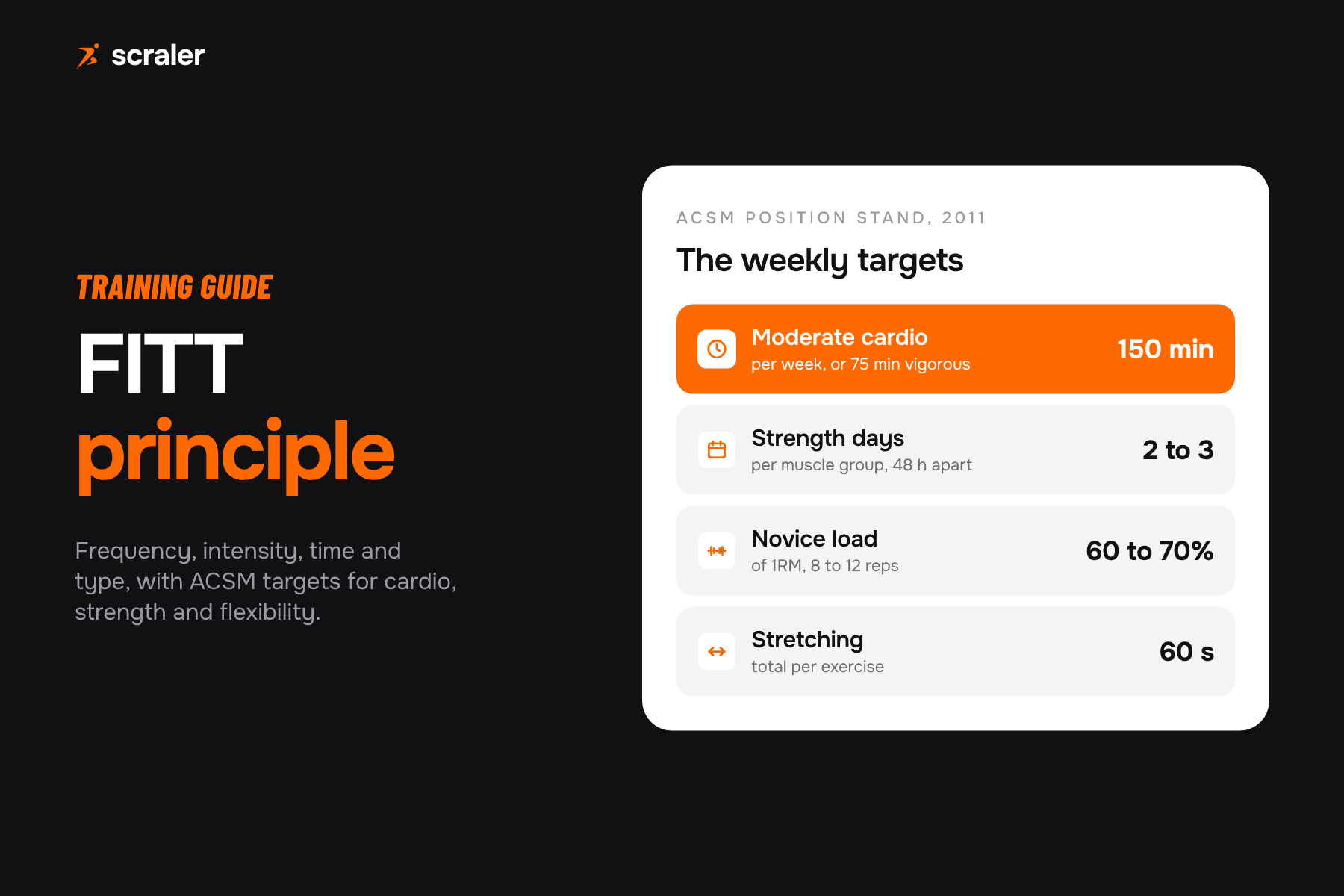
Two guidelines give the floor and the range for most healthy adults. The Physical Activity Guidelines for Americans (2018) set 150 to 300 minutes of moderate activity a week, or 75 to 150 minutes vigorous, plus muscle strengthening for all major muscle groups on 2 or more days. The ACSM 2011 position stand gives resistance training starting points: each major muscle group 2 to 3 days a week, 60 to 70% of 1RM for novice to intermediate exercisers and at least 80% for experienced lifters, about 8 to 12 reps for most adults, and at least 48 hours before training the same muscles hard again. The ACSM 2009 progression stand adds a frequency guide by level: 2 to 3 days a week for novices, 3 to 4 for intermediate and 4 to 5 for advanced lifters, applied in the context of the person's goals and training status.
The order we decide things in
This order is our coaching practice, not a rule from either textbook. It stops the goal from writing a program the client cannot do.
- 1.Constraints first. Screening result, current pain, days and minutes available, equipment. These are hard limits.
- 2.Then the main goal. It decides the type of training and where most of the volume goes.
- 3.Then training status. It sets the starting intensity and volume, and how fast you progress.
- 4.Then preferences. Within what is left, pick the exercises and formats the client enjoys. Adherence beats the perfect exercise.
- 5.Write it down as FITT-VP, with a reassessment date. If a line of the prescription cannot be traced back to an answer, ask why it is there.
Needs analysis examples: two clients, two prescriptions
Both clients below are examples written for this article, not real clients. They show how the same process gives two very different programs.
Client A: busy beginner, fat loss
- Goal: lose about 6 kg in 6 months and "have more energy". Main goal fat loss, second goal build a habit.
- Training history: gym memberships on and off, never more than a month in a row. No structured lifting.
- Injuries and screening: PAR-Q all no. No current pain.
- Schedule: Monday, Wednesday and Saturday, 45 minutes each. Desk job, 6 hours of sleep, high stress.
- Equipment and preferences: commercial gym. Likes machines and dumbbells, dislikes running.
- Baseline: 10 goblet squats with an 8 kg dumbbell at about RPE 6, 6 knee push-ups, about 4,000 steps a day.
What the analysis decides: three full-body sessions, because that is all the schedule allows and it trains each muscle group three times. Moderate intensity and low volume, because training status is low and recovery (sleep, stress) is limited. Walking for extra activity, because the client dislikes running and walking costs no recovery. The calorie side runs separately, for example with our TDEE calculator, because the weights session is there to keep muscle and build the habit.
Client B: intermediate, strength
- Goal: a 140 kg squat and 100 kg bench press within 16 weeks, from about 120 kg and 85 to 90 kg estimated 1RM.
- Training history: 3 years of consistent gym training, mostly bodybuilding splits, little heavy low-rep work.
- Injuries and screening: PAR-Q all no. Right shoulder dislocation 5 years ago, treated and pain-free now; wide-grip bench press feels unstable.
- Schedule: four days a week, 75 minutes each. Sleeps 7 to 8 hours.
- Equipment and preferences: full gym with racks. Likes barbell work, wants some arm training kept in.
- Baseline: squat 100 kg x 6 and bench 70 kg x 8, both at about RPE 8, entered in the one rep max calculator for estimates.
What the analysis decides: four days as an upper and lower split, because training status supports it and the schedule allows it (see workout split for the options). Heavy main lifts, because the goal is maximal strength and the client is experienced. A moderate bench grip and a pause on the chest, because of the shoulder history. Planned blocks and a deload, because a 16 week strength goal needs periodization, not just adding weight every week.
The two prescriptions side by side
- Client A: busy beginner, fat loss
- 3 full-body sessions a week, plus a daily step target
- Client B: intermediate, strength
- 4 sessions a week, upper and lower split
- Client A: busy beginner, fat loss
- RPE 6 to 7 (3 to 4 reps in reserve)
- Client B: intermediate, strength
- Main lifts 75 to 85% of 1RM, RPE 7 to 8; accessories RPE 8
- Client A: busy beginner, fat loss
- 45 minutes, warm-up included
- Client B: intermediate, strength
- 75 minutes, warm-up included
- Client A: busy beginner, fat loss
- Machines and dumbbells: leg press, goblet squat, row, chest press, hip hinge, carry; walking
- Client B: intermediate, strength
- Back squat, bench press with moderate grip, deadlift, overhead press, rows, arm work
- Client A: busy beginner, fat loss
- 2 sets of 10 to 12 reps on 6 exercises (12 working sets a session); steps from 4,000 to 7,000 a day
- Client B: intermediate, strength
- Main lifts 3 to 5 sets of 3 to 6 reps; accessories 3 sets of 8 to 12
- Client A: busy beginner, fat loss
- Add reps up to 12, then add load; add 1,000 steps a day every 2 weeks; retest at week 8
- Client B: intermediate, strength
- Add 2.5 kg to main lifts when the RPE target is met; deload every 4 to 6 weeks; retest 1RM estimate at week 8
| FITT-VP | Client A: busy beginner, fat loss | Client B: intermediate, strength |
|---|---|---|
| Frequency | 3 full-body sessions a week, plus a daily step target | 4 sessions a week, upper and lower split |
| Intensity | RPE 6 to 7 (3 to 4 reps in reserve) | Main lifts 75 to 85% of 1RM, RPE 7 to 8; accessories RPE 8 |
| Time | 45 minutes, warm-up included | 75 minutes, warm-up included |
| Type | Machines and dumbbells: leg press, goblet squat, row, chest press, hip hinge, carry; walking | Back squat, bench press with moderate grip, deadlift, overhead press, rows, arm work |
| Volume | 2 sets of 10 to 12 reps on 6 exercises (12 working sets a session); steps from 4,000 to 7,000 a day | Main lifts 3 to 5 sets of 3 to 6 reps; accessories 3 sets of 8 to 12 |
| Progression | Add reps up to 12, then add load; add 1,000 steps a day every 2 weeks; retest at week 8 | Add 2.5 kg to main lifts when the RPE target is met; deload every 4 to 6 weeks; retest 1RM estimate at week 8 |
The progression rules (double progression for A, load jumps on a target RPE for B) and the deload timing are our coaching practice. The intensity ranges sit inside the ACSM numbers above: moderate, novice-level loads for A, and for B main lift loads around and above the 80% of 1RM that ACSM gives for experienced lifters. For more on the load side, see progressive overload, the RPE chart and deload week. For how B's 16 weeks split into blocks, see mesocycle.
Needs analysis checklist for personal trainers
Use this as a template for every new client. It is our coaching practice, built on the NSCA two-part model. Tick each item before you write the program.
- What to find out
- PAR-Q answers, medication, anything needing medical clearance
- Goes into
- Whether to start, and the intensity ceiling
- What to find out
- One goal, measurable, with a date; the "why" behind it
- Goes into
- Type and where the volume goes
- What to find out
- Anything else that matters, ranked below the main goal
- Goes into
- Accessory work, cardio choice
- What to find out
- How long, how consistent, what kind, last time they trained
- Goes into
- Starting intensity, volume, progression speed
- What to find out
- Where, how long, what makes it worse; under care or not
- Goes into
- Exercise swaps, referral if needed
- What to find out
- What, when, fully recovered or not
- Goes into
- Exercise selection, warm-up focus
- What to find out
- Days a week and real minutes a session
- Goes into
- Frequency and time
- What to find out
- Gym, home or outdoors; what kit exists
- Goes into
- Type
- What to find out
- Job activity, sleep, stress, steps
- Goes into
- Volume and recovery between sessions
- What to find out
- Liked and disliked exercises and formats
- Goes into
- Exercise choice inside the plan
- What to find out
- Movement quality, strength or rep test, cardio test, measures
- Goes into
- Starting loads and the retest
- What to find out
- When to repeat the tests and the analysis
- Goes into
- Progression and the next block
| Area | What to find out | Goes into |
|---|---|---|
| Health screening | PAR-Q answers, medication, anything needing medical clearance | Whether to start, and the intensity ceiling |
| Main goal | One goal, measurable, with a date; the "why" behind it | Type and where the volume goes |
| Second goals | Anything else that matters, ranked below the main goal | Accessory work, cardio choice |
| Training history | How long, how consistent, what kind, last time they trained | Starting intensity, volume, progression speed |
| Current pain | Where, how long, what makes it worse; under care or not | Exercise swaps, referral if needed |
| Past injuries and surgery | What, when, fully recovered or not | Exercise selection, warm-up focus |
| Schedule | Days a week and real minutes a session | Frequency and time |
| Location and equipment | Gym, home or outdoors; what kit exists | Type |
| Lifestyle | Job activity, sleep, stress, steps | Volume and recovery between sessions |
| Preferences | Liked and disliked exercises and formats | Exercise choice inside the plan |
| Baseline tests | Movement quality, strength or rep test, cardio test, measures | Starting loads and the retest |
| Reassessment date | When to repeat the tests and the analysis | Progression and the next block |
Keep the written result short: one line for the main goal, a list of constraints, the FITT-VP prescription and the retest date. That summary is what you read before every program update. The full sheet layout lives in our workout plan template.
How often should you redo a needs analysis?
A needs analysis is not a one-time form. As our coaching practice, we redo it:
- At the end of each program, usually every 8 to 12 weeks, when you retest and write the next one.
- When the goal changes, for example from fat loss to strength, or when a race or event is booked.
- After an injury, illness or long break, starting again from the screening.
- When the schedule or equipment changes, such as a new job, a move or switching to home training.
- When progress stalls for 3 to 4 weeks despite good adherence. Check the prescription against the answers before changing the exercises.
Common needs analysis mistakes
- Collecting answers nobody reads. If a question never changes the program, cut it or start using it.
- Programming the goal and ignoring the schedule. A five day plan for a client with three free evenings fails in week two.
- Copying an athlete template. A general client rarely needs a sport-style power block; they need the main goal, done consistently.
- Guessing the starting load. A short baseline test is quicker than two weeks of loads that are too light or too heavy.
- Treating pain as a programming problem only. Program around it, and refer when it is new, getting worse or unexplained. Diagnosing is not the trainer's job.
- Never revisiting it. The client in week 12 is not the client from the intake form.
How do you store a needs analysis and build the program in Scraler?
In Scraler, the intake side lives in client onboarding. You build up to 10 forms (30 questions in total) with short and long text, number, yes or no, single and multiple choice, date and photo questions, plus a terms step. There are ready templates that match the needs analysis areas: a PAR-Q health screening, Goals & Motivation (main goal, own words, training experience, past obstacles, target date), Injury & Medical History, Lifestyle & Habits (daily activity, sleep, stress, current exercise) and Training Preferences (training days, location, equipment, session length). Edit them or add your own questions.
The answers are saved on the client profile, where you can edit or print them, and you can keep your written analysis and constraints in the trainer notes on the same profile. Then you write the prescription in the training plan builder: the Calendar layout places workouts on days of the week (frequency), exercises come from the library with videos (type), and each set gets reps, weight or % of 1RM, RPE and rest (intensity and volume). Copy a workout or a day into the next week and adjust it to write the progression. Scraler does not turn the intake answers into a program for you; the analysis is still your job, the tool just keeps the answers and the program in one place.
Send every new client your health screening, goals and preferences forms, read the answers on their profile, and build the program next to them.
See client managementFrequently asked questions
- What is a needs analysis in personal training?
- A needs analysis is the first step of program design. You work out what the client's goal demands and what the client brings (training history, injuries, schedule, equipment, preferences), then write a program that closes the gap.
- What are the two parts of a needs analysis?
- In the NSCA model, an evaluation of the sport or activity (movement, physiological and injury analysis) and an assessment of the athlete (training status, physical testing and the primary training goal).
- What is the difference between a needs analysis and a fitness assessment?
- A fitness assessment measures what the client can do. A needs analysis uses those results, plus the intake answers, to decide what the program must do. The assessment is one input to the analysis.
- What is an exercise prescription?
- An exercise prescription is the written dose of training: how often, how hard, how long, what type, how much in total and how it progresses. ACSM organizes it as FITT-VP: frequency, intensity, time, type, volume and progression.
- How do you write an exercise prescription from a needs analysis?
- Settle the constraints first (screening, pain, schedule, equipment), then let the main goal choose the type, training status set the intensity and volume, and preferences choose exercises. Write each FITT-VP line so it traces back to an answer.
- How long does a needs analysis take?
- Most of it is the intake form, which the client fills in before the first session, and a 30 to 60 minute consultation and baseline test. Writing the analysis itself is usually short once the answers are in.
- How often should you update a needs analysis?
- Our coaching practice is at the end of every program (about every 8 to 12 weeks), and whenever the goal, schedule, equipment or health changes, or progress stalls for 3 to 4 weeks.
Keep reading