CSCS Certification: How to Become a Strength and Conditioning Coach
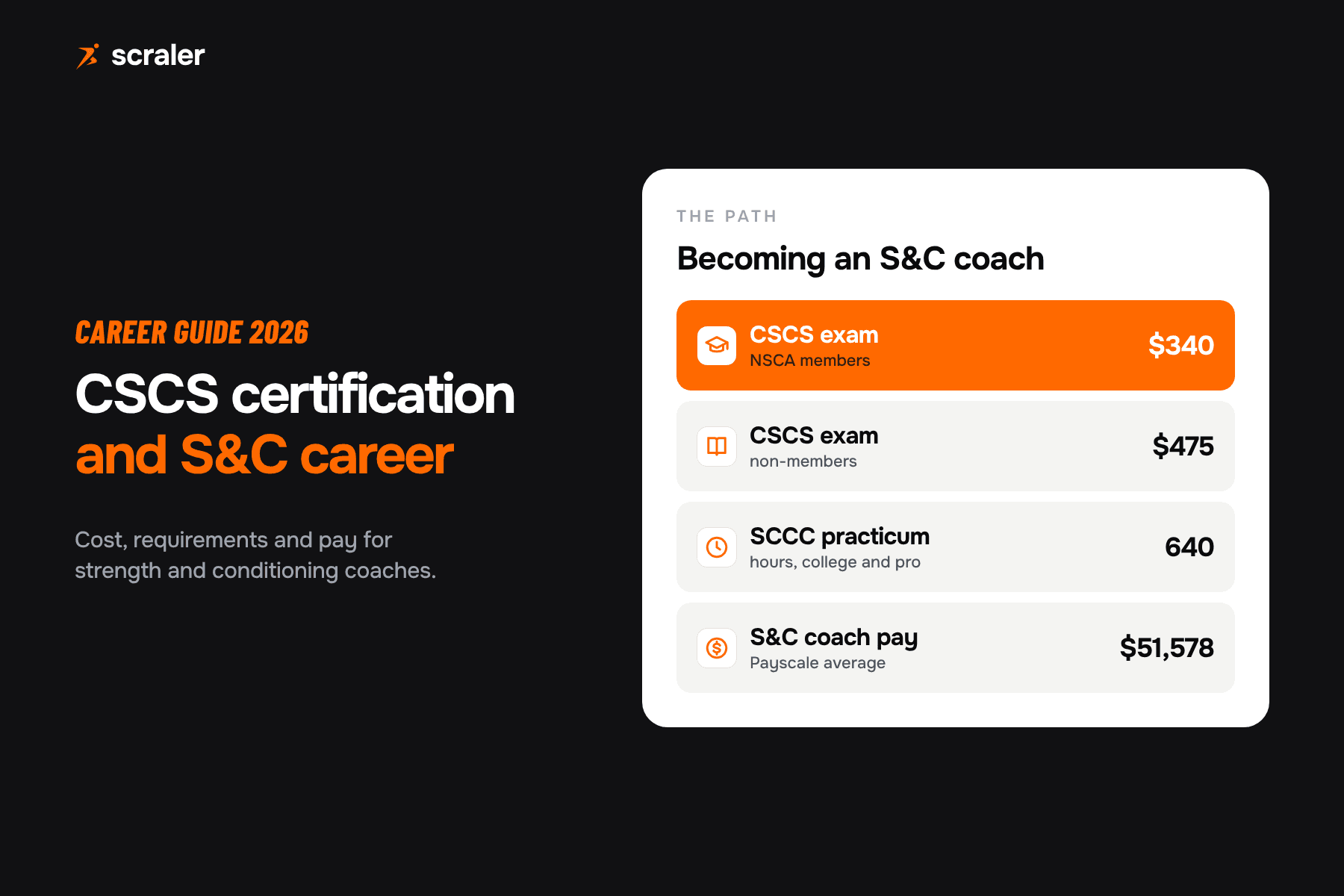
To become a strength and conditioning coach, earn a bachelor's degree, hold CPR/AED and pass the NSCA's CSCS exam, which costs $340 for NSCA members and $475 for non-members. Payscale puts average S&C coach pay at $51,578 a year, and the BLS median for coaches and scouts is $47,320.

- The CSCS needs a bachelor's degree and current CPR/AED. From 2030, US candidates need a degree from a CASCE-accredited program.
- The CSCS exam is $340 for NSCA members and $475 for non-members, and you recertify every three years.
- College and pro roles may also look at the SCCC, which needs a 640-hour practicum and had a 66% overall pass rate in 2026.
- Payscale averages $51,578 for S&C coaches. Neither Payscale nor the BLS splits pay by college, pro or private work.
Strength and conditioning is the part of sport that happens before the game: building strength, speed, power and the capacity to stay healthy through a season. This guide covers the CSCS and its main alternatives, what the path looks like from degree to first job, what S&C coaches are paid, and how to work with athletes privately. Every market figure was read on its source page on 8 October 2026. Anything we calculated is a worked example.
What does a strength and conditioning coach do?
An S&C coach designs and runs physical training for athletes: weight room sessions, speed and agility work, conditioning, warm-ups and in-season load management. The NSCA says CSCS holders work in educational institutions, professional teams and tactical, healthcare and private sector facilities, and may train athletes in one sport or many. The emphasis is outcomes, reducing injury risk and working with the wider performance team.
Job titles include assistant, associate or head strength and conditioning coach, performance coach, sports performance coach and director of high performance. Many S&C coaches also run private groups or one to one athletes on the side. If that is your goal, our guide to how to start a personal training business covers the setup.
What is the CSCS certification and how much does it cost?
The CSCS, or Certified Strength and Conditioning Specialist, is the NSCA's certification for S&C coaches. The NSCA developed it in 1993 and says it was the first strength and conditioning certification to earn NCCA accreditation. The exam registration fee is $340 for NSCA members and $475 for non-members. Membership saves $135. A retake of both sections costs the same as the first attempt, and a retake of one section is $250 for members and $385 for non-members. Study materials are not included.
Once you hold the CSCS, you stay certified by earning continuing education units and recertifying every three years.
Do you need a degree to become a CSCS?
Yes. The NSCA requires at least a bachelor's degree and a current CPR/AED certification to sit the exam. A rule change is coming: from 1 January 2030, US candidates must hold a bachelor's degree from a CASCE-accredited program. That does not affect candidates with a degree from outside the US until January 2036. The current rules stay in force through 31 December 2029.
The degree is also where the wider profession points. The BLS says coaches and scouts typically need a bachelor's degree, and that no work experience in a related occupation is needed. If you do not have a degree, a general fitness certification and private clients are the realistic route today. Our guide to becoming an online personal trainer covers that path, and personal trainer certification compares the main credentials.
Which strength and conditioning certification is best?
For most coaches the answer is the CSCS, because it is the credential employers name most often. The NSCA lists it as often preferred or required for S&C coach jobs. But two others are worth knowing.
The SCCC comes from the Collegiate Strength and Conditioning Coaches association. According to the CSCCa, it is NCCA accredited and has three parts: a 640-hour practicum with an approved mentor, a written exam and a practical exam. A $230 practicum fee applies. Eligibility is limited to full-time college or professional S&C coaches, or students preparing for that work. The CSCCa states that legislation effective 1 August 2015 requires full-time Division I S&C coaches to hold a certification from an accredited program. Its 2026 statistics show 49 of 74 candidates passed overall, or 66.22%.
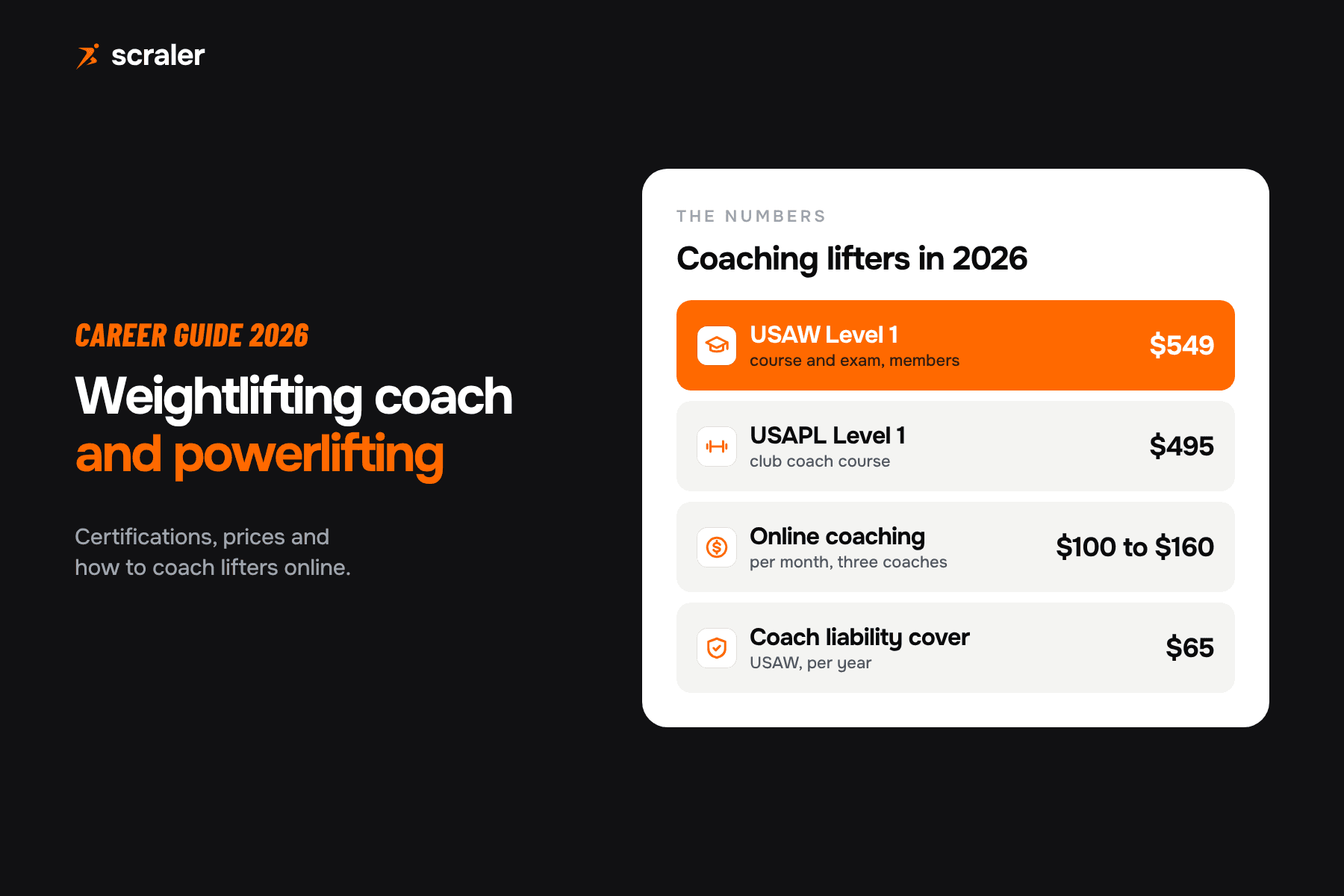
USAW Level 1 is narrower. It is built around weightlifting and costs $549 for members, or $658 with a new membership. It adds weightlifting coaching skills rather than replacing a general S&C certification. If you mainly coach lifters, see how to become a powerlifting or weightlifting coach.
- Cost
- $340 members, $475 non-members
- Who it is for
- Any S&C coach working with athletes
- What it takes
- Bachelor's degree, CPR/AED, one exam
- Cost
- $230 practicum fee plus $340 exam fee (members)
- Who it is for
- Full-time college and pro S&C coaches
- What it takes
- 640-hour practicum, written and practical exams
- Cost
- $549 members, $658 new members
- Who it is for
- Coaches adding the Olympic lifts
- What it takes
- 9 to 13 hour course and exam, yearly renewal
| Certification | Cost | Who it is for | What it takes |
|---|---|---|---|
| CSCS (NSCA) | $340 members, $475 non-members | Any S&C coach working with athletes | Bachelor's degree, CPR/AED, one exam |
| SCCC (CSCCa) | $230 practicum fee plus $340 exam fee (members) | Full-time college and pro S&C coaches | 640-hour practicum, written and practical exams |
| USAW Level 1 | $549 members, $658 new members | Coaches adding the Olympic lifts | 9 to 13 hour course and exam, yearly renewal |
How do you become a strength and conditioning coach?
- 1.Get a degree. Choose a program with the 2030 rule in mind: US candidates will need a bachelor's from a CASCE-accredited program for the CSCS.
- 2.Add CPR/AED. A current certification is required for the CSCS.
- 3.Pass the CSCS. Join the NSCA first if you can, because it saves $135.
- 4.Get supervised experience. Intern or assist. The SCCC practicum is a model: 640 hours, which the CSCCa says is often done at 20 hours a week over 8 to 9 months.
- 5.Take your first role. Assistant jobs, graduate assistantships and performance coach roles are the usual start.
- 6.Keep learning. Recertify every three years and add specialist courses such as weightlifting.
While you study, practice the day-to-day math. The one rep max calculator and the strength standards calculator are useful for testing days, and the VO2 max calculator gives a quick sense of aerobic capacity. They do not replace testing, but they give you the numbers a coach talks about with athletes. For endurance athletes, see how to become a running coach.
What does a first strength and conditioning job look like?
Most people start as an intern, graduate assistant or assistant coach. The CSCCa says graduate and undergraduate assistantships can count toward its practicum while you are still taking classes, and it keeps a jobs board that flags internships approved for the SCCC. It also keeps a list of approved mentors you can contact directly if no posting fits.
Titles above that include associate and head strength and conditioning coach, and director of sport or high performance, according to the NSCA. The BLS notes that part-time work is common for coaches and scouts, and that full-time coaches may work more than 40 hours a week for several months of the sports season. The BLS says schedules may involve irregular hours, including evenings, weekends and holidays, so ask about hours before you accept a role.
For the exam, the NSCA publishes a detailed content outline that covers scientific foundations and practical and applied knowledge, and it says it does not require or endorse any specific study guide. Download the outline first, then pick the study material that suits you.
How much does a strength and conditioning coach make?
Two sources give a useful range. Payscale lists an average base salary of $51,578 for an S&C coach, based on 238 profiles updated 2 July 2026. The 10th to 90th percentile runs from $39,000 to $79,000, and an entry level coach with under a year of experience averages $40,427 in total compensation, based on 20 salaries.
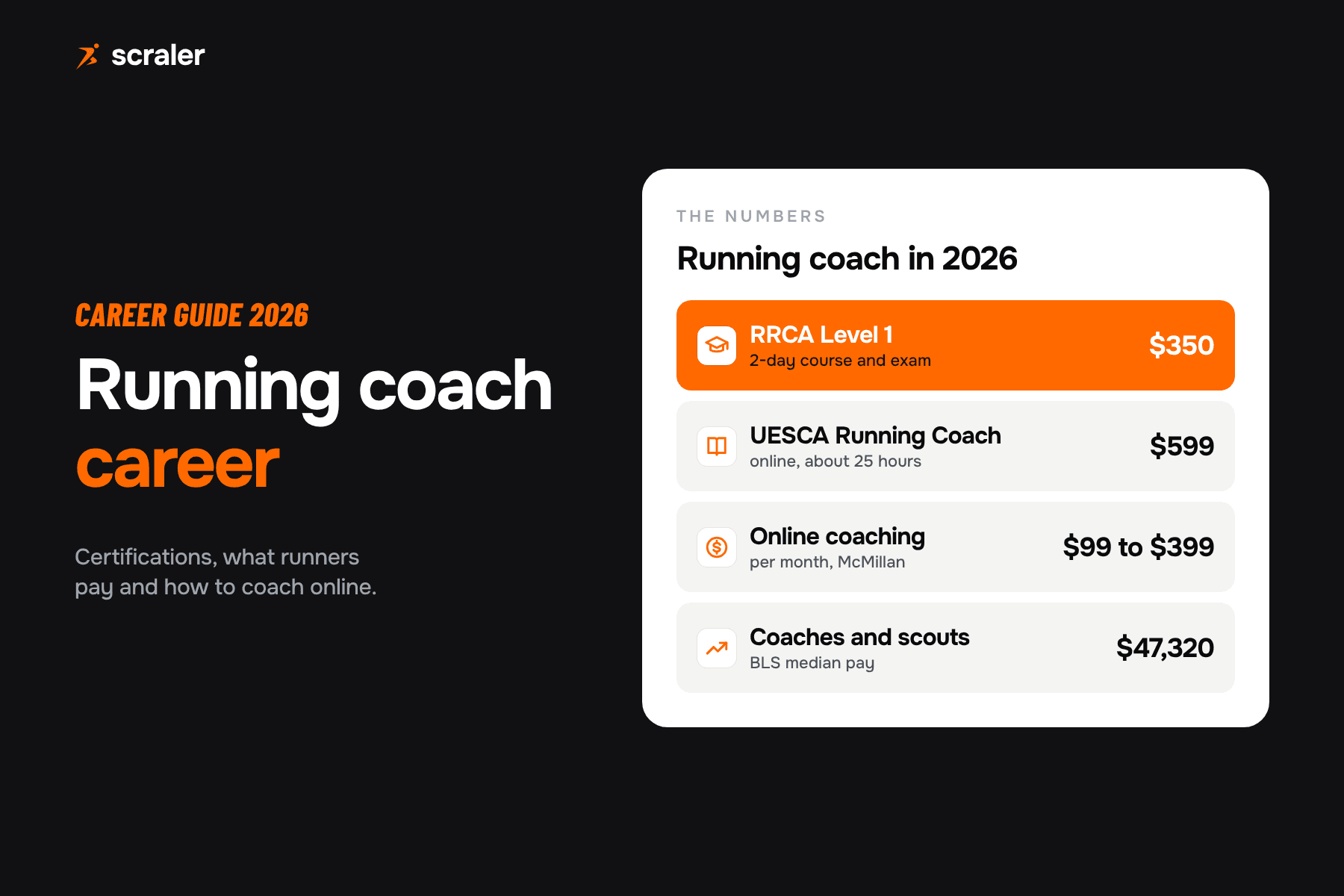
The BLS does not have an S&C category. Its nearest match is coaches and scouts, with a 2025 median of $47,320, 298,800 jobs and 6% growth expected from 2025 to 2035. According to O*NET, using BLS data, the lowest 10% earn $28,790 or less and the top 10% earn $98,860 or more. Neither source splits pay by college, pro or private work, so we do not give a split by setting. The NSCA says the CSCS opens doors to higher pay in professional sports and the private or tactical sectors, but it publishes no figure on that page, so treat it as a claim.
For context, the same data set gives exercise trainers and group fitness instructors a median of $47,160. Our guide to how much personal trainers make covers that group in more detail.
Can you work as a private strength and conditioning coach?
Yes. Many S&C coaches train youth and high school athletes, adult amateurs and tactical groups outside a team. You set the price and the schedule, and you carry your own insurance and admin. The market for a one to one session is covered in personal training prices, which cites an average of $65 a session on Bark in the US. Check personal trainer insurance before you take on minors or work in a facility you do not own.
As a worked example, not survey data: 20 paid sessions a week for 46 weeks at $65 is 920 sessions, or $59,800 a year before tax and costs. Small group training for several athletes at once raises revenue per hour. Small group personal training has the numbers.
Software matters when the roster grows. In Scraler you build a program once in the workout builder, assign it to each athlete and adjust loads for individuals, then collect check-ins on how they felt. Plus is $49 a month (€39 or £39) for up to 50 clients, and Premium is $69 (€59 or £59) for up to 100 clients with Stripe payments. Ultimate starts at $109 (€99 or £99) and adds team and studio management for a facility with several coaches. To compare tools, see workout builder software.
Build a training block once, assign it to your roster, adjust for each athlete and review their check-ins.
See the workout planning featuresFrequently asked questions
- How much does the CSCS certification cost?
- The exam registration fee is $340 for NSCA members and $475 for non-members. Retaking both sections costs the same, and retaking one section is $250 for members and $385 for non-members. Exam preparation materials are not included.
- What are the requirements for the CSCS exam?
- At least a bachelor's degree and a current CPR/AED certification. From 1 January 2030, US candidates need a bachelor's degree from a CASCE-accredited program. You recertify every three years with continuing education units.
- Is the CSCS worth it?
- For college, professional and tactical roles, probably. The NSCA says the CSCS is often preferred or required for S&C coach jobs, and that the NCAA requires credible certification. For private coaching with general clients, weigh the exam cost against the clients and roles you want.
- What is the difference between the CSCS and the SCCC?
- The CSCS (NSCA) needs a degree and one exam. The SCCC (CSCCa) needs a 640-hour practicum, a written exam and a practical exam, and is aimed at full-time college and professional S&C coaches. The SCCC had a 66.22% overall pass rate in 2026.
- How much do strength and conditioning coaches earn?
- Payscale lists an average of $51,578 a year, with a 10th to 90th percentile range of $39,000 to $79,000. The BLS median for coaches and scouts is $47,320. Neither source gives pay by college, pro or private work.