How to Become a Running Coach (and Coach Runners Online)
To become a running coach, take a certification such as RRCA Level 1 ($350, a two-day course plus an exam), UESCA ($599, fully online) or USATF Level 1, then coach runners in person or online. One to one online running coaching sells for roughly $99 to $399 a month.

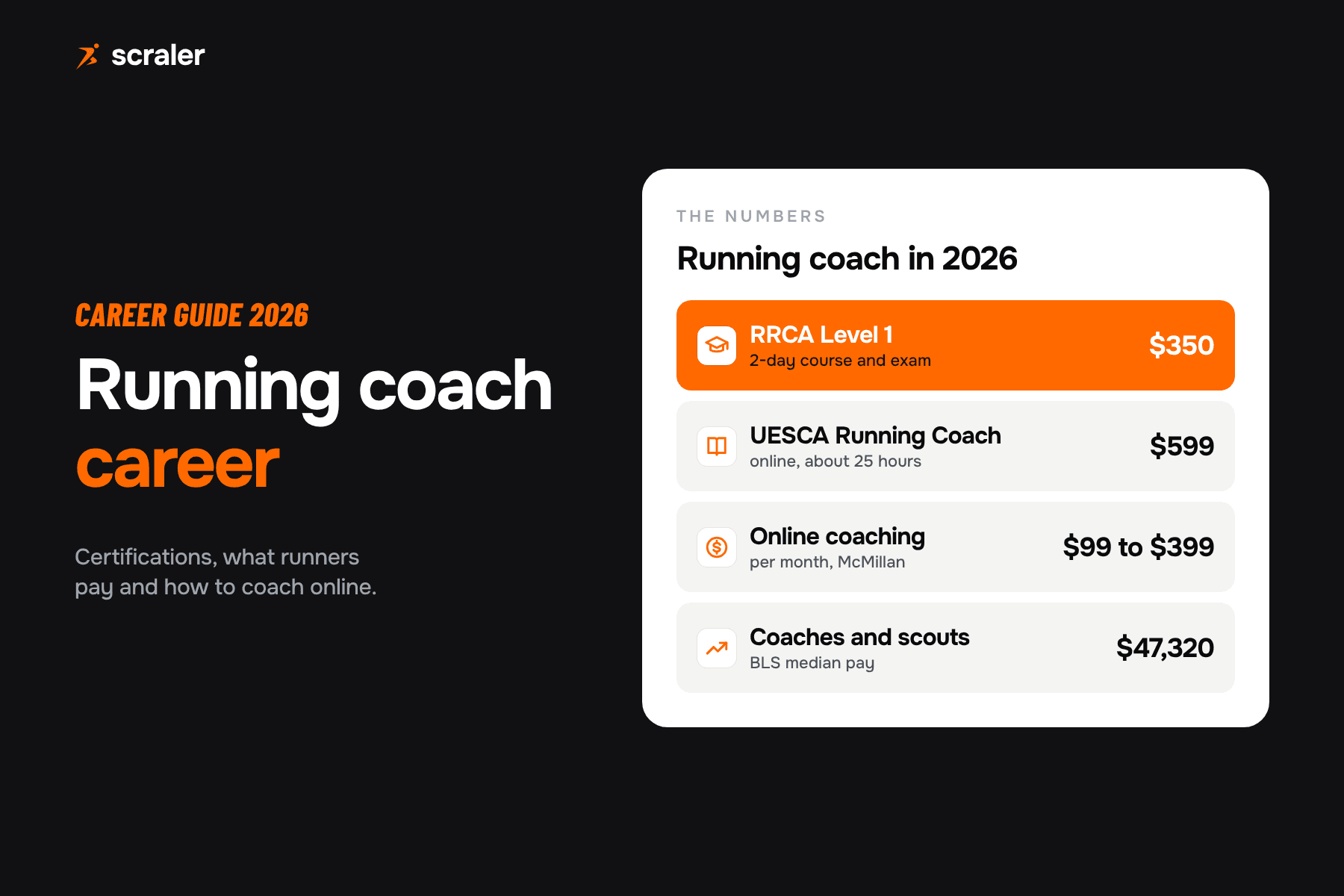
- RRCA Level 1 costs $350 and adds a 100-question exam, CPR and First Aid. UESCA costs $599 and is 100% online.
- Online running coaching is published at $99 to $399 a month. A plan alone can cost far less, for example $7.25 per week of training.
- The BLS median pay for coaches and scouts is $47,320 a year, and part-time work is common, so most running coaches build their own client base.
- A weekly loop of plan, check-in and adjustment lets you coach runners anywhere. Fifty clients fit on Scraler Plus at $49 a month.
A good runner is not automatically a good running coach. Coaching is the skill of turning a goal race and a busy week into a plan the runner can actually follow, then adjusting it when life gets in the way. This guide covers the certifications, the price runners pay, what coaches earn and how to run the work online. Every market figure was read on its source page on 8 October 2026, and anything we calculated is labelled a worked example.
What does a running coach do?
A running coach designs training for a runner and checks how it is going. For a first 5K that can be three runs a week and a walk and run plan. For a marathoner it is mileage build, long runs, workouts at set paces, a taper and a race day plan. Between the plans, the coach answers questions, spots overtraining early and keeps the runner honest on easy days.
People also search for a coach for running when they want a club leader, a track coach or a one to one online coach. The skills overlap, but the business is different. Club and school coaches are usually paid a stipend or work as volunteers. Online coaches sell monthly plans to runners they may never meet. This article leans toward the second route, because that is where an independent coach controls income. If you are new to selling coaching remotely, start with our guide to becoming an online personal trainer.
Do you need a certification to be a running coach?
Not to start. The Bureau of Labor Statistics says coaches and scouts typically need a bachelor's degree, but that requirements range from no formal educational credential to a bachelor's or higher degree. The three running certifications below are private credentials, not government licenses, so check local rules for coaching in public parks, gyms or schools. If you want a general fitness credential alongside a running one, see personal trainer certification.
A certification still matters for three reasons. It gives you a structure to learn from. It shows a new client you took the work seriously. And the RRCA says its Level 1 prepares coaches to work with clubs, events, fitness studios and community programs. Our guide to personal trainer insurance explains what cover you need before you take paying clients.
Which running coach certification should you get?
Three providers cover most US coaches. They differ in format, price and who they are built for.
- Price
- $350
- Format
- Two-day course, online or in person, then a 100-question online exam (85% to pass)
- Requirements
- 18 or older, high school diploma, CPR and First Aid
- Price
- $599
- Format
- 22 online modules, about 25 hours, exam within one year
- Requirements
- None listed on the course page
- Price
- Not listed (see calendar of schools)
- Format
- 22-hour blended course: 60 days online plus a live school
- Requirements
- 18 or older, USATF member
| Certification | Price | Format | Requirements |
|---|---|---|---|
| RRCA Level 1 | $350 | Two-day course, online or in person, then a 100-question online exam (85% to pass) | 18 or older, high school diploma, CPR and First Aid |
| UESCA Running Coach | $599 | 22 online modules, about 25 hours, exam within one year | None listed on the course page |
| USATF Level 1 | Not listed (see calendar of schools) | 22-hour blended course: 60 days online plus a live school | 18 or older, USATF member |
RRCA Level 1 is the most common start for community and club coaches. According to the RRCA, the course focuses on adult distance running and covers training plans built to lower injury risk. You pass an online exam within 30 days of the course, send in CPR and First Aid certificates within 60 days, and pay $25 a year for coach membership to stay in good standing. Level 2 costs about $750 in total.
UESCA is the self-paced option. The UESCA Running Coach course is $599, takes about 25 hours, and gives you one year to pass the exam with lifetime access to the material. It covers 5K to marathon training, plus a business and marketing module, which suits someone building an online practice.
USATF Level 1 is built for track and field, not road running alone. The USATF Level 1 page describes a 22-hour course with all track events, an exam at 80%, and a certificate valid for four calendar years. It does not list a price, so check the calendar of schools for the fee. It fits school and club coaches more than online distance coaches.
How much does a running coach cost?
Runners pay for running coaching by the month, and the range is wide because the service is wide. At the low end, Runners Connect sells a custom training schedule at $7.25 per week of training, so a 12-week schedule costs $87. That is a plan with no ongoing coach.
For one to one coaching, McMillan Running publishes three monthly price points: $99, $199 and $399. At $99 the runner can message the coach, gets weekly check-ins and can book a monthly call. At $199 contact is unlimited. The $399 tier is the head coach, Greg McMillan. Kathy Butler lists $155 (Bronze), $180 (Silver) and $310 (Gold) for one month, with lower monthly prices on 3 and 6 month plans.
The pattern is the same as in other coaching niches. The price rises with contact: a plan, then check-ins, then calls, then unlimited access. For how to structure those levels, see our guide to online personal trainer pricing. If you coach in person, personal training prices shows what a session costs by country.
How much do running coaches earn?
There is no government figure for running coaches alone. The nearest is coaches and scouts. The BLS puts their 2025 median pay at $47,320 a year, with 298,800 jobs and 6% growth expected from 2025 to 2035. According to O*NET, using the same BLS data, the lowest 10% earn $28,790 or less and the top 10% earn $98,860 or more. The BLS also notes that part-time work is common.
For an independent online coach, income is clients times price. These are worked examples, not survey data, using a mid-priced $150 monthly tier that sits between the $99 and $199 McMillan tiers:
- 15 runners at $150 a month: $2,250 a month, or $27,000 a year before tax and costs.
- 30 runners at $150 a month: $4,500 a month, or $54,000 a year.
- 30 runners, half at $99 and half at $199: $4,470 a month, so a mix of tiers lands near the same figure.
Costs come off the top: insurance, a CPR renewal, software and your own continuing education. Our breakdown of how much personal trainers make shows how to turn gross income into take-home pay.
How do you coach runners online?
Online coaching is a weekly loop, not a stream of messages. The same five steps work for a first 10K runner and a sub-three marathoner:
- 1Intake
Goal race and date, current weekly mileage, injury history, available days. Send a health screen such as a PAR-Q first.
- 2Set paces
Use a recent race or time trial to set training paces and heart rate zones.
- 3Build the plan
Base, build, peak and taper phases, with each week laid out by day.
- 4Weekly check-in
How the runs felt, soreness, sleep, missed sessions and one question for you.
- 5Adjust
Edit next week from the check-in, not from the original plan.
Two free tools save time at the pace step. The running pace calculator converts distance and time into pace per mile or kilometer, and the race time predictor estimates finish times at other distances. For intensity, the heart rate zone calculator gives a starting set of zones, and the Zone 2 heart rate calculator covers easy running. Use our PAR-Q template for the health screen at intake.
Scraler lets you build each phase as a program with the exercise and strength work attached, assign it to a runner and collect their weekly check-in in the same place, with chat for questions in between. Plus is $49 a month (€39 or £39) for up to 50 clients. Premium is $69 a month (€59 or £59) for up to 100 clients and adds payments through Stripe, so you can charge a monthly coaching fee without chasing invoices.
Create phased programs with strength work, assign them to runners and review their weekly check-ins in one app.
See the workout planning featuresWhat should a new running coach sell?
Start with three offers so a runner can choose the level of contact. A race plan with no coaching sits at the bottom, priced like the $87 for 12 weeks at Runners Connect. A coached race block sits in the middle, with weekly check-ins and plan changes. A monthly membership sits at the top, for runners who want to keep going after the race. Treat the figures below as a worked example, not a market price: a coached 12-week block at $150 a month is $450 for the three months, and the same runner on a membership pays $150 for each further month.
The block works well because runners think in races. It has a start, an end and a result to talk about. When the race is over, ask for a review, a photo and a decision about the next goal. That conversation turns a one-off sale into a membership more often than a discount does.
How do you find your first running clients?
Start where runners already gather: your own run club, a local race, a gym with a running group. Offer a fixed 12-week plan for one race, because a race date gives the client a clear finish line and gives you a clean testimonial. Then move happy clients to a monthly plan. For group runs, small group personal training shows how to price sessions for several people at once, and how to start a personal training business covers registration, contracts and systems.
Frequently asked questions
- How do I become a running coach?
- Choose a certification such as RRCA Level 1 ($350), UESCA ($599) or USATF Level 1, add CPR and First Aid, then start with a small number of runners and a fixed 12-week plan. Add insurance before you take paying clients.
- How much does an online running coach cost?
- Published prices for one to one coaching run from $99 a month at McMillan Running to $399 for its head coach. Kathy Butler lists $155 to $310 for a one month plan. A custom plan with no ongoing coaching can cost much less, for example $7.25 per week of training at Runners Connect.
- Do running coaches need a degree?
- Not always. The BLS says coaches and scouts typically need a bachelor's degree, but requirements range from no formal credential to a bachelor's or higher. The RRCA requires 18 or older and at least a high school diploma.
- How long does it take to get a running coach certification?
- RRCA Level 1 is a two-day course, then an online exam within 30 days and CPR and First Aid within 60 days. UESCA takes about 25 hours at your own pace, with up to a year to pass the exam. USATF Level 1 is 22 hours with 60 days of online modules before a live school.
- What does a running coach earn?
- The BLS median for coaches and scouts is $47,320 a year, with the lowest 10% at $28,790 or less and the top 10% at $98,860 or more. An independent online coach earns clients times price. As a worked example, 30 runners at $150 a month is $54,000 a year before costs.