Mesocycle, Macrocycle and Microcycle: How to Plan Training Blocks
A mesocycle is a training block of several weeks, most often about four, with one main goal. Blocks sit inside a macrocycle, the whole plan from start to goal, and each block is made of microcycles, usually one week of sessions. In practice, coaches plan the macrocycle first, then the blocks, then the weeks.

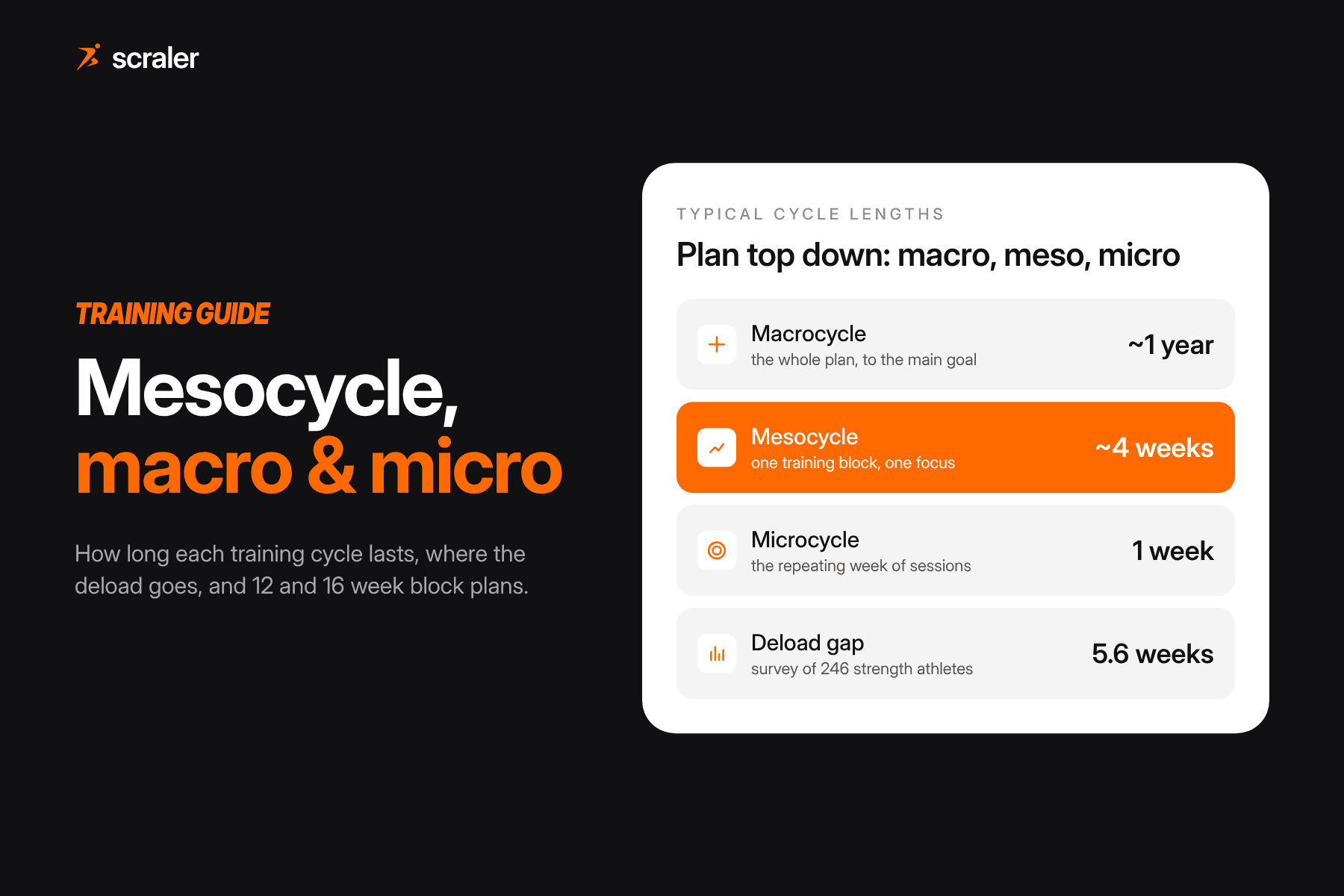
- Macrocycle = the whole plan, typically a year in sport or a 12 to 16 week program for a general client. Mesocycle = a block of about 2 to 6 weeks. Microcycle = usually one week.
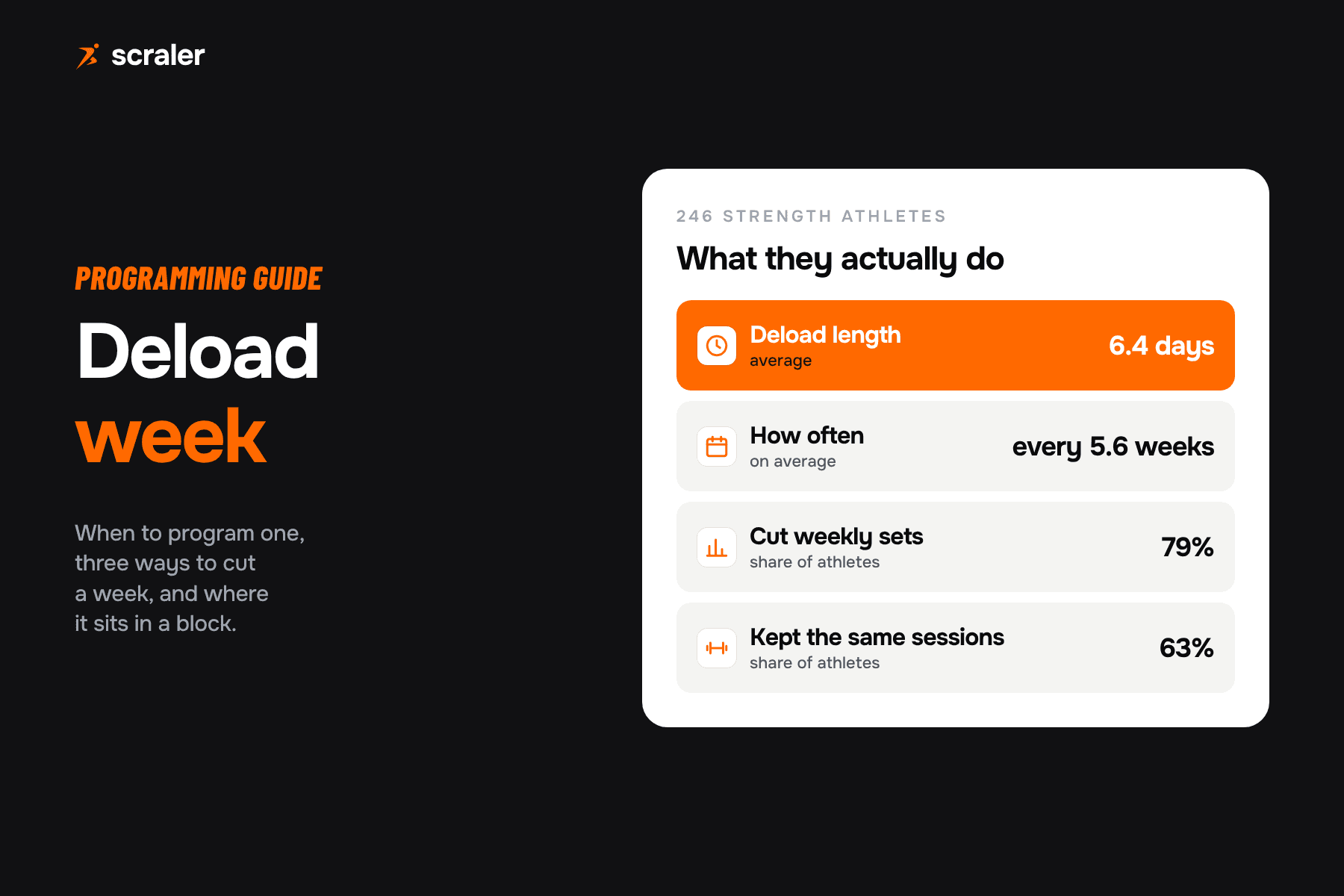
- A mesocycle of about 4 weeks fits the calendar and the deload data: surveyed strength athletes deloaded every 5.6 weeks on average.
- Put the deload in the last week of a mesocycle or between two mesocycles. Expert coaches agreed on both placements.
- For many clients, build one block as a template, prescribe by % 1RM or RPE so loads fit each client, and start clients in cohorts.
Most trainers already plan in blocks without naming them. "Four weeks of base work, then four weeks heavier, then a test" is a macrocycle split into mesocycles. The names matter because they force a decision at each level: what the whole plan is for, what this block is for, and what this week has to do. This guide covers the definitions, the typical lengths and where they come from, deload placement, two worked macrocycles and how to run blocks for a full client roster.
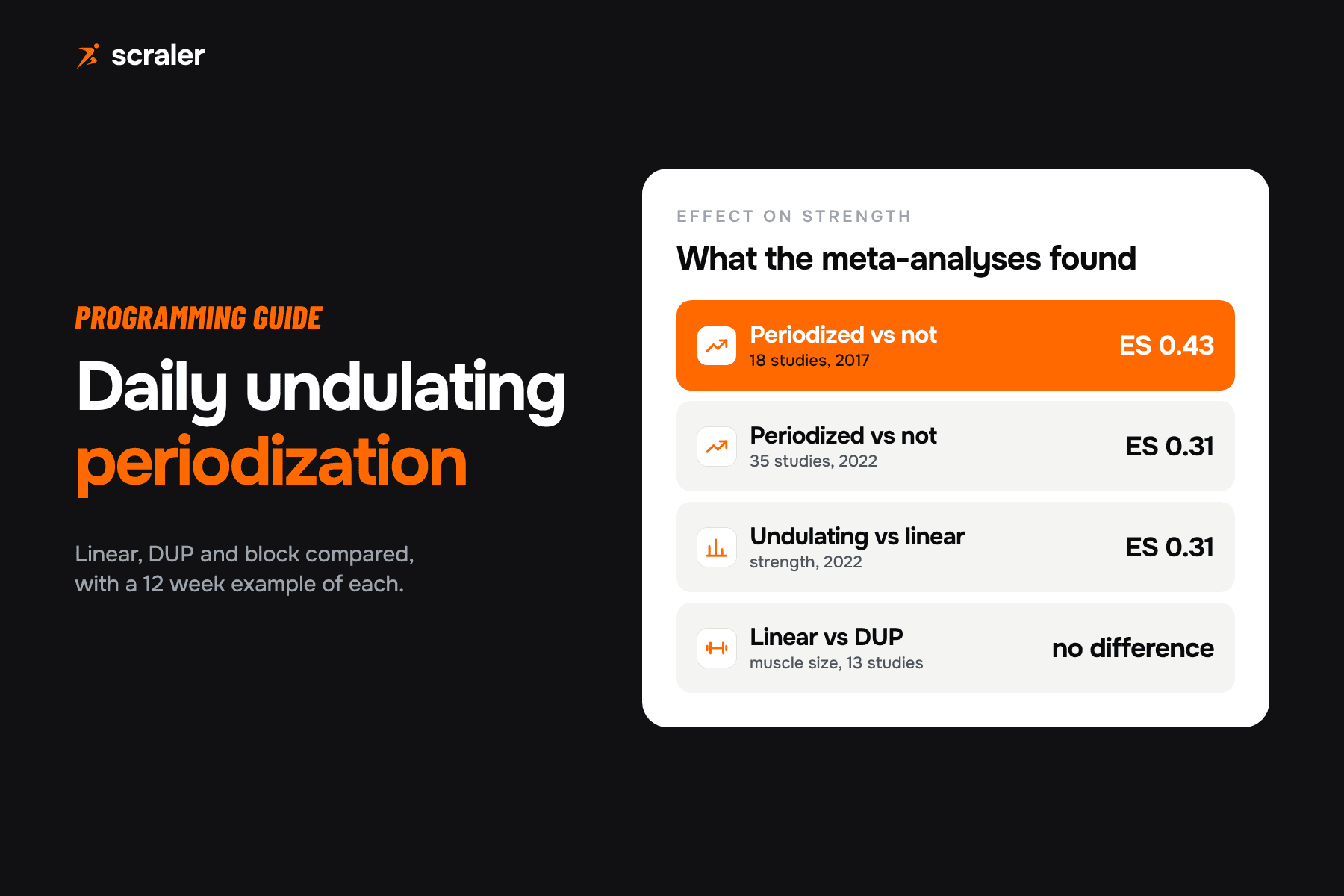
If you want the models themselves (linear, daily undulating and block periodization, with the meta-analysis results), read our periodization guide. This article is about the time frames those models are built on.
What are a mesocycle, macrocycle and microcycle?
Periodization is planned change in training over time. A 2017 meta-analysis describes it as organizing training "into sequential phases and cyclical time periods". Those time periods have three standard names.
- Macrocycle. The whole plan, from the starting point to the main goal. In sport that is usually a season or a year built around a competition. For a general client it is often one program of 12 to 16 weeks ending in a retest (our coaching practice).
- Mesocycle. A block of several weeks with one main focus, such as building volume, getting stronger in lower rep ranges, or peaking. It is the unit you progress across and then reset.
- Microcycle. The repeating short cycle inside a block, usually one week. It holds the sessions, the rest days and the split.
- Typical length
- Typically a year in sport; 12 to 16 weeks for a general client program
- Main question it answers
- Where does the client need to be, and by when?
- Example
- Squat 100 kg by the end of June
- Typical length
- Typically about a month; 2 to 6 weeks in block models
- Main question it answers
- What does this block build?
- Example
- 4 weeks of higher volume at RPE 7 to 9
- Typical length
- Typically a week
- Main question it answers
- Which sessions, in which order, this week?
- Example
- Full body Monday, Wednesday and Friday
| Cycle | Typical length | Main question it answers | Example |
|---|---|---|---|
| Macrocycle | Typically a year in sport; 12 to 16 weeks for a general client program | Where does the client need to be, and by when? | Squat 100 kg by the end of June |
| Mesocycle | Typically about a month; 2 to 6 weeks in block models | What does this block build? | 4 weeks of higher volume at RPE 7 to 9 |
| Microcycle | Typically a week | Which sessions, in which order, this week? | Full body Monday, Wednesday and Friday |
The typical lengths come from a review in the NSCA's Strength and Conditioning Journal by Anthony Turner (2011), which describes a macrocycle as typically a year, a mesocycle as typically a month and a microcycle as typically a week. "Typically" is doing real work in that sentence. The NSCA's Guide to Program Design shows an annual plan that holds two macrocycles, one with 5 mesocycles and one with 10, for an athlete with two competition peaks in a year. So a year can contain more than one macrocycle, and a mesocycle does not have to be four weeks.
How do the cycles nest inside each other?
Each level sits inside the one above. A 12 week macrocycle can hold three 4 week mesocycles, and each mesocycle holds four weekly microcycles. The plan is written top down: the NSCA program design text sets the order as annual plan first, then the focus and loading pattern of each mesocycle, then the microcycles, then the single sessions.
Working top down stops a common mistake: writing great individual weeks that do not add up to anything. If the macrocycle goal is a 5 km run and a stronger squat, every mesocycle needs a stated job toward that goal, and every week needs a job inside its block. When a week has no job, it usually repeats the week before.
How long is a mesocycle, and why?
There is no single correct length, but the sources cluster. Turner gives a month as typical. In block periodization, Vladimir Issurin defines blocks as short mesocycles of about 2 to 4 weeks with highly concentrated loads, as summarized in a 2019 meta-analysis. His 2008 review gives each block type its own length: accumulation is the longest, up to about six weeks, transmutation runs about 2 to 4 weeks and realization is the shortest, about 8 to 15 days.
- Focus
- Basic abilities: higher volume, general strength and work capacity
- Typical length
- Longest block, up to about 6 weeks
- Focus
- Turning that base into specific fitness: heavier or more specific, lower volume
- Typical length
- About 2 to 4 weeks
- Focus
- Peaking for a test or competition: low volume, high intensity, recovery
- Typical length
- About 8 to 15 days
| Block type (Issurin) | Focus | Typical length |
|---|---|---|
| Accumulation | Basic abilities: higher volume, general strength and work capacity | Longest block, up to about 6 weeks |
| Transmutation | Turning that base into specific fitness: heavier or more specific, lower volume | About 2 to 4 weeks |
| Realization | Peaking for a test or competition: low volume, high intensity, recovery | About 8 to 15 days |
Block periodization is a sport model, and its evidence is thin. The 2019 meta-analysis found small advantages for block over traditional organization in endurance athletes, but the included studies were small and scored 3.7 out of 10 on average for methodological quality. Use the lengths as a sensible range, not as proven optimums.
Why do most client blocks land on about four weeks? Three practical reasons, and the last two are our coaching practice:
- 1.It lines up with the deload data. In a survey of 246 competitive strength and physique athletes, deloads came every 5.6 weeks on average (2.3 weeks either way). Three or four hard weeks plus a deload lands in that range.
- 2.It gives enough repeats to progress. With each session repeated weekly, a 4 week block gives three or four exposures to the same lifts, enough to add load or reps a few times before fatigue builds up.
- 3.It fits billing and check-ins. A monthly block lines up with monthly packages, monthly progress photos and a monthly review call, so the client sees a clear start and end.
Shorten the block for clients who stall fast or get bored, and for peaking. Lengthen it, up to about six weeks, for beginners who are still adding load every session and do not need a reset yet.
Where does the deload go?
At the end of the mesocycle, or between two mesocycles. In a 2023 expert consensus on deloading, strength and physique coaches agreed a deload can sit in the last week of a mesocycle or at the start of the next one, and the paper describes regular, pre-planned deloading every 4 to 8 weeks as common practice. In the athlete survey, 67.9% started a new training block after their deload.
Our default for a 4 week mesocycle is three build weeks and one deload week. Weekly hard sets and effort rise for three weeks, then sets drop by about half and effort drops by about three reps in reserve. The chart shows the wave for one muscle group.
- Hard sets per muscle
- 12
- Target RPE
- 7
- Job of the week
- Settle into the block, find working weights
- Hard sets per muscle
- 14
- Target RPE
- 8
- Job of the week
- Add a set or a little load
- Hard sets per muscle
- 16
- Target RPE
- 9
- Job of the week
- Hardest week of the block
- Hard sets per muscle
- 8
- Target RPE
- 6
- Job of the week
- Half the sets of week 3, about three reps further from failure
| Week | Hard sets per muscle | Target RPE | Job of the week |
|---|---|---|---|
| 1 | 12 | 7 | Settle into the block, find working weights |
| 2 | 14 | 8 | Add a set or a little load |
| 3 | 16 | 9 | Hardest week of the block |
| 4 (deload) | 8 | 6 | Half the sets of week 3, about three reps further from failure |
RPE 9 leaves about one rep in reserve and RPE 6 about four, which is where "three reps further from failure" comes from; our RPE chart and RIR guide explain the scale. A planned deload is a slot, not an obligation. If a client arrives at week 4 fresh and still progressing, you can run a fourth build week and deload at the end of the next block. Our deload week guide covers the signs a client needs one, the three ways to deload and the one randomized trial on the topic.
Example: a 12 week macrocycle for a general client
The client: trains three times a week, wants to get stronger and fitter, has no competition date. The macrocycle runs 12 weeks and ends with a retest of the same lifts and a conditioning benchmark. Three mesocycles of four weeks each, every one with three build weeks and a deload. This is a worked example from our coaching practice; how to get from intake answers to a goal like this is in our needs analysis guide.
- Weeks
- 1 to 4
- Focus
- Technique, work capacity, baseline numbers
- Main lifts
- 3 x 10 to 12 at RPE 7 to 8
- Deload
- Week 4
- Weeks
- 5 to 8
- Focus
- More volume, slightly heavier
- Main lifts
- 4 x 8 to 10 at RPE 7 to 9
- Deload
- Week 8
- Weeks
- 9 to 12
- Focus
- Heavier, fewer reps, retest
- Main lifts
- 4 x 5 to 6 at RPE 8 to 9
- Deload
- Retest in week 12
The microcycle stays the same for all 12 weeks: full body on Monday, Wednesday and Friday, with a short conditioning finisher on two of the three days. Keeping the week stable while the block changes makes the plan easy to follow and the logs easy to compare. Week 12 replaces the deload with a lighter retest week: test a rep max on the main lifts with the one rep max calculator, repeat the conditioning benchmark, then plan the next macrocycle from the results.
Example: a 16 week macrocycle for a strength client
The client: an intermediate lifter who wants to test a squat, bench press and deadlift max, or compete in a first meet, in week 15. Here the macrocycle works back from the date, and the mesocycles follow the accumulation, transmutation (called intensification by most strength coaches) and realization order. Worked example, our coaching practice.
- Weeks
- 1 to 5
- Focus
- Volume and muscle, variations of the main lifts
- Main lifts
- 4 x 8 to 10 at RPE 7 to 8
- Deload
- Week 5
- Weeks
- 6 to 10
- Focus
- Heavier competition lifts, lower volume
- Main lifts
- 4 to 5 x 4 to 6 at RPE 8
- Deload
- Week 10
- Weeks
- 11 to 14
- Focus
- Heavy singles and doubles, then a taper
- Main lifts
- 3 to 5 x 1 to 3 at RPE 8 to 9; week 14 cuts volume about in half
- Deload
- Week 14 is the taper
- Weeks
- 15 to 16
- Focus
- Test day, then an easy week
- Main lifts
- Test in week 15, light training in week 16
- Deload
- Week 16
The first two blocks are five weeks (four build weeks and a deload) because an intermediate lifter usually tolerates a longer build than a beginner returning to training. The realization block is four weeks, longer than the 8 to 15 days in Issurin's review, because it holds the last heavy weeks as well as the taper. For an experienced lifter who peaks well, shorten it to about two weeks. The microcycle changes per block: four sessions a week in accumulation, three or four heavier sessions in intensification and realization. Our guides for a powerlifting coach and the strength and conditioning coach go deeper on meet preparation.
How do you plan training blocks for many clients at once?
Writing a fresh 12 week plan per client does not scale past a handful of clients. These rules are our coaching practice for a roster of 20 to 100 clients:
- 1.Template the mesocycle, not the client. Build each block once per goal and level, for example "Base, 3 days, beginner" and "Strength, 4 days, intermediate". Most clients fit one of six to ten blocks with small edits.
- 2.Prescribe by % 1RM or RPE, not fixed kilos. A template with "4 x 5 at 80%" or "4 x 5 at RPE 8" fits every client who has a tested or estimated max. Fixed kilos force you to edit every copy.
- 3.Start clients in cohorts. Start new blocks on the first Monday of each month, or every four weeks. Everyone deloads in the same week, and you review blocks in batches instead of every day.
- 4.Swap exercises, keep the structure. A client with a sore shoulder gets a different press in the same slot with the same sets and RPE. The block stays intact.
- 5.Let the check-in decide the deload. Plan the deload slot in every block, then use the weekly check-in and the workout log to decide whether a client takes it, delays it or needs one early.
- 6.Review at the block boundary. Week 4 is when you compare the logs with the block goal and choose the next block. That is one structured review per client per month instead of constant ad hoc changes.
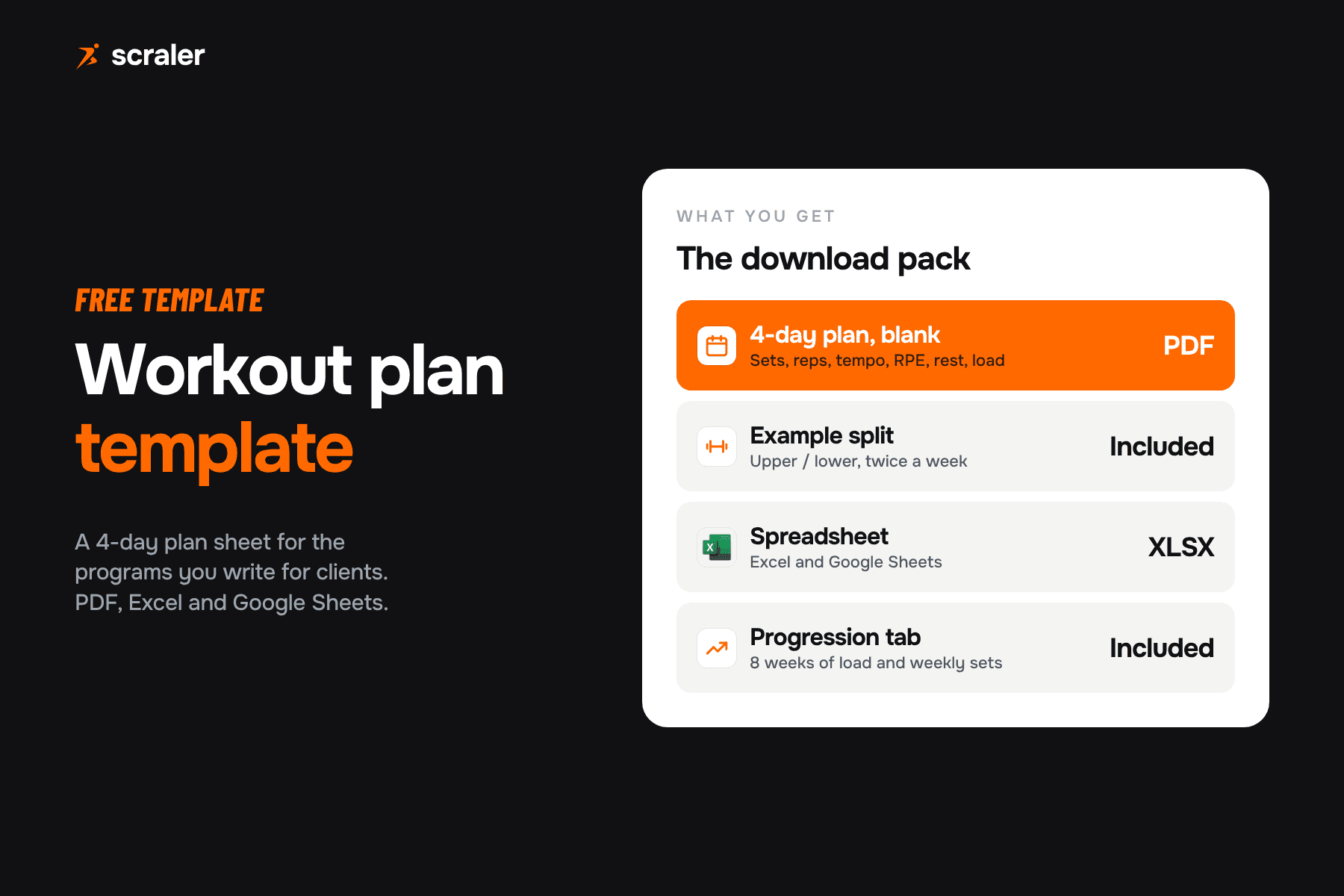
The workout plan template shows how to lay out a multi-week block on a sheet, and the workout split guide helps choose the microcycle for each training frequency.
How do you build training blocks in Scraler?
Scraler has no separate "mesocycle" object, so we will not pretend it does. A training plan in Scraler is a number of weeks, and you build blocks with that. The Calendar layout shows a Monday to Sunday grid with one row per week, and you add weeks with the Add week button, so a 4 week mesocycle is a 4 week plan and a 12 week macrocycle is a 12 week plan or three 4 week plans. You can copy a workout or a day and paste it into another week. The Fixed layout is a rotation of named days without dates, which suits clients who do not train on fixed weekdays.
Each set can carry Reps, % 1RM, KG, RPE and Rest, so one template works across clients. The AI Coach in the builder can also restructure a plan on request: add a deload week after a given week with lower volume, intensity or both, duplicate a week, add a weekly progression, apply a linear, wave or step pattern to % 1RM, reps, sets or RPE across a range of weeks, or taper the final weeks. Every change lands in the builder for you to check. AI Coach is a Plus feature with a monthly allowance and unlimited on Premium.
When you assign a plan you pick the client and a start date, and multi-week plans start on a Monday. Several plans can run side by side in a client's calendar, for example a strength block and a separate conditioning plan. On Ultimate, automations add two pieces for rosters: a Training Plan Completed trigger that can assign the next block with an Assign Training Plan action, and workflows, which schedule actions such as assigning a training plan on set days from a start date. You can tick a group of clients and assign one workflow to all of them, which is the cohort start from the list above.
Build multi-week plans in the Scraler training plan builder, prescribe by % 1RM or RPE, add deload weeks and assign each block with its own start date.
See workout planningComparing tools first? What to look for in workout builder software lists the features that matter for multi-week plans, and AI for personal trainers covers what to check in an AI-edited plan.
Frequently asked questions
- What is a mesocycle?
- A mesocycle is a training block of several weeks, usually about four, with one main focus such as volume, strength or peaking. It sits inside a macrocycle and is made of weekly microcycles. Many coaches end each mesocycle with a deload week.
- How long is a mesocycle?
- Typically about a month. In block periodization, the length depends on the block type: in Issurin's model accumulation is the longest block (up to about 6 weeks), transmutation runs about 2 to 4 weeks and realization about 8 to 15 days. For most clients, 3 to 5 weeks including a deload works well (our coaching practice).
- What is a macrocycle?
- A macrocycle is the whole training plan from the starting point to the main goal. In sport it is usually a season or a year built around a competition. For a general client it is often a 12 to 16 week program ending in a retest.
- What is a microcycle?
- A microcycle is the short repeating cycle inside a training block, usually one week. It sets which sessions happen on which days, the split and the rest days.
- What is the difference between a training block and a mesocycle?
- In everyday coaching they mean the same thing: a few weeks with one focus. In block periodization, a block is a mesocycle with highly concentrated loads on a few abilities, usually 2 to 4 weeks long.
- Where should the deload go in a mesocycle?
- In the last week of the mesocycle or between two mesocycles, the two placements coaches agreed on in a 2023 expert consensus. A common setup is three or four build weeks followed by one deload week.
- How many mesocycles are in a macrocycle?
- It depends on the length of the plan. A 12 week program usually holds three 4 week mesocycles. In the NSCA program design example, a year holds two macrocycles with 5 and 10 mesocycles.
Keep reading