Fitness Technology: What a Gym, Studio or Trainer Actually Needs (and What Is Hype)
Technology in fitness is the software and devices a gym, studio or personal trainer uses to run the business and coach clients. Most need four things: coaching and client management software, booking with payments, a way to check members in, and a client app that reads wearable data. Smart equipment and AI are extras to buy for a clear job.

- Start with software, not hardware: client management, programming, booking and payments do the most work per dollar.
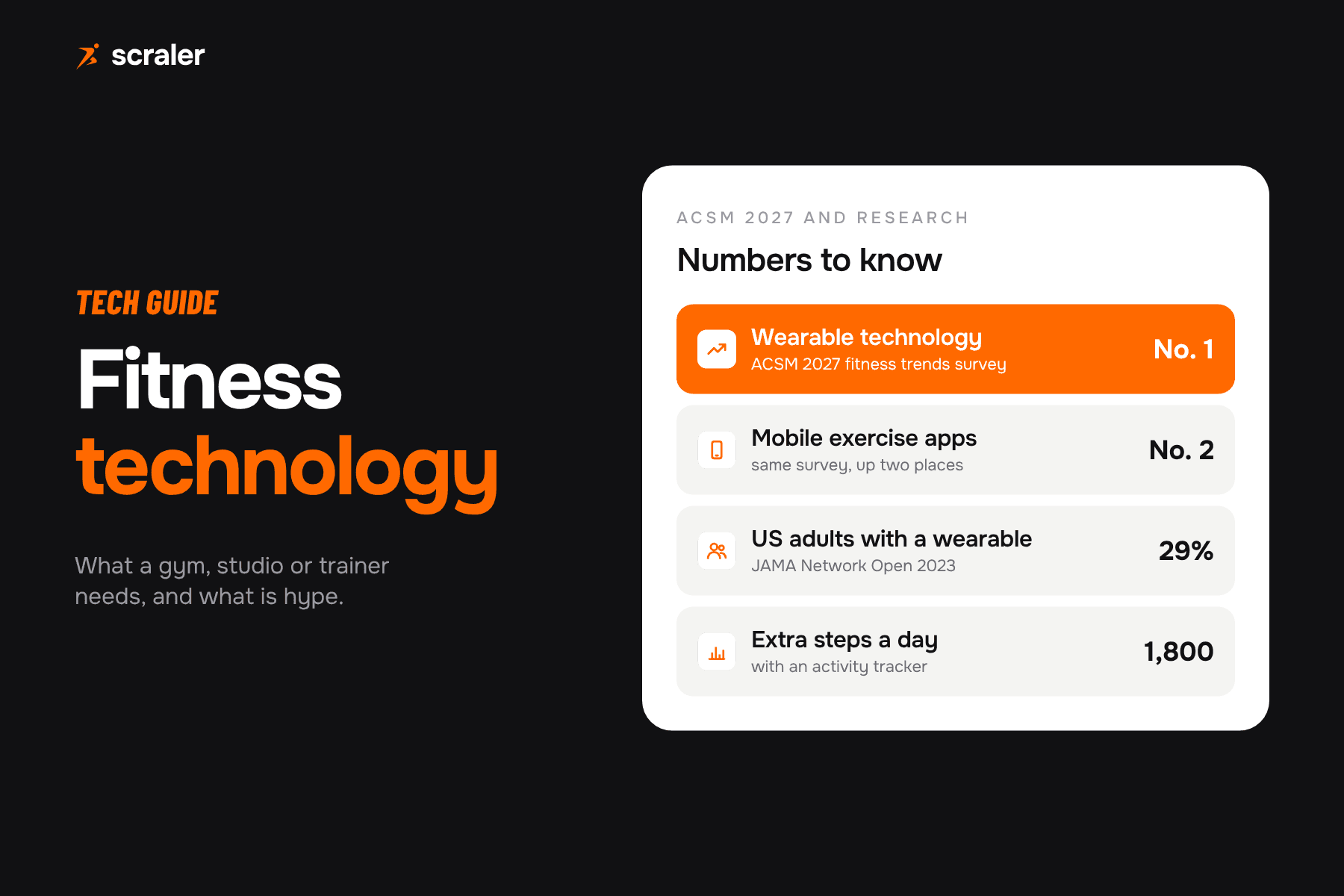
- Wearable technology is the No. 1 trend in the ACSM 2027 survey, and an estimated 29% of US adults already use one, so read your clients' data instead of selling them a device.
- Trust wrist heart rate, not wrist calories: in one lab study heart rate error was 2% to 6.8%, while calorie error was 27% to 93%.
- Access control matters for open gyms, not for a trainer with booked sessions. Smart equipment and AI only pay off with a clear job and a coach in the loop.
This guide is for owners: a personal trainer working alone, a studio with a few coaches, or a gym with a front desk. It sorts fitness technology by the job it does for the business, shows what the research says about wearables, and gives a buying order. Scraler is our own product; we say where it fits and where it does not.
What is technology in fitness?
Fitness and technology meet in two places. One is the business: the software that holds client records, writes programs, takes bookings, collects payments and lets members in. The other is the client: the watch, the app and the connected machine they train with. Technology fitness buyers often mix the two up and buy client gadgets before the business runs smoothly. The table below sorts the main categories by who uses them and who needs them.
- What it does
- Client profiles, programs, nutrition, check-ins, chat
- Who needs it
- Every trainer, studio and gym with coaching
- Our verdict
- Need
- What it does
- Appointment types, class timetable, subscriptions, invoices
- Who needs it
- Anyone who sells sessions or memberships
- Our verdict
- Need
- What it does
- Door entry, QR or card check-in, attendance
- Who needs it
- Gyms with open hours; studios with a front desk
- Our verdict
- Need for gyms, skip for 1:1 trainers
- What it does
- Steps, sleep, heart rate, workouts from the client's device
- Who needs it
- Coaches who want data between sessions
- Our verdict
- Need the integration, not the device
- What it does
- Client app with workouts, logging and a video library
- Who needs it
- Online and hybrid coaches, studios
- Our verdict
- Need for online, nice to have in person
- What it does
- Drafts plans, meal plans and replies for the coach to review
- Who needs it
- Coaches with many clients
- Our verdict
- Nice to have, with review
- What it does
- Connected cardio and strength machines that log sets
- Who needs it
- Larger gyms with budget and floor space
- Our verdict
- Mostly hype for small businesses
| Category | What it does | Who needs it | Our verdict |
|---|---|---|---|
| Client management and coaching software | Client profiles, programs, nutrition, check-ins, chat | Every trainer, studio and gym with coaching | Need |
| Booking and payments | Appointment types, class timetable, subscriptions, invoices | Anyone who sells sessions or memberships | Need |
| Access control and check-in | Door entry, QR or card check-in, attendance | Gyms with open hours; studios with a front desk | Need for gyms, skip for 1:1 trainers |
| Wearables and heart rate | Steps, sleep, heart rate, workouts from the client's device | Coaches who want data between sessions | Need the integration, not the device |
| Mobile app and on-demand | Client app with workouts, logging and a video library | Online and hybrid coaches, studios | Need for online, nice to have in person |
| AI programming | Drafts plans, meal plans and replies for the coach to review | Coaches with many clients | Nice to have, with review |
| Smart equipment | Connected cardio and strength machines that log sets | Larger gyms with budget and floor space | Mostly hype for small businesses |
The verdict column is our advice, not survey data. For a deeper look at the first row, see our guides to personal trainer software and personal trainer CRM.
What is the best fitness technology for a gym, studio or trainer?
The best fitness technology is the one that removes the work you do every week. For most owners that is admin: messages about times, chasing payments, rebuilding the same program in a spreadsheet. Buy in this order and stop when the next item does not solve a real problem.
- 1Client management and coaching
One record per client: programs, nutrition, check-ins, notes and chat.
- 2Booking and payments
Clients book a slot or class and pay by subscription, without you in the middle.
- 3Client app with wearable sync
Clients log workouts and share steps, sleep and heart data from their own device.
- 4Check-in or access control
Only when members train without you there.
- 5AI, on-demand and smart equipment
Add when a specific job (more clients, more content, more floor data) justifies the cost.
Personal trainers
A trainer working 1:1 or online needs the first three steps and little else. Programs, nutrition, check-ins and payments in one app cover most of the job. Our comparison of online coaching platforms lists what each tool includes and costs.
Studios and gyms
A studio adds a class timetable, staff logins and often check-in. A gym with open hours adds door access, which is usually its own system. See fitness studio software for studio tools priced side by side, and gym management software for membership and access systems.
How should trainers use wearable technology in fitness?
Wearable technology is the clearest trend in fitness and technology. In the ACSM 2027 Worldwide Fitness Trends survey, wearable technology ranked No. 1 for the 10th time since it entered the list in 2016, and it was the only trend in the top three for every professional role and work setting. The survey asks fitness professionals how widely they see a trend, so it measures adoption in the industry, not health benefit.
Your clients already own the devices. A study of US national survey data in JAMA Network Open estimated that 29% of US adults used a wearable device in 2019 to 2020, and 49% of users wore it every day. Most users with or at risk of heart disease, about 81% to 83%, were willing to share the data with their clinician. That is the opening for a coach: ask clients to share, then use it.
Do trackers change behaviour? An umbrella review in The Lancet Digital Health pooled 39 systematic reviews with 163,992 participants. Activity trackers added about 1,800 steps and 40 minutes of walking a day, and body weight fell about 1 kg. Effects on blood pressure, cholesterol and quality of life were small and often not significant. So a tracker helps clients move more; it does not replace a program.
What fitness wearable technology data can you trust?
Not all numbers are equal. In a Stanford lab study of 60 adults and seven wrist-worn devices, heart rate error ranged from 2% (Apple Watch) to 6.8% (Samsung Gear S2). Calorie estimates were far worse: median error from 27.4% to 92.6%, and no device got below 20%.
- Daily steps and the weekly trend
- Heart rate during steady cardio
- Resting heart rate trend over weeks
- Sleep duration as a rough guide
- Logged workouts and their duration
- Calories burned per workout
- Calorie targets built on watch burn
- Single-night sleep stage scores
- One-off readings without a trend
- Comparing numbers across brands
In practice: set step targets from each client's own baseline, train cardio in heart rate zones (our heart rate zone calculator gives the ranges), and build nutrition targets from body weight and goals, not from the watch's calorie count.
In Scraler, clients connect Apple Health on iPhone or Health Connect on Android in the client app and choose what to share: steps, sleep, heart data, weight and calories. Workouts such as a ride or a run show up as activities on the client's profile, next to the program you wrote. Nutrition and wearable tracking come with the Plus plan.
Is smart fitness equipment technology worth it?
Connected machines log sets, reps and cardio data automatically and can offer guided sessions on a screen. For a large gym that sells a premium floor, that can be part of the brand. For a trainer or a small studio, technology fitness equipment is mostly hype: it is expensive, it only records what happens on that machine, and a client's phone already logs the session. A barbell and a workout log in an app cover what most coaching needs.
Which booking, payment and check-in technology do you need?
Booking and payments are where software saves the most hours. Clients pick a free slot, recurring classes fill the timetable, and subscriptions bill themselves. Our guide to personal trainer scheduling software compares the options. In Scraler, scheduling handles appointment types, weekly availability and recurring classes, and the finance manager connects Stripe for payment requests, recurring client subscriptions and product sales (payments come with Premium).
Access control is a different job. A gym that is open while staff are away needs door entry and member check-in, usually a dedicated system with hardware. Scraler has no door access or point of sale, so a gym that needs them should pair a coaching platform with an access system, or pick a gym management suite.
Is AI programming useful, or hype?
AI is useful as a first draft and risky as the coach. It can turn a short brief into a training plan or meal plan in seconds, which saves time when you have many clients. It does not know the client's injury history unless you tell it, and it can get exercise choice or volume wrong. The rule is simple: the AI drafts, the coach reviews and edits, the client sees the coach's version.
In Scraler, AI training plans, workouts and meal plans are generated inside the workout planning and meal plan builders, then edited like any other plan. Premium includes unlimited generations and Plus includes 5 a month. Our guide to AI for personal trainers compares the AI tools in coaching apps and how to use them safely.
Do you need a client app and on-demand workouts?
Mobile exercise apps climbed two places to No. 2 in the ACSM 2027 survey, which describes them as making fitness more accessible through on-demand workouts and virtual instruction. For an online or hybrid coach, the app is the product: it is where the client trains, logs and talks to you. For an in-person studio, an app with a short on-demand library keeps clients training on the weeks they cannot come in.
Every paid Scraler plan includes iOS and Android client apps. With on-demand, available from Premium, you curate collections of standalone workouts with your own covers and demo videos. On Ultimate, the app can be published under your own brand.
Scraler puts each client's program, nutrition, check-ins and Apple Health or Health Connect data on one profile, with booking and Stripe payments next to it.
See client managementWhat fitness technology mistakes should owners avoid?
- Buying hardware first. A smart machine does not fix missed bookings or late payments. Software does.
- Running five tools that do not talk. A booking tool, a payment link, a spreadsheet and a chat app mean copying data by hand. One platform, or tools that integrate, saves the time; our fitness business software guide maps which tool covers which job.
- Coaching from watch calories. Use heart rate and steps; set energy targets from body weight and goals.
- Letting AI write unchecked plans. Review every draft before a client sees it.
- Ignoring data the client already has. If a client wears a watch, ask them to share it. It costs nothing and shows what happens between sessions.
Frequently asked questions
- What is technology in fitness?
- It is the software and devices used to run a fitness business and coach clients: client management and coaching software, booking and payments, access control, wearables, client apps, AI tools and connected equipment.
- What is the best fitness technology for a personal trainer?
- A coaching platform that holds programs, nutrition, check-ins, chat and payments, with a client app that syncs wearable data. Most trainers need little hardware beyond what clients already wear.
- Is wearable technology the top fitness trend?
- Yes. Wearable technology ranked No. 1 in the ACSM 2027 Worldwide Fitness Trends survey, the 10th time since it entered the survey in 2016. Since 2016 it has ranked first every year except 2018 (No. 3) and 2021 (No. 2).
- How accurate is fitness wearable technology?
- Heart rate is fairly accurate: in a Stanford lab study, wrist devices were off by 2% to 6.8%. Calories burned were not: median errors ran from 27% to 93%, and no device was below 20%.
- Do fitness trackers make people more active?
- An umbrella review of 39 systematic reviews found activity trackers added about 1,800 steps and 40 minutes of walking a day and about 1 kg of weight loss. Effects on blood pressure and cholesterol were small.
- Is technology fitness equipment worth buying for a small studio?
- Usually not. Connected machines are expensive and only record what happens on them. A coaching app with workout logging and wearable sync gives a small studio most of the same data.
- Do I need access control for my fitness business?
- Only if members train without staff present, as in an open gym. A personal trainer with booked sessions does not need door entry. Access systems are usually separate hardware from coaching software.
- Can AI write training programs for my clients?
- It can draft them. Treat the result as a first version: check exercise choice, volume and the client's history, then edit before the client sees it.