Personal Training Client Retention: How to Keep Clients Longer (2026)
Client retention in personal training is the share of clients who stay with you from one period to the next. Most clients do not quit over one bad session; they drift when progress stalls, the plan stops fitting their life or nobody notices they went quiet. The fix is a planned first 90 days, regular check-ins, visible progress and a quick response to inactivity.

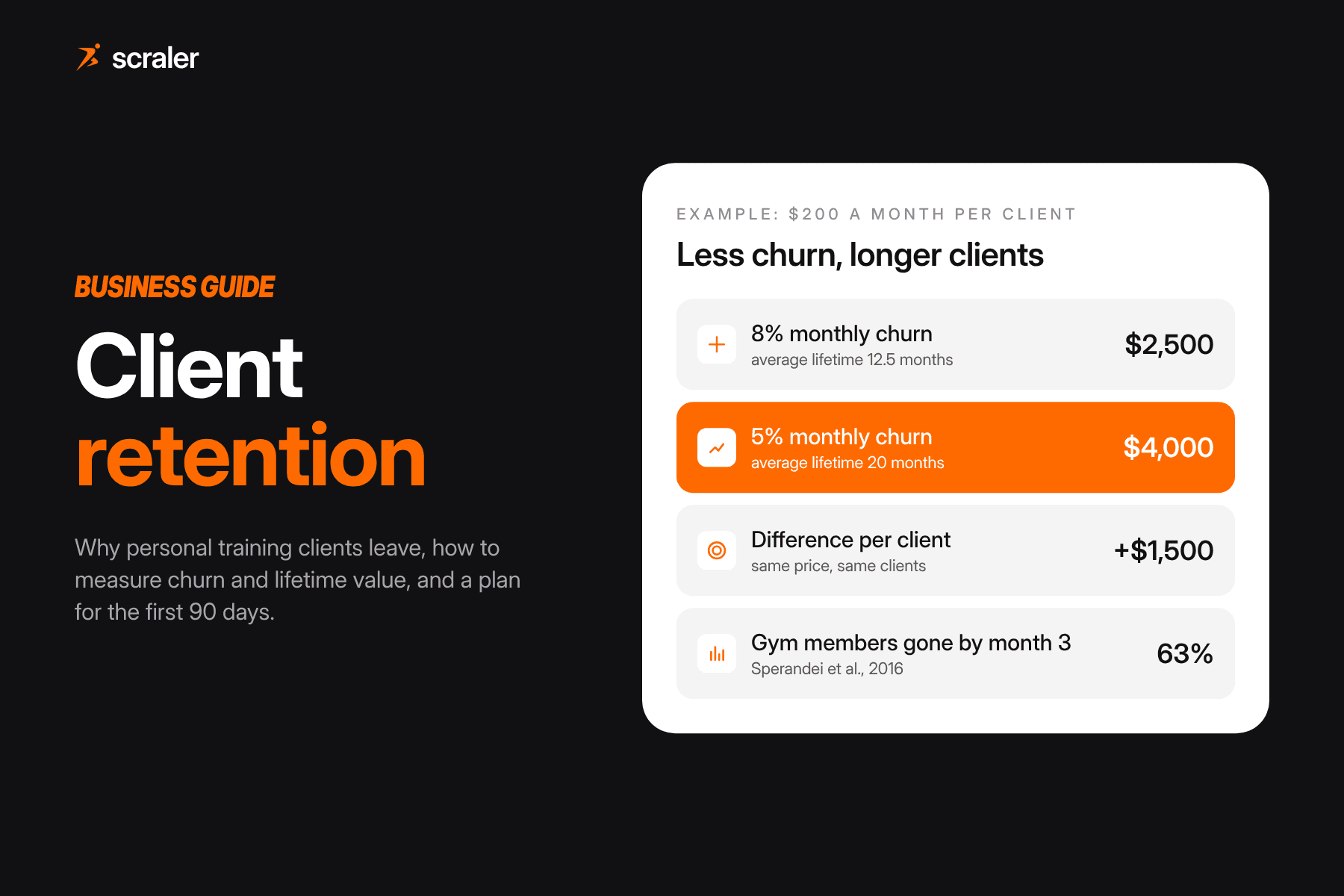
- Exercise dropout is the norm, not the exception: supervised programs typically lose about half their participants, and in one gym study 63% of new members quit before month three.
- Track three numbers: monthly retention rate, monthly churn and average client lifetime. Lifetime is roughly 1 divided by monthly churn, and lifetime value is monthly revenue per client times lifetime.
- In our example, cutting churn from 8% to 5% a month takes a $200 client from $2,500 to $4,000 of lifetime value without a price rise.
- The first 90 days decide most of it. Plan a touchpoint every week, a progress review at week 4 and a goal reset before day 90.
- Clients who exercise because they value it and enjoy it keep going longer. Give choices, explain the why and make progress visible.
What is client retention in personal training?
Client retention is how many of your clients keep paying and training with you over time. A trainer with 30 clients who keeps 28 of them each month has a very different business from one who keeps 24, even if both sign the same number of new clients. The first trainer grows; the second runs to stand still.
Retention is also the cheapest growth lever you have. Every client who stays one more month is revenue you did not have to win through ads, discovery calls or free sessions. This guide covers why clients leave, how to measure retention, and what to do in the first 90 days, at every check-in and when a client goes quiet. It does not repeat our guides on client onboarding software or check-in forms; it links to them where they fit.
Why do personal training clients leave?
Start with the base rate. Dropping out of exercise is common even with supervision. In a 1986 review, Rod Dishman wrote that supervised exercise programs typically show dropout rates of about 50%. Without supervision it is worse: a 2016 study of 5,240 members of a fitness center in Rio de Janeiro found that 63% quit before their third month and fewer than 4% kept training for more than 12 months. Those were gym members training on their own, not personal training clients, but they show where people fall off: early.
Motivation explains part of it. A 2012 systematic review by Teixeira and colleagues looked at 66 studies on self-determination theory and exercise. It found consistent support for a link between more autonomous motivation (exercising because you value it or enjoy it, not because you feel pushed) and exercise. Valuing the outcome predicted starting and short-term adherence more strongly, while enjoying the activity itself predicted long-term adherence. A client who trains only because a doctor, partner or wedding date told them to is a retention risk once that pressure fades.
In our coaching practice, the reasons clients give when they leave fall into six groups:
- What it sounds like
- "It is not really working"
- What usually sits underneath
- Results are happening but nobody showed them, or the goal was never measurable
- What it sounds like
- "Work is crazy right now"
- What usually sits underneath
- The plan only fit a perfect week, with no minimum version for busy weeks
- What it sounds like
- "I need to cut costs"
- What usually sits underneath
- The client no longer sees enough value for the price, or the package ended with no next step
- What it sounds like
- "I think I can do it alone now"
- What usually sits underneath
- Nobody set a new goal after the first one
- What it sounds like
- Silence, then a cancellation
- What usually sits underneath
- Missed workouts and unanswered check-ins went unnoticed for weeks
- What it sounds like
- "It is just not for me"
- What usually sits underneath
- Wrong program, wrong format or wrong coach for this person
| Reason | What it sounds like | What usually sits underneath |
|---|---|---|
| No visible progress | "It is not really working" | Results are happening but nobody showed them, or the goal was never measurable |
| Life changed | "Work is crazy right now" | The plan only fit a perfect week, with no minimum version for busy weeks |
| Money | "I need to cut costs" | The client no longer sees enough value for the price, or the package ended with no next step |
| Goal reached or forgotten | "I think I can do it alone now" | Nobody set a new goal after the first one |
| Felt unseen | Silence, then a cancellation | Missed workouts and unanswered check-ins went unnoticed for weeks |
| Bad fit | "It is just not for me" | Wrong program, wrong format or wrong coach for this person |
Only the last group is hard to fix. The other five are mostly about attention and structure, which you control.
How do you measure client retention?
Measure monthly. Weekly numbers are too noisy for a small client list, and yearly numbers come too late to act on. You need four formulas:
- Retention rate = (clients at end of month minus new clients that month) divided by clients at start of month, times 100.
- Churn rate = clients lost during the month divided by clients at start of month, times 100. Retention plus churn is 100%.
- Average client lifetime (in months) is roughly 1 divided by monthly churn. At 10% churn, the average client stays about 10 months.
- Lifetime value (LTV) = average monthly revenue per client times average client lifetime. This is revenue, not profit; subtract your costs per client if you want margin.
A worked example, with example numbers, not data from any real business. You start the month with 50 clients, sign 6 new ones and end with 52. Clients retained: 52 minus 6 = 46. Retention rate: 46 divided by 50 = 92%. Churn: 4 lost out of 50 = 8%.
- Monthly churn
- 8%
- Average client lifetime
- 1 / 0.08 = 12.5 months
- Revenue per client
- $200 a month
- Lifetime value
- $200 x 12.5 = $2,500
- Monthly churn
- 5%
- Average client lifetime
- 1 / 0.05 = 20 months
- Revenue per client
- $200 a month
- Lifetime value
- $200 x 20 = $4,000
The 1 divided by churn shortcut assumes churn stays roughly steady from month to month. In real coaching it does not: churn is highest in the first three months and lower for clients who have been with you a year. So also track churn by tenure: how many clients who started in a given month are still with you after 1, 3, 6 and 12 months. If most of your losses happen before month three, the first 90 days are where to work. Our personal trainer income calculator shows what that extra lifetime means for yearly income.
What should happen in the first 90 days?
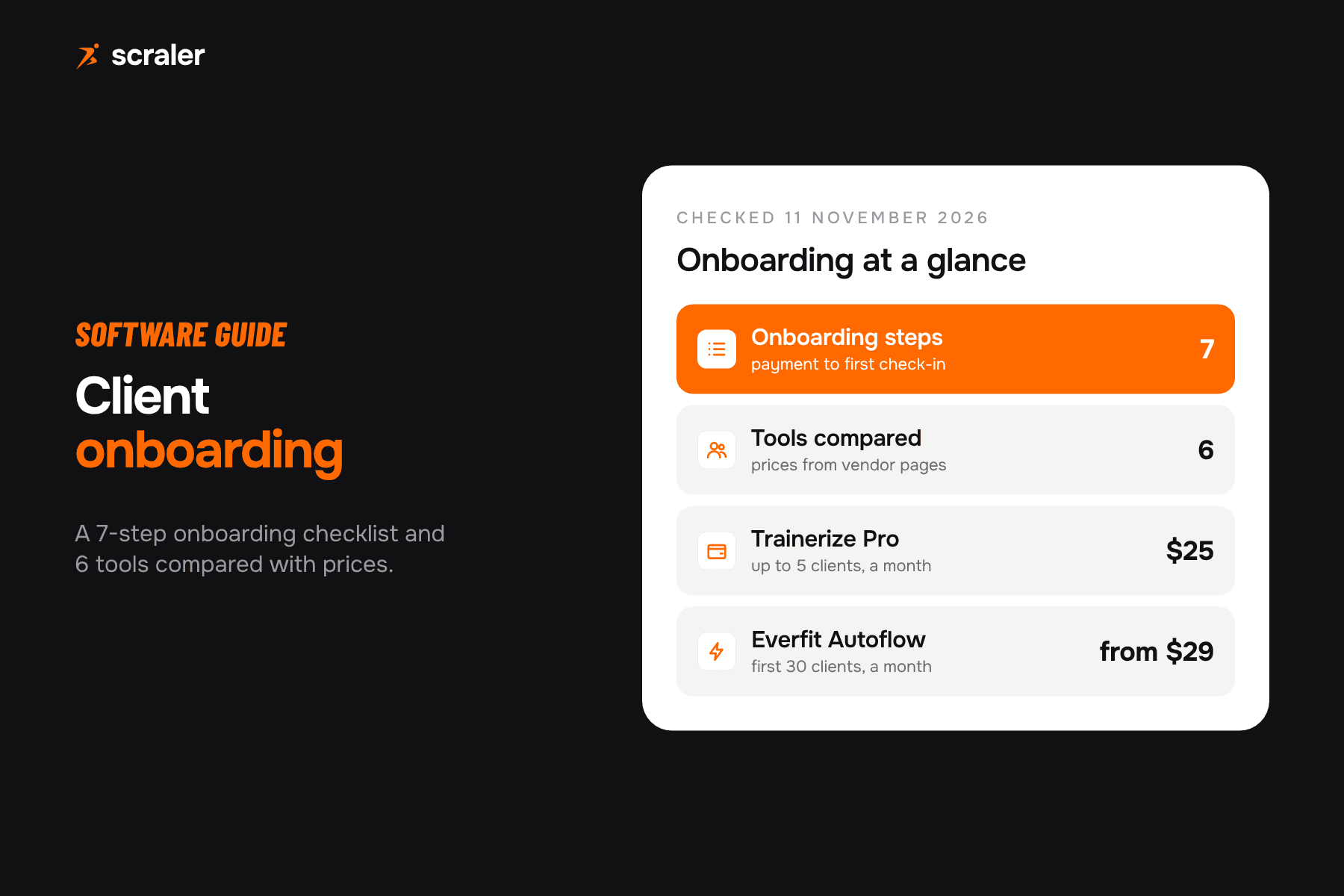
The first 90 days are when a client decides whether training with you is part of their life or a phase. Onboarding (intake, health screening, first program) is covered in our client onboarding guide and intake form template. Retention starts the day after. This touchpoint plan is our own coaching practice:
- 1.Day 1: first workout and a message after it. Ask one question: how did it feel? A reply tells you the client is engaged; silence on day 1 is already a signal.
- 2.Day 3: a short check. Soreness, schedule, anything confusing in the app. Fix friction while it is small.
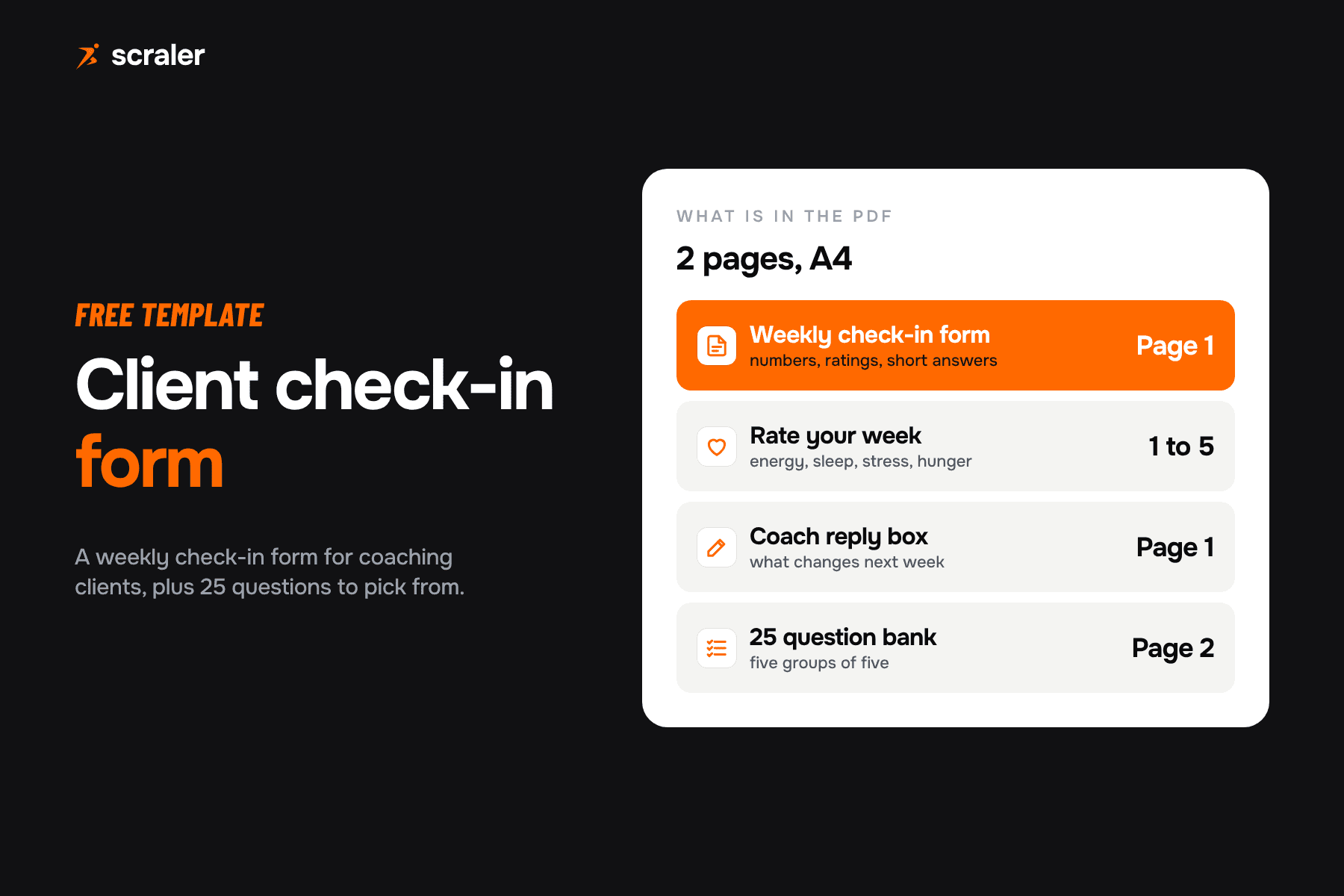
- 3.Week 1: first weekly check-in. Use the same form every week from now on, so answers can be compared. Our check-in form template has the questions.
- 4.Week 2: fit the plan to the real week. By now you know which sessions they skip. Move or shorten them instead of hoping the client changes their life.
- 5.Week 4: first progress review. Photos, measurements, training numbers and a short summary in writing. Show change the client may not have noticed. See how to take progress photos and our body measurement chart.
- 6.Week 8: second review and one win. Pick one concrete improvement, such as 10 kg more on the deadlift or three weeks without a missed session, and name it.
- 7.Day 75 to 90: goal reset. Before the first 12 week program ends, agree on the next goal and the next 12 weeks. A client who knows what comes next does not have to decide whether to continue.
How do check-ins keep clients longer?
A check-in is the regular moment where the client reports and you respond. Its retention value is not the form; it is the reply. A client who fills in a check-in and gets a generic "great work!" learns that nobody reads it. These rules are our own coaching practice:
- Same day every week. A fixed rhythm is easier to keep than a check-in "whenever".
- Short form. Questions the client can answer in a few minutes; our check-in template suggests 8 to 12. Long forms get skipped.
- Reply within 24 to 48 hours with one thing they did well, one change for next week and one question. Personal beats long.
- Watch for the pattern, not the answer. Shorter answers, later submissions and lower ratings across two or three weeks predict a cancellation better than any single bad week.
- Change something visible. If a client reports poor sleep three weeks running, adjust the plan and say you did. Feedback that leads to nothing stops coming.
Weekly works for most online and hybrid clients. Clients you see in person twice a week may only need a short monthly review, because you already talk every session.
How does progress tracking help retention?
"I am not seeing results" is often a measurement problem. Fat loss slows, strength gains get smaller after the first months, and the mirror changes too slowly to notice day to day. If the only measure is the scale, a flat month feels like failure even when the client is stronger and leaner.
- Track several outcomes. Body weight trend, waist and other measurements, photos, training loads or reps, steps, sleep and how clothes fit. Something is usually improving.
- Track behavior, not only outcomes. Sessions completed, weeks in a row with all workouts done, days with the protein target hit. Clients control behavior; outcomes lag.
- Show the comparison. Put week 1 next to week 12. A side by side review works better than "you are doing great".
- Use performance markers. Retesting the same workout every 4 to 8 weeks, like the AMRAP retest, gives a number that goes up when the scale does not.
When should you reset a client's goals?
Reset goals at three moments: when a goal is reached, when a goal stops mattering, and at the end of every program (about every 12 weeks in our practice). Clients who hit their goal and get no new one are among the easiest to lose, because from their side the job is done.
A goal reset is a short conversation, not a new intake. Ask what changed since you started, what they are proud of, what they want next and what would make the next 12 weeks feel worth it. Then write the new goal down with one outcome (for example, a 5 km run under 30 minutes) and one behavior (three runs a week), and rerun the needs analysis so the next program fits the new goal. The Teixeira review suggests why the second part matters: goals the client chose and values hold up better than goals set for them.
How does habit coaching improve retention?
Training two or three hours a week is not enough to change most clients' results. The other 165 hours, sleep, steps, food and stress, decide a lot of it. Coaching one or two habits at a time gives clients a daily win, gives you something to talk about between sessions and makes progress less dependent on the scale.
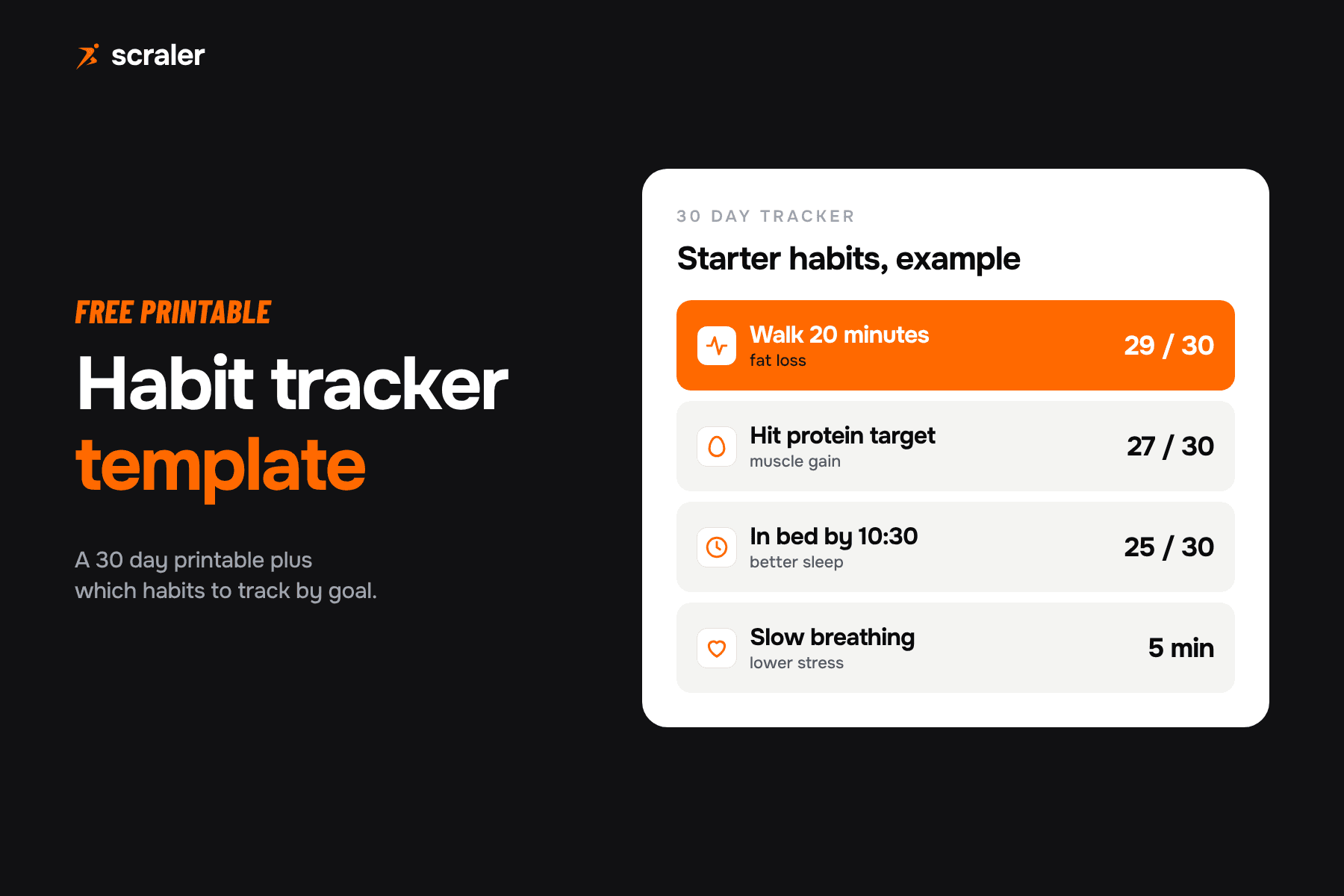
Keep the habits small and few. In a 2010 study by Lally and colleagues, it took a median of 66 days for a new daily behavior to feel automatic, with a wide range between people (18 to 254 days, the upper end a projection). So a habit needs months, not a 21 day challenge. Our habit tracker template covers how to choose, track and review habits, so we will not repeat it here.
Does community help clients stay?
Social support helps people stick with behavior change. In a 1999 trial by Wing and Jeffery, 95% of weight loss participants who joined with friends and got social support strategies completed treatment, and 66% kept their weight loss in full over the following six months. Among those who joined alone with the standard program, 76% completed and 24% kept their weight loss. Participants chose whether to join with friends, so this is not proof for every setting, but the direction is clear.
For a personal trainer, community can be small: a client group chat, a monthly group session for one to one clients, a shared challenge, or clients who train with a partner. A group challenge with a simple leaderboard of days completed gives clients a reason to log in on days without a session. Keep it opt in, keep it positive and never share anyone's weight or photos without consent.
How do pricing and commitment structures affect retention?
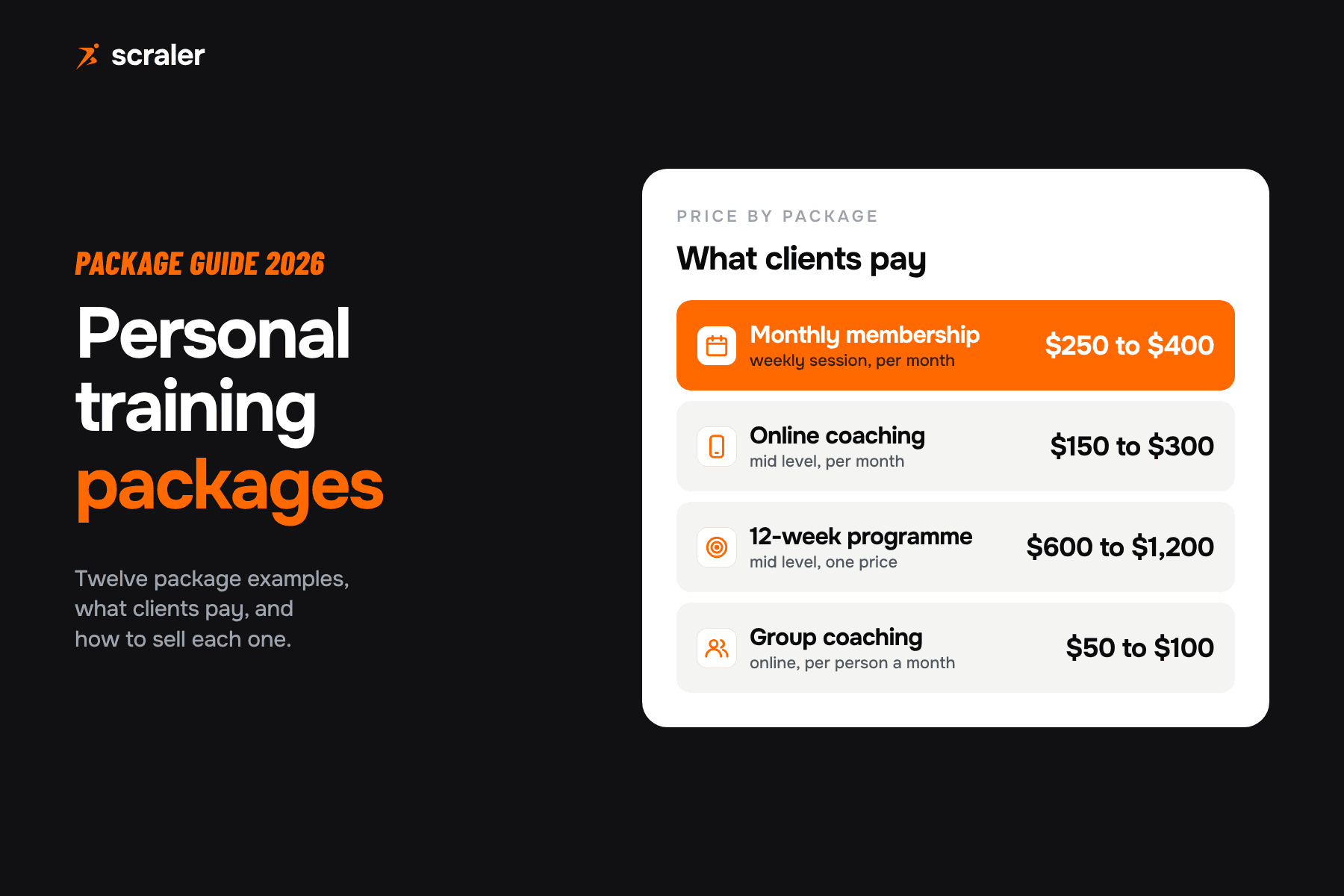
How you sell coaching sets the moments where a client has to decide to continue. Every package end is a natural exit. These structures are our coaching practice; the package details are in our personal training packages guide.
- Retention effect
- Each pack end is a decision point; clients often stop "for now"
- Watch out for
- Book the renewal talk two sessions before the pack runs out
- Retention effect
- No built-in exit, so drift is the main risk
- Watch out for
- Low effort clients keep paying until they suddenly cancel; watch activity, not payments
- Retention effect
- High commitment and a clear finish line
- Watch out for
- The finish line is also an exit; plan the next program before week 10
- Retention effect
- Covers the riskiest first 90 days, then removes pressure
- Watch out for
- State the terms plainly in your contract
| Structure | Retention effect | Watch out for |
|---|---|---|
| Session packs (10 or 20 sessions) | Each pack end is a decision point; clients often stop "for now" | Book the renewal talk two sessions before the pack runs out |
| Monthly membership, cancel anytime | No built-in exit, so drift is the main risk | Low effort clients keep paying until they suddenly cancel; watch activity, not payments |
| Fixed term program (12 weeks) | High commitment and a clear finish line | The finish line is also an exit; plan the next program before week 10 |
| Minimum term, then monthly (3 months, then rolling) | Covers the riskiest first 90 days, then removes pressure | State the terms plainly in your contract |
Avoid using contracts to hold unhappy clients. A client stuck in a term they resent leaves at the first chance and tells others why. A minimum term works best when the first 90 days are planned well enough that the client would have stayed anyway.
What are the warning signs a client is about to quit?
Clients rarely announce they are drifting. In our coaching practice, these signs show up two to four weeks before a cancellation:
- Missed or rescheduled sessions, two or more in a month
- Workouts not logged in the app for a week or longer
- Check-ins late, skipped or shorter than usual
- Slower replies to messages, or none
- Questions about pausing, cheaper options or the end date of the package
- A failed payment that is not fixed within a few days
One sign is a reason to ask. Two or more at once is a reason to call.
How do you re-engage a lapsed client?
Act early, make it personal and make it easy to come back. These steps are our coaching practice:
- 1.Reach out within a week of silence. "I noticed you have not logged a session since Tuesday. Everything OK?" works better than a discount.
- 2.Ask, do not chase. Find out what changed: time, money, motivation, injury, or the plan itself.
- 3.Offer a smaller version. Two 30 minute sessions a week, or a home plan for a busy month, keeps the habit alive. A client who does a little stays a client.
- 4.Offer a pause, not only a cancel. A dated pause with a return check-in brings back many clients who would otherwise be gone for good.
- 5.For former clients, send something useful. A short email every few weeks with a tip and a client story keeps you in mind. Our fitness newsletter guide shows a simple format.
- 6.Ask for honest feedback when someone leaves. One question, "what would have made you stay?", tells you which of the six reasons to fix first.
Keep a simple record of who left, when and why, either in your CRM or a spreadsheet. After six months you will see which reason costs you the most clients.
How does Scraler help with client retention?
Scraler does not have a retention rate, churn or lifetime value report, so you calculate those yourself with the formulas above. What it does have are the tools to act on the rest of this guide:
- Recurring check-ins (every plan): send a check-in form on a repeating schedule, every set number of days or every calendar month, and review the answers on the client profile.
- Progress tracking and summaries (every plan): weight, body fat, measurements, custom metrics, progress photos, training and nutrition data on one profile, and a progress summary the client sees in their own app.
- Chat (every plan) for the day 1 and day 3 messages and your check-in replies.
- Habits (Plus and up) assigned per client and tracked in the client app.
- Community (Premium and up) with posts and a challenge board that ranks members by days completed and current streak.
- Packages and subscriptions (Premium and up) to sell monthly memberships, fixed programs and payment requests.
- Automations (Ultimate): a Client Inactive trigger that fires after a number of days you choose (14 by default), plus Missed Workout, Check-in Submitted, Milestone Reached (such as workouts completed, days active or weeks consistent), Training Plan Completed, Subscription Expiring and Payment Failed. Each can send a chat message, schedule a check-in, send a progress summary, assign a new training plan, add the client to a category or notify you.
A simple retention setup on Ultimate: when a client has been inactive for 7 days, send a personal check-in message and notify yourself; when they complete 25 workouts, send a congratulations message and a progress summary; when a training plan is completed, notify yourself to book the goal reset. On lower plans you do the same by hand with recurring check-ins, chat and the progress view.
Recurring check-ins, progress summaries and inactivity automations in one coaching app.
See automationsFrequently asked questions
- What is a good client retention rate for personal trainers?
- There is no reliable published benchmark for personal training. Track your own monthly retention and churn and aim to improve them. As an example, 92% monthly retention (8% churn) means the average client stays about 12.5 months; 95% retention means about 20 months.
- How do you calculate client retention rate?
- Take the clients you have at the end of the month, subtract the new clients you signed that month, divide by the clients you had at the start and multiply by 100. Starting with 50, signing 6 and ending with 52 gives 46 divided by 50, or 92%.
- How do you calculate client lifetime value?
- Multiply average monthly revenue per client by the average client lifetime in months. Lifetime is roughly 1 divided by monthly churn. At $200 a month and 8% churn: 1 divided by 0.08 is 12.5 months, so lifetime value is $2,500.
- Why do most personal training clients quit?
- Most leave because they stop seeing progress, life gets busier than the plan allows, the price no longer feels worth it, their goal was reached with no new one, or they felt unnoticed. Few leave over a single bad session.
- When are clients most likely to quit?
- Early. In a study of 5,240 gym members, 63% quit before their third month. Personal training clients have more support, but the first 90 days are still the riskiest, so plan them closely.
- How often should you check in with personal training clients?
- Weekly works for most online and hybrid clients, on a fixed day with a short form and a personal reply within 24 to 48 hours. Clients you see in person several times a week may only need a monthly review.
- How do you get a lapsed client back?
- Reach out within a week of silence with a personal message, ask what changed, and offer a smaller plan or a dated pause instead of a discount. For former clients, a useful email every few weeks keeps the door open.
- Do minimum contracts improve client retention?
- A short minimum term, such as 3 months then rolling monthly, covers the riskiest first months. It works best when clients would have stayed anyway. Holding unhappy clients in a long contract tends to backfire.
Keep reading