Facebook and Instagram Ads for Personal Trainers (With Examples)
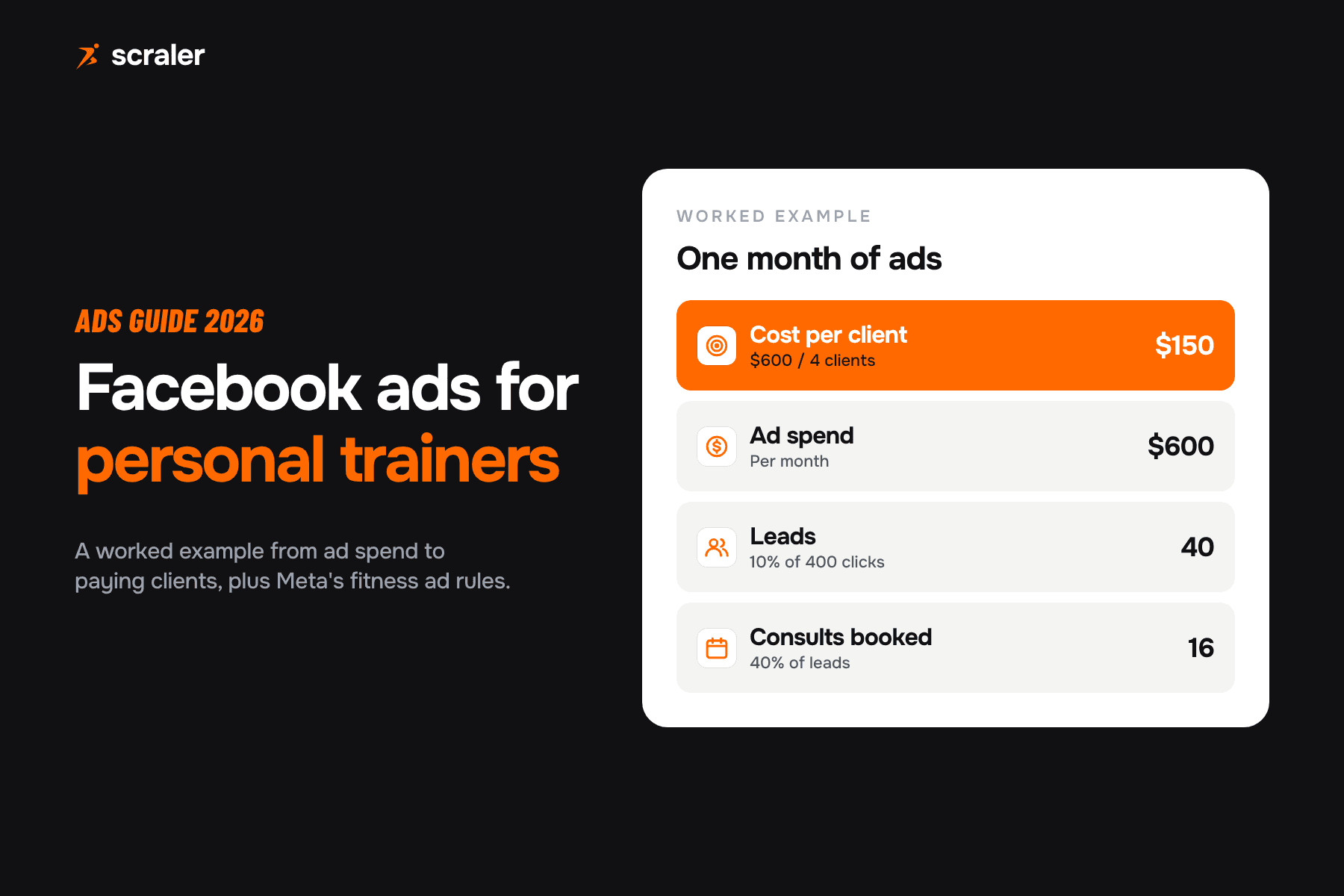
Facebook ads for personal trainers work when they send local people to one clear offer on a landing page: a free call, a trial or a challenge. You pay Meta per view or click, so judge them by cost per paying client. In our worked example, $600 of spend gives four clients at $150 each.

- Run ads to one landing page with one offer. Meta shows the ad on Facebook and Instagram, your page does the selling.
- Cost per client is spend divided by clients. In our worked example, $600 and 4 clients is $150 each. Your own rates will differ.
- Fitness services are not age restricted, but weight loss products need 18+ targeting, and appearance shaming, fat pinching close ups and cure claims are not allowed.
- A benchmark from Superads puts fitness CPC at about $1.47 on average over the last year, with large swings. Use your own account data after the first two weeks.
Ads are the fastest way to get strangers to look at your offer, and the easiest way to waste money if the page behind them is weak. This guide covers how the ads work, what a client costs in a worked example, Meta's rules for fitness ads, three example ads, and how to set up the funnel. If you have no clients yet, start with the free ideas in personal trainer marketing.
How do Facebook ads work for personal trainers?
You create an ad in Meta Ads Manager, choose who sees it, set a daily budget and send people to a destination. Ads run on both Facebook and Instagram, so one setup covers both. This is the answer to "personal trainer Instagram" ads too: the same campaign can place your ad on Instagram.
Meta reviews ads against its Advertising Standards, usually before they run, though an ad may start delivering before every policy is checked. According to the Business Help Center page on ads in review, most ads are reviewed within 24 hours, the review covers the image or video, the text, the targeting and the page the ad leads to, and an ad can be reviewed again at any time, including after it is live.
The Meta Pixel is code you put on your website. It records what people do after clicking an ad, such as submitting a form, so you can measure results and build audiences from visitors. Without any tracking you only know clicks. Whatever page you use, check how it can report a lead or booking back to your ad account before you spend.
Are Facebook ads worth it for personal trainers?
They are worth it when one new client is worth clearly more than it costs to win them, and when you can handle the extra enquiries. The way to find out is a funnel, from people who see the ad to people who pay. Here is one, as a worked example, not survey data. Every rate is an assumption.
- Number
- $600
- Assumed rate
- One month
- Number
- 30,000
- Assumed rate
- $20 per 1,000 impressions
- Number
- 400
- Assumed rate
- about 1.33% of impressions, $1.50 per click
- Number
- 40
- Assumed rate
- 10% of clicks fill in the form
- Number
- 16
- Assumed rate
- 40% of leads book a call
- Number
- 4
- Assumed rate
- 25% of consults sign up
| Step | Number | Assumed rate |
|---|---|---|
| Ad spend | $600 | One month |
| Impressions | 30,000 | $20 per 1,000 impressions |
| Link clicks | 400 | about 1.33% of impressions, $1.50 per click |
| Leads | 40 | 10% of clicks fill in the form |
| Consults booked | 16 | 40% of leads book a call |
| New clients | 4 | 25% of consults sign up |
Four clients from $600 is $150 per client. If each client pays $200 a month and stays six months, that is $1,200 of revenue for $150 of ad spend, also a worked example. If only one in eight consults signs up instead of one in four, the cost per client doubles to $300, which is still fine at that price but no longer cheap. Your landing page and your consult change the answer more than the ad does.
Run the same sum with your own price. If you sell a $200 monthly membership, the break-even question is how many months a client stays. If you sell a one-off package, it is the package price. Our guide to personal training packages shows how to price them, and the personal trainer rate calculator helps check your numbers.
How much do Facebook ads cost for personal trainers?
Meta sets prices by auction, so there is no fixed rate. Benchmarks come from ad analytics vendors, not from Meta, and they differ. Superads publishes fitness and training centers data for all countries. On its CPC page, median CPC averaged about $1.47 between July 2025 and July 2026, with a low near $0.99 in February 2026 and a high of $4.08 in July 2026. On its CPM page, CPM averaged about $21.28, from $14.82 in February 2026 to $29.68 in July 2026.
- Fitness and training centers
- About $1.47 average
- Range over the year
- $0.99 to $4.08
- Fitness and training centers
- About $21.28 average
- Range over the year
- $14.82 to $29.68
| Metric | Fitness and training centers | Range over the year |
|---|---|---|
| CPC (cost per click) | About $1.47 average | $0.99 to $4.08 |
| CPM (cost per 1,000 impressions) | About $21.28 average | $14.82 to $29.68 |
Superads calls these directional benchmarks, covers many countries, and shows winter months far cheaper than summer. Treat them as a range for planning, not a promise. The worked example above uses $1.50 per click and $20 per 1,000 impressions to sit inside it. After about two weeks of real spend, replace every benchmark with your own account numbers.
- Start small. A budget you can afford to lose while you learn what your page converts.
- Give it time. Judge on cost per lead and cost per client after at least two weeks, not after two days.
- Watch the consult rate. If leads are cheap but nobody signs up, fix the offer or the call, not the ad.
What are the Meta ad rules for fitness and health ads?
Meta's Health and Wellness policy is the page to read before you write your first ad. Its change log shows an update on 22 July 2026, and policies change, so read the live page before you publish. This is not legal advice. What it says today:
- Age. Ads for dietary, health, weight loss or weight gain products and services must target people 18 or older. The age restriction does not apply to fitness services, equipment and health clubs, or to general food products including protein products.
- No appearance shaming. Weight loss and cosmetic ads can't contain statements of inferiority about physical appearance: negative terms or questions that attack someone's appearance or body parts.
- No fat pinching. Weight loss ads can't depict a close up on a specific body area by pinching fat.
- No wearable claims. Weight loss ads can't claim results can be achieved solely by using a wearable.
- No cure claims. Ads can't claim to cure, heal or eliminate listed incurable diseases, including diabetes and cancer. Claims about managing symptoms are not covered by that rule.
- No clickbait. No sensational or extreme claims, and no promises of a specific outcome within a set time without disclaimers or qualifiers.
The policy also says weight loss ads can show people using a service and its impact, as long as the ad clearly states the time it takes to see noticeable results. The page lists general cosmetic before and after images as allowed for adults, but it does not spell out the same for weight loss transformation photos. Do not assume yes. Check the live page, and prefer client stories told in words and with their consent.
A strength coach selling a fitness service is not age restricted, but many trainers sell weight loss, so write every ad as if the rules apply. Fitness is also not one of the Special Ad Categories Meta lists on its help page, which are social issues, elections or politics, employment, housing and financial products and services.
What do good Facebook ads for personal trainers look like?
Three examples we wrote for this guide, one per offer. They are templates, not results from a real campaign. Each names a specific audience, one offer and one button, and none of them comment on anyone's body.
- Local small group. Headline: "Small group strength training in [Town]". Text: "Max 6 per class, coached by a certified trainer. Book a free first session." Button: Book now.
- Online coaching. Headline: "Online coaching for busy parents". Text: "A plan in an app, a weekly check-in and a coach who replies. See how it works and book a free call." Button: Learn more.
- Free challenge. Headline: "Free 4 week strength challenge starts Monday". Text: "Join in, get the plan by email, finish with a coach checking in." Button: Sign up.
- "Lose 10 lb in 14 days." A set outcome in a set time without qualifiers.
- "Tired of your belly fat?" Talks about someone's body.
- "Reverse your diabetes with this plan." A cure claim for a listed disease.
- A close up of someone pinching their stomach. Listed in the policy as not allowed.
- "Results with just a smartwatch." Results solely from a wearable.
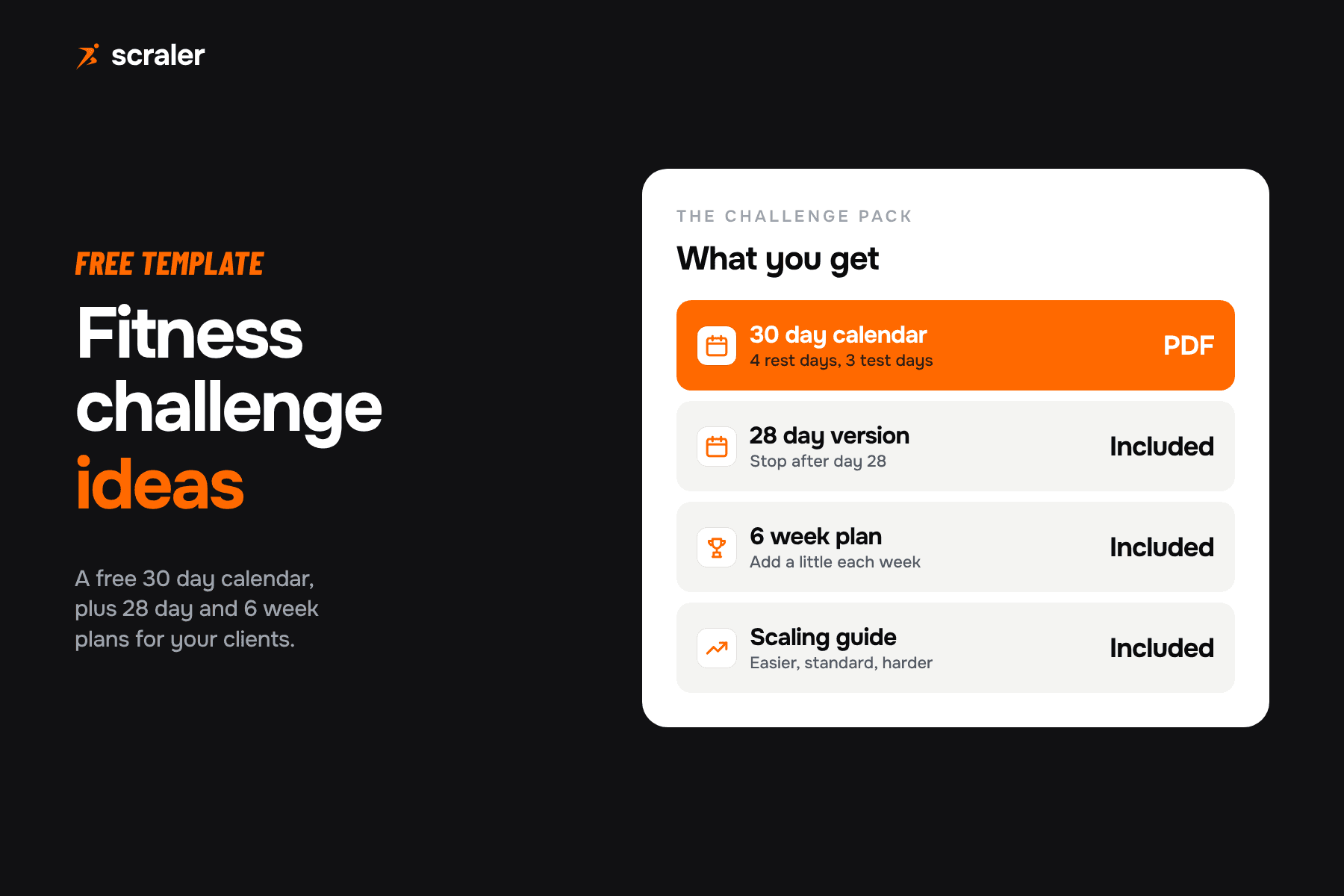
The creative can be simple: a short video of you coaching a session, a photo of your small group with consent, or a screenshot of a real review. For a challenge ad, our fitness challenge ideas give you the plan to offer. Always show real clients and real sessions, and ask permission before using anyone's image.
Where should a personal trainer Facebook ad send people?
To a landing page with one offer, not to your homepage and not to your profile. The page should match the ad: same headline, same offer, same button. Include a short description of who it is for, three or four testimonials, how it works in three steps, the price or the next step, an FAQ and a single booking or sign-up button. Our personal trainer website guide has examples.
Scraler's landing page builder has sections for testimonials, FAQ, contact, memberships, programs, events, appointments and a challenge sheet. People can buy or book from the page, and you can publish it on your Scraler subdomain, or on your own domain on Ultimate. The builder is part of Premium, $69 a month, and Ultimate, from $109. Tracking is the part to check before you spend: decide how you will count leads and clients from each campaign, whether through the Meta Pixel on your page or a simple note of where each lead came from.
Build the landing page your ad sends people to, with testimonials, an FAQ and a live buy or booking button, then publish it on your branded subdomain (or your own domain on Ultimate).
See the landing page builderHow do you set up your first Facebook ad campaign?
- 1.Build the page first. One offer, testimonials, one button. Do not run ads to a page that is not ready.
- 2.Pick one offer. A free call, a free first session, a trial or a challenge. Not all four.
- 3.Choose a local audience. Set a radius around where you train, or a country for online coaching. Keep it broad at the start.
- 4.Make two or three versions. One video and one image, with the example text above, so Meta can show which works.
- 5.Set a small budget. An amount you can afford to lose while you learn.
- 6.Read the policy, then publish. Check the ad text against the rules above. Meta reviews ads, usually within 24 hours.
- 7.Reply to every lead the same day. Speed to reply decides how many leads turn into consults.
- 8.Review after two weeks. Work out cost per lead, per consult and per client. Keep what works, stop what does not.
A common mistake is to turn on an ad, wait for sign-ups to appear, and give up after a week. Another is to optimise for clicks, which are cheap, instead of consults, which pay. Count the people who book and the people who pay.
Frequently asked questions
- Are Facebook ads worth it for personal trainers?
- They are when a new client is worth clearly more than it costs to win one. Work out your cost per client with a funnel: spend divided by paying clients. In our worked example, $600 of spend gives four clients at $150 each, but your rates will differ.
- How much should a personal trainer spend on Facebook ads?
- Start with a small budget you can afford to lose, run it for at least two weeks, then compare cost per lead, consult and client with your own numbers. Increase spend only after a page and offer that convert.
- Can personal trainers advertise weight loss on Facebook?
- Yes, with limits. Meta's Health and Wellness policy requires 18+ targeting for weight loss products and services and bans appearance shaming, fat pinching close ups, cure claims and clickbait promises of set outcomes in a set time. Read the live policy before you publish.
- Do Facebook ads work on Instagram too?
- Yes. Meta runs ads on both Facebook and Instagram, and its ad review applies to both. One campaign can place your ad on Instagram as well as Facebook.
- What is a good cost per click for fitness ads?
- Superads, an ad analytics vendor, reports a fitness and training centers average of about $1.47 per click over July 2025 to July 2026, from about $0.99 to $4.08 by month. Treat that as a planning range and replace it with your own account data.
- Where should the ad send people?
- To a landing page with a single offer and a single button that matches the ad, not to your profile or homepage. Include testimonials, how it works, and a way to book or buy.