Body type calculator
This body type calculator has two tabs. Somatotype rates your build as endomorphy, mesomorphy and ectomorphy with the Heath-Carter method, the anthropometric standard in sport science. Body shape sorts bust, waist, high hip and hip measurements into hourglass, pear, rectangle and the other FFIT shapes. Neither result tells you how to train or eat; both describe what is there today.

Balanced mesomorph. The rating describes your build as measured today. It shifts when fat and muscle change, and it does not decide how you should train or eat.
How the body type calculator works
The somatotype tab uses the Heath-Carter anthropometric method as written up in Carter's 2002 instruction manual. It rates three components on an open scale, usually between 0.5 and 9: endomorphy (relative fatness), mesomorphy (relative muscle and bone robustness) and ectomorphy (relative linearity). The rating is always written in that order, so 2.4-5.0-2.3 means endomorphy 2.4, mesomorphy 5.0, ectomorphy 2.3.
Endomorphy
Add the triceps, subscapular and supraspinale skinfolds in millimetres and scale the sum to a 170.18 cm reference height: X = sum x 170.18 / height. Endomorphy is then -0.7182 + 0.1451X - 0.00068X² + 0.0000014X³. The height correction stops a tall person from scoring as fatter simply because larger bodies have thicker folds.
Mesomorphy
Mesomorphy is 0.858 x humerus breadth + 0.601 x femur breadth + 0.188 x corrected arm girth + 0.161 x corrected calf girth - 0.131 x height + 4.5, all in centimetres. Corrected arm girth is flexed, tensed arm girth minus the triceps skinfold in cm; corrected calf girth is calf girth minus the medial calf skinfold in cm. Subtracting the fold removes the fat so the girth reflects muscle.
Ectomorphy
Ectomorphy only needs height and weight. The height-weight ratio is HWR = height / cube root of weight. At an HWR of 40.75 or more, ectomorphy is 0.732 x HWR - 28.58; between 38.25 and 40.75 it is 0.463 x HWR - 17.63; at 38.25 or below it is 0.1. Any component that comes out at zero or below is recorded as 0.1.
Worked example
A 178 cm, 75 kg man with skinfolds of 8, 10, 7 and 6 mm (triceps, subscapular, supraspinale, calf), a 7.0 cm humerus, a 9.8 cm femur, a 33 cm flexed arm and a 37 cm calf. X = 25 x 170.18 / 178 = 23.9, so endomorphy is 2.4. Mesomorphy is 6.01 + 5.89 + 0.188 x 32.2 + 0.161 x 36.4 - 23.32 + 4.5 = 5.0. HWR is 178 / 4.217 = 42.21, so ectomorphy is 2.3. The rating is 2.4-5.0-2.3, a balanced mesomorph.
The three types of somatotype: ectomorph, mesomorph, endomorph
Ectomorph, mesomorph and endomorph are not three boxes a person falls into. They are three scores every person has at once. A sprinter might rate 1.5-5.5-2.0, a distance runner 1.5-4.0-3.5, a sedentary office worker 4.5-4.0-1.5. The label people use day to day is just the highest of the three.
Endomorph
A high first number: more fat relative to height, softer contours, round trunk. It is the component that moves fastest, because it tracks skinfolds. Lose 5 kg of fat and your endomorphy drops noticeably within months.
Mesomorph
A high second number: wide bones at the elbow and knee and large, muscular arm and calf girths for your height. Bone breadth is fixed in adults, so mesomorphy changes only through muscle, and slowly.
Ectomorph
A high third number: tall for your weight, long and narrow. It is pure arithmetic on height and weight, so it rises when you lose weight of any kind and falls when you gain it.
The 13 Heath-Carter somatotype categories
Carter groups ratings into 13 categories by which component is highest and how the other two compare. Two components count as equal when they differ by 0.5 or less. Central means no component is more than one unit away from the other two. The calculator applies these rules to the ratings rounded to one decimal, the same numbers it shows you.
| Category | Rule | Example |
|---|---|---|
| Central | No component differs by more than 1 from the others | 3.5-4.0-3.0 |
| Balanced endomorph | Endo highest, meso and ecto equal | 5.0-3.0-2.5 |
| Mesomorphic endomorph | Endo highest, meso above ecto | 5.0-4.0-1.5 |
| Mesomorph-endomorph | Endo and meso equal, ecto lower | 4.5-4.5-1.5 |
| Endomorphic mesomorph | Meso highest, endo above ecto | 3.5-5.0-1.5 |
| Balanced mesomorph | Meso highest, endo and ecto equal | 2.0-5.0-2.0 |
| Ectomorphic mesomorph | Meso highest, ecto above endo | 1.5-5.0-3.0 |
| Mesomorph-ectomorph | Meso and ecto equal, endo lower | 1.5-4.0-4.0 |
| Mesomorphic ectomorph | Ecto highest, meso above endo | 1.5-3.5-5.0 |
| Balanced ectomorph | Ecto highest, endo and meso equal | 2.0-2.0-5.0 |
| Endomorphic ectomorph | Ecto highest, endo above meso | 3.0-1.5-4.5 |
| Endomorph-ectomorph | Endo and ecto equal, meso lower | 4.0-1.5-4.0 |
| Ectomorphic endomorph | Endo highest, ecto above meso | 5.0-1.5-3.0 |
Body type calculator measurements: what you need
A full Heath-Carter rating takes ten measurements: height, weight, four skinfolds (triceps, subscapular, supraspinale, medial calf), two bone breadths (humerus and femur) and two girths (flexed arm and calf). Carter's manual uses the right side of the body and the same landmarks as the ISAK anthropometry protocol.
Skinfolds need a caliper and practice; readings between two untrained testers can differ by several millimetres. Bone breadths need a small sliding caliper, because a tape cannot measure across the elbow and knee condyles. Take each skinfold twice and use the mean; if two readings differ by more than about 5 percent, take a third.
| Measurement | Where | Tool |
|---|---|---|
| Height and weight | Standing, light clothing | Stadiometer, scale |
| Triceps skinfold | Back of the upper arm, midway shoulder to elbow | Skinfold caliper |
| Subscapular skinfold | Just below the shoulder blade, angled down and out | Skinfold caliper |
| Supraspinale skinfold | Above the front of the hip bone, angled in and down | Skinfold caliper |
| Medial calf skinfold | Inner calf at its widest girth, vertical fold | Skinfold caliper |
| Humerus breadth | Across the two bony points of the elbow, arm bent 90 degrees | Small bone caliper |
| Femur breadth | Across the two bony points of the knee, knee bent 90 degrees | Small bone caliper |
| Arm girth | Upper arm flexed and tensed, at the biggest point | Tape |
| Calf girth | Standing, at the widest point | Tape |
Quick estimate vs a measured somatotype test
Most people asking "what is my body type" do not own a bone caliper, so the calculator has a quick estimate mode. It is labelled as an estimate on purpose. Ectomorphy is still the exact Heath-Carter formula, because it only needs height and weight. Endomorphy and mesomorphy come from your own rating of fat and of muscle and bone on four bands (low, moderate, high, very high) based on the descriptions in Carter's manual, scored at the middle of each band: 2, 4, 6 or 8.
That makes the quick estimate a structured self-assessment, not a somatotype test. It is good enough to learn the vocabulary and to see roughly where you sit. It is not good enough to compare two people, track change over time or report in a client file. For that, measure the ten sites above, ideally with the same trained tester each time.
Body shape calculator for women: hourglass, pear, rectangle and more
Search for a female body type calculator and you mostly find body shape, not somatotype. The body shape tab uses the Female Figure Identification Technique (FFIT for Apparel) from Simmons, Istook and Devarajan at North Carolina State University, the rule set apparel researchers use to sort 3D body scans. Lee and colleagues applied the same rules to more than 6,300 US women from SizeUSA and found rectangle the most common shape.
FFIT works on four tape measurements: bust at the fullest point, waist at the narrowest, high hip at the top of the hip bones and hips at the widest point of the seat. The rules use differences in inches, so the calculator converts centimetres before applying them, and checks the shapes in the order below. The first match wins.
Where is apple?
Apple is a magazine term, not an FFIT result. FFIT has oval and diamond shapes for a waist that is as wide as or wider than bust and hips, but they need extra measurements this calculator does not take. If your waist is close to your bust and hip, you will most likely land on rectangle, and the waist-to-hip ratio below tells you more than any shape label.
| Shape | Rule | Plain reading |
|---|---|---|
| Hourglass | B - H ≤ 1, H - B < 3.6, and B - W ≥ 9 or H - W ≥ 10 | Bust and hips similar, much smaller waist |
| Bottom hourglass | 3.6 ≤ H - B < 10, H - W ≥ 9, HH / W < 1.193 | Hips larger than bust, much smaller waist |
| Top hourglass | 1 < B - H < 10, B - W ≥ 9 | Bust larger than hips, much smaller waist |
| Spoon | H - B > 2, H - W ≥ 7, HH / W ≥ 1.193 | Hips larger, with a shelf at the high hip |
| Triangle (pear) | H - B ≥ 3.6, H - W < 9 | Hips larger, waist less defined |
| Inverted triangle | B - H ≥ 3.6, B - W < 9 | Bust larger, waist less defined |
| Rectangle | H - B < 3.6, B - H < 3.6, B - W < 9, H - W < 10 | Bust and hips similar, waist less defined |
Body shape and waist-to-hip ratio
Body shape is a clothing fit tool. It says nothing about health. The number from the same tape measurements that does carry health information is the waist-to-hip ratio: waist divided by hips. The WHO expert consultation lists a ratio of 0.85 or more for women and 0.90 or more for men as substantially increased metabolic risk.
Take a woman with a 92 cm bust, 72 cm waist, 88 cm high hip and 100 cm hips. In inches that is 36.2, 28.3, 34.6 and 39.4. Bust minus hips is -3.1, hips minus waist is 11.0, so she is an hourglass, and her waist-to-hip ratio is 0.72. The calculator shows that ratio next to every shape; for the full risk bands, use the waist-to-hip ratio calculator.
Body type calculator for men
For men, use the somatotype tab. The Heath-Carter equations are the same for both sexes, and most published somatotype data on athletes is on men. FFIT was built and validated on women's bodies, and there is no equivalent validated shape system for men; the V, rectangle and oval labels you see online are descriptive, not tested rules.
A typical untrained man of average build rates somewhere around the middle of the somatochart, with no component far above the others. Strength athletes push mesomorphy up, endurance runners push ectomorphy up, and weight gain from fat pushes endomorphy up and ectomorphy down together.
What your body type does not tell you
Somatotyping started with William Sheldon in 1940, who claimed each body type came with a temperament: relaxed endomorphs, assertive mesomorphs, anxious ectomorphs. Those personality claims did not hold up and are discredited. Heath and Carter rebuilt the method in 1967 as a purely physical description from measurements, which is why sport scientists still use it.
The fitness industry later revived the Sheldon idea in a new form: "eat for your body type" plans that give endomorphs low carb diets and ectomorphs high calorie ones. There is no trial evidence that matching a diet to somatotype improves results. In the DIETFITS trial, even a genotype pattern and insulin secretion, both far more specific than a body type label, did not predict who lost more weight on low fat or low carb.
What a somatotype does tell you is your starting point. High endomorphy with low ectomorphy means fat loss will move the rating the most. A low mesomorphy says there is room to build muscle. Training and nutrition still come from the goal, the person's preferences and how they respond, not from the label.
How coaches use somatotype and body shape
For a coach, the value of a somatotype is the trend. A client who goes from 5.0-4.0-1.5 to 3.5-4.5-2.0 over six months has lost fat and kept or gained muscle, which the scale may hide. Re-rate every 8 to 12 weeks with the same tester and the same caliper.
Talent identification is the other use. Sports with clear physical demands cluster on the somatochart, which is why selection programmes in rowing, gymnastics and throwing events have used it. It describes who succeeds at a sport, not who could.
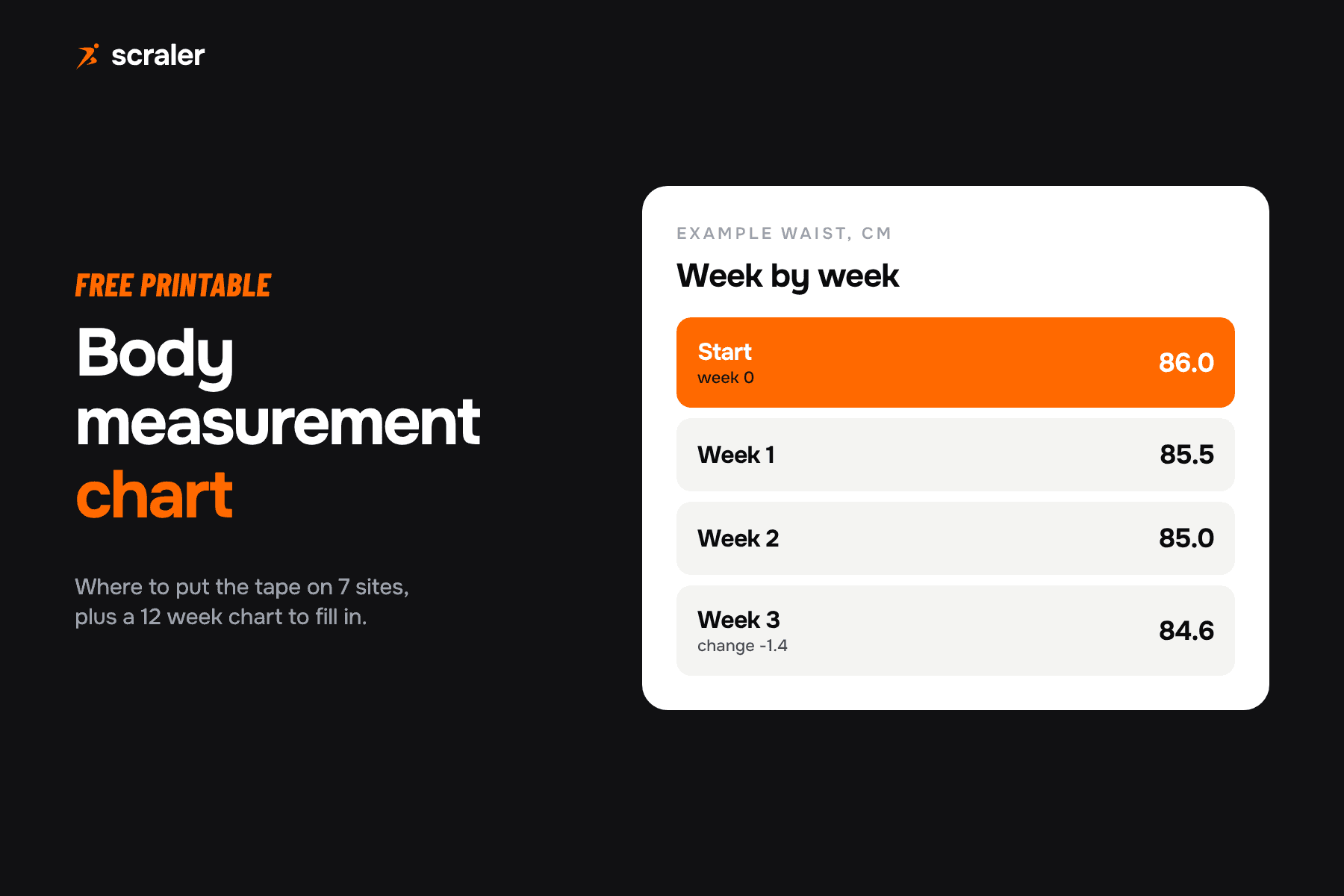
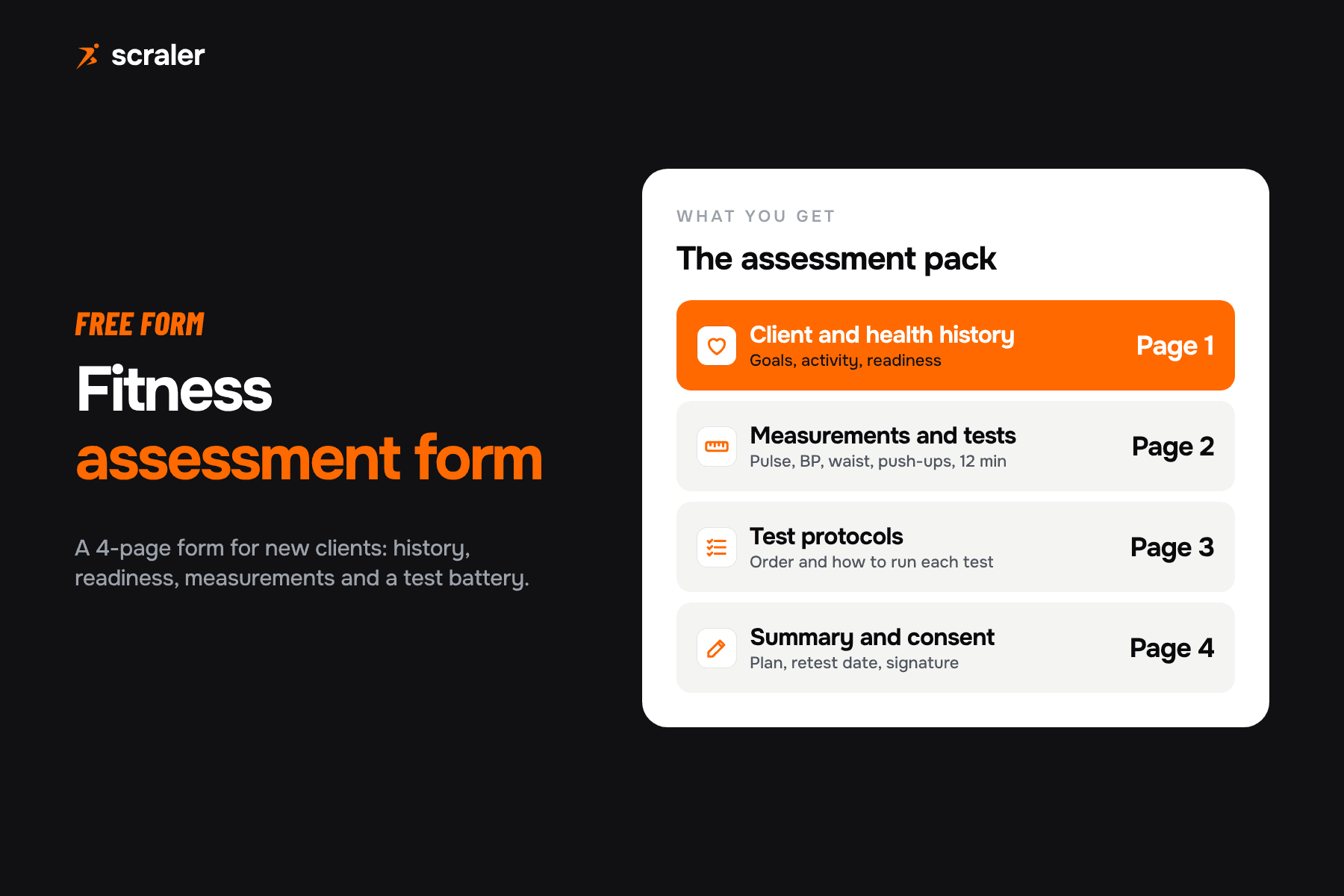
Body shape is useful for fit conversations, not targets. Telling a client they are a spoon or triangle gives them vocabulary for clothes, but goals belong on measurable numbers: waist, waist-to-hip ratio, body fat and strength. Put the measurements in a body measurement chart at intake and add them to your fitness assessment form.
Scraler stores measurements, progress photos and check-ins per client, so a somatotype or waist trend sits next to the training and nutrition that changed it.
Common mistakes
Treating the type as permanent. Endomorphy and ectomorphy shift with fat and weight change within months. Only bone breadth is fixed.
Reading the estimate as a measurement. The quick estimate is a guided self-rating. Do not compare it with a measured Heath-Carter rating.
Using an unflexed arm girth. The formula expects the arm flexed and tensed. A relaxed arm can cut mesomorphy by several tenths.
Measuring the waist at the navel for body shape. FFIT uses the narrowest point. A navel measurement inflates the waist and pushes results toward rectangle.
Choosing a diet by body type. No controlled trial supports it. Set calories and protein from goals and body weight instead.
Mixing testers. Two people taking skinfolds can differ by more than the change you want to detect. Keep one tester per client.
Frequently asked questions
- What is my body type?
- In sport science, your body type is your somatotype: three numbers for endomorphy, mesomorphy and ectomorphy. In fashion, it usually means body shape, such as hourglass or pear. This calculator does both, on separate tabs.
- How accurate is this body type calculator?
- With all ten measurements, the somatotype tab runs the exact Heath-Carter equations, so accuracy depends on the measurer. The quick estimate is a self-rating and only rough. Body shape uses the FFIT rules; Parker and colleagues found the same body can land in a different shape in up to 40 percent of cases depending on how the landmarks are placed.
- What is a somatotype test?
- A somatotype test is a Heath-Carter rating from ten anthropometric measurements: height, weight, four skinfolds, two bone breadths and two girths. It takes about 15 minutes with a trained tester and calipers.
- Can your somatotype change?
- Yes. Endomorphy changes with body fat, ectomorphy with weight, and mesomorphy with muscle. Bone breadths do not change in adults, so mesomorphy has a ceiling set partly by frame.
- Should I eat or train for my body type?
- No evidence supports it. Diet and training plans should come from your goal, your current intake and how you respond, not from a somatotype label. Somatotype is a description, not a prescription.
- What are the female body shapes?
- FFIT sorts women into hourglass, bottom hourglass, top hourglass, spoon, triangle (pear), inverted triangle and rectangle from bust, waist, high hip and hips. Oval and diamond also exist in FFIT but need extra measurements.
- Is there a body type calculator for men?
- Use the somatotype tab. The Heath-Carter equations apply to both sexes. There is no validated body shape system for men equivalent to FFIT.
- What is the difference between an ectomorph, mesomorph and endomorph?
- Endomorphy rates relative fatness, mesomorphy relative muscle and bone, ectomorphy relative linearity. Everyone has all three; the label people use is the highest of the three.
Sources
- Carter JEL. The Heath-Carter anthropometric somatotype: instruction manual. San Diego State University, 2002The endomorphy, mesomorphy and ectomorphy equations, the 0.1 rule, the 13 categories and the descriptive rating bands.
- Heath BH, Carter JEL. A modified somatotype method. Am J Phys Anthropol, 1967The original Heath-Carter method that replaced Sheldon's photo-based typing.
- Carter JEL, Heath BH. Somatotyping: development and applications. Cambridge University Press, 1990The reference text on the method, its history and its use in sport.
- Simmons KP, Istook CL, Devarajan P. Female Figure Identification Technique (FFIT) for apparel, Part I: describing female shapes. J Textile Apparel Technol Manag, 2004The body shape definitions used in the body shape tab.
- Lee JY, Istook CL, Nam YJ, Park SM. Comparison of body shape between USA and Korean women. Int J Clothing Sci Technol, 2007Applies the FFIT formulas to SizeUSA and SizeKorea scans; rectangle was the most common shape.
- Parker CJ, Hayes SG, Brownbridge K, Gill S. Assessing the female figure identification technique's reliability as a body shape classification system. Ergonomics, 2021Shows the same body can be classified into a different FFIT shape in up to 40 percent of cases.
- World Health Organization. Waist circumference and waist-hip ratio: report of a WHO expert consultation, 2008The 0.85 (women) and 0.90 (men) waist-to-hip ratio cut-offs.
- Rosenbaum R. The great Ivy League nude posture photo scandal. The New York Times Magazine, 1995History of Sheldon's somatotype and temperament claims and why they were discredited.
- Gardner CD et al. Effect of low-fat vs low-carbohydrate diet on 12-month weight loss in overweight adults (DIETFITS). JAMA, 2018Neither genotype pattern nor insulin secretion predicted who did better on low fat or low carb.

Calories, macros, workouts and check-ins tracked per client, so the number you just calculated becomes a plan you can run. Free to try, no card needed.
Start free trial